The Funeral Director Said Embalming Is Required by Law. It Is Not. But You Did Not Know That Until After You Signed the Authorization and the $900 Charge Appeared on Your Invoice.
You are sitting in the "arrangement conference" at a funeral home in Albuquerque or Las Cruces or Santa Fe. Your mother died two days ago. You have not slept. You cannot think clearly. The funeral director slides a thick price list across the table and starts walking you through the services. He mentions that New Mexico law requires embalming. You do not question it. He says you will need a casket for cremation. You do not question that either. He recommends the "complete traditional package." You sign because you trust him. Because you assume the funeral home is telling you the truth about what the law requires.
He is not. New Mexico does not require embalming. The body must be refrigerated below 40 degrees or embalmed within 24 hours — and refrigeration is always your choice. A casket is not required for cremation — the FTC Funeral Rule mandates that every funeral home offer inexpensive alternative containers. You did not know this. And now you are paying $600 to $1,000 for a procedure the decedent never wanted, plus $2,000 for a casket that will be incinerated.
This is not unusual. It happens because families walk into that conference with no objective reference point. They trust the funeral director the way they trust the doctor. But a funeral home is a commercial business. The funeral director's income depends on the services you purchase. And New Mexico's funeral regulations — scattered across NMSA 1978, NMAC 7.3.2, the FTC Funeral Rule, and the Office of the Medical Investigator's permitting system — are written in dense legal language that no grieving family has time to decode.
The New Mexico Funeral Laws & Consumer Rights Guide is a Consumer Protection Roadmap that translates every New Mexico funeral statute, administrative code, and federal consumer protection rule into plain English — with checklists, action items, and the exact statutory citations you need to walk into any funeral home as an informed consumer, not a vulnerable target.
What's Inside the Consumer Protection Roadmap
A 20-chapter step-by-step guide and a standalone Consumer Rights Checklist — covering every legal right, regulatory deadline, and financial decision you face when arranging a funeral in New Mexico, built on NMSA 1978, the New Mexico Administrative Code, FTC Funeral Rule requirements, and the specific OMI permitting processes that make this state different from any other:
Who Has the Legal Right to Make Funeral Decisions
This is where families fracture. If the deceased did not leave written disposition instructions, New Mexico law imposes a strict hierarchy under NMSA 24-12A-2: a designated agent first, then the surviving spouse, then a majority of adult children, then parents, then a majority of siblings. That word "majority" is where the trouble starts — if four adult children are split 2-2 on burial versus cremation, the funeral home cannot proceed. The family must petition a court. The guide maps the full priority order, explains the military exception where DD Form 93 overrides all civilian documents, and covers the unusually progressive "special care and concern" provision that allows an unrelated adult who knew the decedent best to take legal control when biological family is absent.
The 24-Hour Rule: Embalming, Refrigeration, and What You Can Refuse
Under NMAC 7.3.2.17, all remains must be either embalmed or refrigerated below 40 degrees Fahrenheit within 24 hours of death. That is the actual law. Embalming is legally mandatory only in three narrow circumstances: when the OMI orders it for forensic purposes, when refrigeration is genuinely unavailable, or when remains are being shipped across state lines via commercial carrier. In every other scenario, you choose. The guide gives you the exact language to decline embalming and the statutory citations that back it up — so the funeral director's claim that embalming is "required by state law" has a documented answer.
Cremation: The Two Permits Nobody Explains
Cremation in New Mexico cannot proceed without two separate authorizations: a cremation authorization signed by the legal next of kin, and a cremation permit from the Office of the Medical Investigator. The OMI reviews the death certificate to confirm the death does not warrant forensic investigation, and charges a $230 fee that appears on your invoice as a "cash advance" item. If the OMI assumes jurisdiction — in cases of sudden, unexpected, or unattended death — cremation is delayed indefinitely until the investigation concludes. New Mexico does not impose a separate statutory waiting period for cremation, but the bureaucratic process typically takes two to three days. The guide explains the entire timeline so you know exactly what is causing a delay and whether it is normal.
Home Funerals: Legal, but You Need the Right Permits
New Mexico preserves the right of families to care for their dead without hiring a commercial funeral director. You can bathe and dress the body, hold a private vigil at home, transport remains in a private enclosed vehicle, complete the demographic section of the death certificate, and arrange burial on private land or cremation at a licensed crematory. What you cannot skip: the 24-hour refrigeration deadline, the 5-day death certificate filing window, and the Burial-Transit Permit required whenever disposition is handled by someone other than a licensed funeral professional. The guide walks you through every step of managing a home funeral legally, including how to coordinate with the medical certifier and the Bureau of Vital Records.
Private Land Burial, Green Burial, and What Is Still Banned
Burial on private land is legal in New Mexico. Graves must be at least six feet deep. You must check county zoning laws first and file a survey map of the burial location with the property deed at the County Clerk's office. Green burial — interment without toxic embalming, concrete vaults, or non-biodegradable caskets — is legal and available at certified facilities like La Puerta Natural Burial Ground. But alkaline hydrolysis and natural organic reduction are not legal in New Mexico as of 2026. Senate Bill 368 in the 2025 session attempted to expand the definition of cremation to include chemical reduction and died in committee. If you want aquamation, the guide explains how to arrange legal interstate transport to a state where it is available.
The FTC Funeral Rule: Your Federal Shield Against Overcharging
Every funeral home in New Mexico must hand you a General Price List before discussing any services. You cannot be forced to purchase bundled packages. You can buy caskets from third-party vendors and the funeral home cannot charge a handling fee. Cash advance items — the $230 OMI cremation permit, the $5 death certificate copies, obituary publication — must be listed separately without markup. The guide explains how to read a GPL, what to compare between funeral homes, and how to use the Funeral Rule to strip unnecessary charges from your invoice.
Filing Complaints: When the Funeral Home Broke the Rules
If a funeral provider engaged in deceptive pricing, negligence, or unprofessional conduct, the New Mexico Board of Funeral Services at the Regulation and Licensing Department accepts notarized complaints. The guide provides the exact process: obtaining the complaint form, completing it with factual allegations, getting it notarized, and submitting it. If the Board finds merit, the case is forwarded to the attorney general's office for an administrative prosecutor. The guide positions this as a last resort — and explains how to prevent ever needing it by knowing your rights before you walk through the door.
Preneed Contracts and Medicaid: The Trust That Must Be Irrevocable
Prepaying for a funeral can protect assets from Medicaid's five-year look-back period — but only if the funeral trust is irrevocable. A revocable trust is counted as an available asset and can disqualify you. New Mexico does not impose a strict statutory maximum on irrevocable funeral trust values, though practical limits based on reasonable expenses apply. The guide explains the difference between revocable and irrevocable contracts, New Mexico's requirement that insurance-funded preneed policies list "Any Funeral Service Provider" as beneficiary so you are never locked into one funeral home, and the critical warning signs that an improperly structured trust could trigger Medicaid penalties.
Medical Aid in Dying: Protecting Life Insurance Payouts
New Mexico's Elizabeth Whitefield End-of-Life Options Act allows terminally ill adults to request and self-administer medication to end their lives. Families utilizing the Act need to know exactly one thing: the death certificate must list the underlying terminal illness as the cause of death, with no mention of the Act. This is not optional — it is mandated by the statute. The Act explicitly states that medical aid in dying is not suicide, which means life insurance suicide clauses cannot be triggered. The guide covers the death certificate requirements, the insurance protections, and the coordination with hospice and funeral homes that families need before the medication is administered.
The Death Certificate, the OMI, and Tribal Jurisdiction
Death certificates must be filed electronically within five days of death and before final disposition. The OMI assumes jurisdiction over sudden, unattended, or potentially criminal deaths — and when it does, the body is not released until the investigation concludes. For deaths occurring on tribal land, the OMI explicitly excludes Indian reservations from its primary jurisdiction. Tribal law enforcement and tribal health authorities manage the initial response, and the state OMI will only cross onto tribal land when formally invited by the sovereign nation. The guide covers all three systems — civilian, OMI, and tribal — so you know which process applies and who to contact.
Who This Guide Is For
- The family sitting in the funeral home arrangement conference right now — who needs to know which charges are legally required and which are optional before signing anything, and who has the right to decline embalming, refuse bundled packages, and bring their own casket without paying a handling fee
- The adult child managing a parent's funeral from out of state — who needs the complete New Mexico regulatory framework in one document instead of calling the OMI, the Board of Funeral Services, the Bureau of Vital Records, and three different funeral homes to piece together what is required
- The family planning a home funeral — who knows it is legal but needs the exact permit sequence, the 24-hour refrigeration deadline, the Burial-Transit Permit process, and the death certificate filing steps to do it without a commercial funeral director
- The caregiver managing end-of-life planning for an aging parent — who needs to understand preneed contracts, irrevocable funeral trusts for Medicaid planning, and how to document disposition preferences before a crisis forces decisions under pressure
- The family navigating the Elizabeth Whitefield Act — who needs absolute clarity that the death certificate will list the terminal illness, not the Act, and that life insurance payouts are legally protected
- Native American families managing deaths that span tribal and state jurisdiction — who need to understand when the OMI has authority, when tribal sovereignty takes precedence, and how death certificates are processed through the coordination between funeral homes, tribal enrollment offices, and New Mexico Vital Records
Why Free Resources Will Not Protect You at the Funeral Home
The information exists in the public domain. That is true. Here is what you actually encounter when you try to use it:
- The NMRLD and OMI websites provide the raw statutes but no consumer guidance. You can read NMSA 24-12A-2 on the Regulation and Licensing Department website. What you cannot find is a plain-English explanation of what it means when three of five siblings refuse to sign the cremation authorization, whether your unmarried partner qualifies under the "special care and concern" provision, or what sequence of steps gets the OMI permit processed fastest. The statutes tell you what the law says. They do not tell you what to do.
- Funeral home websites are sales tools, not consumer protection resources. Local funeral homes in Albuquerque, Santa Fe, and Las Cruces publish blog posts explaining their services. These pages are designed to generate appointments. They will not tell you that embalming is optional, that caskets are not required for cremation, or that you have the right to use any casket vendor without paying a handling fee. Their content answers the question "what services do we offer," not "what are you legally required to buy."
- The Funeral Consumers Alliance has no active chapter in New Mexico. The FCA is the leading national consumer advocacy group for funeral rights. They maintain excellent general resources. But they do not have a New Mexico chapter, their state-specific data is sparse, and their price surveys rely on national averages rather than local funeral home GPLs. The FCA tells you what the FTC Funeral Rule says nationally. It does not tell you how to navigate the OMI cremation permit, the tribal jurisdiction boundaries, or the specific New Mexico statutes that go beyond the federal rule.
- Attorney blog posts exist to sell $300-per-hour consultations. Elder law firms and estate attorneys in New Mexico publish content about preneed contracts, Medicaid funeral trusts, and disposition rights. Every post ends with a call-to-action for a paid consultation. They describe how complex the process is. They never give you the step-by-step instructions that would make the consultation unnecessary for straightforward situations.
Free resources give you fragments from a dozen sources that do not reference each other, do not sequence the steps, and cannot walk you through a funeral home negotiation with statutory citations in hand. The Consumer Protection Roadmap puts every New Mexico funeral law, consumer right, and regulatory deadline into one document, in the order you actually need them.
— Less Than the Embalming You Do Not Need
Embalming costs $600 to $1,000. A probate attorney charges $250 to $450 per hour. A funeral home "complete traditional package" averages $8,000 to $12,000. This guide costs less than the single unnecessary procedure you would decline in the first ten minutes of reading it — and gives you the complete New Mexico-specific funeral consumer protection framework: every right, every regulation, every deadline, and the exact language to use when a funeral provider tells you something is "required by state law."
Your download includes 12 PDFs: the complete 20-chapter guide, the standalone Consumer Rights Checklist, and 10 printable reference cards and worksheets you can use independently — a Disposition Authority Reference, Cremation Authorization Checklist, FTC Rights Card, Home Funeral Guide, Complaint Filing Guide, Agency Contact Reference, Fees & Deadlines Reference, Preneed & Medicaid Guide, Small Estate Transfer Guide, and Elizabeth Whitefield Act Reference. Everything you need from the first hour after a death through the final disposition of remains. Instant download, no account required.
30-day money-back guarantee. If the guide does not give you clarity on your legal rights, what is required versus what is optional, and how to navigate New Mexico's funeral regulations — email us for a full refund. No questions asked.
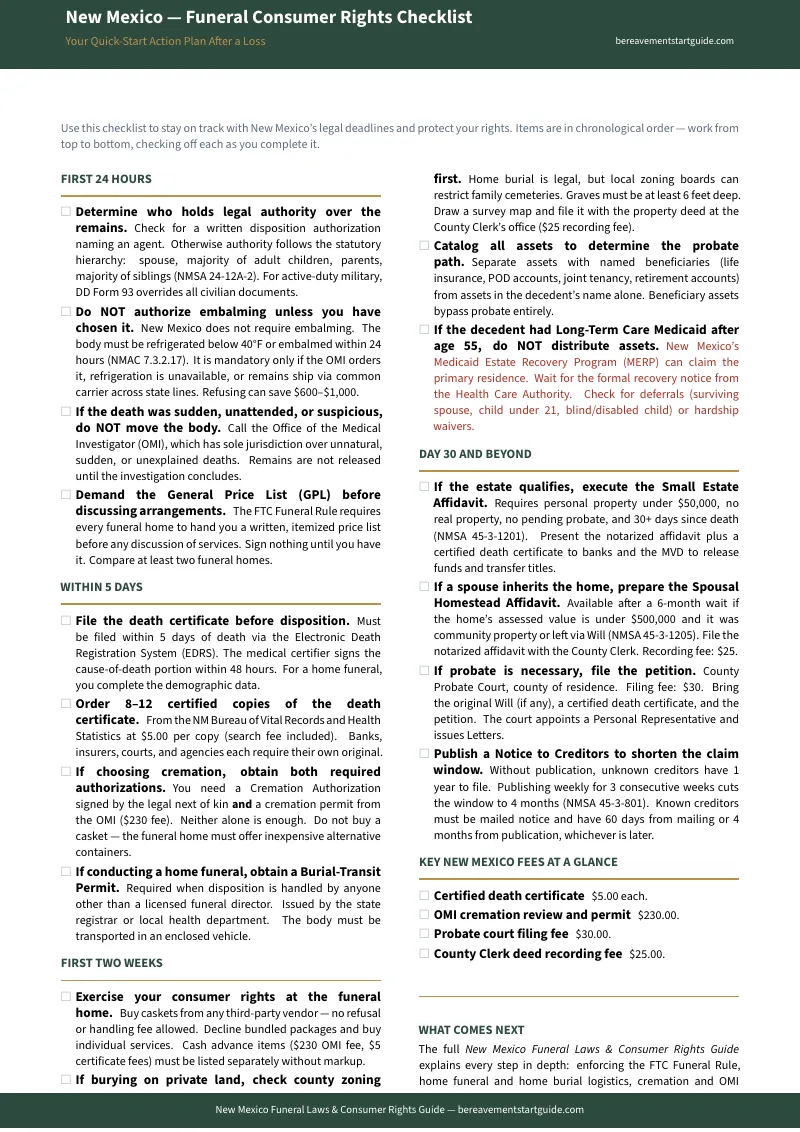
Not ready for the full guide? Download the free New Mexico Funeral Consumer Rights Checklist — a chronological action plan covering the critical deadlines, required permits, and the specific consumer rights you need to know before walking into any funeral home in New Mexico. Enough to protect yourself from the most common overcharges and procedural mistakes.
Grief should not come with a surprise invoice. Know what the law actually requires before you sit down at the arrangement table.