The Bank Froze the Account. The County Clerk Handed You a Form and Said She Cannot Tell You How to Fill It Out. Somewhere in That Paperwork Is a Thirty-Day Waiting Period You Did Not Know About — and Missing It Means Starting Over.
You walked into the bank with the death certificate, the original will, and your ID. The teller said the account is frozen until you produce "Letters Testamentary." You had never heard that phrase before today. You drove to the county probate court. The clerk gave you Form 4B-302 and said — politely, firmly — that the court cannot give you legal advice. She cannot tell you how to fill it out, which sections apply to your situation, what to attach, or what happens after you file it. That is the rule in New Mexico: the probate court provides forms but cannot advise you on using them.
So now you are home with a blank application, a frozen bank account, a will that everyone says "needs to be probated," and a growing fear that you are going to get this wrong. Maybe you will file the wrong application and waste weeks waiting for a correction notice. Maybe you will not realize the estate qualifies for the small estate affidavit — where you could bypass the court system entirely — and spend six months in a process you could have avoided. Maybe you will distribute assets before the four-month creditor claim window closes and discover that you are personally liable for debts the estate should have paid. Maybe the deceased received Medicaid benefits and you do not know about the estate recovery claim the state is legally required to file — or the specific exemptions that could protect the family home. Or maybe the deceased owned mineral rights in Lea or Eddy County, and you are about to learn that transferring them without completing proper probate creates title defects that make the rights unsellable for years.
The New Mexico Probate Process Guide is a Four-Pathway Executor's Manual for every filing, deadline, and decision in a New Mexico probate case — from classifying the estate through final distribution and closing. Not a generic overview written for all fifty states. Not a blog post designed to convince you that probate is too dangerous to attempt without a $5,000 retainer. A plain-English, New Mexico-specific manual that tells you exactly what the county clerk cannot: which pathway applies to your estate, which forms to file, when to file them, what to attach, what happens next, and which mistakes will cost you money or expose you to personal liability.
What's Inside the Four-Pathway Executor's Manual
A 19-chapter step-by-step guide, a filing-readiness checklist, and standalone reference sheets — covering every phase of probate in New Mexico from the first day through estate closing, built on the New Mexico Uniform Probate Code (NMSA 1978, Chapter 45) and the specific community property rules, tribal jurisdiction boundaries, and statutory thresholds that make this process different from any other state:
Before You File: Which of the Four Pathways Fits Your Estate?
This is the question that determines whether you spend twelve months in court or thirty days completing a simplified process. New Mexico gives you four distinct pathways — and the one you choose shapes everything. If the total solely owned personal property (minus liens) is $50,000 or less and there is no real estate to transfer, the Small Estate Affidavit under NMSA § 45-3-1201 lets you bypass the court system entirely after a mandatory thirty-day waiting period. If the primary asset is a family home held as community property, assessed at $500,000 or less, and the surviving spouse is the transferee, the Homestead Affidavit Transfer under NMSA § 45-3-1205 lets you transfer the title without a court filing — but only after a six-month waiting period. For everything else, you choose between Informal Probate in the county probate court ($30 filing fee, administrative process, no hearings) and Formal Probate in the district court ($132 filing fee, evidentiary hearings, judge-supervised). The guide includes a decision tree that walks you through the exact criteria for each pathway — so you do not file a full probate petition for an estate that qualifies for the shortcut, and you do not attempt the affidavit process on an estate that requires court supervision.
Community Property: The Classification That Changes Everything
New Mexico is one of nine community property states. Under NMSA § 40-3-8, all property acquired by either spouse during the marriage is presumed to be community property, owned equally by both spouses. When a married person dies, only their one-half of community property enters the probate estate — the surviving spouse already owns the other half. But separate property (acquired before the marriage, or received as a personal gift or inheritance) follows different rules entirely. The burden of proving an asset is separate falls on whoever claims it. Getting this classification wrong means including assets in the probate estate that were never the deceased person's to leave — or excluding assets that should have been distributed to heirs. The guide walks you through the classification process, the documentation needed to prove separate property, and the specific traps that catch executors in community property states.
Opening the Case: What the Court Needs and What Triggers a Rejection
The application to open informal probate is not a single form — it is a package. You need Form 4B-301 (intestate) or Form 4B-302 (testate), the original will if one exists, a certified death certificate, and the thirty-dollar filing fee. If the will is self-proved — meaning it includes a notarized self-proving affidavit under NMSA § 45-2-504 — the process is streamlined because the court does not need to locate and examine the witnesses. If it is not self-proved, the court may require witness testimony or an affidavit establishing the will's validity. The guide covers both scenarios. It also covers the specific steps if only a copy of the will exists, if the will names an out-of-state executor, and the precise difference between Letters Testamentary (Form 4B-306, issued when there is a valid will) and Letters of Administration (Form 4B-307, issued for intestate estates).
Intestate Succession: When There Is No Will
If the deceased person died without a will, New Mexico's intestate succession statutes dictate exactly who inherits — and the statutory formulas frequently contradict what the family expects. A surviving spouse with children who are all also children of the surviving spouse inherits the entire estate. A surviving spouse with children who are not also children of the surviving spouse receives the first $150,000 plus three-quarters of the remaining estate. A surviving spouse with no children but surviving parents receives the first $300,000 plus three-quarters. These are rigid statutory formulas that no executor, judge, or family agreement can override without formal court proceedings. The guide maps every scenario, including what happens when there is no surviving spouse, when there are children from multiple relationships, and when the deceased person had no identifiable heirs at all.
The Estate Inventory: What You Must Report and How to Value It
Within ninety days of appointment, NMSA § 45-3-706 requires you to file a detailed inventory listing every probate asset at fair market value as of the date of death, along with all liens and encumbrances. For real estate, this typically requires a professional appraisal. For mineral rights — common in southeastern New Mexico — you may need a qualified petroleum landman or mineral appraiser. The guide explains what qualifies as a probate asset versus a non-probate asset, how to handle community property in the inventory, and when the court can grant an extension if the ninety-day window is insufficient.
Creditor Claims: The Most Dangerous Phase for Executors
After appointment, you must publish a Notice to Creditors (Form 4B-501) once per week for three consecutive weeks in a newspaper of general circulation in the county. This opens a strict four-month window for unknown creditors to file claims. You must also send direct written notice to every known or reasonably ascertainable creditor. If you distribute assets before this window closes and a creditor files a valid claim, you are personally liable for the shortfall — not the estate, you. The guide maps every notification requirement, every deadline, the specific format the court expects, and the strict statutory priority order for paying debts: family allowance ($30,000) and personal property allowance ($15,000) first, then funeral and last illness expenses, then administration costs, then taxes, then general creditors.
Medicaid Estate Recovery: What the State Can Claim and How to Protect the Family
If the deceased person was fifty-five or older and received Medicaid-funded long-term care, the New Mexico Health Care Authority is federally mandated to seek recovery of those costs from the estate. Executors panic when they learn this — they assume the state will seize the family home. The guide explains what actually happens: heirs are not personally liable, the claim is strictly against the estate, and specific statutory exemptions exist. Recovery is deferred or waived if the deceased is survived by a spouse, a child under twenty-one, or a child of any age who is blind or disabled. Undue hardship waivers are available if the homestead is worth fifty percent or less than the average home price in the county. The guide outlines exactly how to report the death to the Income Support Division within ten calendar days, how to respond to a recovery claim, and how to apply for the hardship waiver.
The Elizabeth Whitefield Act: Life Insurance and Medical Aid in Dying
New Mexico's Elizabeth Whitefield End-of-Life Options Act, effective June 2021, allows terminally ill adults to request medical aid in dying. Executors handling these estates frequently fear that life insurance policies will be voided — that the death will be classified as a suicide. The Act is explicit: medical aid in dying is not suicide, life insurance policies cannot treat it as such, and the cause of death on the certificate is recorded as the underlying terminal disease. This chapter removes that fear with the specific statutory citations that settle the question.
Tribal Jurisdiction: When State Probate Does Not Apply
New Mexico is a non-Public Law 280 state, meaning state courts generally lack civil jurisdiction over Indian Country. If the deceased person was a member of one of New Mexico's twenty-three federally recognized tribes and owned trust land or restricted property, state probate forms do not apply. Jurisdiction falls to the Bureau of Indian Affairs under the American Indian Probate Reform Act of 2004. Most state probate guides never mention this. The guide explains the jurisdictional boundary, when state courts must abstain, and the contact protocols for the BIA's Branch of Probate Services — so you do not waste months filing state petitions that will be rejected.
Ancillary Probate: When the Deceased Lived Elsewhere but Owned Property in New Mexico
If the deceased person lived in another state but owned real property, mineral rights, or oil and gas interests in New Mexico, the out-of-state executor must open an ancillary probate in New Mexico under NMSA § 45-4-201. You cannot sell, lease, or transfer New Mexico real property using letters issued by another state's court. Skipping this step creates title defects that make the property unmarketable. The guide covers the specific filing requirements, the authenticated documents you need from the domiciliary court, and the particular complications of mineral rights transfers in Lea, Eddy, San Juan, and other oil-producing counties.
Closing the Estate: Final Accounting and Discharge
Probate does not end when you distribute assets. For informal probate, you file a verified closing statement (Form 4B-701 or 4B-702) certifying that you have administered the estate in accordance with New Mexico law. For formal probate, you petition the court for a decree of final distribution and formal discharge. Until you file, your personal liability as executor never technically ends. The guide covers the closing requirements for each pathway, the accounting format the court expects, and how to secure signed releases from all beneficiaries before the final distribution.
Who This Guide Is For
- The executor who just received the will and has no idea what to do with it — who needs to understand that a will is legally inactive until validated by a New Mexico probate court, and that the process between "holding the will" and "having legal authority" involves specific applications, potential bond requirements, and a judicial appointment
- The surviving spouse whose bank accounts were frozen this morning — who needs Letters Testamentary or Letters of Administration to unlock those accounts, and who may also qualify for the homestead affidavit transfer that bypasses probate for the family home entirely
- The family managing a modest estate that may not need probate at all — who needs the decision tree that maps the $50,000 small estate affidavit threshold, the $500,000 homestead transfer limit, and the specific criteria that separate a thirty-day simplified process from a twelve-month court administration
- The family with no will navigating intestate succession — who needs to understand exactly how New Mexico's statutory formulas divide the estate among the spouse, children, and parents, and who the court will appoint as administrator
- The adult child managing probate from out of state — who is filing in a New Mexico county probate court remotely and needs every form, every deadline, and every filing requirement in one document instead of calling the clerk's office and getting the same answer: "We cannot give legal advice"
- The out-of-state executor who just discovered the deceased owned mineral rights in New Mexico — who needs to understand ancillary probate, the specific filing requirements under NMSA § 45-4-201, and the title defects that result from skipping it
Why Free Resources Will Not Get You Through This
New Mexico probate information exists. It is scattered across the state judiciary website, thirty-three county probate court offices, attorney blogs designed to generate retainer clients, and national platforms that treat New Mexico as a footnote. Here is what you actually encounter when you try to navigate probate using free sources:
- The New Mexico Courts website provides the 4B-series forms but no operational guidance. You can download Form 4B-301, Form 4B-302, Form 4B-306, Form 4B-501, and Form 4B-601 from the state judiciary's self-help page. What you cannot find is a chronological roadmap explaining which forms to file in which order, what to attach, what deadlines apply, or what happens if you fill them out incorrectly. The forms are the raw ingredients. The recipe does not exist on the state website.
- County probate courts vary wildly and cannot give legal advice. Bernalillo County handles more probate filings than any other county in the state. Doña Ana County, Santa Fe County, and Sandoval County each have their own local procedures and filing requirements. Every county clerk will tell you the same thing: they cannot advise you on how to use the forms they provide. If your estate spans multiple counties — common when real property is in one county and the deceased lived in another — nobody at any county office will help you coordinate the filings.
- Attorney blog posts are designed to sell consultations, not solve your problem. Every probate attorney in Albuquerque, Santa Fe, and Las Cruces publishes content explaining how complex and risky probate is. For contested estates and formal probate in district court, that is true. For the straightforward informal estate where the will is clear, the heirs agree, and the assets are modest, the blog post never quite tells you that you can handle this with a thirty-dollar filing fee and no attorney. It always ends with "schedule a free consultation."
- National platforms charge hundreds and miss New Mexico-specific rules. Platforms like Atticus charge $175 to $499 for estate settlement tools. They cover probate in general terms. They do not cover New Mexico's four-pathway system, the $50,000 small estate affidavit threshold, the six-month homestead transfer waiting period, the community property classification process, the Medicaid estate recovery exemptions, the Elizabeth Whitefield Act, or the tribal jurisdiction boundaries. New Mexico's Uniform Probate Code has its own rules, and national platforms do not know them.
- New Mexico Legal Aid serves low-income residents, not the middle-class executor. The state's legal aid organizations provide essential services for people who meet income eligibility requirements. The family handling a $75,000 estate does not qualify. They fall into the gap between free legal help and affordable legal help — which is precisely where this guide lives.
Free resources give you fragments from a dozen sources that do not reference each other, do not sequence the steps, and cannot tell you which of the four pathways applies to your estate. The Four-Pathway Executor's Manual puts every New Mexico probate statute, form, deadline, and filing requirement into one document, in the order you actually need them.
— Less Than Thirty Minutes With a New Mexico Probate Attorney
A consultation with a New Mexico probate attorney runs $200 to $350 per hour. Full representation averages $4,000 to $15,000 depending on estate complexity. National estate platforms charge $175 or more per year. This guide costs less than thirty minutes of professional legal time and gives you the complete New Mexico-specific probate roadmap — every pathway, every filing requirement, every statutory deadline, every community property rule, and the decision tree that tells you whether you need to go to court at all.
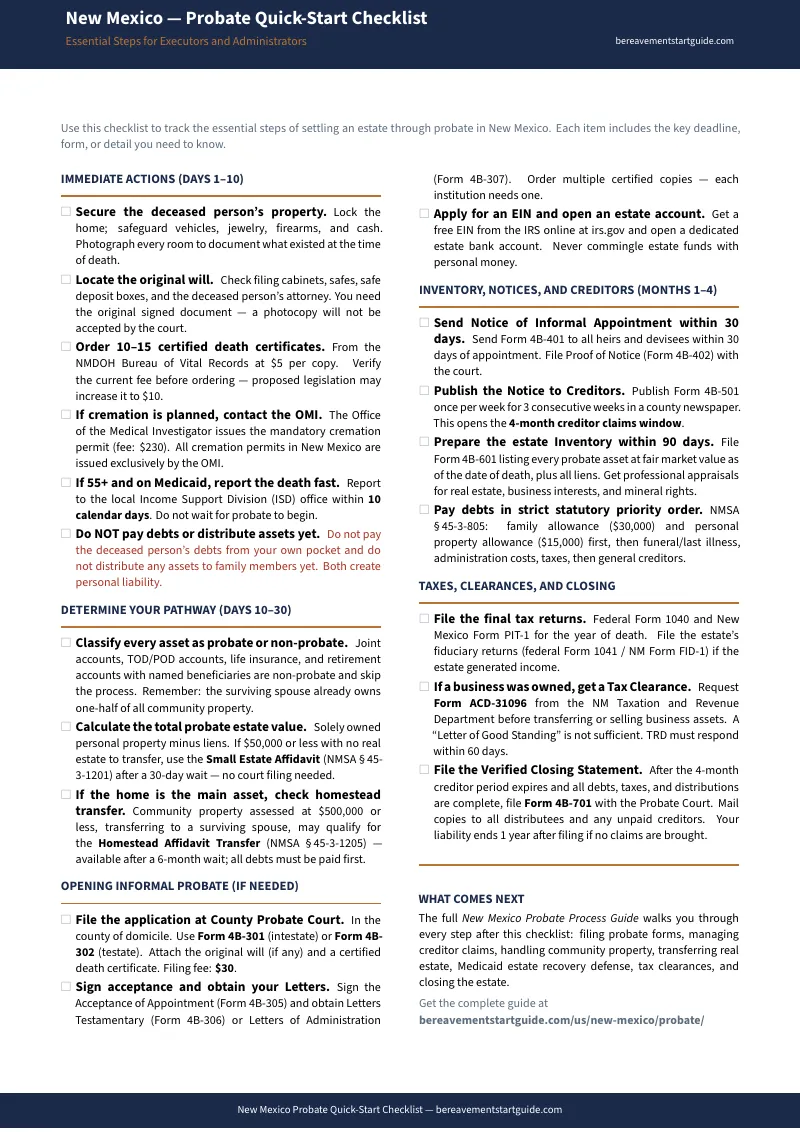
Your download includes the complete 19-chapter step-by-step guide, the standalone New Mexico Probate Quick-Start Checklist, and six printable reference sheets: the Four-Pathway Decision Tree, Community Property Classification Worksheet, Creditor Notification and Claims Guide, Medicaid Estate Recovery Reference, Intestate Succession Reference, and Ancillary Probate and Mineral Rights Guide. Eight PDFs total covering all four pathways, community property classification, intestate succession formulas, the complete creditor notification process, Medicaid estate recovery with hardship waivers, the Elizabeth Whitefield Act and life insurance, tribal jurisdiction boundaries, ancillary probate for mineral rights and out-of-state property, personal representative compensation, and estate closing procedures. Instant download, no account required.
30-day money-back guarantee. If the guide does not give you clarity on which pathway applies to your estate, what to file, and what happens next — email us for a full refund. No questions asked.
Not ready for the full guide? Download the free New Mexico Probate Quick-Start Checklist — an overview of the probate process and the key deadlines, decisions, and documents you need to have ready before you walk into the county probate court. Enough to understand which of the four pathways fits your situation and whether you need the full guide.
Probate is not something you were trained for. But it is something you can get through with the right instructions. The guide gives you those instructions, one pathway at a time.