Your Spouse Just Died in New Mexico. You Do Not Know Which Benefits You Qualify For, Which Agencies to Call First, or How Long You Have Before Deadlines Start Closing. The State Will Not Send You a List. The Attorney Wants $3,000 to Tell You What the Law Already Says You Are Owed.
You are sitting with a death certificate and a growing stack of bills. The pension check stopped. The health insurance card does not work anymore. Someone at the bank told you the joint account is frozen until you produce paperwork you have never heard of. Your spouse's employer sent a condolence card and a COBRA election notice with a 60-day deadline in small print. Social Security's website says you might qualify for survivor benefits, but the local office cannot see you for three weeks. The property tax bill arrived and it is higher than last year because the veteran exemption disappeared with your spouse's name. And you are trying to figure out which of these fourteen different agencies you are supposed to call first, while also figuring out how to pay for the funeral.
Here is what makes New Mexico especially difficult: the benefits exist. The state has a $30,000 Family Allowance that protects surviving spouses from creditors. There is a $15,000 personal property allowance. There are property tax exemptions worth thousands of dollars annually for veterans' surviving spouses — expanded in 2024 to cover proportional disability ratings. PERA and ERB pension systems have a "spouse as default beneficiary" rule enacted in 2019 that most families do not know about. The Crime Victims Reparation Commission will pay up to $6,000 in funeral costs if the death resulted from a violent crime. Workers' compensation covers up to $7,500 in burial expenses and up to 700 weeks of wage replacement. New Mexico even repealed the state income tax on Social Security for most recipients. These protections are real, they are substantial, and they are scattered across fourteen different state agencies that do not talk to each other, do not cross-reference their programs, and do not tell you what you are missing.
The New Mexico Survivor Benefits Navigator is a Claim-Shield-Transfer System that puts every benefit, every deadline, and every application sequence into one document. The name reflects the three things surviving families in New Mexico must do simultaneously: claim every dollar the state and federal government owe you, shield your home and assets from Medicaid recovery and creditors using the statutory protections New Mexico law already provides, and transfer property, pensions, and accounts into your name using the administrative shortcuts that bypass $3,000 to $5,000 in attorney fees. Not a sympathy pamphlet. Not a generic national checklist that confuses New Mexico's community property rules with common-law states. A state-specific benefits manual that tells you exactly what you are owed, which agency controls it, and how long you have to claim it before the deadline passes.
What's Inside the Claim-Shield-Transfer System
A comprehensive guide and a standalone benefits checklist — covering every survivor benefit available in New Mexico from the moment of death through the first full year, organized by the agency that controls the money and the deadline that governs your claim:
Pension and Retirement Benefits: PERA, ERB, and the Default Beneficiary Rule
If your spouse was a state employee, municipal worker, or public school educator, you need to contact the Public Employees Retirement Association (PERA) or the Educational Retirement Board (ERB) immediately — and "immediately" is not a suggestion. These agencies mandate notification upon the death of a retiree, and delayed notice triggers aggressive overpayment recovery that can cost your family thousands. This section explains the difference between Option A (life-only annuity — no ongoing monthly benefit) and Option B (100% joint survivor benefit), walks you through the 2019 "spouse as default beneficiary" rule from Senate Bill 664 that protects spouses even when no beneficiary was named, covers the NMRHCA group life insurance payout (up to $6,000 for pre-2012 retirees), and tells you exactly which forms to file and in what order. It also explains what most families learn too late: unlike Social Security, New Mexico state pensions are fully subject to state income tax, and you need to submit withholding elections immediately to avoid penalties.
Social Security Survivor Benefits and the New Mexico Tax Advantage
The federal rules are the same everywhere, but New Mexico adds a substantial advantage that most survivors miss. Starting with the 2022 tax year, New Mexico repealed the state income tax on Social Security benefits for single filers earning under $100,000 and joint filers under $150,000 — saving the average senior household approximately $710 annually. This section covers the $255 lump-sum death payment, the monthly survivor benefit structure, the earnings test if you are still working, the age-based reduction schedule, and the specific New Mexico PIT-1 filing strategy that ensures you do not overpay state taxes on benefits the legislature specifically exempted.
Health Insurance Continuation: COBRA, beWellnm, and the Decision That Cannot Be Undone
When your spouse dies, you have a narrow window to make a health insurance decision that you cannot reverse. If the deceased carried employer-sponsored coverage, you can elect COBRA continuation — but the premiums are brutal because you pay the full cost plus a 2% administrative fee. The alternative is the New Mexico state health exchange, beWellnm, where Advance Premium Tax Credits can dramatically reduce your monthly cost. But here is the trap: once you enroll in COBRA, you cannot voluntarily drop it for beWellnm outside of the Open Enrollment Period. This section walks you through the Special Enrollment Period triggered by a spouse's death, the exact timeline for making your decision, the cost comparison framework, and the NMRHCA continuation rules for surviving spouses of public employees — where coverage continues without interruption once the survivor profile is processed.
Property Tax Relief: The Three Exemptions Most Families Never Claim
New Mexico provides three distinct property tax exemptions that surviving spouses can claim, and most families claim zero of them because nobody tells them they exist. The Head of Family exemption reduces taxable value by $2,000. The standard veteran surviving spouse exemption reduces it by $10,000 — with inflation adjustments starting in 2026. And the 2024 Constitutional Amendment expanded the disabled veteran exemption to be proportional to the federal disability rating, meaning a spouse of a 70%-rated veteran gets a 70% property tax reduction, not zero. You need a death certificate, marriage certificate, and the DD-214 (specifically Member Copy 4). This section tells you exactly what to bring to the county assessor's office and which form to file for each exemption.
The $30,000 Family Allowance and $15,000 Personal Property Allowance
Before any creditor, any medical bill collector, and any credit card company receives a dollar from the estate, New Mexico law entitles the surviving spouse to a $30,000 Family Allowance and a $15,000 personal property allowance. These are statutory rights — they come before general creditors in the priority hierarchy. Most families do not know these allowances exist, and creditors will not volunteer the information. This section explains how to claim them, what qualifies as personal property for the $15,000 exemption, and how the Family Allowance interacts with the probate process.
Workers' Compensation Death Benefits
If the death was work-related, the Workers' Compensation Administration provides funeral expenses up to $7,500 and wage replacement at two-thirds of the deceased's average weekly wage for up to 700 weeks. Children receive benefits until age 18, extending to 23 if enrolled in school, or indefinitely if disabled. This section also covers the 2017 amendment ensuring that surviving spouses of first responders do not forfeit death benefits upon remarriage — a protection many families do not know was enacted.
Crime Victims Reparation: The Two-Year Deadline
If the death resulted from a violent crime, the New Mexico Crime Victims Reparation Commission can cover up to $6,000 in funeral costs within a broader $20,000 maximum benefit. The Commission also covers medical expenses, mental health counseling (up to 30 sessions), and lost earnings. But the filing deadline is strict: two years from the date of the crime. Property damage, attorney fees, and pain and suffering are not covered. This section provides the exact application process, the eligibility requirements, and the documentation you need.
Medicaid Estate Recovery: The Shield Strategy
If your spouse received Medicaid long-term care after age 55, the Health Care Authority will seek reimbursement from the estate. This terrifies families — but the law provides clear protections. The state cannot recover against the home while a surviving spouse is living in it, or while a child under 21 or a disabled child of any age resides there. There is a 90-day hardship waiver window from receipt of the recovery notice. This section separates the fear from the facts, explains every deferral and exemption, and tells you exactly what to do when the recovery notice arrives.
The Elizabeth Whitefield Act: Life Insurance and Medical Aid in Dying
If your spouse chose medical aid in dying under the Elizabeth Whitefield End-of-Life Options Act, you may face pushback from life insurance companies attempting to invoke suicide clauses. New Mexico law is explicit: actions taken under this Act do not constitute suicide, assisted suicide, or homicide. Any contract provision that conditions benefits on the patient's end-of-life choices is void. This section gives you the statutory citation to include with your claim and the exact language to use when an out-of-state insurance adjuster is unfamiliar with New Mexico's law.
County Indigent Burial Programs and Emergency Funeral Assistance
When there is no money for a funeral, New Mexico counties operate indigent burial programs under NMSA 24-13-1. The reality is harsh: programs in counties like Bernalillo, Otero, and Sierra strictly limit costs, mandate cremation within 30 days, and seek reimbursement from any assets later discovered. This section covers the county programs, how to access them, and the interaction with CVRC funds and workers' compensation burial benefits — so you understand every source of funeral cost relief before accepting a $3,000 cremation bill you cannot afford.
Tribal Land, Federal Benefits, and Dual-Jurisdiction Complexities
New Mexico has 23 federally recognized tribes, pueblos, and nations. If the deceased held trust or restricted land, state survivor benefit rules do not govern those assets — the Bureau of Indian Affairs and the American Indian Probate Reform Act do. This section delineates which assets fall under New Mexico district court jurisdiction and which require BIA intervention, so you do not make procedural missteps that delay your inheritance.
Who This Guide Is For
- The surviving spouse whose pension check just stopped — who needs to know whether to call PERA or ERB first, whether the "spouse as default beneficiary" rule applies, and how to prevent the state from clawing back overpayments while simultaneously filing for continuation of health coverage through NMRHCA
- The widow or widower facing a COBRA election notice — who has 60 days to decide between paying $1,800 a month for COBRA or navigating beWellnm with tax credits, and who does not realize that choosing wrong locks them in for the rest of the year
- The veteran's surviving spouse — who does not know about the newly expanded proportional property tax exemption, the $10,000 standard veteran exemption, or the VA Dependency and Indemnity Compensation that requires a separate federal application
- The family with no liquid assets for the funeral — who needs to know about workers' compensation burial benefits, the Crime Victims Reparation Commission, county indigent programs, and the $30,000 Family Allowance before signing a payment plan with the mortuary
- The adult child managing a parent's affairs from out of state — who needs a single document showing every New Mexico-specific benefit, every agency contact, every deadline, and every form, instead of searching fourteen different government websites that do not link to each other
- The family dealing with Medicaid recovery — who received a notice from the Health Care Authority and needs to understand the surviving spouse deferral, the hardship waiver, and the 90-day deadline before they panic and pay a claim the state may not be legally entitled to collect
Why Free Resources Will Not Get You Through This
Every benefit described in this guide is created by state or federal law. The information is technically public. Here is what happens when you try to assemble it yourself:
- Fourteen agencies, zero coordination. PERA does not tell you about ERB. ERB does not mention the NMRHCA. The Health Care Authority does not explain beWellnm. The county assessor does not reference the Crime Victims Reparation Commission. Each agency answers questions about its own program and nothing else. You get fourteen partial answers and no sequence.
- Government websites explain eligibility, not process. The PERA website will tell you that survivor benefits exist. It will not tell you to file the withholding election simultaneously, that Option A means zero ongoing monthly payments, or that delaying notification triggers overpayment recovery. Agency websites describe what the benefit is, not how to claim it without making the mistakes that cost you money.
- National platforms miss New Mexico specifics. Generic survivor benefit guides do not cover the 2019 Senate Bill 664 default beneficiary rule, the 2024 property tax amendment expanding proportional disability exemptions, the Elizabeth Whitefield Act insurance protections, the beWellnm vs. COBRA trap, or the county-level indigent burial programs under NMSA 24-13-1. New Mexico is a community property state with its own pension systems, its own health exchange, and its own end-of-life legislation. National templates get the broad strokes right and the critical details wrong.
- Attorneys highlight complexity to justify retainers. Law firm blog posts about survivor benefits in New Mexico are accurate — and designed to convince you that a $3,000 retainer is the only safe path. For contested estates and complex trust situations, that is true. For the surviving spouse claiming a pension, filing property tax exemptions, and securing health insurance, the process is administrative, not legal. The forms are free. The sequence is what you are missing.
- Funeral homes stop at the cemetery gate. Bereavement coordinators will help you notify Social Security and order death certificates. They will not explain PERA Option A vs. Option B, the 90-day Medicaid hardship window, or the property tax exemptions that expire if you do not file proactively with the county assessor.
Free resources give you fragments from fourteen agencies that do not reference each other. The Claim-Shield-Transfer System puts every New Mexico survivor benefit into one document, in the order you need to claim them, with the deadlines that govern each one.
— Less Than Thirty Minutes With a New Mexico Attorney
A single consultation with a New Mexico estate attorney costs $150 to $300 per hour. Standard representation runs $3,000 to $5,000. National benefits-planning platforms charge $100 to $500 for templates that do not know the difference between PERA and ERB. This guide costs less than thirty minutes of professional legal time and gives you the complete New Mexico-specific benefits roadmap — every pension system, every tax exemption, every health insurance pathway, every statutory allowance, and the deadline calendar that tells you exactly when each claim must be filed.
Your download includes 10 PDFs — the complete guide, the standalone checklist, and 8 printable worksheets and reference cards you can use independently:
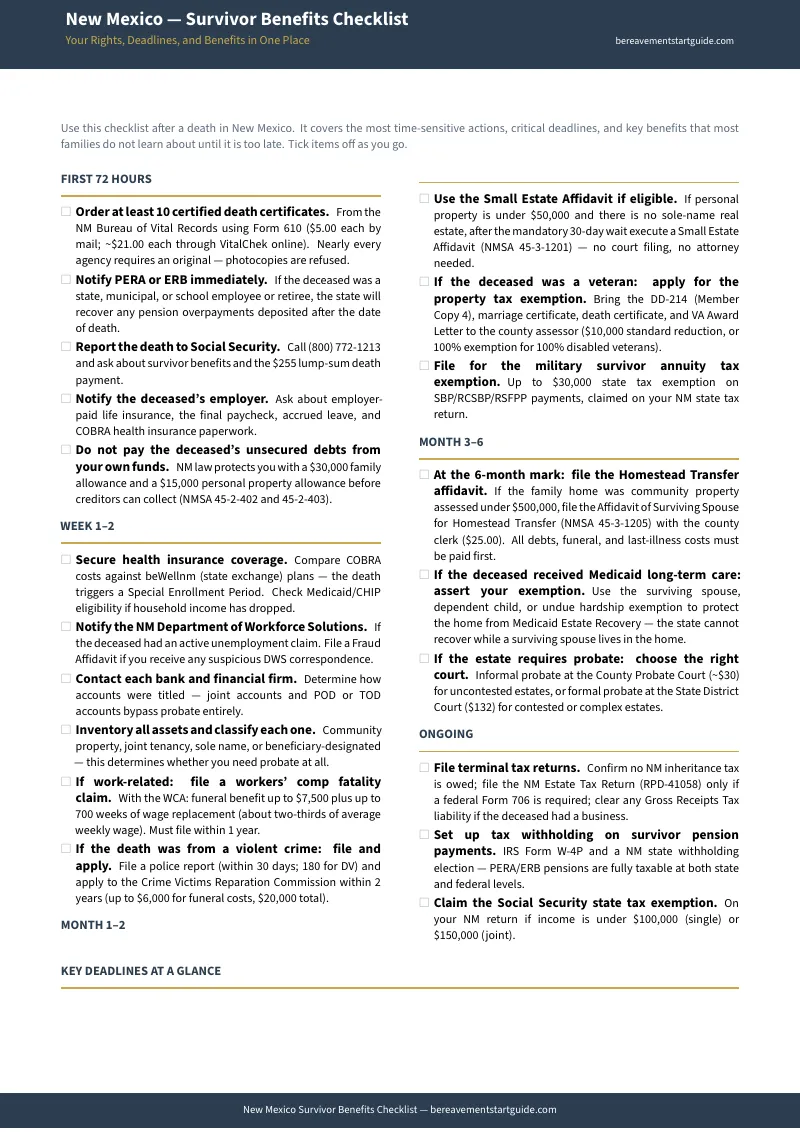
- New Mexico Survivor Benefits Checklist — print-and-pin reference covering every benefit claim, every agency contact, and every deadline in sequence
- Deadline Calendar — every time-sensitive filing organized chronologically with a fillable "Your Date" column
- Asset Inventory Worksheet — classify every asset and determine the correct transfer path (Small Estate Affidavit, Homestead Transfer, or Probate)
- Funeral Expense Comparison Worksheet — compare funeral home quotes against available assistance programs
- Health Insurance Decision Framework — COBRA vs. beWellnm side-by-side comparison with the Special Enrollment Period timeline
- PERA and ERB Pension Claims Reference — Option A vs. Option B, the Senate Bill 664 default beneficiary rule, and tax withholding requirements
- Veterans Benefits Checklist — property tax exemptions, document requirements for the county assessor, and veteran-specific claims
- Medicaid Recovery Decision Tree — step-by-step defense strategy to determine your exposure and which exemption protects you
- Tax Filing Checklist — what you owe, what you do not, and every form number you need
Instant download, no account required.
30-day money-back guarantee. If the guide does not give you clarity on what you are owed and confidence that you are claiming it in the right order, email us for a full refund. No questions asked.
Not ready for the full guide? Download the free New Mexico Survivor Benefits Checklist — a prioritized reference covering the benefits that matter most in the first 30 days: pension notifications, Social Security, health insurance decisions, property tax exemptions, and the Family Allowance. It is enough to identify what you are owed and which agencies to call first.
You should not have to fight for what the law already says is yours. The guide shows you how to claim it, one benefit at a time.