The Surrogate's Court Roadmap: Stop Guessing, Start Executing
Someone you love just died in New York. The funeral is over, the casseroles have stopped arriving, and now you are staring at a stack of paperwork from a court system that operates differently in all sixty-two counties.
The bank froze the accounts. The Surrogate's Court website handed you a pile of PDFs written in statutory shorthand. And the probate attorneys you called are quoting $200 to $600 per hour — assuming they return your call at all.
Here is what nobody tells you: the administrative part of settling a New York estate is not mysterious. It is a sequence. A specific order of operations with specific forms, specific deadlines, and specific dollar thresholds that determine whether you need the court at all. The problem is that no one lays out that sequence in plain English — the court cannot advise you, the free forms assume you already know what you are doing, and the attorneys have a financial incentive to keep the process opaque.
The Surrogate's Court Roadmap — that is what this guide is. Not a 400-page legal textbook. Not a generic national template that gets rejected by New York court clerks. A step-by-step administrative manual built specifically for New York's unique rules, written for the person standing in the middle of the chaos trying to figure out what happens next.
— Less Than One Hour of a Probate Attorney's Time
The average New York probate attorney charges $350 to $500 per hour. This guide costs less than a single billable hour — and it handles the administrative heavy lifting that attorneys charge thousands of dollars to organize.
What Makes New York Different
A generic estate settlement guide is useless in New York. Here is why:
- 62 Surrogate's Courts, 62 sets of local rules. Paperwork accepted in Erie County can be rejected in Nassau County. Manhattan and the Bronx require mandatory electronic filing through NYSCEF. The guide maps these county-level differences so your filings are not sent back.
- Two completely separate death certificate systems. NYC deaths go through the Department of Health and Mental Hygiene ($15/copy, VitalChek only, $9.30 processing fee). Deaths outside the city go through the NYS Department of Health ($30/copy). Order from the wrong system and you wait weeks for nothing.
- Cooperative apartments follow different rules from houses. A co-op is personal property — shares in a corporation — not real estate. Even when a will clearly names an heir, the co-op board can reject the transfer. This guide explains the stock certificate process, board approval requirements, and what to do when the board says no.
- The estate tax cliff. New York does not just tax the amount above the exemption — if the estate exceeds 105% of the $7,350,000 threshold, the exemption vanishes entirely and the state taxes every dollar from the first. A $40,000 miscalculation triggers hundreds of thousands in estate tax.
- The seven-month trap. Under SCPA 1802, creditors get seven months to file claims. Pay the wrong debt too early and the executor — not the estate — bears personal liability. The guide maps the exact creditor priority order so you know what to pay, when, and what to refuse.
What's Inside the Guide
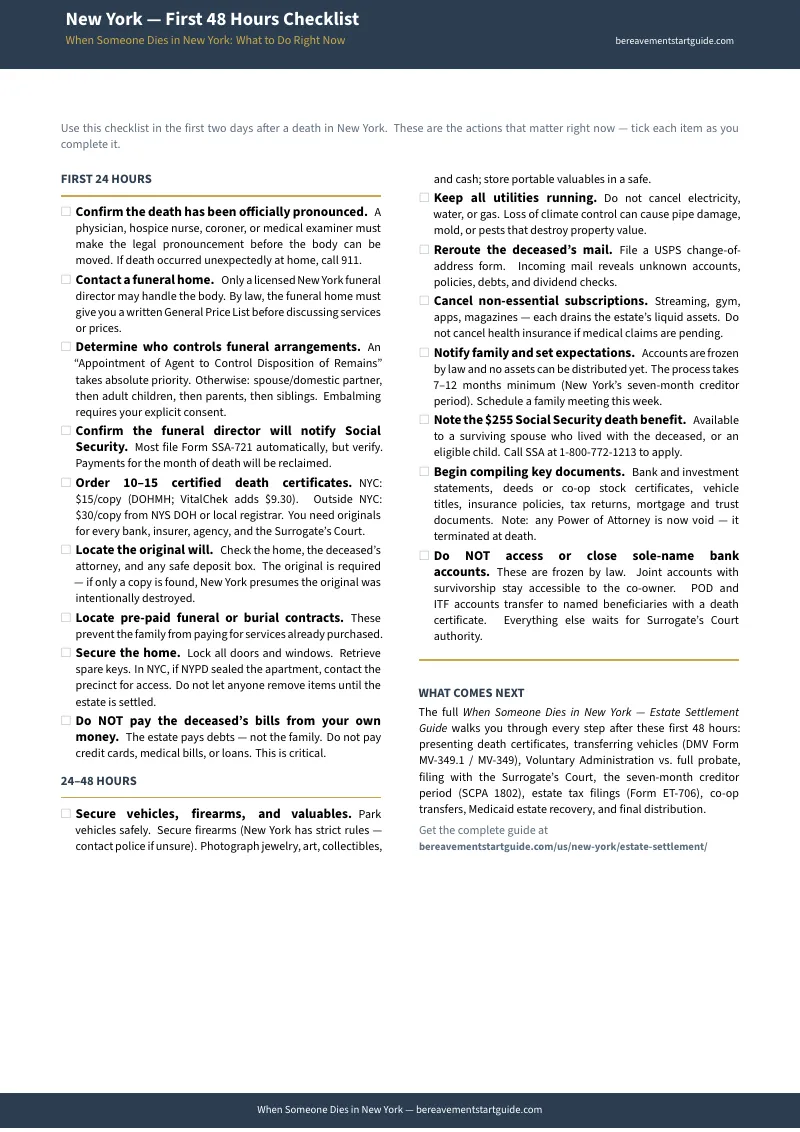
- First 48 Hours Emergency Sequence — Pronouncement of death, funeral director rights and protections under New York Public Health Law 4201, which death certificate system to use, how many to order, and what to secure at the home before anyone touches anything.
- The Probate Decision Tree — A yes/no walkthrough that tells you whether you need the Surrogate's Court at all. Joint accounts, TOD/POD designations, life insurance, and retirement accounts may mean you never file a single court document.
- Small Estate Bypass (Article 13) — The complete Voluntary Administration process for estates under $50,000 in personal property. Form SE-3A, the $1 filing fee, what counts toward the limit (and what does not — one vehicle up to $25,000 and spousal cash up to $15,000 are excluded), and the Family Tree Affidavit requirement that derails most self-filers.
- Full Probate/Administration Step by Step — Petitioning for Letters Testamentary or Letters of Administration, the filing fee schedule ($45 to $1,250 based on estate value), the Family Tree Form (FT-1), NYSCEF mandatory e-filing requirements, and the original-document delivery rules that still apply in electronic-filing counties.
- Creditor Management Protocol — The SCPA 1802 seven-month timeline mapped out in detail. Which debts to pay first (funeral expenses, then administration costs, then taxes), which to refuse, and how to protect yourself from personal liability if the estate turns out to be insolvent.
- Co-op Transfer Playbook — Stock certificate cancellation, proprietary lease transfer, board approval process, what happens with jointly held co-ops, and the estate tax lien (Form ET-117) that blocks every transfer until released.
- Real Property Transfer Guide — Fiduciary deeds, ACRIS recording for NYC properties, county clerk recording for upstate, and the ET-117 lien release process (one per property, each filed separately).
- Vehicle Transfer Without Court — DMV Form MV-349.1 for surviving spouses (one vehicle up to $25,000, no court involvement), Form MV-349 for next of kin, and the restriction that kills the shortcut if a formal estate proceeding has been filed.
- Surviving Spouse Exemptions (EPTL 5-3.1) — Every category of exempt property: household goods ($20,000), family media ($2,500), one vehicle ($25,000), cash ($15,000). These assets vest immediately in the surviving spouse, completely outside the court's reach and beyond the claims of general creditors.
- Estate Tax Cliff Breakdown — The 2025-2026 Basic Exclusion Amounts, the 105% drop-off calculation, the ET-706 filing deadline (nine months from death), and the "Santa Clause" charitable bequest strategy that pulls estates back below the cliff.
- Medicaid Estate Recovery (MERP) Defense — The 2011 repeal that limits recovery to the probate estate only, statutory deferrals, hardship waiver criteria (50% of county average selling price), and how to respond to the HMS recovery notice without panicking.
- Intestacy Distribution Table — The complete EPTL 4-1.1 breakdown of who inherits what when there is no will, including the domestic partner gap that leaves unmarried partners with nothing.
- Tax Filing Checklist — Final IT-201, estate EIN, fiduciary income tax returns, estate tax return, and the joint-return option for surviving spouses.
- Master Timeline Calendar — Every statutory deadline from Day 1 through Month 12+, organized as a project management calendar with the seven-month creditor period, nine-month estate tax deadline, and final accounting milestones.
- Complete Forms & Agency Directory — SE-3A, FT-1, MV-349, MV-349.1, ET-706, ET-117, ET-30, ET-85, IT-201, SCM-1, SCM-2. Every form, its issuing agency, and exactly when you need it.
Standalone Printable Tools Included
In addition to the 74-page guide and the First 48 Hours checklist, you get five standalone worksheets and reference cards — print them separately and use them at the kitchen table, the Surrogate's Court, or your desk:
- Probate Decision Tree — A one-page yes/no flowchart: Voluntary Administration, formal probate, or no court involvement
- Asset Inventory Worksheet — Fillable table for categorizing every asset as probate, non-probate, or EPTL 5-3.1 exempt
- Creditor Priority Worksheet — The statutory debt payment order with space to track the seven-month creditor window
- Timeline Calendar — Every statutory deadline from Day 1 through final distribution on one page
- Forms & Agency Reference Card — Every NY form mapped to its issuing agency and filing deadline
Who This Is For
- Surviving spouses trying to access frozen accounts, claim exempt property, and figure out which bills to pay during the seven-month creditor window
- Named executors who want to walk into an attorney's office with everything organized — cutting billable hours from dozens to a handful
- Adult children managing a parent's New York estate from out of state
- Families with small estates who may qualify for the $1 Voluntary Administration process and skip probate entirely
- Families with co-op apartments facing board approval, stock certificate transfers, and estate tax lien releases
Why Not Just Use the Free Court Forms?
You can. The NY Courts website provides the forms and basic instructions. Here is what it does not provide:
- A chronological sequence telling you which form to file first, second, and third
- The decision tree that determines whether you need probate at all
- An explanation of the county-by-county differences in NYSCEF requirements
- The creditor priority order that protects you from personal liability
- The co-op transfer process that has nothing to do with the Surrogate's Court
- The EPTL 5-3.1 exemptions that let a surviving spouse bypass the court entirely for vehicles, household goods, and cash
The court forms are the ingredients. This guide is the recipe — in the right order, with the timing that keeps you out of legal trouble.
The Guarantee
If this guide does not give you a clearer picture of the New York estate settlement process within the first 30 minutes of reading, email [email protected] for a full refund. No conditions, no time limit, no questions.
Start With the Free Checklist — or Get the Full Guide Now
Download the free New York First 48 Hours Checklist to handle the immediate crisis. When you are ready for the complete system — every form, every deadline, every county-level nuance — the full guide is here.