The Bank Froze the Accounts. The Surrogate's Court Clerk Rejected Your Petition. The Estate Might Qualify for a $1 Filing Fee. And Nobody Told You That Cooperative Apartments Are Not Real Estate in New York.
Someone named you executor in a New York will --- or there is no will, and you are the closest relative stepping into the role of administrator. Either way, you went to the NYCourts.gov website and started downloading forms. P-1. A-1. SE-3A. You spent a weekend filling them out. You drove to the Surrogate's Court, waited in line, and the clerk looked at your petition for about ten seconds before handing it back: "You need a Family Tree Affidavit." Or: "This county requires NYSCEF electronic filing." Or simply: "The original will appears to have been un-stapled."
You did not know that removing staples from an original will triggers court suspicion of tampering in New York and requires a separate explanatory affidavit. You did not know that Nassau County demands a detailed Family Tree Affidavit (Form FT-1) from a disinterested party before it will process your petition. You did not know that the estate might qualify for Voluntary Administration --- a $1 filing fee --- because certain assets are exempt under EPTL 5-3.1 and do not count toward the $50,000 small-estate threshold.
Meanwhile, the $280-to-$1,250 filing fee is looming, the bank accounts are frozen until you produce Letters Testamentary, and a relative is asking when they will receive their share. You have a seven-month creditor waiting period you have never heard of, a Medicaid estate recovery lien you did not expect, and if the decedent owned a co-op apartment, you are about to discover that New York classifies it as personal property --- shares in a corporation --- requiring board approval to transfer, even when the will says "I leave everything to my spouse."
Here is the problem nobody explains: New York has 62 Surrogate's Courts, each with its own local rules. The state has generous family exemptions that can shrink a $140,000 estate below the small-estate threshold. But if you file the wrong petition first, you are locked into the full probate track --- months of court appearances, a mandatory 7-month creditor window, and filing fees you did not need to pay.
The New York Probate Process Guide is the Surrogate's Court Navigation System --- the decision framework that routes you to the fastest, cheapest legal pathway before you accidentally file the wrong petition. Not a collection of blank forms. Not a national overview with "New York" in the title. A New York-specific procedural manual built around the Surrogate's Court Procedure Act and the Estates, Powers and Trusts Law, covering every county variation, every exemption calculation, and every deadline that starts running from the date of death.
What's Inside the Surrogate's Court Navigation System
A comprehensive guide and the Probate Quick-Start Checklist --- covering every stage from the first 14 days through final distribution, built specifically for New York's SCPA and EPTL statutes and the county-level Surrogate's Court procedures that make probate here unlike any other state:
The Three-Path Decision --- Which Route Applies to Your Estate
National websites talk about "formal" vs. "informal" probate. New York does not use those terms. The state has three distinct paths: Voluntary Administration for small estates ($50,000 or less, $1 filing fee), Probate when a will exists (Form P-1), and Administration when someone dies intestate (Form A-1). Before you file anything, you need to know which path applies --- and whether the EPTL 5-3.1 family exemption (up to $92,500 in exempt property for a surviving spouse) can shrink the estate below the small-estate threshold. The guide walks you through the calculation step by step, because many families file for full probate when their estate qualified for the $1 path all along.
The EPTL 5-3.1 Exemption Calculator --- The Math That Saves Thousands
A surviving spouse or children under 21 can exempt a motor vehicle up to $25,000, cash and securities up to $25,000, household items up to $20,000, and more --- totaling up to $92,500 --- before the $50,000 small-estate test even applies. Combined with the exemption, estates worth up to roughly $142,500 can sometimes qualify for Voluntary Administration instead of full probate. The guide shows you exactly which assets to subtract, how to document the exemptions, and how to file the SE-3A affidavit that avoids the full probate process entirely.
Petition, Notice, Bond, and Letters --- Getting Appointed Without Rejection
The chapter that prevents courthouse rejections. How to file the P-1 (Probate) or A-1 (Administration) petition without triggering a return from the clerk. The specific requirements for Waivers of Process and Consent from every distributee. The Citation procedure for anyone who refuses to sign. The SCPA 1409 notice to non-distributee beneficiaries. The bond requirements under SCPA 805 --- when you need one, when you can waive it, and the difference between the bond filing fee ($20-$30) and the bond premium. County-specific warnings: Nassau's Family Tree Affidavit (FT-1), mandatory NYSCEF e-filing counties, and the stapled-will rule that catches everyone off guard.
The 7-Month Creditor Shield and Payment Hierarchy
New York imposes a strict 7-month creditor claim period under SCPA 1802. Distribute assets before the window closes and you are personally liable for valid late claims. But creditor payment order matters too: funeral expenses first, then administration costs, then federal liens, then New York State and Medicaid, then general unsecured creditors like credit cards last. Pay a credit card bill before the Medicaid lien and you can be sued for the difference. The guide includes a calendar template for tracking the 7-month window and a ledger for prioritizing payments in the correct statutory order under SCPA 1811.
The Medicaid Estate Recovery Defense
If the decedent was over 55 and received Medicaid for long-term care, the state may file a recovery claim against the probate estate. But New York is a "probate-only" recovery state under 18 NYCRR 360-7.11 --- meaning assets that pass outside probate (joint accounts, living trusts, TOD designations, life estates) are safe from Medicaid recovery. The guide maps exactly which assets are exposed and which are protected, so you know the real size of the claim before you panic.
The Co-Op Apartment Survival Guide
In New York City and the surrounding metro area, cooperative apartments create a unique administrative trap. Co-ops are legally classified as personal property --- shares in a corporation plus a proprietary lease --- not real estate. This means the board must approve the transfer even when the will explicitly leaves the apartment to a spouse. If the co-op was purchased by a married couple before January 1, 1996, the law may have treated it as a tenancy in common, meaning the surviving spouse does not automatically inherit. The 1996 EPTL 6-2.2 amendment fixed this going forward, but pre-1996 purchases remain a minefield. The guide covers the titling analysis, the board approval process, and the specific documents needed to transfer inherited co-op shares.
The Estate Tax Cliff and the Three-Year Gift Clawback
The 2026 New York estate tax exemption is $7,350,000. But if the taxable estate exceeds 105% of that amount (roughly $7,717,500), the entire estate is taxed from dollar one --- not just the excess. This is the "cliff" that catches families who assume New York works like the federal exemption. Additionally, New York claws back gifts made within three years of death into the taxable estate calculation. The guide explains exactly when to bring in a CPA or tax attorney, how to file the ET-706 return, and why you need to clear the ET-117 estate tax lien before selling any real property or co-op --- even if no tax is owed.
Real Estate Transfers, the 9-Month Inventory, and the Commission Schedule
The filing deadline for the Inventory of Assets is 9 months from receiving Letters (22 NYCRR 207.20) --- miss it and the court can revoke your appointment and your commission. The guide covers date-of-death valuations, appraisal requirements, and the specific complications of New York real property transfers during probate. It also covers the executor's commission under SCPA 2307 (5% of the first $100,000, scaling down), how to calculate it, and when to claim it.
Pre-Death Documents and the POA Confusion
Many executors arrive expecting the Power of Attorney to still work. It does not --- all POA authority dies with the principal. The guide clarifies how New York's statutory POA form, the 2021 "substantial conformity" amendments, and the Health Care Proxy (New York has no statutory living will form) all interact with the probate process. Understanding which pre-death documents are still relevant and which are not prevents weeks of wasted effort with banks and institutions.
County-by-County Variations Across 62 Surrogate's Courts
New York has 62 counties, and each Surrogate's Court maintains its own local rules: different cover sheet preferences, different requirements for genealogical documentation, different procedures for serving citations, and a growing number that mandate NYSCEF electronic filing. The guide flags the major variations and tells you exactly where to check for your county's local rules before you file anything. Filing without checking local rules is the most common reason petitions are rejected.
Who This Guide Is For
- The executor whose petition was just rejected by the Surrogate's Court clerk --- you filled out the P-1 using the NYCourts.gov forms, drove to the courthouse, and the clerk handed it back. Missing waiver. Wrong county. Un-stapled will. The guide translates the rejection, shows you what was missing, and walks you through the county-specific requirements that determine whether your petition is accepted on the next try or handed back again.
- The administrator of an intestate estate who does not know where to start --- there is no will, no trust, and the bank is demanding Letters of Administration before it will release a dollar. The guide covers the A-1 petition process, the bond requirements, the priority of distributees under EPTL 4-1.1, and the specific differences between Letters Testamentary and Letters of Administration that affect what you can and cannot do.
- The family that might not need full probate at all --- the estate is a bank account, a car, and some personal property. The guide's exemption calculator shows you whether the EPTL 5-3.1 family exemptions shrink the estate below the $50,000 Voluntary Administration threshold, qualifying you for the $1 filing fee that avoids the full probate process entirely.
- The heir dealing with a New York City co-op apartment --- the will says everything goes to the spouse, but the board says they need probate documents, a financial review, and an interview before they will approve the transfer. The guide covers the co-op classification as personal property, the pre-1996 tenancy rules, and the board approval process that makes co-op transfers unlike any other asset class.
- The out-of-state executor managing New York probate remotely --- you live in Florida or California and the deceased was domiciled in Manhattan. You cannot get the Surrogate's Court on the phone. You do not understand why each county has different filing rules. The guide gives you every form number, every filing fee, every deadline, and every county-specific resource so you can manage the process without flying back and forth.
- The family working with an attorney who wants to understand the fees --- you retained counsel because the estate is complex, but you want to know whether you are being billed appropriately. The guide explains the SCPA 2402 filing fee schedule, the SCPA 2307 executor commission scale, and the questions to ask before approving any invoice.
Why Free Forms and Generic Legal Sites Will Not Get You Through New York Probate
The forms are free. Filing them correctly is the expensive part. Here is what actually happens when families try to handle New York probate using free resources:
- NYCourts.gov gives you forms, not strategy. You can download the P-1, A-1, SE-3A, and every other Surrogate's Court form for free. What the website does not tell you is whether your estate qualifies for Voluntary Administration after applying the EPTL 5-3.1 exemptions --- or that filing the wrong petition locks you into the full probate track with hundreds of dollars in filing fees and months of court proceedings you did not need. The forms are blank pages. The decision tree that tells you which ones to use is what the court website does not provide.
- National legal platforms produce documents that New York courts reject. Trust & Will, LegalZoom, and similar services use national templates. New York Surrogate's Courts have county-specific local rules, mandatory e-filing requirements, and a Family Tree Affidavit system that national platforms do not account for. A petition that looks correct on screen gets rejected at the clerk's window because it does not comply with Nassau County's FT-1 requirement or because the bond waiver calculation does not match the SCPA 805 conditions.
- Attorney blogs explain the complexity in a way that makes hiring them seem inevitable. Every New York probate attorney blog accurately describes the Surrogate's Court system as complicated. They are less forthcoming about the fact that a straightforward estate --- bank accounts, a car, personal property, no contested beneficiaries --- can often be administered without full legal representation if you understand the forms, the exemptions, and the county-specific requirements. Attorneys billing $400 to $900 per hour have a financial interest in your conclusion that this is too hard to do yourself.
- Venture-backed estate platforms charge $4,500+ and still miss New York-specific details. ClearEstate, Atticus, and similar platforms offer slick interfaces and empathetic branding, but their content funnels to high-ticket conversions, not DIY guidance. They rarely address the EPTL 5-3.1 exemptions that could qualify the estate for a $1 filing, the Medicaid "probate-only" recovery rule that protects non-probate assets, or the 1996 co-op tenancy amendment that determines whether a surviving spouse automatically inherits.
Free resources give you blank forms and a warning not to make mistakes. The Surrogate's Court Navigation System gives you the decision framework that prevents the most expensive mistake of all: filing for full probate when the estate qualified for the $1 Voluntary Administration pathway.
--- Less Than a Single Surrogate's Court Filing Fee
The filing fee for a Petition for Probate (P-1) in New York ranges from $45 to $1,250 depending on estate value. A single consultation with a New York probate attorney costs $400 to $900 per hour. Venture-backed estate settlement platforms start at $4,500. National DIY legal sites charge $89 to $199 per year for templates that do not address Nassau County's Family Tree Affidavit, NYSCEF mandatory e-filing, or the exemption calculation that determines whether you need formal probate at all. This guide costs less than the lowest Surrogate's Court filing fee and gives you the complete New York-specific probate roadmap --- every SCPA form, every EPTL exemption, every statutory deadline, and the decision framework that tells you whether you should be filing that petition in the first place.
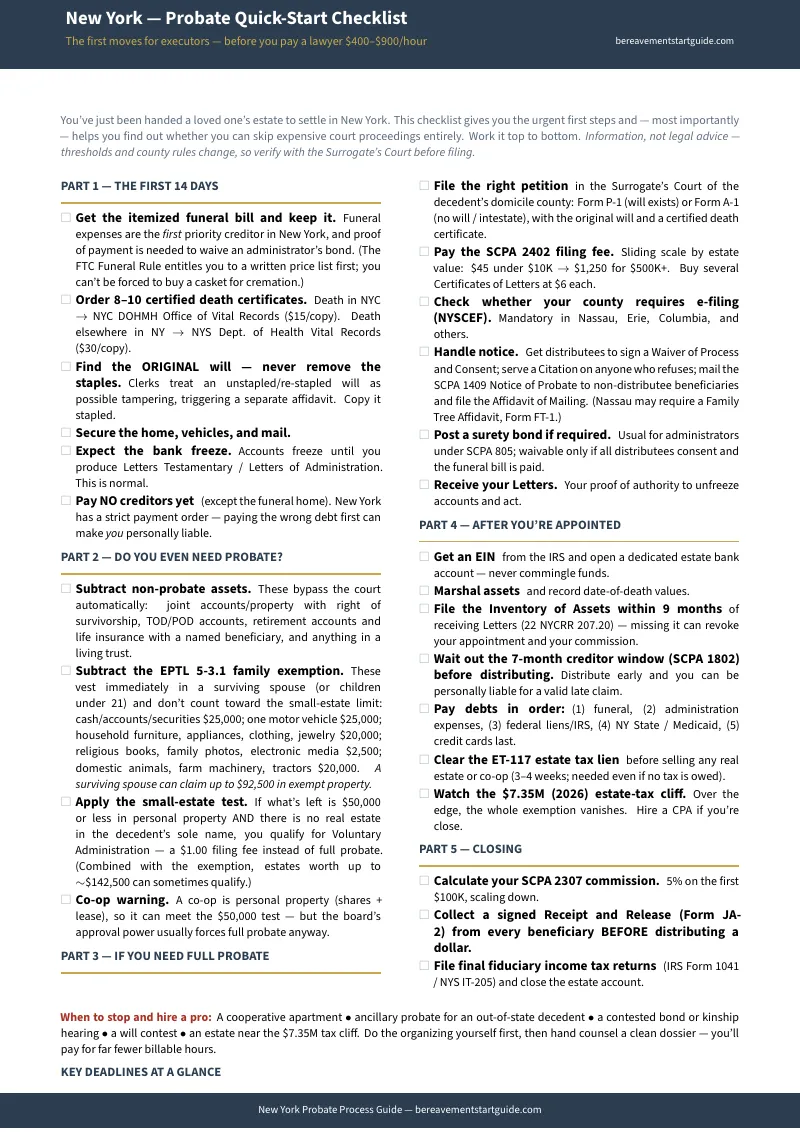
Your download includes the complete guide, the standalone New York Probate Quick-Start Checklist, and printable worksheets --- the Three-Path Decision Flowchart, the EPTL 5-3.1 Exemption Calculator, the 7-Month Creditor Calendar, the Payment Hierarchy Ledger, and the Asset Inventory Worksheet. Print them and bring them to the Surrogate's Court or use them to organize the documents your attorney will need. Instant download, no account required.
30-day money-back guarantee. If the guide does not immediately clarify which probate path applies to your estate and what to file next, email us for a full refund. No questions asked.
Not ready for the full guide? Download the free New York Probate Quick-Start Checklist --- covering the three-path decision, the EPTL 5-3.1 exemption calculation, the 48-hour actions for new executors, and the deadlines that start running from the date of death. It is enough to determine whether you are on the right track or about to file a petition you do not need.
The Surrogate's Court clerk will not tell you which path to choose. NYCourts.gov will not warn you that filing the P-1 locks you into months of proceedings when the estate qualified for a $1 affidavit. The probate attorney will not mention the exemptions that shrink the estate below the small-estate threshold. This guide tells you all of it --- before you file the wrong form.
This guide provides educational information about New York probate procedures. It is not legal advice and does not create an attorney-client relationship. For contested estates, will contests, complex trust litigation, business interests, cooperative apartment disputes, estates near the $7.35 million tax cliff, or insolvent estates, consult a licensed New York probate attorney. The guide includes guidance on when professional help is necessary and how to verify that the fees you are quoted match the statutory schedules.