Someone Just Died in North Carolina. The State Won't Send You a Tax Bill — But the IRS Will. And If You Pay the Wrong Creditor First, You're Personally Liable for the Difference.
North Carolina repealed its estate and inheritance taxes years ago. That fact will show up in every search result you find tonight. What those results will not tell you is everything that still applies — the final individual income tax return (Form D-400) that must be filed with the NCDOR by April 15, the fiduciary income tax return (Form D-407) triggered by as little as $600 of estate income from a bank account or rental property, the federal estate tax return (Form 706) that may be strategically necessary even when no tax is owed, and the beneficiary K-1 allocations that can create surprise income tax bills for heirs who assumed their inheritance was tax-free.
Meanwhile, the Clerk of Superior Court in your county requires a complete estate inventory within 90 days, creditor notices published for four consecutive weeks, and personal notice mailed to every known creditor — including NC DHHS if the decedent received Medicaid. If you distribute a single dollar to a beneficiary before paying creditors in the exact priority order mandated by G.S. 28A-19-6, you can be held personally responsible for the unpaid debts. Not the estate. You.
You are managing all of this while grieving. While the government forms are free but the instructions assume you already know which form to file, when, and in what order. While every law firm blog gives you just enough information to panic — then ends with "Call our office for a consultation."
The North Carolina Final Tax & Estate Tax Guide is a Tax Filing Sequence System built from the North Carolina General Statutes (Chapter 28A), the NCDOR tax codes, and the IRS estate and fiduciary filing requirements. Not a generic "what happens after someone dies" overview. Not a national estate tax summary that treats all fifty states the same. A chronological, form-by-form roadmap that tells you exactly which tax returns to file, which creditors to pay first, which spousal protections to claim, and how to document the step-up in basis that prevents your family from paying capital gains tax on inherited property.
What's Inside the Tax Filing Sequence System
An 18-chapter guide and the North Carolina Tax After Death Checklist — covering every tax obligation, every statutory protection, and every form you need from the first week through final distribution:
North Carolina's Tax Landscape After Death — What You Actually Owe
The state estate and inheritance taxes are gone. But the final individual income tax return (Form D-400), the fiduciary income tax return (Form D-407), and potentially the federal estate tax return (Form 706) are not. This chapter maps every remaining tax obligation — federal and state — so you know what applies to your estate and what you can ignore. No more searching "Does NC have an inheritance tax?" at midnight and getting ten different answers.
The First 10 Days: Urgent Steps That Affect Taxes
Death certificates, property security, credit reports, surrendering the will to the Clerk of Superior Court, and opening the estate with Letters Testamentary or Letters of Administration. Each step is sequenced by urgency — because ordering death certificates before notifying the bank matters, and pulling the credit report before publishing creditor notices determines whether you have identified every claimant.
The Estate EIN and the Estate Bank Account
The decedent's Social Security number dies with them. The IRS requires a new Employer Identification Number for the estate before you can open a bank account, deposit asset proceeds, or file the fiduciary return. The guide walks you through the IRS online application, the three minutes it takes to get the number, and the one mistake that forces you to wait for the paper application — checking the wrong entity type box.
Filing the Decedent's Final Income Tax Returns (D-400 and 1040)
How to complete North Carolina Form D-400 for the year of death: marking the "Deceased Taxpayer Information" section, formatting the name-and-address block for surviving spouse joint filing versus separate filing, reporting income from January 1 through the date of death, and handling the gap between the death date and the end of the tax year. The guide parallels the federal Form 1040 requirements so you can prepare both returns simultaneously.
The $60,000 Year's Allowance — Filing Form AOC-E-100 Before Creditors Take Everything
Under Session Law 2023-120, a surviving spouse can claim $60,000 from the estate's personal property with absolute priority — before credit card companies, before medical bills, before virtually every unsecured creditor. Dependent children under 21 qualify for $10,000 each. But the allowance requires filing Form AOC-E-100 with the Clerk of Superior Court. If a formal estate is opened, you have six months from the date letters are issued. The guide covers the form, the $20 filing fee, the math for calculating available personal property, and the interaction with the child's allowance when estate assets are limited.
The Fiduciary Income Tax Return (Form D-407 and Form 1041)
If the estate earns more than $600 in gross income — interest from the estate bank account, dividends, rent from a property held during administration — you must file federal Form 1041 and North Carolina Form D-407. The guide explains the $600 threshold, the North Carolina additions and deductions (Form NC-PE), the D-407 NC K-1 that must be distributed to each beneficiary, and the punitive federal trust tax rate that kicks in at just $16,000 of retained income. Miss this filing and the IRS sends notices directly to the executor — not the estate.
Step-Up in Basis — The Tax Break That Prevents Capital Gains Catastrophe
When someone dies, inherited assets receive a new tax basis equal to their fair market value at the date of death. This erases decades of unrealized capital gains. But North Carolina is a common-law state, which means surviving joint tenants only receive a step-up on the decedent's half of jointly held property — not the full asset. The guide explains the documentation requirements, the date-of-death appraisal process, the difference between joint tenancy and tenancy by the entirety, and the specific forms of evidence that the IRS and NCDOR accept as proof of basis.
Creditor Claims, Priority of Payment, and the Order That Protects You
G.S. 28A-19-6 establishes the exact sequence in which creditors must be paid: estate administration costs first, then the first $3,500 of funeral expenses, then federal taxes, then debts due the State of North Carolina, and so on through seven statutory priority classes. Pay a lower-priority creditor before a higher-priority one and you absorb the shortfall personally. The guide gives you the complete priority matrix with the statutory citation for each class — because "I didn't know the order" is not a defense.
Selling Inherited Real Estate Without a Tax Trap
Real property vests in the heirs at the instant of death under North Carolina law — it passes automatically outside probate. But the property remains liable for estate debts for two years. If heirs sell before the creditor claim window closes, they can become personally responsible for the estate's unpaid obligations. The guide covers the step-up in basis documentation, the capital gains calculation, the difference between the heir's authority and the executor's authority to sell, and the situations where a court order is required.
Federal Estate Tax, Portability, and the Form 706 Decision
The 2026 federal estate tax exemption is $15,000,000 per individual. Most estates will not owe tax. But filing Form 706 to elect "portability" — preserving the deceased spouse's unused exclusion for the surviving spouse — is an insurance policy against future legislative changes that could lower the threshold. The guide explains when the voluntary 706 filing is worth the cost, the simplified 706 for portability-only elections, and the nine-month filing deadline with the six-month extension option.
Medicaid Estate Recovery, Small Estate Affidavits, the Elective Share, and More
The guide also covers Medicaid estate recovery defense (exemptions for surviving spouses, minor children, the Undue Hardship Waiver, and the caretaker child exception), the small estate affidavit shortcut (Form AOC-E-203B — under $20,000 or $30,000 if the spouse is sole heir), the Elective Share under Session Law 2025-33 (15% to 50% based on marriage length), vehicle title transfers through the NC DMV (Form MVR-317), real property title clearance, and the master deadline calendar for every filing from Day 1 through Month 12.
Who This Guide Is For
- The executor who just received Letters Testamentary — and needs to know which tax returns to file, in what order, by which deadlines, and what happens if you distribute assets before the IRS and NCDOR are paid
- The surviving spouse managing everything alone — who needs the $60,000 Year's Allowance filed, the final joint return handled correctly, the step-up in basis documented before it becomes impossible to reconstruct, and the Medicaid recovery question answered
- The out-of-state adult child named as executor — who has never dealt with the North Carolina Clerk of Superior Court system, does not know the creditor payment priority order, and is trying to manage 100-county-specific procedures from another state without hiring a $300-per-hour attorney for routine tax filings
- The beneficiary worried about surprise tax bills — who needs to understand that inherited life insurance is tax-free but an inherited IRA is not, that the step-up in basis only applies to the decedent's share in a common-law state, and that the D-407 NC K-1 means estate income flows through to you whether you expected it or not
- The DIY executor determined to minimize fees — who has done the math on CPA and attorney rates, knows the guide costs less than fifteen minutes of billable time, and wants to arrive at professional consultations with the tax returns organized, the EIN obtained, the Year's Allowance filed, and the creditor priority matrix documented
Why Free Government Forms Will Not Get You Through This
Every form referenced in this guide is available for free from the NC Judicial Branch website, the NCDOR, or the IRS. Here is what you actually get when you try to assemble a complete tax strategy from free sources:
- The NCDOR publishes Form D-407 instructions but not filing strategy. You can read the 20-page instruction booklet. What it will not tell you is whether your estate needs to file at all, how the $600 threshold interacts with estate income distributions, how to complete Form NC-PE for North Carolina additions and deductions, or how to calculate the beneficiary K-1 allocations so your heirs report the correct amount on their personal returns. The forms assume you already understand fiduciary taxation. The guide assumes you do not.
- Law firm blogs explain the problem, not the solution. Every Charlotte and Raleigh probate firm has a blog post titled "Taxes After Death in North Carolina." Each one gives you an accurate overview of the obligations — then stops short of the actual implementation. The D-400 filing instructions, the EIN application walkthrough, the creditor priority matrix, the step-up documentation process — none of these appear, because the purpose of the blog post is to generate a phone call to the firm. Their goal is a retainer. Your goal is a completed tax return.
- National tax software misses the North Carolina specifics. TurboTax and similar platforms handle the federal returns competently. But they do not address the NC-specific D-407 requirements, the state additions and deductions on Form NC-PE, the Year's Allowance that shields $60,000 from creditors before tax obligations are calculated, or the small estate affidavit that may eliminate the need for full probate altogether. The gap between the federal return and the state-specific obligations is exactly where executors make costly mistakes.
- No single source connects the tax returns to the probate timeline. The IRS does not explain the Clerk of Superior Court's inventory deadline. The Clerk's forms do not reference the D-407 filing threshold. The NCDOR does not mention the creditor priority order that determines which obligations get paid first. And none of them tell you that distributing assets to beneficiaries before confirming all tax returns are accepted creates personal liability for the executor. The guide connects every agency, every deadline, and every form into one sequence.
Free resources give you forms from agencies that do not communicate with each other. The Tax Filing Sequence System puts every North Carolina tax obligation, every creditor priority rule, every spousal protection, and every deadline into one document — organized around the decisions you are making right now.
— Less Than Fifteen Minutes of a CPA's Billable Time
A North Carolina CPA charges $150 to $400 per hour for estate and fiduciary tax work. An initial consultation alone typically runs $300 or more. This guide costs less than a fraction of that first meeting — and covers every form, every deadline, every creditor payment rule, and every spousal protection specific to North Carolina estates.
Your download includes 7 printable PDFs: the complete 18-chapter guide covering the final income tax returns (D-400 and 1040), the fiduciary returns (D-407 and 1041), the federal estate tax decision (Form 706), the step-up in basis, the $60,000 Year's Allowance, the creditor payment priority matrix, Medicaid estate recovery defense, the Elective Share, real property rules, the small estate shortcut, and the complete deadline calendar — plus 6 standalone tools you can print and carry separately:
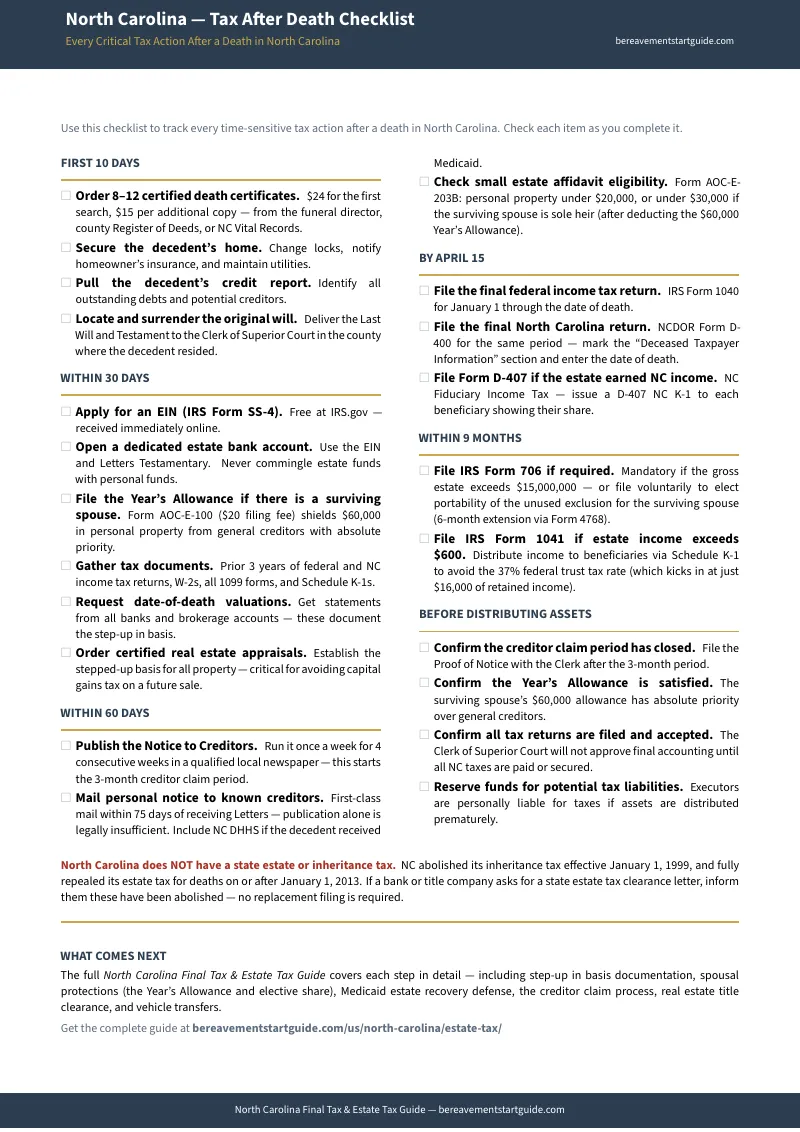
- Tax After Death Checklist — every action item sequenced from the first 10 days through final distribution
- CPA Document Checklist — the complete document-gathering list organized by category, so you arrive at your CPA meeting with everything they need
- Master Deadline Calendar — every filing deadline from Day 1 through Month 12 with statutory citations
- Creditor Payment Priority Matrix — the exact G.S. 28A-19-6 statutory order with an executor tracking table
- Step-Up in Basis Worksheet — fillable tables for calculating the basis adjustment on sole and jointly owned assets, with the 50% common-law rule explained
- Tax Form Decision Tree — visual flowcharts for choosing your probate route and determining which tax forms apply
30-day money-back guarantee. If the guide does not give you clarity on what you owe, what you can protect, and the exact sequence for filing every return and paying every creditor, email us for a full refund. No questions asked.
Not ready for the full guide? Download the free North Carolina Tax After Death Checklist — covering the most critical deadlines, the key tax forms, the EIN application, and the step-by-step actions from the first 10 days through final asset distribution. It is enough to start the process tonight while you decide whether the full guide is right for your situation.
North Carolina eliminated its estate tax. It did not eliminate the tax obligations that follow a death. The returns still need to be filed. The creditors still need to be paid in the right order. The spousal protections still need to be claimed before the deadlines pass. The only question is whether you do this with a complete roadmap — or piece it together from government forms that assume you already know the system.