The Funeral Director Just Told You Embalming Is Required by North Carolina Law. It Is Not. And That Is Only the First Thing They Are Counting on You Not Knowing.
You are sitting across from someone in a quiet room, surrounded by casket brochures, and every question you ask is met with the same calm deflection: "Most families choose this option." Most families choose a $2,000 embalming procedure that no North Carolina statute requires. Most families choose a sealed casket for cremation that serves no preservation purpose whatsoever. Most families pay $8,000 to $15,000 for a traditional funeral when a direct cremation at a specialized facility costs $1,000 to $3,000 — and the law says they could have handled the entire process themselves, at home, without hiring a funeral director at all.
Maybe you are the surviving spouse trying to arrange services while your checking account is frozen and the funeral home is asking for a deposit before they will move the body. Maybe you are the adult child who just discovered that your siblings disagree about burial versus cremation, and now the funeral director says they cannot proceed until the family resolves the dispute — but no one can tell you who legally has the authority to decide. Maybe your parent signed a preneed contract years ago, and the funeral home is now insisting on thousands in additional charges that were not part of the original agreement. Maybe you want a home burial on the family's land and you have been told it is illegal — when it is not.
And underneath all of it is the question no one is answering: what does North Carolina law actually say? Not what the funeral home says the law says. Not what the internet says. What does the statute say, and what does that mean for the decisions I am making right now?
The North Carolina Funeral Laws & Consumer Rights Guide is a Funeral Consumer Defense Manual built entirely from North Carolina General Statutes, the FTC Funeral Rule, and the regulatory frameworks administered by the NC Board of Funeral Service and the NC Cemetery Commission. Not a sympathy pamphlet. Not a generic "what to expect" brochure written for all fifty states. A plain-English, statute-by-statute breakdown of every right you have, every cost you can refuse, every alternative the funeral industry does not volunteer — and the exact procedures for holding them accountable when they cross the line.
What's Inside the Funeral Consumer Defense Manual
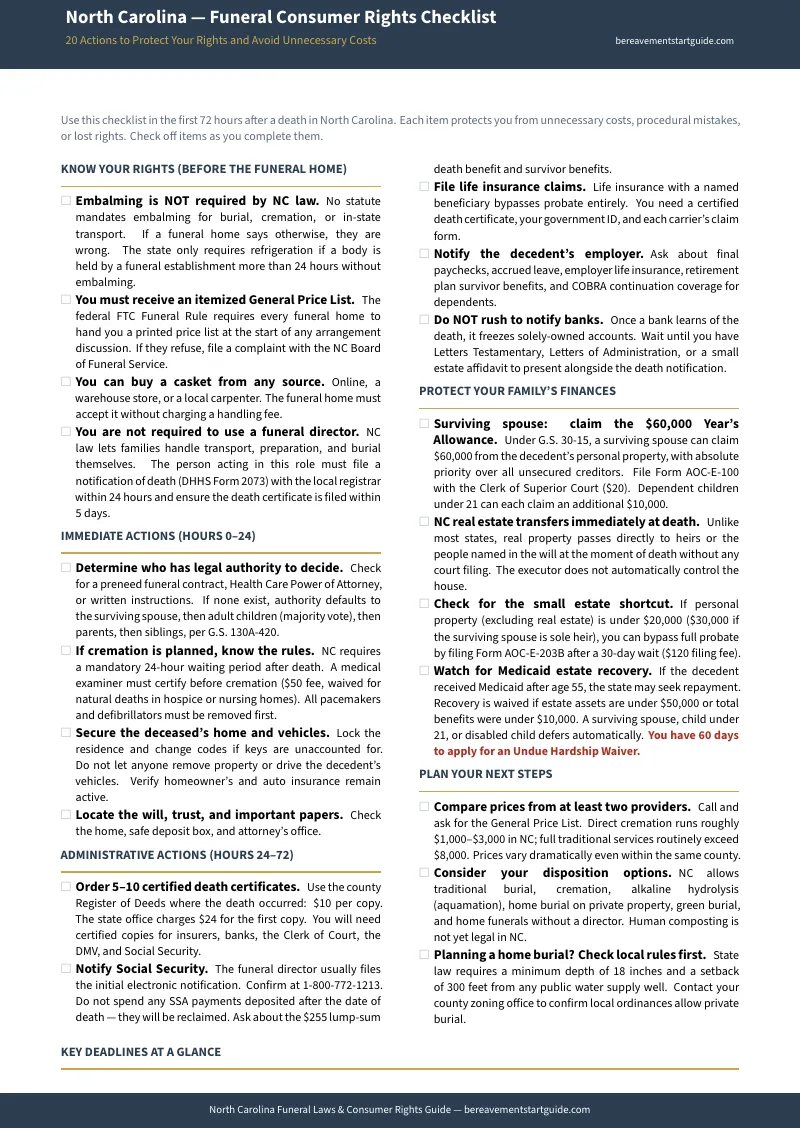
A 20-chapter guide and the 72-Hour Funeral Consumer Rights Checklist — covering disposition authority, advance directives, consumer rights, every legal method of disposition available in North Carolina, the death certificate process, preneed contract protections, financial safeguards for surviving families, and the formal complaint process:
Who Has the Legal Right to Make Funeral Decisions
North Carolina has a strict statutory hierarchy under G.S. 130A-420 that dictates exactly who controls the body — the method, location, and type of disposition. A preneed funeral contract takes absolute precedence. Then a Health Care Power of Attorney. Then a will. Then the surviving spouse. Then a majority of adult children. Then parents, then siblings, down through nine priority levels. If the person with authority fails to act within 5 days of notification (or 10 days from the date of death), their right is legally waived and passes to the next person in line. The guide lays out the complete hierarchy, explains how voluntary waivers work, and covers what happens when the family is deadlocked and no majority can be reached.
Advance Directives: How the HCPOA, Living Will, and MOST Form Actually Work Together
North Carolina families routinely confuse three documents that serve entirely different purposes. The Health Care Power of Attorney is the only one that controls funeral decisions — and its authority survives death. The Living Will handles end-of-life treatment preferences but designates no agent and has nothing to do with disposition. The MOST form — the distinctive pink clinical order signed by a physician — carries immense legal weight for in-the-moment medical decisions and can override both the Living Will and the HCPOA on treatment. But it does not control what happens after death. The guide explains exactly what each document does, what it does not do, and how to prevent the conflicts that arise when families do not understand the difference.
Your Consumer Rights Under the FTC Funeral Rule
Every funeral home in North Carolina must hand you a printed General Price List before discussing services. They must give accurate prices over the phone. They must accept a third-party casket without penalty. They must disclose in writing that embalming is not legally required. They cannot force you into bundled packages. If a funeral home embalms a body without your explicit written authorization and then charges you, they have violated federal law. The guide covers every right, every disclosure requirement, and the exact documentation process for violations — because knowing these rights at the arrangement table is worth more than learning about them afterward.
Embalming, Refrigeration, and the 24-Hour Rule
No North Carolina statute mandates chemical embalming — not for burial, not for cremation, not for in-state transport. The state enforces one rule: if a funeral home holds a body for longer than 24 hours without embalming, it must be refrigerated. That is a public health regulation, not a mandate to embalm. Declining embalming and using refrigeration instead saves families hundreds to over a thousand dollars. The guide gives you the statutory citations to decline with confidence, the situations where embalming is genuinely useful, and the alternatives — dry ice, refrigeration, and prompt disposition — that funeral directors are not required to mention.
Cremation: Waiting Periods, Medical Examiner Certification, and the $50 Fee
North Carolina law prohibits cremation within 24 hours of the time of death. Before any cremation, a medical examiner must certify that no further investigation is necessary — and the family pays a mandatory $50 fee. Deaths from natural causes in hospice or nursing homes are exempt from this certification. Pacemakers and defibrillators must be surgically removed before flame cremation. The guide covers the complete regulatory framework, the authorizing agent requirements under G.S. 130A-420, cost ranges by service level ($1,000 to $8,000+), and the fact that you are not required to buy an urn from the crematory.
Alkaline Hydrolysis, Home Funerals, Home Burial, Green Burial, and Scattering Ashes
North Carolina permits aquamation under G.S. 90-210.136 with 2025 legislative updates. It permits families to conduct a complete home funeral without a licensed funeral director. It permits burial on private property — minimum 18-inch depth, 300 feet from any public water supply well, subject to local zoning. It does not require caskets, vaults, or embalming for any burial. It permits scattering ashes on private land, public lands, and at sea (three nautical miles offshore, EPA notification within 30 days). The guide covers the exact legal requirements, the administrative filings you must handle yourself (Form 2073 within 24 hours, death certificate within 5 days), and the practical logistics — cooling the body, transport, the burial site map to file with the property deed.
Preneed Contract Protections and the 10% Retention Trap
North Carolina law permits preneed funeral homes to retain up to 10% of your payments outside the trust — money that does not grow with interest and that the original funeral home keeps if you transfer the contract. The guide explains the difference between revocable and irrevocable contracts (and why irrevocable matters for Medicaid planning), the distinction between standard and inflation-proof contracts, the $20 filing fee, the Preneed Recovery Fund that protects consumers if a funeral home goes bankrupt, and the religious accommodation provisions that most families never learn about.
Financial Protections: The $60,000 Year's Allowance and Medicaid Defense
The surviving spouse can claim $60,000 from the estate's personal property before virtually any creditor — including medical bills, credit card debts, and Medicaid recovery — through Form AOC-E-100. Dependent children under 21 can claim $10,000 each. The Elective Share protects surviving spouses from disinheritance: 15% to 50% of Total Net Assets based on marriage length. And Medicaid Estate Recovery — the fear that the state will seize the family home — has specific exemptions most families never discover: automatic waiver if estate assets are under $50,000, deferral if a surviving spouse or minor child exists, the Caretaker Child exception, and the Undue Hardship Waiver within 60 days. The guide covers every protection, every form, every deadline.
Filing Complaints: Board of Funeral Service vs. Cemetery Commission
If a funeral home violates your rights, the complaint goes to the NC Board of Funeral Service via Form BFS-9. If a cemetery violates its obligations, the complaint goes to the NC Cemetery Commission. Most families do not know these are two separate agencies with two separate jurisdictions. The guide covers both processes, what each agency investigates, the documentation you need, and the timeline for response.
Vehicle Title Transfers, Death Certificates, and the Complete After-Death Timeline
The guide includes the Form MVR-317 affidavit process for transferring vehicles without full probate, the death certificate ordering strategy that saves $140 on 10 copies ($10 from the county Register of Deeds versus $24 from the state office), who can legally request certified copies, the NCDAVE electronic registration system, the complete after-death administration timeline from Day 1 through Month 12, and a directory of every official form and agency with contact information.
Who This Guide Is For
- The family sitting in a funeral home arrangement room right now — who needs to know, before signing anything, which charges are legally required and which are optional, whether embalming is mandatory (it is not), whether they must buy a casket from the funeral home (they do not), and what the FTC Funeral Rule actually entitles them to demand
- The surviving spouse whose partner just died — who needs to understand the $60,000 Year's Allowance, the Elective Share, the small estate affidavit shortcut, and the Medicaid recovery exemptions that protect the family home
- The family considering a home funeral or home burial — who has been told these are illegal in North Carolina (they are not) and needs the exact statutory framework: filing requirements, depth standards, water supply setbacks, zoning considerations, and the property deed filing for burial grounds
- The adult child who discovered a preneed contract — who needs to know whether the contract is binding, what the 10% retention fee means, whether the contract can be transferred to a different funeral home, and how irrevocable contracts interact with Medicaid eligibility
- The family choosing between cremation, aquamation, green burial, or traditional services — who needs a side-by-side comparison of every legal disposition method in North Carolina, with costs, regulations, and practical logistics for each
- The executor or next-of-kin who believes a funeral home acted improperly — who needs the step-by-step complaint process, the correct regulatory agency, the right form, and the documentation that makes a complaint actionable
Why Free Resources Will Not Protect You at the Arrangement Table
The information exists. It is scattered across state legislative portals, county clerk websites, the NC Board of Funeral Service, the FTC, national legal directories, and consumer advocacy nonprofits. Here is what you actually encounter when you try to exercise your funeral consumer rights using free sources alone:
- The NC Board of Funeral Service publishes raw statutes and complaint forms. It does not provide plain-English explanations of what the statutes mean for your specific situation, and it does not sequence the information into a decision framework. You get fragments of law, not a process you can follow.
- National legal sites miss the North Carolina details. Nolo, LegalZoom, and similar platforms provide generic funeral planning overviews that do not address the 2025 Session Law updates to cremation and aquamation regulations, the specific MOST form triad (HCPOA vs. Living Will vs. MOST), the 10% preneed retention rule, the Caretaker Child exception to Medicaid recovery, or the disposition authority hierarchy under G.S. 130A-420. They are written for all fifty states and specific to none.
- The Funeral Consumers Alliance of NC is fiercely independent — and severely fragmented. Their price surveys and consumer advocacy work is invaluable. But the data is buried in un-indexed PDFs, the coverage stops at funeral pricing, and the site does not address probate, Medicaid, advance directives, or the financial protections that determine how the surviving family pays for all of this.
- Local elder law firms write content designed to sell retainers. Their blog posts on Medicaid trusts and disposition disputes are accurate and intentionally incomplete — structured to convince you the situation is too dangerous to handle without a $300-per-hour consultation. For contested estates, that is true. For the majority of straightforward funeral decisions, the answer is statutory and the cost should not be measured in attorney hours.
- The funeral home itself has a financial interest in what you do not know. Their staff may be compassionate and professional. But their business model depends on selling services and merchandise, and the FTC Funeral Rule exists precisely because the industry's track record of voluntary transparency was insufficient to protect consumers.
Free resources give you fragments from a dozen sources that do not reference each other and are not designed to be used at the arrangement table. The Funeral Consumer Defense Manual puts every North Carolina statute, every consumer right, every disposition option, and every financial protection into one document — organized around the decisions you are actually making.
— Less Than the Embalming Charge You Do Not Legally Owe
A single embalming procedure costs $500 to $1,500 — and North Carolina law does not require it. A sealed casket for cremation adds $2,000 or more for a service with no preservation benefit. A consultation with a North Carolina elder law attorney runs $250 to $400 per hour. This guide costs less than the single unnecessary charge it helps you refuse — and it covers every legal right, every disposition option, every financial protection, and every complaint procedure specific to North Carolina families.
Your download includes 6 printable PDFs: the complete 20-chapter guide, the standalone 72-Hour Funeral Consumer Rights Checklist, the FTC Funeral Rule Rights Reference (bring it to the arrangement meeting), the Disposition Options Comparison (every legal method side by side), the Financial Protection Playbook (forms, deadlines, and filing fees for surviving families), and the After-Death Administration Timeline (Day 1 through Month 12, check off as you go).
30-day money-back guarantee. If the guide does not give you clarity on your rights and confidence in the decisions you are making, email us for a full refund. No questions asked.
Not ready for the full guide? Download the free North Carolina Funeral Consumer Rights Checklist — covering your FTC Funeral Rule rights, the embalming truth, who has legal authority over disposition, cremation rules, death certificate ordering, and the financial protections every surviving family should know about. It is enough to walk into a funeral home tonight with your rights in your pocket.
You did not choose to be in this room. But you can be the person who knows what the law actually says — and that changes every conversation that follows.