The Bank Froze Every Account the Day They Received the Death Certificate. The Clerk of Superior Court Handed You a Stack of AOC-E Forms and Said They Cannot Tell You Which Ones to File. The Real Estate Agent Says She Cannot List the House Because Title Vested in the Heirs at Death and Now There Is a Two-Year Creditor Cloud on the Property. You Are Settling an Estate in North Carolina, and the One System That Was Supposed to Help You Generate the Paperwork Cannot Tell You Which Probate Path to Choose.
You went to the county Clerk of Superior Court to find out what to do next. They handed you the Application for Probate and Grant of Letters (AOC-E-201), the Inventory for Decedent's Estate (AOC-E-505), and an Affidavit for Collection of Personal Property (AOC-E-203B). You asked which one you need. They said they are legally prohibited from advising you. You tried the eCourts Guide & File system — the state's online tool that generates court forms based on your answers. It produced a stack of blank paperwork. It did not tell you whether your situation calls for Full Administration, Summary Administration, Collection by Affidavit, or a Petition for Year's Allowance. You have four possible probate paths and no one authorized to tell you which one fits your estate.
You searched online. You found the NC Courts website linking to AOC-E form directories with form numbers but no filing sequence. You found Nolo and FindLaw publishing national overviews that mention North Carolina's small estate threshold without explaining the strict statutory priority order for paying creditors that makes the affiant personally liable if they get it wrong. You found three estate attorneys in Wake County and Mecklenburg County publishing blog posts about executor liability that ended with "schedule a consultation" and retainer quotes of $3,000 to $7,000. You found EZ-Probate offering concierge probate settlement for $1,250 to $1,999. Nobody explained that North Carolina real estate does not enter the probate estate at all — that under N.C. Gen. Stat. Section 28A-15-2, title vests immediately in the heirs at the exact moment of death, and the executor has no inherent authority to sell, manage, or even insure the property without a specific court order or power-of-sale language in the will. Nobody explained that the surviving spouse can claim a $60,000 Year's Allowance that takes absolute priority over every general creditor in the estate. Nobody connected the free state forms into a sequence you could actually follow.
Meanwhile, deadlines are running. The Inventory (AOC-E-505) is due within 90 days of your qualification date — miss it and the clerk can issue a Civil Contempt Order and revoke your Letters. The Notice to Creditors must run in a qualified newspaper once per week for four consecutive weeks. Creditors get three months after first publication to file claims, and unknown creditors are barred forever after that window closes. But real estate creditors have a separate two-year window that clouds the title until it expires or you publish formal notice. The Medicaid Estate Recovery program has filed a claim, and the Undue Hardship Waiver deadline is 60 days from the claim notice. You are paying the estate's debts, and you just learned that North Carolina has a rigid statutory priority order — Year's Allowance first, then administration costs, then funeral expenses, then federal taxes, then state taxes, then Medicaid — and paying a credit card bill before satisfying a higher-priority claim creates personal liability for you, not the estate.
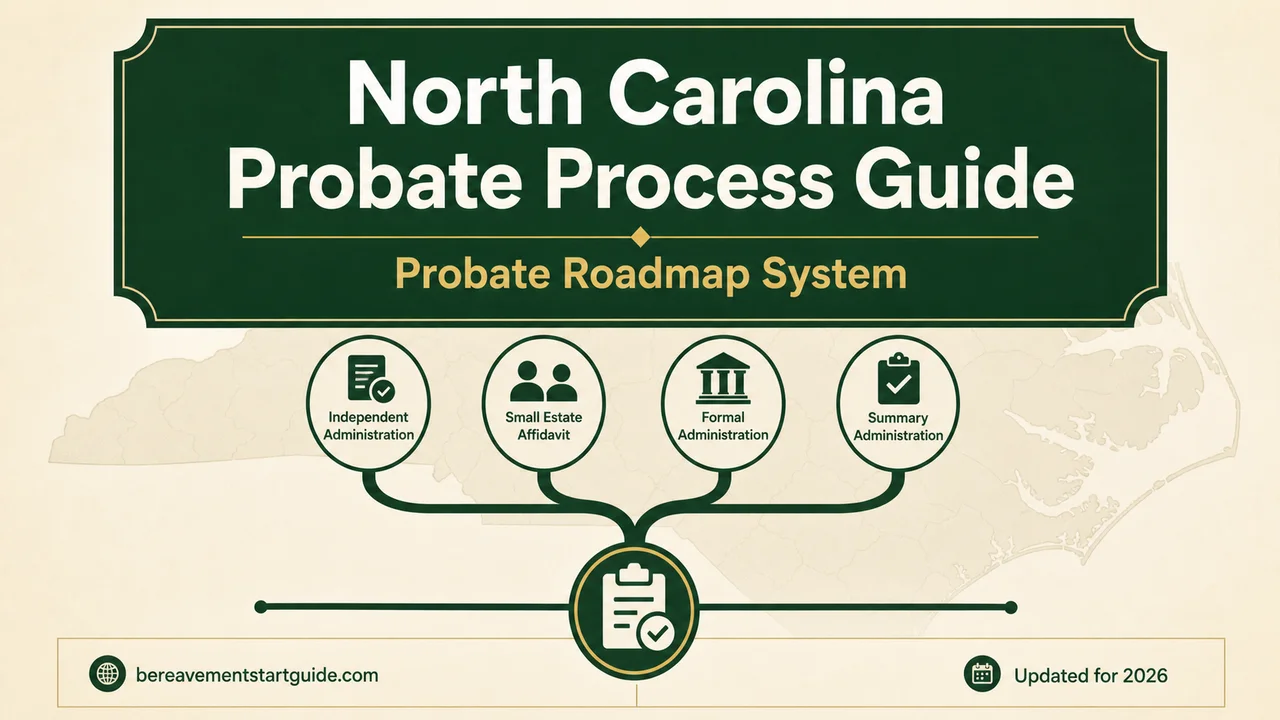
The North Carolina Probate Process Guide is a Probate Roadmap System for every probate path, form, deadline, and filing obligation an executor, administrator, or surviving spouse faces after a death in North Carolina. Not a generic national probate primer with North Carolina's name stapled on. Not a law firm blog post engineered to generate $5,000 retainer agreements. A plain-English, North Carolina-specific manual that tells you what the Clerk of Superior Court is legally prohibited from saying, what the eCourts system cannot advise, and what the free AOC-E form instructions never explain: which probate path fits your estate, which forms to file, in what order, by which deadlines, and which mistakes create personal liability for the person administering the estate.
What's Inside the Probate Roadmap System
A step-by-step guide, a probate quick-start checklist, and standalone reference sheets covering every probate path, filing obligation, and asset transfer decision an executor, administrator, or surviving spouse faces after a death in North Carolina, built on Chapter 28A of the North Carolina General Statutes, the Clerk of Superior Court procedures, and current NCAOC form requirements — not a generic template repurposed with North Carolina terminology:
Four Probate Paths: Which One Fits Your Estate
North Carolina does not have one probate process — it has four distinct paths, and choosing the wrong one costs you months of unnecessary administration or exposes you to debts you did not need to assume. The guide walks you through the decision tree: Full Administration for estates that do not qualify for shortcuts. Collection by Affidavit (AOC-E-203B) for personal property under $20,000 — or $30,000 if the surviving spouse is the sole heir — with the mandatory 30-day waiting period and 90-day final affidavit deadline. Summary Administration (AOC-E-905) when the surviving spouse is the sole beneficiary, with no dollar limit but the critical catch that the spouse assumes every debt the deceased owed. And the Year's Allowance (AOC-E-100), which gives the surviving spouse up to $60,000 in personal property with absolute priority over all general creditors. The guide explains the eligibility rules, the liability traps, and the exact circumstances where each path saves or costs you money.
The 90-Day Inventory and Critical Deadlines
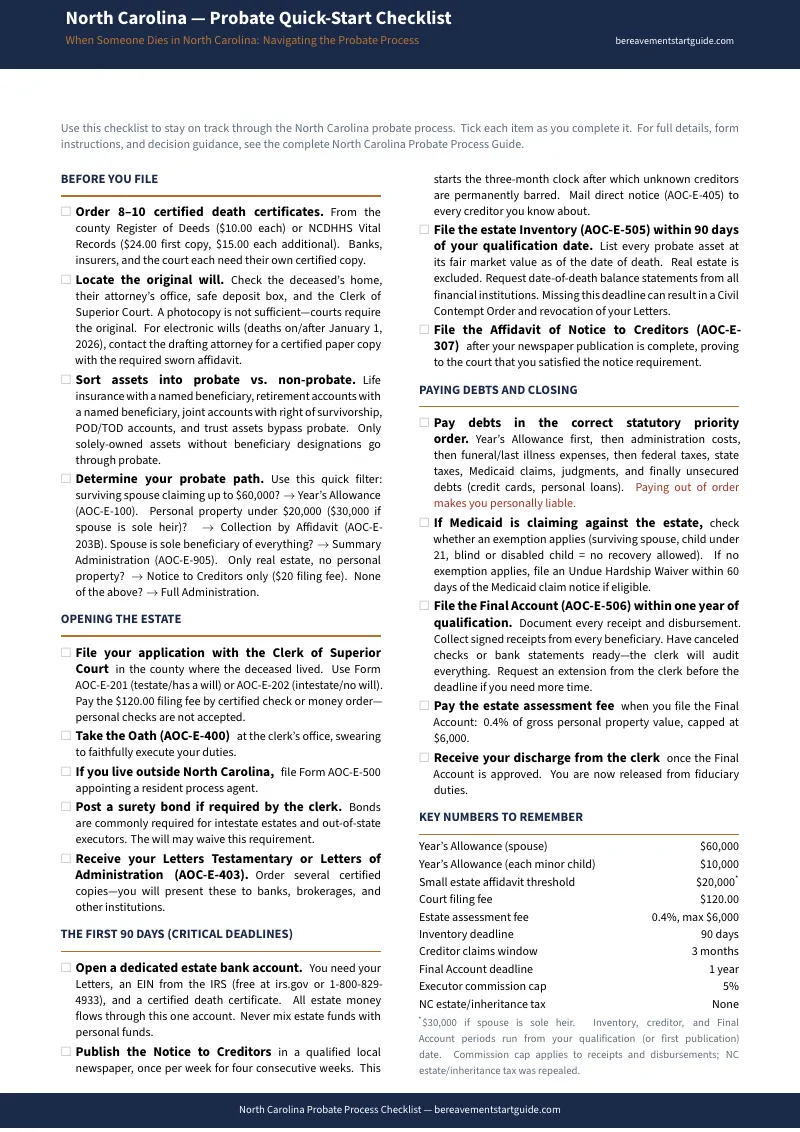
The Inventory for Decedent's Estate (AOC-E-505) is due within 90 days of your qualification date. This is the deadline most first-time executors discover too late. Miss it and the Clerk of Superior Court can hold you in Civil Contempt and revoke your Letters Testamentary — stripping your legal authority to act on behalf of the estate. The guide provides the complete timeline: the 90-day inventory, the four-week creditor notice publication, the three-month creditor claims window, the one-year Final Account deadline (AOC-E-506), and the estate assessment fee of 0.4% of gross personal property value capped at $6,000. Every deadline is mapped to a calendar so nothing slips through.
Real Estate: Immediate Vesting and the Two-Year Creditor Cloud
This is the rule that confuses every executor who has ever administered an estate in another state. Under N.C. Gen. Stat. Section 28A-15-2, real estate does not enter the probate estate. Title vests immediately in the heirs or devisees at the moment of death. The executor has no inherent authority to sell, lease, insure, or even pay the property taxes on the house using estate funds. But creditors hold a two-year window to assert claims against the property, and title insurance companies will not close on a sale until that cloud is cleared. The guide explains the strategies for clearing title — publishing the notice to creditors through probate, waiting out the two-year window, or obtaining a court order — and when you need power-of-sale language in the will versus a Special Proceeding petition to force a sale.
Year's Allowance and Spousal Protections
The Year's Allowance is North Carolina's most powerful tool for surviving spouses, and most people who qualify for it have never heard of it. Under N.C. Gen. Stat. Section 30-15, the surviving spouse is entitled to $60,000 in personal property — free from the claims of all general creditors, liens, and judgments. In modest estates, this single filing can consume the entire estate and eliminate the need for formal probate administration entirely. The guide also covers the Elective Share — the statutory right of a surviving spouse who was left out of the will to claim 15% to 50% of the estate depending on the length of the marriage, with a six-month filing window from the issuance of Letters.
Creditor Payment Priority Order
North Carolina has a rigid statutory hierarchy for paying estate debts, and the executor who pays in the wrong order becomes personally liable for the difference. The guide walks through the exact priority sequence mandated by N.C. Gen. Stat. Section 28A-19-6: Year's Allowance at the top, followed by costs of administration, funeral and last illness expenses, federal taxes, state taxes, Medicaid recovery claims, judgments, and finally unsecured debts like credit cards and personal loans. The guide explains what happens when the estate is insolvent — when debts exceed assets — and how to petition for a court order to sell real estate to cover the shortfall.
Medicaid Estate Recovery
If the deceased received Medicaid long-term care benefits after age 55, the North Carolina Department of Health and Human Services will file a recovery claim against the probate estate. The guide explains the exact scope of recovery, the exemptions that block it entirely — surviving spouse, surviving child under 21, or a blind or disabled child — and the Undue Hardship Waiver that must be filed within 60 days of the Medicaid claim notice. To qualify for the waiver, the applicant must have lived on the property continuously for 12 months before the death and have household income below 200% of the federal poverty level. Miss the 60-day deadline and the waiver option disappears.
Opening to Closing: The Complete Filing Sequence
From filing the Application for Probate (AOC-E-201) and taking the Oath (AOC-E-400), through receiving your Letters (AOC-E-403), opening the estate bank account, publishing the Notice to Creditors, filing the Inventory (AOC-E-505), paying debts in statutory order, filing the Final Account (AOC-E-506), collecting signed beneficiary receipts, and receiving your discharge from the clerk — every step in the exact order it happens, with the form numbers, the deadlines, and the filing fees at each stage. The guide also covers the resident process agent requirement (AOC-E-500) for out-of-state executors and the surety bond rules for intestate estates.
Who This Guide Is For
- The executor who just received Letters Testamentary and has 90 days to file the Inventory — who cannot find a straight answer about what goes on AOC-E-505, how to value assets as of the date of death, and whether the deceased's house is even part of the probate estate (it is not)
- The surviving spouse who needs immediate access to the deceased's accounts — who qualifies for the $60,000 Year's Allowance but has never heard of it, and does not know that this single filing can consume a modest estate and eliminate the need for formal probate
- The adult child handling a parent's small estate — who looked up Collection by Affidavit and found the $20,000 threshold but cannot determine whether the strict statutory creditor payment priority order applies to them and what happens if they pay the credit card company before satisfying Medicaid
- The surviving spouse deciding between Summary Administration and Full Administration — who learned there is no dollar cap on Summary Administration but was not told that choosing it means personally assuming every debt the deceased owed, including medical bills and potential Medicaid recovery claims
- The family trying to sell an inherited house — who was told by the title company that the property has a two-year creditor cloud, that the executor has no authority to sign the deed, and that the estate needs either a formal notice to creditors through probate or a court order before the sale can close
- The out-of-state executor coordinating everything remotely — who needs to appoint a resident process agent, understand when a surety bond is required, and follow a single document through the entire process without making a trip to the courthouse for every question the clerk cannot answer
Why Free Resources Will Not Get You Through This
North Carolina probate information exists. The NC Courts website publishes AOC-E forms, the eCourts Guide & File system generates paperwork from your answers, and the Clerk of Superior Court accepts filings in all 100 counties. Here is what you actually encounter when you try to navigate probate using free sources:
- The eCourts Guide & File system generates forms — but cannot tell you which probate path to choose. The system works like tax preparation software: answer questions, receive forms. But clerks are legally prohibited from advising you whether your estate needs Full Administration, Summary Administration, Collection by Affidavit, or a Year's Allowance. You get a stack of correctly formatted paperwork with no decision-making framework. Choosing the wrong path means either months of unnecessary administration or personal assumption of debts you did not need to take on.
- The NC Courts AOC-E form directory lists dozens of forms — with no filing sequence. You can download AOC-E-201, AOC-E-505, AOC-E-203B, AOC-E-506, and a dozen others. Nothing tells you which ones your estate requires, what order to file them in, or which deadlines carry consequences. The forms assume you already know the process. They are the paperwork, not the instructions.
- Nolo and FindLaw publish national overviews — and stop before the North Carolina details that matter. National legal aggregators summarize small estate thresholds and executor duties. They rarely mention that North Carolina real estate vests immediately in heirs at death, that the executor has no authority to sell the house, that the Year's Allowance takes absolute priority over all creditors, or that the creditor payment priority order carries personal liability for the executor. Their content is accurate at the headline level and absent at the operational level.
- The UNC School of Government publishes exhaustive legal analysis — for judges and practicing attorneys. These resources are authoritative, academic, and written in a register that assumes the reader can parse appellate case law and statutory cross-references. They explain how the law works. They do not tell a first-time executor what to do on Monday morning.
- Law firm blogs explain the dangers — and end with a retainer agreement. Estate attorneys in Charlotte, Raleigh, Durham, and Wilmington publish blog posts about the 90-day inventory deadline, the real estate vesting rule, and executor liability. The posts are accurate, alarming, and deliberately incomplete. They explain the risk in enough detail to frighten you. They never explain the solution in enough detail to act on it. Every post ends with "contact our office" and $3,000 to $7,000 in retainer fees.
- No free resource connects the forms into one filing sequence with the decision framework. The eCourts system generates forms. The AOC directory lists them. The court clerks accept them. None of these sources tell you which probate path fits your estate, which forms to file in what order, what the deadlines are, how to pay creditors without creating personal liability, or how to clear the two-year creditor cloud on real estate so the title company will close the sale. Each agency handles its own piece and knows nothing about the rest.
Free resources give you blank forms from a system that cannot advise you, an AOC directory with no filing sequence, national overviews that stop before the North Carolina rules that matter, academic analysis written for attorneys, and law firm blogs that end with a $5,000 retainer. The Probate Roadmap System puts every probate path, form, deadline, and filing sequence into one document, in the order you actually need them.
— Less Than the Filing Fee to Open the Estate
A consultation with a North Carolina probate attorney runs $250 to $400 per hour. A full-service retainer for standard estate administration costs $3,000 to $7,000 depending on complexity. EZ-Probate's concierge probate settlement service charges $1,250 to $1,999. The court filing fee alone to open the estate is $120. This guide costs less than the courthouse filing fee and gives you the complete North Carolina-specific probate roadmap — every path, every form, every deadline, and the decision framework that determines whether you finish in months or get stuck in years of unnecessary administration.
Your download includes the complete step-by-step guide covering every probate path and filing obligation, the standalone North Carolina Probate Quick-Start Checklist, and printable reference sheets: the Four-Path Decision Tree, the 90-Day Inventory Guide, the Creditor Payment Priority Worksheet, the Year's Allowance and Spousal Protection Quick Reference, the Real Estate Title Clearing Guide, the Medicaid Estate Recovery Quick Reference, the Executor Liability and Commission Calculator, and the North Carolina Probate Timeline with every deadline mapped to a calendar. Instant download, no account required.
30-day money-back guarantee. If this guide does not save you hours of confusion with the Clerk of Superior Court and make the probate process immediately clearer, email us for a full refund. No questions asked.
Not ready for the full guide? Download the free North Carolina — Probate Quick-Start Checklist — an overview of the probate paths available in North Carolina, the key forms and deadlines, and the most common executor mistakes. Enough to understand which path fits your estate and whether you need the full guide.
Nobody trained you for this. The Clerk of Superior Court is legally prohibited from telling you which probate path to choose. The eCourts system generates forms but cannot explain the decision behind them. The AOC form directory lists paperwork without a filing sequence. You have something none of them provide — a single roadmap that connects all four probate paths, every court form, and every deadline into one sequence, with plain-English instructions for each step.