Someone You Love Just Died in North Dakota. The Bank Froze Their Accounts. The Oil Company Wants Paperwork You Have Never Seen. You Cannot Even Apply for Probate Until the 120-Hour Waiting Period Ends.
You are standing in the middle of a crisis that nobody warned you about. Maybe you were named personal representative in a will you skimmed years ago, and now the funeral director is asking how many death certificates to order while the bank tells you every account is frozen. Maybe there was no will at all, and because you are the surviving spouse or the eldest child, everyone in the family is looking at you to figure out what happens next. Maybe a letter arrived from North Dakota Health and Human Services demanding reimbursement for Medicaid, or you just discovered that the deceased owned fractional mineral rights in McKenzie County and you have no idea how to transfer them — or what happens if you do not.
You are grieving and exhausted, but the paperwork has its own calendar. The funeral director needs a death certificate count by tomorrow. North Dakota requires embalming within 48 hours if disposition will not occur by then — a timeline shorter than most states. Social Security will claw back any benefits deposited for the month of death. And a question keeps circling: the deceased owned mineral rights in the Bakken. If I do not file the right paperwork, do those rights just disappear?
The answer is yes. Under N.D.C.C. 38-18.1-02, any mineral interest that goes unused for twenty years is deemed legally abandoned — and title automatically transfers to whoever owns the surface estate. That is not a theoretical risk. It is a North Dakota statute with real consequences for families who delay. And it is one of dozens of state-specific rules that a generic national checklist will never mention.
The When Someone Dies in North Dakota — Estate Settlement Guide is a Statutory Sequencing System for every legal, financial, and administrative step between the funeral home and final distribution. Not a law textbook. Not a generic checklist that treats North Dakota the same as Nebraska. An 18-chapter, North Dakota-specific manual that separates what must happen in the first 48 hours from what requires the 120-hour waiting period, what needs the 30-day small estate delay, and what can legally wait six months — so you stop guessing, stop panicking, and start moving through this in the order North Dakota law actually requires.
What's Inside the Statutory Sequencing System
An 18-chapter guide, the First 48 Hours Checklist, and 4 quick-reference appendices — covering every stage from the moment of death through estate closure, built specifically for North Dakota's Uniform Probate Code, district court procedures, and the state-specific rules that make settling an estate here different from any other state:
The First 48 Hours: Securing the Estate Before You Have Legal Authority
North Dakota's embalming rules are stricter than most states — if the body will not reach its destination within 24 hours, or disposition will not occur within 48 hours, embalming is required unless the family has religious objections and can arrange refrigeration. The funeral director files the death certificate through North Dakota's Electronic Death Registration system, but you still need to decide how many certified copies to order. The guide gives you the exact calculation based on the deceased's assets. The first certified copy costs $15 from the Division of Vital Records in Bismarck, each additional copy ordered at the same time costs $10, and if the decedent held mineral rights, you will need copies for each oil and gas operator — a detail that catches most families by surprise. This chapter also covers securing the home, locking down firearms and valuables, and the single most important rule: do not pay any of the deceased's debts with your own money.
The 120-Hour Wall: What You Cannot Do and What You Can
North Dakota imposes a mandatory 120-hour (five-day) waiting period after death before any application for informal probate can be submitted. During this enforced pause, you cannot file court paperwork, but you can take every organizational step that will save you weeks later: gathering financial documents, ordering death certificates, notifying the employer, contacting insurance companies, and forwarding the deceased's mail. The guide maps exactly what to accomplish during the waiting period so the moment it ends, you are ready to file — not scrambling to locate account numbers.
The $100,000 Small Estate Shortcut
Not every North Dakota estate needs probate. If the total value of probate assets — personal property only, no real estate — is under $100,000 after deducting liens, you can use the Affidavit for Collection of Personal Property (SFN 2916) instead. You must wait 30 days after death before using it. Many online sources still cite the old $50,000 threshold — that limit was raised by the North Dakota Legislature and the current law is $100,000. The guide includes a decision tree that walks you through the exact criteria: Is there real estate? Are there mineral rights? What is the total personal property value? If you qualify, you skip probate entirely. If you do not, the guide tells you exactly why and what the full process requires.
Informal vs. Formal Probate: North Dakota's Dual-Track System
North Dakota's adoption of the Uniform Probate Code gives families two probate tracks. Informal probate is handled by the court registrar with minimal court appearances. Formal probate involves supervised proceedings and is required when the will is contested, when an interested party demands it, or when the estate involves complex disputes. The guide covers both tracks: filing the application, the $160 court filing fee, obtaining Letters from the court, the bond requirement (and when it can be waived), opening an estate bank account with a new EIN, and the mandatory estate inventory that must be filed within three months of appointment.
Mineral Rights and the Bakken — The Chapter That Makes This Guide Worth Having
If the deceased owned mineral rights anywhere in North Dakota — particularly in the Bakken Shale counties of Williams, McKenzie, Mountrail, and Dunn — this chapter alone saves you from a catastrophic loss. North Dakota's 20-year abandonment rule means that any mineral interest not actively used (producing, leased, or mortgaged) for twenty consecutive years is deemed abandoned. Title automatically vests in the surface owner on the date of abandonment. To protect inherited mineral rights, you must record a Statement of Claim with the county recorder in every county where minerals are located. The guide walks through filing the Statement of Claim, transferring mineral titles, notifying operators, and the specific documentation package each operator requires — including why operators routinely reject Affidavits of Heirship and only accept certified court orders.
Agricultural Land: Farm and Ranch Succession
If the family farm or ranch must pass through formal probate, the resulting legal delays can interfere with planting, harvest, and livestock operations. This chapter explains how to determine whether the property is governed by a Transfer on Death Deed, a Life Estate, or standard joint tenancy — because identifying the right mechanism can instantly remove the most valuable asset from probate. It covers the Auditor's Certificate required for all real property transfers in North Dakota, CRP contract transfers, and how to handle the situation when the land is producing income while the estate is being settled.
Medicaid Estate Recovery: What North Dakota Families Must Know
North Dakota Health and Human Services operates a mandatory recovery program for individuals who received Medicaid after age 55 or were permanently institutionalized. Here is the critical detail most families do not know: North Dakota is a "probate-only" recovery state. That means HHS limits recovery strictly to assets that pass through probate. Joint accounts, POD designations, and real estate with a properly recorded TOD deed are generally protected. And if recovery would threaten a family farm or a modest home valued at less than 50 percent of the average county home price, you can apply for an Undue Hardship Waiver — but you have only 30 days from the date the hardship papers are mailed. The guide covers Form 7, the In re Estate of Krueger surviving-spouse issue, and the exact waiver process.
Spousal and Family Protections
North Dakota law gives surviving spouses and families three statutory protections that must be paid before almost any creditor claim: the Homestead Allowance (up to $100,000), Exempt Property (up to $15,000 for household goods and personal effects), and the Family Allowance (up to $27,000 lump sum or $2,250 per month for one year). These allowances exist regardless of what the will says. Together they can consume a significant portion of a modest estate, leaving nothing for unsecured creditors and everything for the surviving family.
Creditor Management: Who Gets Paid and in What Order
The estate pays the debts, not the family. But when the estate does not have enough money to pay everyone, North Dakota law dictates a strict priority order under N.D.C.C. 30.1-19-05: administrative costs and attorney fees first, then funeral expenses, then debts and taxes with preference under federal law, then medical expenses from the last illness, then taxes due the state, then everything else. If you publish a Notice to Creditors in the local newspaper for three successive weeks, creditors have exactly three months to file claims. If you do not publish, creditors have three full years. The guide maps this hierarchy and explains what happens when an executor pays lower-priority debts before higher-priority ones — personal liability under N.D.C.C. 30.1-19-07.
Plus: Vehicle Transfers, Real Property Transfers, Government Notifications, Fiduciary Income Tax, Intestate Succession, Closing the Estate, and When to Hire a Professional
Transferring a vehicle through the ND DOT using the SFN 2916 form. Transferring real property with the mandatory Auditor's Certificate from the county auditor. Filing the decedent's final federal and North Dakota state income tax returns, plus the estate's fiduciary income tax on ND Form 38. The complete North Dakota intestate succession table when there is no will. The formal process for closing an estate and discharging the personal representative. And an honest assessment of when you need a licensed North Dakota attorney — because not every estate can be settled without one, and the guide tells you exactly where that line falls.
Who This Guide Is For
- The surviving spouse whose partner just died and whose bank accounts were frozen this morning — who needs to know which accounts stay accessible, which ones require court paperwork, and how to claim the homestead allowance, exempt property, and family allowance that North Dakota law guarantees before any creditor gets paid
- The out-of-state heir who just learned the deceased owned mineral rights in western North Dakota and has no idea how to transfer them — or that a 20-year abandonment rule could permanently strip those rights from the family if a Statement of Claim is not recorded
- The adult child named as personal representative who has never been through probate and is terrified of making a mistake that triggers personal liability — who needs the complete sequence of fiduciary duties, court deadlines, and filing requirements in one document
- The family with no will who just learned that North Dakota's intestate succession laws will decide everything — who needs to understand exactly who inherits what, whether the $100,000 small estate shortcut applies, and whether the house and mineral rights can bypass probate
- The rural family dealing with farm succession whose working agricultural land cannot afford to sit in legal limbo during planting season — who needs to identify TOD deeds, Life Estates, CRP contracts, and the Auditor's Certificate requirement before time-sensitive operations are disrupted
- The family facing Medicaid recovery who received a letter from ND HHS demanding reimbursement for nursing home costs — who needs to understand probate-only recovery limits, the assets that are protected, Form 7, and the 30-day window for the Undue Hardship Waiver
Why Free Resources Will Not Get You Through This
The information exists. It is scattered across the North Dakota court system website, the Legal Self Help Center, county district court offices, and a dozen federal agency portals. Here is what you actually encounter when you try to settle an estate using free sources alone:
- The ND Legal Self Help Center provides forms — and tells you to use them at your own risk. The state explicitly warns that its forms are provided without legal advice, that no forms exist for formal probate, and that court staff cannot tell you which forms to use. You get blank paperwork with no instructions on sequencing, no guidance on non-probate tasks like claiming life insurance or notifying mineral operators, and heavy disclaimers everywhere.
- National document vendors are dangerously outdated on North Dakota law. Multiple form-selling websites still cite the old $50,000 small estate threshold. The Legislature raised it to $100,000. A family relying on these sites might conclude they need full probate when the small estate shortcut would have saved them months of court proceedings.
- Local probate attorneys publish blog posts designed to sell retainers. Attorney blogs about North Dakota probate are accurate — and intentionally incomplete. They explain enough complexity to convince you that the process requires professional representation at $200 to $600 per hour ($324 average). For contested or complex estates, that is true. For the many straightforward estates where the law explicitly says an attorney is not required, the cost does not match the need.
- National software platforms miss everything specific to North Dakota. EstateExec, Trust & Will, and similar platforms offer estate administration tools for $99 to $199. They cover probate in general terms. They do not cover mineral rights abandonment, the Bakken transfer process, agricultural TOD deeds, Form 7 for Medicaid, the Auditor's Certificate for real property, or ND Form 38 fiduciary income tax. North Dakota is not a generic state, and generic tools miss its most consequential requirements.
Free resources give you forms from one source, legal concepts from another, and federal requirements from a third — none of which reference each other. The Statutory Sequencing System puts every North Dakota-specific statute, form, deadline, and procedure into one document, in the order you actually need them.
— Less Than Thirty Minutes With a North Dakota Estate Attorney
A single consultation with a North Dakota probate attorney costs $200 to $600 per hour. The state average is $324 per hour. National estate software platforms charge $99 to $199 per year in recurring subscriptions. This guide costs less than thirty minutes of professional legal time and gives you the complete North Dakota-specific roadmap — every statute, every deadline, every form, every court fee, and the decision tree that tells you whether you even need an attorney at all.
Your download includes 8 PDFs — instant download, no account required:
- The complete 18-chapter guide with four quick-reference appendices (key forms, key deadlines, key costs, and key contacts)
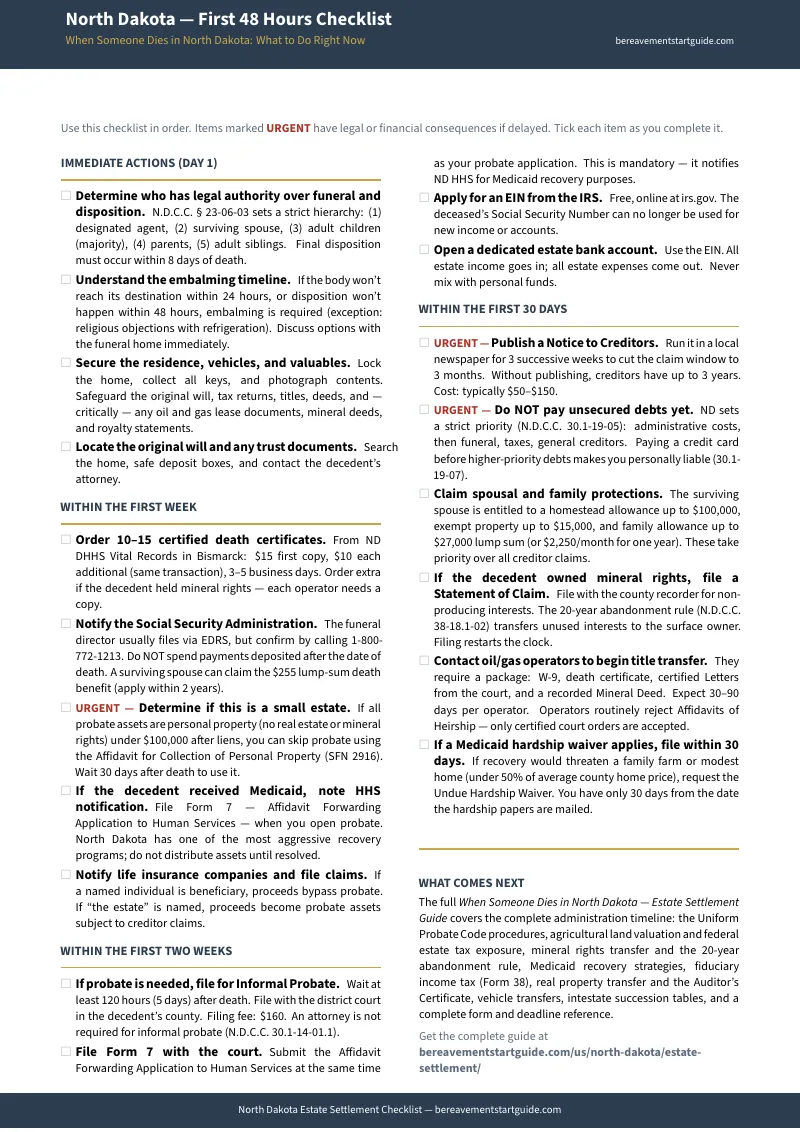
- First 48 Hours Checklist — 20 time-sensitive actions from death certificates through mineral rights protection
- Small Estate Decision Tree — step-by-step flowchart to determine if you qualify for the $100,000 shortcut
- Spousal Protection Worksheet — calculate and claim the Homestead Allowance, Exempt Property, and Family Allowance
- Creditor Priority Map — the exact statutory payment order to protect you from personal liability
- Mineral Rights Checklist — 7-step action plan for protecting and transferring Bakken oil and gas interests
- Medicaid Recovery Reference — probate-only limits, Form 7, the Krueger trap, and the 30-day hardship waiver
- Farm & Ranch Succession Reference — TOD deeds, Auditor's Certificate, CRP contracts, and estate tax exposure
30-day money-back guarantee. If the guide does not give you clarity on what to do next and confidence that you are doing it in the right order, email us for a full refund. No questions asked.
Not ready for the full guide? Download the free North Dakota First 48 Hours Checklist — 20 items covering everything that must happen in the first two days after a death in North Dakota: death certificates, securing the home, the embalming timeline, notifying Social Security, protecting mineral rights, and what not to pay. It is enough to get through tonight and tomorrow.
You did not ask for this job. But you can do it. The guide shows you how, one step at a time.