North Dakota Has No Estate Tax. That Doesn't Mean the Tax Filing Is Over.
You've probably heard the good news already — North Dakota abolished its state estate tax in 2005 and repealed the inheritance tax decades before that. So there's nothing to worry about, right?
Except the decedent's final income tax return is due by April 15. The estate is generating oil royalty income that triggers a fiduciary return you didn't know existed. The energy company froze the royalty checks until you submit a packet of documents nobody explained. And if the estate sells any inherited property without documenting the step-up in basis first, the family could owe capital gains taxes on decades of appreciation that should have been legally erased.
"No estate tax" does not mean "no tax obligations." It means the obligations are scattered across three different return types, two levels of government, and a set of North Dakota-specific rules that no generic national guide will ever cover.
The North Dakota Tax Clearance Blueprint
The North Dakota Final Tax & Estate Tax Guide is not another overview of what estate taxes are. It's a sequential filing plan built for North Dakota's specific tax landscape — covering the exact returns, deadlines, and asset documentation steps that determine whether the estate closes cleanly or triggers penalties, frozen accounts, and surprise bills for the heirs.
Where the state provides blank forms and tells you to figure out the rest, this guide tells you which return to file, in what order, and what happens if you miss one.
What's Inside
Three-Return Filing Map
North Dakota estates face up to three separate tax returns, and most executors don't realize the second and third exist. The guide walks you through the decedent's final individual return (Form ND-1), the fiduciary income tax return (Form 38) for any income the estate earns during probate, and the state estate tax return (Form 54-91) that's still required when a federal Form 706 is filed — even though North Dakota collects nothing. Miss Form 38 because you didn't know oil royalties triggered it, and you're personally liable for the penalties.
Step-Up in Basis Documentation Kit
The step-up in basis is the single most valuable tax mechanism available to heirs — it resets inherited property to its fair market value at the date of death, wiping out all prior capital appreciation. But if you sell the family farm or house without securing a date-of-death appraisal first, you lose this protection permanently. The guide provides the documentation sequence to lock in the step-up before any asset is liquidated, and explains North Dakota's 40 percent long-term capital gains exclusion that can reduce the remaining tax bill even further.
Bakken Mineral Rights Tax Protocol
If the estate includes oil, gas, or mineral interests in the Bakken region, you're dealing with income that doesn't stop flowing after the owner dies — but the checks do. Energy companies suspend royalty payments until you submit a W-9, death certificate, Letters of Administration, and a recorded Mineral Deed of Distribution. Meanwhile, the estate owes fiduciary income tax on royalties it hasn't received yet. This section gives you the exact ticket submission sequence to unfreeze suspended royalties and the filing steps to report mineral income correctly on both the federal and state returns.
Beneficiary Distribution Tax Shield
When the estate distributes income to heirs, that income passes through on a Schedule K-1 — and the beneficiaries owe tax on it, not the estate. Executors who don't understand this mechanism either freeze distributions indefinitely (extending probate by months) or distribute without issuing K-1s (creating audit exposure for every heir). The guide maps the distribution-to-K-1 sequence so income passes through cleanly and no beneficiary gets a surprise bill.
Medicaid Recovery and Tax Interaction
If the decedent received Medicaid-funded long-term care, the state holds a preferred claim against probate assets. But Medicaid recovery and tax filing interact in ways most executors don't anticipate — funeral expenses up to $3,500 are paid before the state recovers, and the timing of property sales relative to the step-up in basis determines how much value the family actually preserves. This section maps the exemptions (surviving spouse, caregiver child, hardship waiver) alongside the tax implications so you handle both simultaneously instead of making one decision that undermines the other.
Agricultural Tax Benefits Preservation
North Dakota offers significant tax exclusions for farm succession — including a full income deduction when farmland is sold to a beginning farmer. But the qualifying criteria are strict, and executors who sell agricultural land without checking eligibility first forfeit benefits that can save the estate tens of thousands of dollars. The guide covers the Farm Residence Exemption and beginning farmer provisions so no agricultural tax benefit is left on the table.
Deadline Calendar and EIN Walkthrough
Every critical deadline on one timeline: the April 15 final return, the nine-month federal estate tax window, the fifteen-month state reporting deadline. Plus a step-by-step EIN acquisition walkthrough — because you can't open an estate bank account, deposit royalty checks, or file Form 38 without one, and using the decedent's Social Security Number for post-death activity is a compliance violation.
Printable Standalone Tools
In addition to the full guide and checklist, you get standalone PDFs you can print and use independently:
- Tax Filing Sequence Card — all three North Dakota returns with their form numbers, triggers, and deadlines on one page
- Step-Up in Basis Documentation Worksheet — fillable worksheet for recording date-of-death appraisals on every inherited asset
- Mineral Rights Income Tracker — log for tracking royalty payments, suspense amounts, and fiduciary income allocations
- Beneficiary K-1 Distribution Worksheet — fillable template for calculating and documenting income pass-throughs to each heir
- Estate Tax Deadline Timeline — fill-in-the-date calendar covering every federal and state filing window from date of death through final closing
Who This Is For
- Executors filing final returns who need to know which North Dakota forms are required, in what order, before the deadlines hit
- Out-of-state heirs with mineral rights who just learned that Bakken royalties trigger North Dakota fiduciary tax obligations even if the executor lives elsewhere
- Families selling inherited property who need to document the step-up in basis and understand North Dakota's capital gains treatment before listing
- Cost-conscious estates that want to organize all tax documents before hiring a CPA — cutting billable hours in half by showing up prepared instead of paying $200–$400/hour for document sorting
Why Not Just Use the Free State Resources?
The North Dakota Tax Department provides downloadable forms and instructions. What it doesn't provide is the filing sequence — which return to file first, which triggers the next, and how the three returns interact with each other. It also explicitly warns that courts are not required to accept self-help forms and that clerks are forbidden from offering advice.
National software like TurboTax handles the federal side but doesn't address North Dakota Form 38, the state Form 54-91 reporting requirement, or the Bakken mineral rights suspension process. LegalZoom and Nolo cover North Dakota in a single generic paragraph that doesn't mention the Dormant Minerals Act, the 40 percent capital gains exclusion, or the fiduciary income tax trigger.
Local CPAs and estate attorneys provide thorough guidance — at $200 to $400 per hour. For a modest estate, the tax preparation fees alone can consume a significant portion of the inheritance.
This guide fills the gap: North Dakota-specific filing guidance, in plain English, in the correct sequence, for less than fifteen minutes of professional billing time.
Your Investment Is Protected
If the guide doesn't save you time, confusion, or at least one call to a tax professional's office, email us and we'll refund your purchase. No forms, no questions.
Start Filing with Confidence Tonight
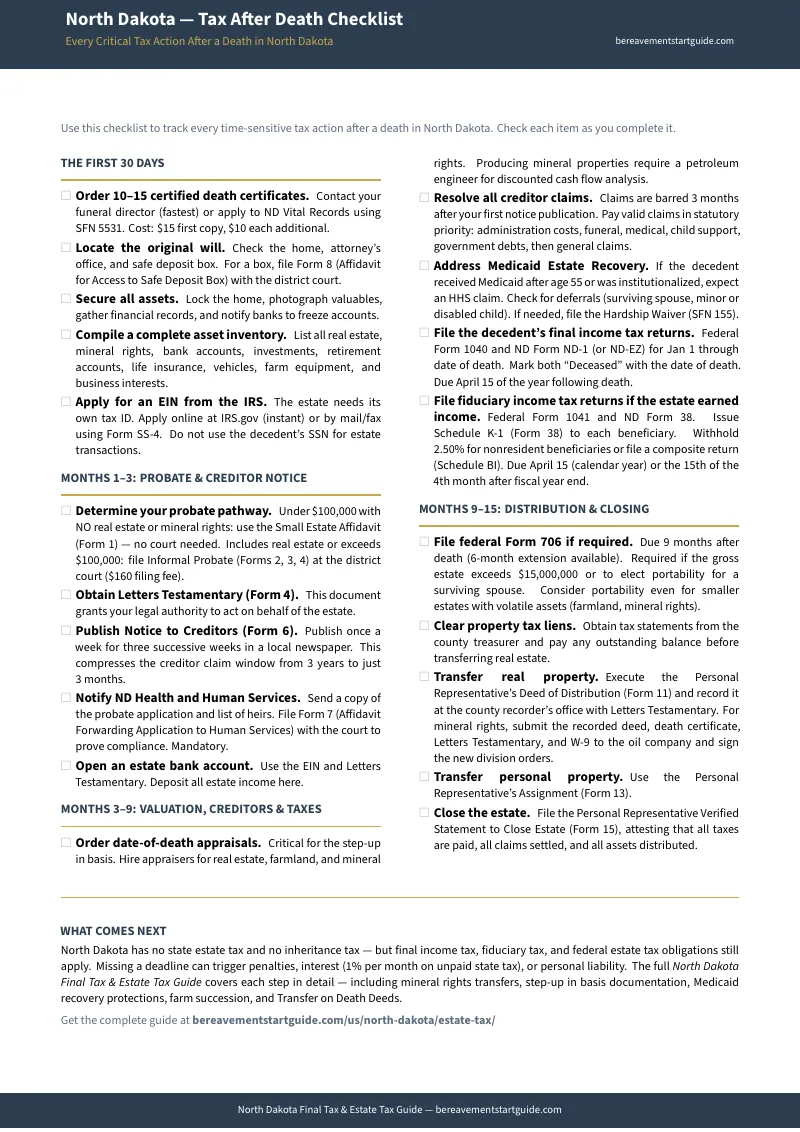
Download the free North Dakota — Tax After Death Checklist to see every tax obligation at a glance — or get the full North Dakota Final Tax & Estate Tax Guide for and start working through the filing sequence immediately.
That's less than fifteen minutes of CPA time — for a system that covers every return, deadline, and asset class the estate will face.