The Funeral Director Handed You a Price List With 47 Line Items. The Body Must Be Embalmed or Buried Within 48 Hours. And Nobody Will Tell You Which Charges Are Required by North Dakota Law and Which Ones You Can Legally Refuse.
You are standing in a funeral home — or sitting at a kitchen table with a stack of papers — and you are making decisions that cost thousands of dollars while your brain is running on grief and adrenaline. The funeral director is professional and sympathetic, but he is also running a business. The average traditional funeral in North Dakota costs $8,868 before the cemetery plot, headstone, or flowers. Basic services alone — just the staff and coordination — run $2,190 to $3,145. Embalming adds another $795 to $945. And the casket, which you are about to choose from a showroom designed to make the cheapest option look inadequate, costs $1,500 to $3,000 or more.
Here is what nobody in that room is going to volunteer: federal law gives you the right to buy a casket from any third-party seller and the funeral home cannot charge you a handling fee for using it. North Dakota law does not require embalming for every death — only when disposition will not occur within 48 hours, when the body must travel more than 24 hours to its destination, or when the death involved specific communicable diseases like anthrax, cholera, or plague. You can legally conduct a home funeral without hiring a licensed funeral director at all. And if you want to bury a family member on your own land, you can — but you need a licensed surveyor, a recorded plat, and the casket must be at least three and a half feet below the surface.
None of this is hidden. It is all in the North Dakota Century Code, the Administrative Code, and the FTC Funeral Rule. But it is scattered across Title 23, Title 43, Title 50, and a federal regulation that most funeral directors will not bring up unless you ask. Good luck finding it while sleep-deprived and emotionally wrecked.
The North Dakota Funeral Laws & Consumer Rights Guide is a Consumer Defense Manual for every funeral, cremation, burial, and body-transport decision families face in North Dakota. Not a pamphlet. Not a generic national explainer that treats all 50 states the same. A North Dakota-specific manual that translates the actual statutes into plain-language sequences — what you must do, what you can refuse, and what you should never pay for without understanding your rights first.
What's Inside the Consumer Defense Manual
A multi-chapter guide, the 48-Hour Consumer Rights Checklist, and quick-reference appendices — covering every funeral consumer decision from the moment of death through final disposition, built specifically on North Dakota Century Code, Administrative Code, and FTC Funeral Rule protections:
The 48-Hour Clock: What Triggers Mandatory Embalming and How to Avoid It
North Dakota has one of the strictest embalming triggers in the country: if the body will not reach its final destination within 24 hours during transport, or if final disposition will not occur within 48 hours, embalming becomes legally required. The guide maps these exact timelines so you know whether refrigeration is an option, when the clock starts, and how to coordinate with funeral homes or crematories to stay within the window. It also covers the communicable disease exceptions — deaths from anthrax, cholera, plague, tuberculosis, and meningitis trigger mandatory embalming regardless of timing. If the death involved viral hepatitis, AIDS, or Creutzfeldt-Jakob disease, the body must be tagged with blood and body fluid precautions. Knowing these thresholds before you walk into the arrangement conference is the difference between an informed decision and a $795 charge you did not need.
Who Has Legal Authority Over the Body — and What Happens When the Family Disagrees
North Dakota Century Code 23-06-03 establishes a strict hierarchy for who controls funeral and disposition decisions. A person designated on a DD Form 93 has absolute priority. Then the surviving spouse. Then adult children, parents, siblings — in that exact statutory order. This matters because when families disagree about burial versus cremation, or when an estranged relative tries to take control, the law decides — not the loudest voice. The guide covers the complete priority list, the court's power to bypass an estranged family member, and the legal immunity that protects public authorities who step in when families refuse to act within eight days.
Your FTC Funeral Rule Rights: The Price List You Are Legally Entitled to Receive
Federal law requires every funeral home to give you a written, itemized General Price List before any discussion of arrangements begins. You are legally entitled to see every charge, line by line. You have the right to purchase only the goods and services you want. You can supply your own casket from a third-party seller and the funeral home cannot refuse it or charge you a handling fee. And the funeral home must disclose, in writing, any legal requirements that mandate a specific service — because most line items on a GPL are optional, not required. The guide gives you the exact language of the FTC rule, explains how it applies at North Dakota funeral homes, and provides a framework for reviewing your price list item by item before you agree to anything.
Cremation: Authorization, Paperwork, and the 12-Month Unclaimed Remains Rule
Cremation in North Dakota requires authorization from the person with legal disposition authority — but the state also allows a competent adult to authorize their own cremation in writing before death. The guide covers who can authorize, the pacemaker removal requirement, the documentation crematories need, and a rule that surprises most families: if cremated remains go unclaimed for 12 months, the funeral establishment can dispose of them after providing 30 days' written notice. If you are coordinating cremation from out of state or managing remains for an elderly relative, this chapter prevents procedural delays and permanent loss.
Home Funerals: Legal in North Dakota, But the Paperwork Is Real
North Dakota law explicitly allows a family to take custody of a body and arrange final disposition without using a licensed funeral director. You can wash and prepare the body at home. You can hold a vigil or viewing in your own living room. But the bureaucratic requirements are precise: you must obtain a paper worksheet from the Department of Vital Records, coordinate with the physician or coroner for medical certification so a state staffer can enter the data into the Electronic Death Registration system, and wait for the mandatory burial-transit permit before moving the body. The guide walks through each of these steps in sequence, so you can exercise your legal right without accidentally violating the state's reporting requirements.
Private Burial on Family Land: What the County Requires Before You Break Ground
Burying a family member on private property is legal in North Dakota. It is also more complicated than most families expect. You must hire a licensed surveyor to map the plat and record it with the county recorder before the burial site legally qualifies as a family cemetery. The top of the casket or container must be at least three and a half feet below the natural surface. Best practice calls for burial at least 150 feet from any water supply and 25 feet from property lines. Municipal zoning laws may impose additional restrictions. The guide consolidates the state requirements, county recording procedures, and practical considerations so you can make this decision with full knowledge of what it actually requires.
Green Burial, Alkaline Hydrolysis, and the Regulatory Gray Areas
North Dakota does not prohibit natural or green burials. Outer burial containers — the concrete vaults most cemeteries require — are a cemetery policy, not a state law. You can decline embalming if you stay within the 48-hour timeline. But alkaline hydrolysis (water cremation) occupies a genuine regulatory gap: it is not explicitly defined as a legal method of disposition under the current Century Code, and no in-state facilities currently offer it. Families who want aquamation typically need to arrange transport to Minnesota or South Dakota. The guide explains the current legal status honestly, so you can make plans based on what is actually available rather than what national directories inaccurately report.
Transporting Remains Across North Dakota's 70,000 Square Miles
Moving a body across county lines or state borders requires the burial-transit permit generated by the EDR system. If the body cannot reach its destination within 24 hours, embalming is mandatory. For a state where families routinely live hours from the nearest funeral home or crematory, these logistics matter. The guide covers the transit permit process, the 24-hour transport rule, interstate requirements, and practical coordination — including calling the receiving facility in advance to confirm they can accept remains from a private citizen.
Preneed Funeral Contracts and the Medicaid Trap
Before 2019, North Dakota families could shelter up to $6,000 in a simple bank account designated for burial expenses. That system no longer exists. Legislative changes in 2019 and 2021 abolished the old cap and replaced it with a strict requirement: to protect funeral funds from Medicaid asset counting, the money must be placed in an irrevocable itemized funeral contract held in an FDIC- or NCUA-insured account linked to a licensed funeral establishment. CMS forced retroactive compliance, meaning even existing Medicaid recipients had to restructure their accounts or risk disqualification. The guide explains the current rules, the transition requirements, and how to set up a compliant contract without overpaying for services you may never use.
Filing a Complaint When a Funeral Home Violates Your Rights
If a funeral home performs embalming without authorization, refuses to provide a General Price List, charges a handling fee for a third-party casket, or withholds remains — those are violations of state and federal law. The guide provides the exact process for filing a formal complaint with the North Dakota State Board of Funeral Service in Rugby, what constitutes a code violation under Title 43-10, and how to document your grievance so it gets taken seriously.
Who This Guide Is For
- The family sitting in an arrangement conference right now who just received a General Price List with dozens of line items and has no idea which ones are legally required and which ones they can decline — who needs to know their FTC rights before signing anything
- The surviving spouse or adult child making cremation decisions who needs to understand authorization requirements, the pacemaker rule, and what happens to unclaimed cremated remains after 12 months
- The rural family considering a home funeral or private burial who wants to exercise their legal right to care for a loved one's body at home but needs the exact bureaucratic sequence — EDR worksheets, medical certification, surveyor plats, and county recorder filings
- The proactive planner setting up a preneed funeral contract who learned that the old $6,000 designated account no longer works and needs to understand irrevocable itemized contracts before Medicaid disqualifies the funds
- The out-of-state family member coordinating a funeral across North Dakota's vast geography who needs to understand the 24-hour transport rule, embalming triggers, and how to receive remains from a facility they have never visited
- The family who believes a funeral home overcharged or performed unauthorized services who needs the complaint process, the regulatory board, and the specific code sections that define violations
Why Free Resources Will Not Protect You at the Arrangement Table
The laws are public. The FTC Funeral Rule is online. The Century Code is searchable. Here is what you actually encounter when you try to use them:
- State government sites provide statutes — not instructions. The North Dakota Century Code spreads funeral law across Title 23 (Health and Safety), Title 43 (Occupations and Professions), and Title 50 (Public Welfare). The Administrative Code adds its own layer of embalming and transportation rules. None of these sources tell you what to do first, what to refuse, or how the rules interact with each other.
- The Funeral Consumers Alliance has no active North Dakota chapter. The national FCA provides general FTC Funeral Rule guidance, but nothing on North Dakota's 48-hour embalming trigger, the EDR system, private burial surveyor requirements, or the 2021 preneed contract changes. National guidance and North Dakota law are not the same thing.
- Funeral home websites are sales tools, not consumer protection resources. Local funeral homes publish helpful-looking content, but it is designed to generate business. They explain their services and pricing — they do not explain your legal right to decline those services, bring your own casket, or skip embalming entirely.
- Elder law attorney blogs explain enough to sell a retainer. Specialized attorneys publish accurate blog posts about preneed contracts and Medicaid planning, then end with a call to schedule a consultation at $200 to $600 per hour. For families who need a compliant preneed contract, that makes sense. For families who just need to understand the funeral home price list, it is a $300 answer to a $24 question.
Free resources give you raw statutes from one source, FTC rules from another, and funeral home pricing from a third — none of which reference each other. The Consumer Defense Manual puts every North Dakota-specific law, consumer right, and procedural requirement into one document, in the order you actually need them.
— Less Than the Embalming You Might Not Legally Need
A single embalming procedure in North Dakota costs $795 to $945. A casket from the funeral home showroom costs $1,500 to $3,000. A consultation with an elder law attorney about preneed contracts costs $200 to $600 per hour. This guide costs less than any single one of those items and tells you which ones you can legally avoid, which ones you can source elsewhere for less, and which ones are genuinely required by North Dakota law.
Your download includes 6 PDFs — instant download, no account required:
- The complete multi-chapter guide with quick-reference appendices covering North Dakota funeral statutes, FTC rights, and disposition procedures
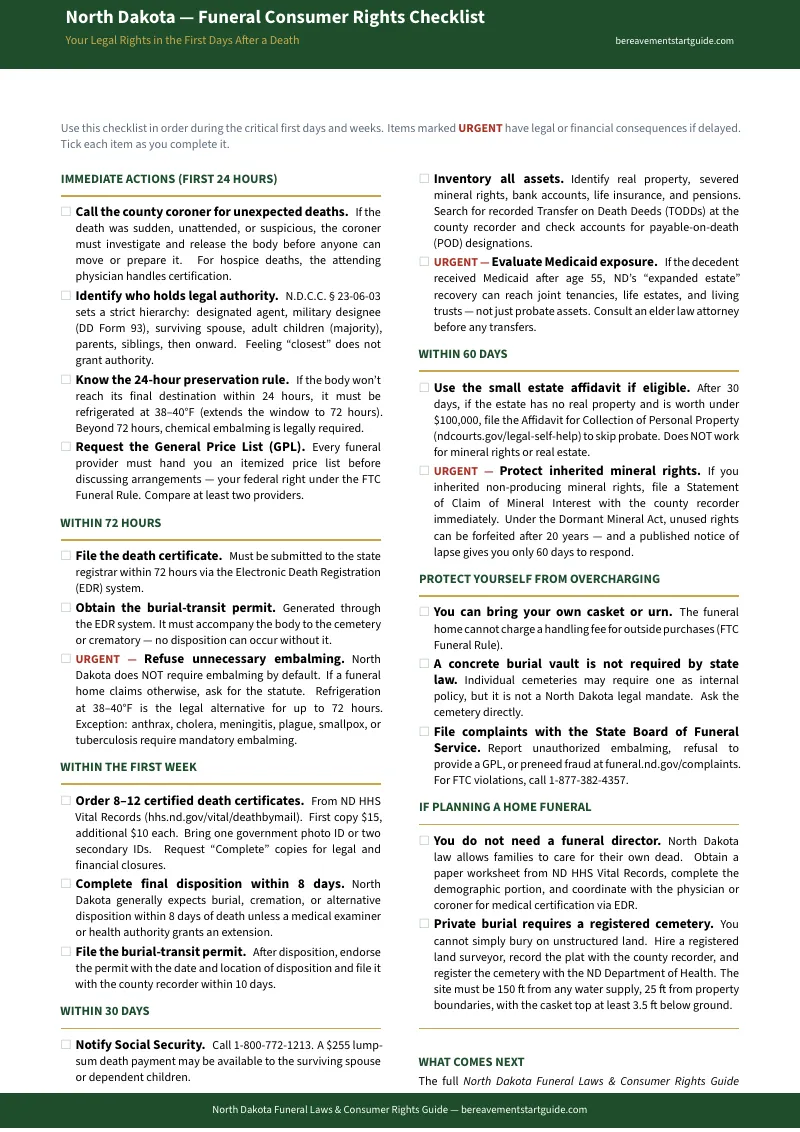
- 48-Hour Consumer Rights Checklist — the time-sensitive decisions and legal deadlines from the moment of death through disposition, designed to print and bring to the funeral home
- FTC Funeral Rule Quick Reference — your federal rights at the arrangement table: price list requirements, third-party casket protections, and itemization rules
- Disposition Authority Reference — the exact North Dakota statutory hierarchy for who controls funeral decisions, including court intervention for family disputes
- Home Funeral & Private Burial Checklist — EDR worksheet procedures, surveyor requirements, county recorder filings, and depth specifications
- Preneed Contract Compliance Guide — the 2021 irrevocable itemized contract requirements, Medicaid asset rules, and what the old $6,000 designated account rule was replaced with
30-day money-back guarantee. If the guide does not give you clarity on your legal rights and confidence that you are not overpaying, email us for a full refund. No questions asked.
Not ready for the full guide? Download the free North Dakota Funeral Consumer Rights Checklist — a one-page summary of your core legal rights at the funeral home, the embalming rules, and the line items you can decline. It is enough to walk into the arrangement conference informed.
Grief is not a reason to overpay. Knowing your rights is not disrespectful — it is responsible. The guide shows you exactly where the law is on your side.