
The Bank Froze the Account. The Probate Court Handed You a Stack of Standard Forms. And Nobody Can Tell You Whether You Need Full Administration or a One-Page Release.
Someone you love just died in Ohio. The bank locked the checking account the moment they saw the death certificate. You need that money for the funeral director's bill, but the teller says you need "Letters of Authority" -- and you have no idea what that means or how to get them from the county probate court. You drove to the courthouse and were handed a pile of Supreme Court standard forms -- Form 4.0, Form 5.0, Form 6.0 -- without anyone explaining which ones apply to your situation. There's a house involved, and a neighbor mentioned something about a Transfer on Death Designation Affidavit, but you're also hearing that Ohio Medicaid can come after the property even if it bypasses probate.
You start looking for help. Ohio Legal Help has detailed pages on small estates and surviving spouse rights, but the information is scattered across dozens of separate topic pages with no chronological sequence. Atticus and Empathy look polished but their Ohio content is generic -- they don't explain the difference between a Summary Release and a standard Release from Administration, or that surviving spouses can transfer vehicles worth up to $65,000 outside probate using BMV Form 3773. Every county probate court website is designed for attorneys, not for a grieving family member trying to figure out whether to file in Cuyahoga, Franklin, or Hamilton County. And the probate lawyers you've called quote $250 per hour -- thousands of dollars for an estate that might qualify for a streamlined process costing under $150 at the courthouse.
Meanwhile, a coworker told you that Ohio has multiple fast-track options for small estates, but you can't find a single resource that explains the exact dollar thresholds, which forms to file, or whether real estate changes everything. The county probate court index lists forms from 1.0 through 13.2, and you have no idea whether you need Form 12.0 or Form 12.1 to transfer the house deed. And you're terrified of paying the deceased's credit card bills out of order, distributing assets too early, or missing the six-month creditor deadline and facing personal liability as executor.
The Ohio Estate Settlement Sequence
This guide does what no single Ohio government website, legal aid page, or attorney consultation does: it puts the entire estate settlement process into one chronological sequence, from the hour of death through final distributions and estate closure -- with every form number, court requirement, statutory deadline, and agency contact in one place.
It's built specifically for Ohio. Not a generic national probate overview with "check your state laws" footnotes. Every chapter addresses the exact thresholds, timelines, and traps that make Ohio different -- the $40,000 Summary Release from Administration for surviving spouses, the $100,000 Release from Administration that lets spouses skip formal probate entirely, the $35,000 threshold for non-spouse applicants, the BMV Form 3773 that transfers vehicles outside probate, the strict ORC 2117.25 debt payment hierarchy that protects executors from personal liability, the Transfer on Death Designation Affidavit that bypasses probate for real estate, and the aggressive Medicaid Estate Recovery rules that reach beyond traditional probate assets.
What You Get
The Complete Guide
- First 48 Hours protocol -- understanding that all Powers of Attorney are immediately and irrevocably void at the moment of death, securing the residence and vehicles, maintaining insurance coverage, and the one rule that prevents the most common financial mistake: do not pay the deceased's debts from your own money
- Death certificate strategy -- ordering through the Ohio Department of Health or your local county health department, costs ranging from approximately $21.50 at the state level to $27 in Hamilton County, how many to order (minimum 8-10 certified copies with raised seals), which institutions demand certified copies versus photocopies, and the VitalChek expedited option
- The three small estate tracks -- Ohio's Summary Release from Administration for estates under $5,000 (any applicant) or under $40,000 plus $5,000 funeral reimbursement (surviving spouses), the standard Release from Administration for estates under $35,000 (no surviving spouse) or under $100,000 (surviving spouse inherits everything), and when these tracks save you months of time and hundreds of dollars in fees compared to full administration
- Formal probate administration -- filing Form 4.0 (Application for Authority to Administer Estate) at the probate court in the county where the decedent resided, filing fees that vary by county, bond requirements and when the will waives them, the difference between Letters Testamentary (with a will) and Letters of Administration (without), and how Letters of Authority give you legal power over every asset in the estate
- The surviving spouse's $65,000 vehicle transfer -- BMV Form 3773 (Surviving Spouse Affidavit) allows the transfer of unlimited passenger vehicles, boats, and outboard motors up to a combined value of $65,000 entirely outside the probate court. Step-by-step instructions for completing the form at the County Clerk of Courts Title Office, plus the separate BMV Form 3811 route for vehicles with a Transfer on Death beneficiary designation
- Creditor claims and the six-month window -- the strict ORC 2117.25 priority of claims (administration costs first, then up to $4,000 for funeral expenses, then surviving spouse and minor children's allowance, then federal debts, then expenses of the last illness, then general unsecured debts), why paying out of order creates personal liability for the executor, and the absolute statutory bar on claims filed more than six months after death
- Real estate transfers -- three paths: the Transfer on Death Designation Affidavit (ORC 5302.22) that bypasses probate entirely if recorded before death, the Certificate of Transfer (Form 12.1) through probate court filed with both the County Auditor and County Recorder, and survivorship deeds. Plus the surviving spouse's right to remain in the family home for one year rent-free
- Bank account procedures -- the critical distinction between Payable on Death (POD) accounts that bypass probate (just bring the death certificate and ID) and accounts without beneficiaries that require Letters of Authority or a Release from Administration, plus how to handle frozen accounts during the waiting period
- Medicaid Estate Recovery -- Ohio's aggressive program that applies to individuals over 55 who received Medicaid benefits, the critical detail that Ohio recovers from non-probate assets including TOD real estate and jointly held bank accounts, the absolute exemptions (surviving spouse, child under 21, blind or permanently disabled child), and when to apply for a hardship waiver
- Ohio's estate tax repeal -- confirmation that Ohio completely repealed its estate tax for deaths occurring on or after January 1, 2013, eliminating an entire layer of state tax filing and reporting. Only federal estate tax applies, and only to estates exceeding the federal threshold
- Retirement accounts and life insurance -- why named beneficiaries on 401(k)s, IRAs, and life insurance policies bypass probate entirely, the surviving spouse's rollover advantages, and the risk of naming the estate itself as beneficiary
- Social Security notification -- verifying that the funeral director filed Form SSA-721, the strict rule requiring return of the final month's payment, how to return electronic deposits through the receiving bank, and the one-time $255 lump-sum death benefit for eligible survivors
- Final accounting and estate closure -- the complete process for filing the final account with the probate court, distributing remaining assets to heirs only after the six-month creditor window closes, and obtaining a formal discharge of the executor's fiduciary duties
- When to hire a professional -- the exact triggers for an attorney, CPA, or elder law specialist, so you don't pay thousands for tasks you can handle yourself but don't accidentally mishandle the situations that require professional help
- Complete forms directory -- every form referenced in the guide with the exact agency, filing location, and situation that triggers each one, from the Supreme Court standard probate forms through BMV affidavits and county health department applications
6 Standalone Printable Tools
- Estate Inventory Worksheet -- fillable worksheet for cataloging every asset by category (real estate, financial accounts, vehicles, personal property) with columns for title type, estimated value, beneficiary designation, and probate status. Bring it to the courthouse or your first attorney meeting.
- Probate Decision Tree -- one-page flowchart: does the estate qualify for a Summary Release, a standard Release from Administration, or does it need full probate? Follow the arrows and know your track in minutes.
- Creditor Priority Reference -- the strict ORC 2117.25 statutory payment order for estate debts on one page. Print this and keep it with your executor files -- paying out of order creates personal liability.
- Statutory Deadline Calendar -- every Ohio estate deadline on one page: six-month creditor claim window, inventory filing deadline, final account due date. Post it where you'll see it daily.
- Vehicle Transfer Guide -- step-by-step instructions for BMV Form 3773 (surviving spouse), BMV Form 3811 (TOD beneficiary), and probate-required transfers, with the County Clerk of Courts Title Office process for each route.
- Real Estate Transfer Checklist -- the three paths for Ohio real estate (TOD affidavit, Certificate of Transfer through probate, survivorship deed) with recording requirements for the County Auditor and County Recorder.
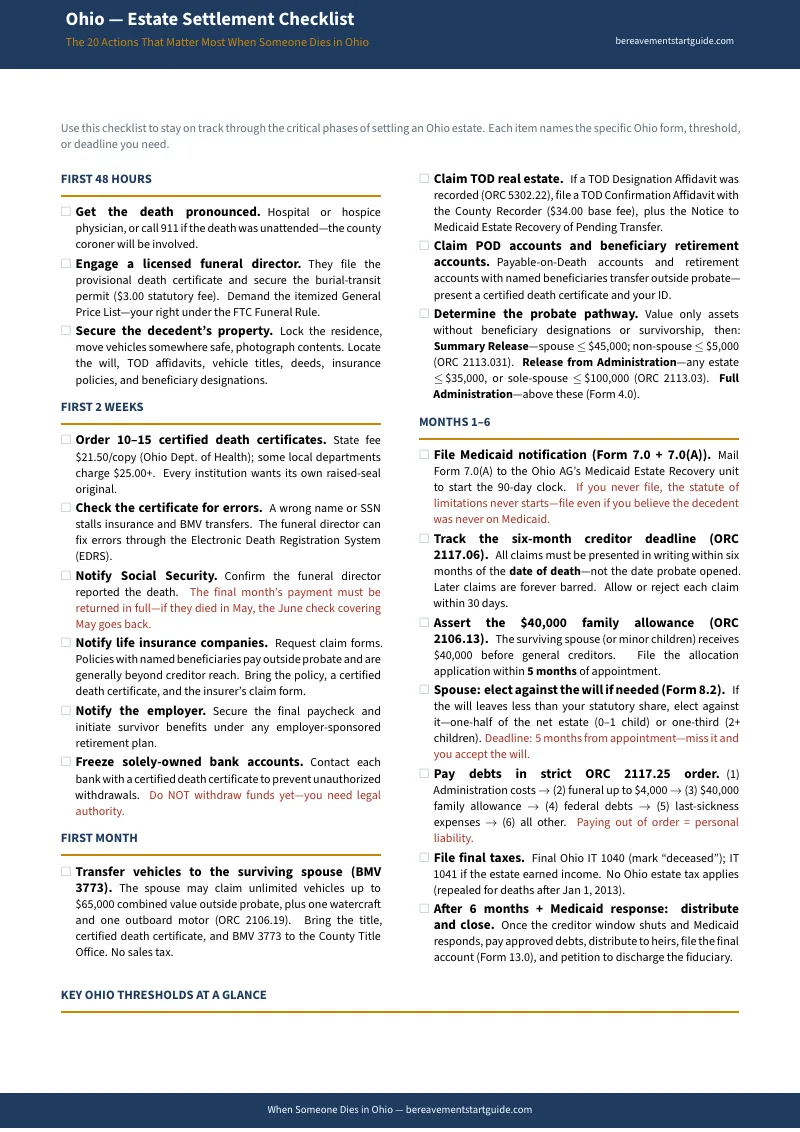
The Free Ohio First 48 Hours Checklist
A printable emergency checklist covering the most urgent tasks -- from understanding that all Powers of Attorney are now void and securing the residence through ordering death certificates, notifying Social Security, and determining whether the estate might qualify for one of Ohio's small estate fast-tracks. Available as a free download so you can start immediately while deciding whether the full guide is right for your situation.
Who This Is For
- Surviving spouses who need to transfer vehicles using BMV Form 3773 without going through probate, determine whether the estate qualifies for the $100,000 Release from Administration, understand whether the family home is shielded from Medicaid Estate Recovery, access frozen bank accounts, and exercise their right to one year of rent-free residence in the family home
- Adult children settling a parent's estate for the first time -- especially those living out of state who need to navigate an unfamiliar Ohio county probate court, understand the difference between the small estate tracks and full administration, and determine whether they can handle the process without hiring a local attorney
- Executors and personal representatives who want to fulfill their fiduciary duties correctly, protect themselves from personal liability by paying creditors in the exact ORC 2117.25 statutory order, file the inventory on time, and close the estate through proper final accounting
- Families dealing with Medicaid recovery who need to know whether the absolute exemptions apply, understand that Ohio's recovery program reaches non-probate assets like TOD real estate and joint accounts, and determine when an elder law attorney is essential
- Cost-conscious administrators of modest estates who want to determine whether a Release from Administration can bypass full probate entirely -- saving thousands in attorney fees that would otherwise consume a significant portion of a small inheritance
Why Not Just Use the Free Government Forms?
Every form referenced in this guide is available for free from an Ohio government office. The Supreme Court standard probate forms are on the Ohio courts website. The BMV affidavits are available at the County Clerk of Courts Title Office. Death certificate applications are on the county health department websites.
What's not free -- and what no government website provides -- is the sequence. The probate court clerk can hand you Form 4.0 but is legally prohibited from telling you whether your estate actually needs it, or whether a one-page Release from Administration would save you months of time and hundreds of dollars in fees. Ohio Legal Help has excellent pages on surviving spouse rights and small estates, but the information is scattered across dozens of separate topic pages with no chronological order. County court websites list forms from 1.0 through 13.2 but don't explain that you probably need only three or four of them. No single state website explains how BMV Form 3773 connects to the probate court's Release from Administration, connects to the County Recorder's Transfer on Death Designation requirements, or warns you about the ORC 2117.25 creditor payment hierarchy that protects you from personal liability.
Each agency handles its piece. None of them tell you what the next agency in line requires, or warn you about the traps hiding between the steps. This guide connects the dots -- putting every form, every deadline, every threshold, and every agency into the order you actually need them.
-- Less Than One Hour of Attorney Time
A probate attorney in Ohio charges $250 per hour or more. A flat-fee retainer for a straightforward estate starts at $2,000 to $5,000. And Ohio's statutory fiduciary fee schedule -- 4% on the first $100,000, 3% on the next $300,000 -- means professional administration of even a modest estate can cost thousands before court filing fees and bond premiums. This guide covers the administrative fundamentals that would otherwise consume your first several billable hours -- ordering certificates, qualifying for the small estate process, organizing your documents, understanding the creditor priority rules, and meeting every statutory deadline. Even if you ultimately hire an attorney, completing these steps first saves the estate hundreds of dollars in billable intake time.
If the guide doesn't save you at least ten hours of frustrating research across scattered government websites, email us within 30 days for a full refund. No questions asked.