The Funeral Director Hands You a Contract. The Clerk Hands You a Stack of Forms. Nobody Hands You a Sequence.
Someone just died in Ohio, and the decisions are already stacking up. The funeral home wants you to choose a casket, approve embalming, and sign a contract -- but you don't know whether embalming is required (it isn't), whether you can bring your own casket (you can), or whether the General Price List they handed you is missing line items they're legally required to disclose. Meanwhile, three siblings are arguing about cremation versus burial, and the funeral director says they can't proceed until the family reaches agreement -- while daily refrigeration fees keep climbing.
You search online. The Ohio Revised Code is free to read, but ORC 2108.81 doesn't tell you what to actually do when your brother disagrees with your sister about disposition. The funeral home's website has a FAQ page that conveniently omits your right to decline every add-on service they're about to suggest. The law firm blogs describe the right-of-disposition hierarchy in careful detail, then end with "contact our office for a consultation" -- $300 an hour to learn what a single document could have told you. And the county health department's sub-registrar has never processed a burial permit for a family handling disposition without a funeral director, because the Electronic Death Registration system was built for licensed professionals, not for you.
You need a step-by-step sequence that connects the statutes to the forms to the deadlines to the phone numbers -- in the order you actually encounter them.
The Ohio Funeral Consumer Defense System
This guide does what no single Ohio government website, funeral home brochure, or attorney consultation provides: it puts your complete funeral consumer rights -- from the moment of death through final estate settlement -- into one chronological sequence built specifically for Ohio law. Every statute number, every form, every filing fee, every consumer protection, every deadline, and every bureaucratic workaround in one place.
It covers what makes Ohio uniquely complicated: the rigid right-of-disposition hierarchy that gives funeral directors legal immunity to refuse your family's instructions until you prove who holds authority. The Electronic Death Registration system that locks out families attempting home funerals. The expanded Medicaid Estate Recovery program that reaches assets most people think are protected. The preneed contract portability rights that funeral homes have zero incentive to mention. And the specific FTC Funeral Rule requirements that every Ohio funeral home must follow -- but rarely volunteer.
What You Get
The Complete Ohio Funeral Laws Guide
- Right of Disposition -- who decides, and what happens when they disagree -- the exact statutory hierarchy under ORC 2108.81 (surviving spouse first, then adult children by majority vote, then parents, then siblings), who is legally disqualified (pending divorce, abuse charges), how the Written Declaration of Right of Disposition (ORC 2108.70) supersedes the entire hierarchy, and what a probate court considers when the family deadlocks
- Immediate actions timeline (Days 1-3) -- hour-by-hour protocol from pronouncement through funeral home selection, when to call 911 versus hospice versus the coroner, how to secure the home and financial accounts, and the critical first decisions that lock in costs if you make them too quickly
- Death certificates and burial permits -- the Electronic Death Registration system explained, the $10 burial-transit permit from the local health department, why you need 8-12 certified copies at $25-$27 each, the five-working-day filing deadline, and how families handling a home funeral can navigate the EDR system that was designed to exclude them
- Embalming -- what Ohio law actually requires -- the definitive answer: Ohio does not require embalming for standard burials or cremations. The only exception involves deaths from virulent communicable diseases, and even then the legal requirement is expedited disposition or embalming, not embalming alone. How to respond when a funeral director implies it's mandatory
- Cremation authorization rules -- the mandatory 24-hour waiting period, the statutory Cremation Authorization Form (ORC 4717.24), disclosure requirements for pacemakers and personal property, recent legislative changes removing the witness signature requirement (House Bill 582), and why funeral directors demand signatures from every family member even when only the majority of the priority class is legally required
- Preneed contract protections -- your right to transfer a preneed trust or insurance policy to a different funeral home, the 7-day cancellation window on new contracts, how excess funds are handled after services are rendered, and the ORC Chapter 4717 trust requirements that protect your prepaid money from disappearing if the funeral home closes
- Home funerals and family-directed disposition -- what Ohio law actually permits families to do without hiring a funeral director, how to work with a physician to obtain medical certification, the burial-transit permit process for non-professionals, and step-by-step workarounds for the EDR system's institutional bias toward licensed directors
- Home burial and family cemeteries -- the family cemetery exemption under ORC 4767.02 (three-fourths common ancestor requirement), township zoning setback rules, recording the burial site with the county auditor, and the property deed implications that protect future owners from discovering an undisclosed burial
- Green burial, scattering ashes, and emerging methods -- Green Burial Council certification for Ohio cemeteries, biodegradable container and vault requirements, scattering rules for private land versus public land versus waterways, EPA Clean Water Act requirements for inland scattering, and the current legal status of alkaline hydrolysis (not legal in Ohio as of current regulations) and human composting
- Transporting remains -- intra-state and inter-state transport requirements under ORC 3705.18, paperwork that must physically accompany the body, the travel protection plan provision from House Bill 582, and whether a family can use a personal vehicle
- FTC Funeral Rule -- your federal rights at every Ohio funeral home -- the General Price List you must receive before any discussion of services, your absolute right to purchase a casket from a third-party vendor with no handling fee, the right to decline embalming, the right to choose a direct cremation or immediate burial package, and how to audit a funeral home's proposed contract for compliance
- Small estate shortcuts -- Summary Release from Administration (Form 5.10, surviving spouse up to $45,000, non-spouse up to $5,000), Release from Administration (Form 5.0, surviving spouse up to $100,000, non-spouse up to $35,000), the exact supporting documents required, and how to avoid filing for full administration when a one-page form would close the case
- Medicaid Estate Recovery -- Ohio's expanded program that recovers from both probate and non-probate assets including TOD designations, joint accounts, and revocable trusts. The absolute exemptions (surviving spouse in the home, child under 21, disabled child), the hardship waiver, and why standard estate planning tools like TOD deeds and living trusts do not protect Ohio families the way most people assume
- Surviving spouse protections -- the $40,000 family allowance (ORC 2106.13), the $65,000 vehicle transfer outside probate (BMV Form 3773), the one-year right to remain in the family home, and the Embassy Healthcare v. Bell ruling that protects surviving spouses from necessaries claims after the 6-month creditor window
- Filing complaints -- the Ohio Board of Embalmers and Funeral Directors for professional misconduct (14-day response period), the Cemetery Dispute Resolution Commission for cemetery issues, and the FTC complaint process for Funeral Rule violations
- Complete forms reference -- every Ohio Revised Code form, BMV affidavit, and county filing referenced in the guide, with the specific situation that triggers each one
- Fees quick reference -- burial-transit permits, death certificate copies, probate filing fees, and county-specific cost ranges
- Master timeline -- every deadline from the first 24 hours through the 6-month creditor period, mapped to the specific action, form, and statute that governs it
5 Standalone Printable Reference Sheets
- FTC Funeral Rule Rights Card -- Your 5 core rights at every Ohio funeral home, a pre-visit checklist, an at-the-meeting checklist, and complaint filing contacts. Print this and bring it to the funeral home.
- Small Estate Decision Tree -- One-page flowchart: identify probate assets, apply the Summary Release vs. Release from Administration vs. Full Probate thresholds, choose your path, and check county filing fees.
- Forms Reference Card -- All 12 Ohio forms (Written Declaration, Cremation Authorization, Forms 5.10/5.0/1.0/7.0, BMV 3773/3774/3811, Affidavit of Confirmation, IT 1041/1140) with purpose and where to get them.
- Fees Quick Reference -- Every fee you will encounter: death certificates, burial permits, probate filing deposits, vehicle transfers, real estate recording, and late-filing penalties.
- Master Timeline -- 6-phase checklist from Days 1-3 through Months 6-12. Post it on the fridge and check off each step as you complete it.
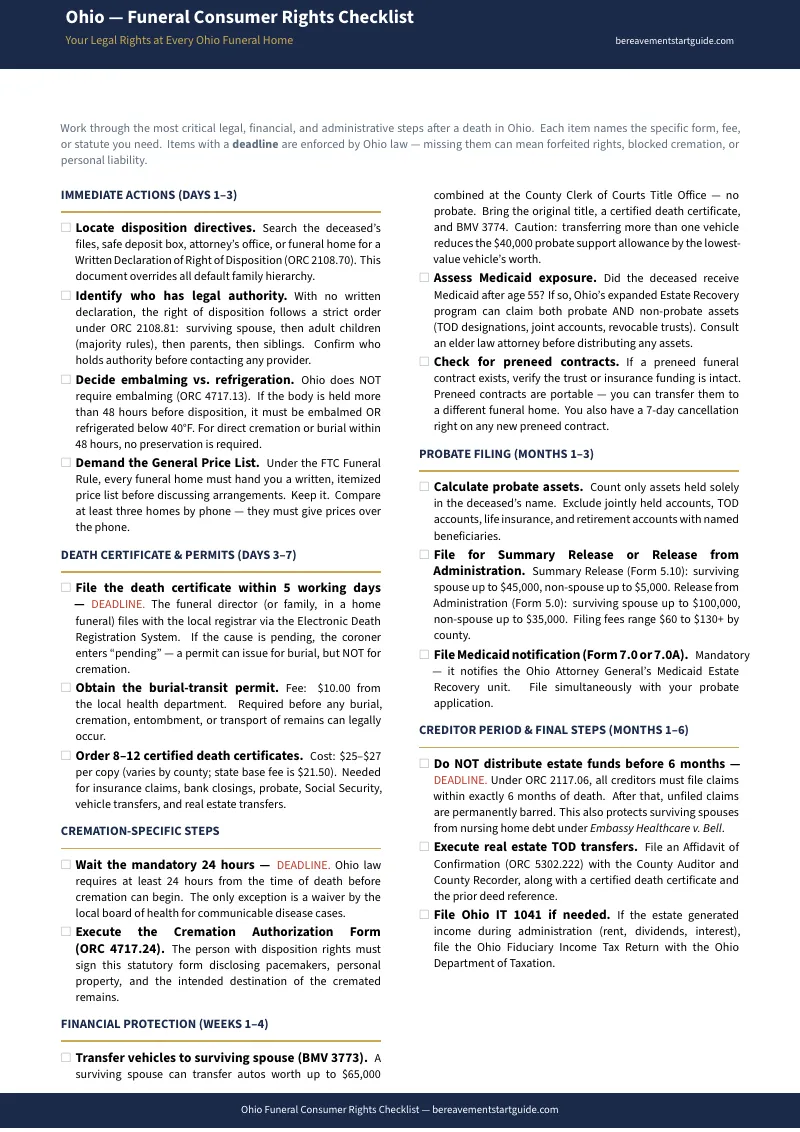
The Free Ohio Funeral Consumer Rights Checklist
A printable 18-step action plan covering the most critical legal, financial, and administrative steps after a death in Ohio -- from locating disposition directives and demanding the General Price List through filing for Summary Release and navigating Medicaid exposure. Available as a free download so you can start immediately while deciding whether the full guide is right for your situation.
Who This Is For
- Families planning a funeral right now who need to know their exact legal rights before signing a contract -- what embalming costs they can decline, what casket markups they don't have to accept, and how to compare prices across three funeral homes by phone as the FTC Funeral Rule requires
- Surviving spouses navigating the immediate financial aftermath -- transferring vehicles without probate using BMV Form 3773, claiming the $40,000 family allowance, determining whether the estate qualifies for Summary Release, and understanding whether the family home is exposed to Medicaid Estate Recovery
- Adult children managing a parent's death -- especially when siblings disagree about burial versus cremation, when the estate is too small for an attorney to make financial sense, or when a preneed contract exists but the family wants to use a different funeral home
- Families considering alternatives -- home funerals, home burial on private property, green burial, direct cremation, or ash scattering -- who need to know exactly what Ohio law permits, what local zoning requires, and how to navigate a system designed for licensed funeral directors
- Pre-planners who want to document their wishes in a legally binding Written Declaration of Right of Disposition, evaluate preneed contracts without falling for inflexible terms, and protect their assets from Ohio's expanded Medicaid Estate Recovery program before it's too late
Why Not Just Read the Law Online?
Every statute cited in this guide is published free on codes.ohio.gov. The FTC Funeral Rule is on the FTC website. The burial-transit permit application is at your county health department. The probate forms are on the Supreme Court of Ohio's website.
What's free is the raw text. What doesn't exist anywhere is the sequence. ORC 2108.81 tells you the right-of-disposition hierarchy, but it doesn't tell you what to do when your siblings deadlock and the funeral director starts charging $75 per day for refrigeration while waiting for a probate court ruling. The FTC Funeral Rule gives you the right to decline embalming, but it doesn't tell you that Ohio law only requires preservation when a communicable disease is involved -- which means the funeral director's "it's required by state law" claim is false. The county health department will issue a burial-transit permit for $10, but their sub-registrar may have never processed one for a family acting without a funeral director, because the Electronic Death Registration system wasn't built for you.
Each agency handles its fragment. No single source connects the right-of-disposition declaration to the death certificate timeline to the FTC price protections to the cremation authorization form to the small estate filing to the Medicaid recovery notice -- in the order you actually need them. This guide connects all of those dots.
-- Less Than One Hour with an Elder Law Attorney
A single consultation with an Ohio elder law attorney runs $300 to $500. Funeral homes mark up caskets by 300% or more over wholesale. A missed Summary Release filing means months of unnecessary full probate administration and hundreds of dollars in avoidable fees. And Ohio's Medicaid Estate Recovery program recovers over $87 million per year from families who assumed their TOD deeds and living trusts would protect them.
This guide covers the exact consumer rights, filing sequences, and financial protections that prevent those losses -- for the cost of a single certified death certificate copy.
If the guide doesn't save you at least ten hours of research across scattered government websites and funeral home brochures, email us within 30 days for a full refund. No questions asked.