88 County Probate Courts. 50+ Standardized Forms. And the Clerk Is Legally Prohibited from Telling You Which Ones You Actually Need.
Someone close to you just died in Ohio, and now the probate court expects you to know what to do. The bank froze the accounts the moment they saw the death certificate. The funeral director is waiting for payment. And the county probate court website lists forms numbered 1.0 through 24.0 -- but nobody there can tell you whether you need three of them or thirty, or whether you should be filing Form 2.0 before Form 4.0 or the other way around. The clerk can hand you a stack of blank PDFs, but Ohio law prohibits them from explaining how to fill them out, which order to file them in, or whether your estate even needs to go through full administration at all.
You start searching online. Nolo and FindLaw have "Ohio probate" pages, but the content is so generic it could apply to any state -- no mention of Form 5.10A, no explanation of the difference between a Summary Release and a Release from Administration, no county-level filing fees. The local law firms you find are worse: their blog posts describe the probate process as impossibly complex, then end with "call us for a free consultation" -- which turns into a $4,500 retainer for an estate that might qualify for a one-page streamlined filing. Meanwhile, you're reading that Ohio's Medicaid Estate Recovery program can come after assets that bypass probate, that distributing anything to heirs before six months creates personal liability, and that each of Ohio's 88 counties has its own local rules layered on top of the state statutes. Cuyahoga County requires mandatory e-filing and forfeits your $250 deposit if you miss a 14-day deadline. Franklin County won't release your Letters of Authority until they receive a $250 recommended deposit even though the statutory minimum is $125. And Hamilton County requires the judge's written approval before any fees can be paid from a supervised estate.
You need a clear sequence. Not another list of links. Not a generic overview. Not an attorney's sales pitch disguised as a blog post.
The County-by-County Probate Roadmap
This guide does what no single Ohio government website, legal aid page, or attorney consultation provides: it puts the entire probate process -- from "do I even need probate?" through the final Certificate of Termination -- into one chronological sequence built specifically for Ohio's 88-county system. Every form number, every statutory deadline, every filing fee range, every county-specific trap, and every small estate shortcut in one place.
It covers what makes Ohio different from every other state: the three-tier small estate system (Summary Release, Release from Administration, and Full Administration), the surviving spouse's $65,000 vehicle transfer that bypasses probate entirely, the aggressive Medicaid Estate Recovery rules that reach beyond traditional probate assets, the 13-month final accounting deadline that gets executors cited for contempt, and the county-level rules that mean filing the same form in Cuyahoga, Franklin, and Hamilton County can produce three completely different experiences.
What You Get
The Complete Probate Process Guide
- Do you actually need probate? -- a plain-English breakdown of which assets skip probate entirely (joint accounts with survivorship, TOD real estate, POD accounts, life insurance, retirement accounts with named beneficiaries) versus which ones force you into the court system. Most people start probate for assets that already transferred automatically by operation of law
- The three small estate tracks -- Ohio's Summary Release from Administration (Form 5.10A) for estates under $5,000 or up to $45,000 for surviving spouses who paid funeral costs, the Release from Administration (Form 5.0) for estates under $35,000 or up to $100,000 for surviving spouses, and Full Administration for everything above. Eligibility rules, filing fees by county, and the exact forms for each track
- Full Administration step by step -- the exact filing sequence: Form 1.0 first (identifying heirs), Form 2.0 if there's a will (Application to Probate Will), Form 4.0 (Application for Authority to Administer Estate), resolving the bond requirement, receiving Letters of Authority (Form 4.5), and the critical first 30 days after appointment
- County-specific filing rules -- Cuyahoga County's mandatory e-filing and 14-day will delivery deadline, Franklin County's deposit structure and unique e-filing credentials requirement, Hamilton County's mandatory bond rules and judicial fee pre-approval, and how to check your specific county's requirements before you drive to the courthouse
- The Medicaid Recovery notice you cannot miss -- Form 7.0(A) must be mailed via certified mail within 30 days of appointment if the decedent was 55 or older. The Medicaid Estate Recovery program then has 90 days to present a claim. Miss this step and you face personal liability. The guide covers the notice process, the hardship waiver, and the critical detail that Ohio recovers from non-probate assets including TOD real estate and joint accounts
- The 6-month creditor wall -- under ORC 2117.06, all creditor claims must be presented within six months of the date of death. Distribute a single dollar to heirs before that window closes and you are personally on the hook for any shortfall. The guide covers how creditors present claims, the absolute bar on late claims, and the Embassy Healthcare v. Bell rule that protects surviving spouses from necessaries claims
- Estate inventory and asset valuation -- how to complete the inventory within the 3-month deadline, when you need a court-appointed appraiser (Form 3.0) versus when the County Auditor's tax valuation suffices for real estate, and how to list date-of-death values without triggering a court audit
- Surviving spouse protections -- the $40,000 family allowance (ORC 2106.13) that takes priority over most creditors, the $65,000 vehicle transfer outside probate using BMV Form 3773, watercraft transfers (ORC 2106.19), and the right to remain in the family home rent-free for one year
- Real estate transfers -- three paths explained: the Transfer on Death Designation Affidavit (ORC 5302.22) that bypasses probate, the Certificate of Transfer (Forms 12.0 and 12.1) through probate court, and the "Real Estate Transfer Only" shortcut when the sole probate asset is a house and six months have passed
- Ancillary administration -- what to do when an out-of-state decedent owned Ohio real property, the authenticated (not merely certified) document requirement, and when the Real Estate Transfer Only procedure eliminates the need for full ancillary administration
- Executor compensation and attorney fees -- Ohio's statutory commission tiers (4% on the first $100,000, 3% on the next $300,000, 2% above), county-specific attorney fee guidelines (5.5% on the first $50,000 in Brown County, 4.5% on the first $100,000 in Cuyahoga County), and the math that shows why professional administration of a modest estate can cost thousands
- Taxes -- confirmation that Ohio repealed its estate tax for deaths after January 1, 2013, plus when the estate's Ohio IT 1041 (fiduciary income tax) and the decedent's final Ohio IT 1040 must be filed
- Final accounting and closing -- the 13-month deadline for filing Form 13.0, what happens if you need more time (Form 13.13 Status Report), the voucher and zero-balance requirements, and receiving your Certificate of Termination (Form 13.6) that officially ends your fiduciary duties
- 12 common mistakes -- distributing before the creditor window, ignoring the Medicaid notice, missing the inventory deadline, paying creditors out of priority order, forgetting county-level rules, and more -- each with the specific statutory consequence and how to avoid it
- Complete forms directory -- every Supreme Court standard form referenced in the guide, every BMV affidavit, every county-specific variant, with the exact situation that triggers each one and where to download it
8 Standalone Printable Tools
- Probate Decision Tree -- a visual flowchart that walks you through the three questions that determine your probate track: Summary Release, Release from Administration, or Full Administration. Print it and answer the questions before you file anything
- Statutory Deadline Calendar -- every critical deadline on one page: 30-day Medicaid notice, 3-month inventory, 6-month creditor window, 13-month final accounting. Mark your appointment date and the calendar fills in the rest
- Forms Directory -- every Supreme Court standard form, BMV affidavit, and county-specific variant referenced in the guide, organized by when you need it and where to download it
- Creditor Priority Reference -- Ohio's statutory payment hierarchy from ORC 2117.25 on one page: funeral costs first, then administration expenses, then federal taxes, then medical expenses of the last illness, then all other claims. Pay out of order and you are personally liable
- Vehicle Transfer Guide -- step-by-step instructions for the surviving spouse's $65,000 vehicle transfer using BMV Form 3773, plus the standard title transfer process for vehicles that do not qualify for the spousal exemption
- Estate Inventory Worksheet -- a fillable worksheet for cataloging every estate asset with date-of-death values, organized by asset category (real property, financial accounts, vehicles, personal property, digital assets, debts and liabilities)
- Real Estate Transfer Checklist -- the three transfer paths side by side (TOD Designation Affidavit, Certificate of Transfer through probate, Real Estate Transfer Only shortcut) with the specific forms, recording requirements, and county auditor steps for each
- County Filing Fees Reference -- filing fee ranges across Ohio's 88 counties for each probate track, including application fees, bond premiums, and deposit requirements for the major metropolitan counties
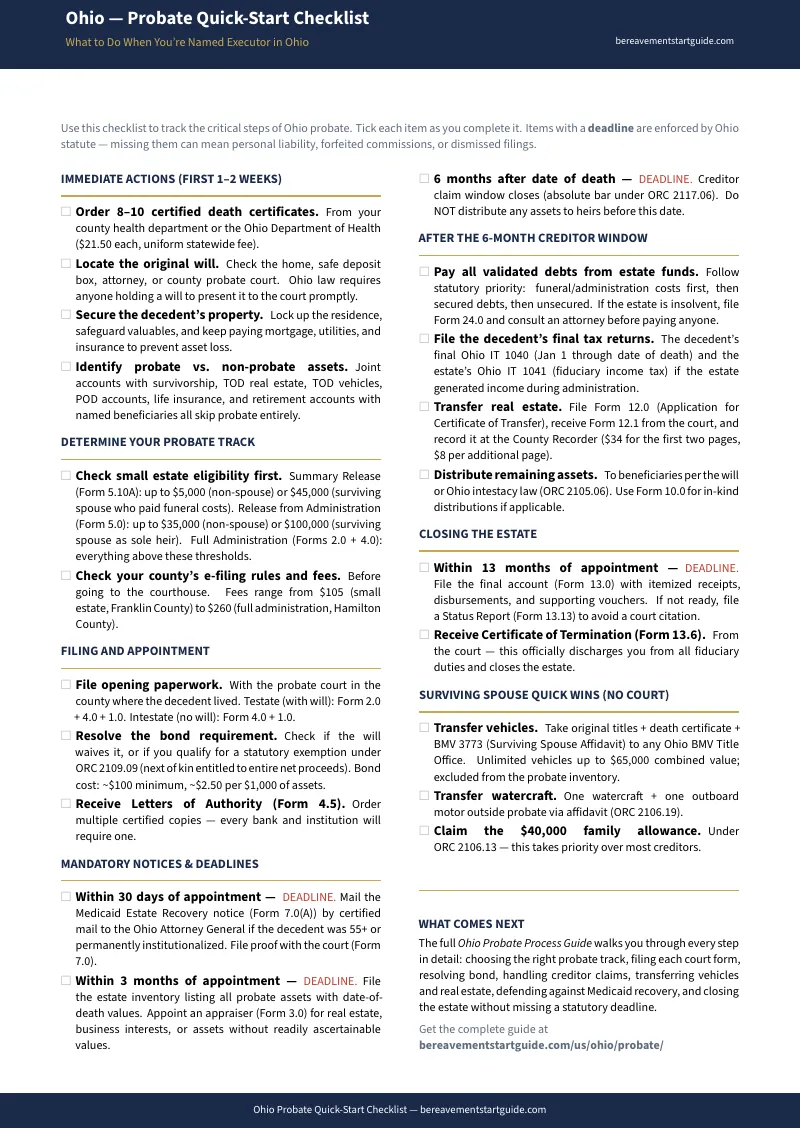
The Free Ohio Probate Quick-Start Checklist
A printable checklist covering the most critical tasks in chronological order -- ordering death certificates, locating the original will, securing the estate, determining your probate track (Summary Release, Release from Administration, or Full Administration), and the surviving spouse quick wins that require no court involvement at all. Available as a free download so you can start immediately while deciding whether the full guide is right for your situation.
Who This Is For
- Surviving spouses who need to transfer vehicles using BMV Form 3773 without going through probate, determine whether the estate qualifies for the $100,000 Release from Administration, claim the $40,000 family allowance, and understand whether the family home is protected from Medicaid Estate Recovery
- Adult children settling a parent's estate -- especially those facing the probate court for the first time, trying to determine whether the estate qualifies for a small estate shortcut or needs full administration, and deciding whether to handle it themselves or hire a local attorney
- Named executors who have just been handed a legal obligation they never trained for -- and need to understand their fiduciary duties, personal liability exposure, bond requirements, and the statutory deadlines that govern every step from inventory to final accounting
- Cost-conscious administrators of modest estates who recognize that a $4,500 attorney retainer on a $90,000 estate consumes a painful share of the inheritance -- and want to know exactly which parts of probate they can handle themselves
- Out-of-state executors managing ancillary administration for Ohio real property owned by someone who lived and died in another state -- and need to understand the authenticated document requirements and whether the Real Estate Transfer Only shortcut applies
Why Not Just Download the Free Court Forms?
Every single form referenced in this guide is available for free. The Supreme Court of Ohio publishes the standardized probate forms on its website. The BMV affidavits are at the County Clerk of Courts. Death certificate applications are on every county health department site.
What's free is the content. What doesn't exist anywhere is the context. The court's Form 4.0 doesn't tell you that filing it before checking the small estate thresholds might lock you into 9-12 months of full administration when a one-page Form 5.10A would have closed the case in two weeks. The Supreme Court forms index lists 30+ forms alphabetically but doesn't explain that a straightforward testate estate might need only four of them in a specific order. No government website explains that Cuyahoga County's e-filing system auto-schedules a hearing 14 days out and forfeits your deposit if the original will isn't hand-delivered before that deadline -- while Franklin County's system won't even accept shared credentials between an attorney and their assistant.
Every county handles its piece. No single source connects what the probate court requires to what the BMV needs to what the County Recorder demands to what the Medicaid Estate Recovery administrator is waiting for. This guide connects all of those dots in the order you actually encounter them.
-- Less Than One Hour of Attorney Time
Ohio probate attorneys charge $250 per hour or more. Under local county fee schedules, statutory attorney fees on a straightforward $100,000 estate reach $4,500 to $5,000 -- before filing fees and bond premiums. Even the initial consultation that determines whether you need full administration or qualify for a small estate shortcut typically runs $300 to $500. This guide covers the exact same territory -- which track applies, which forms to file in which order, how to meet every deadline, where each county differs -- for the cost of a single certified death certificate.
If the guide doesn't save you at least ten hours of frustrating research across scattered court websites, email us within 30 days for a full refund. No questions asked.