The Bank Froze the Accounts. The County Clerk Handed You a Blank Affidavit and Said "We Cannot Give Legal Advice." And Somewhere in the Paperwork Is a Nine-Month Deadline Nobody Told You About.
Someone you love just died in Oklahoma. You walked into the bank to pay a bill and the teller said the account is frozen until you produce "Letters" from a district court — a document you do not have and do not know how to get. You called the county clerk and they read you a sentence about not being able to offer legal advice, then pointed you to a blank form. You searched online and found three different dollar thresholds, two kinds of affidavit, and a wall of statute numbers that may as well be written in another language.
And buried in all of it, almost in passing, you saw something about a Transfer-on-Death deed having to be "accepted" within nine months — or the house reverts to probate. Was there a TOD deed? You are not even sure. The clock may already be running and nobody handed you a calendar.
Here is the truth that makes Oklahoma different from almost every other state: Oklahoma gives families fast, lawyer-free shortcuts to settle a modest estate — and surrounds them with traps that can cost thousands of dollars or force you into the exact court proceeding you were trying to avoid. A TOD deed that lapses in exactly nine months. Severed mineral interests that cannot move on the same affidavit that unlocked the bank account. A brand-new affidavit that, since November 2023, the county clerk must reject every deed without. Aggressive SoonerCare recovery aimed straight at the family home. The funeral home gives you a sympathy folder. The state gives you blank forms and statute numbers. Neither one gives you the order to do them in.
The When Someone Dies in Oklahoma — Estate Settlement Guide gives you The Oklahoma Sequence — the right things, in the right order, translated out of statute language and into plain English. Not a national template with "Oklahoma" pasted into the header. An 18-chapter manual built around the specific Oklahoma rules — the three probate paths, the nine-month cliff, severed minerals, tribal land, SoonerCare recovery — that generic guides miss and grieving families pay for.
What's Inside The Oklahoma Sequence
An 18-chapter guide, the standalone First 48 Hours Checklist, plus a forms appendix and an Oklahoma glossary — covering every stage from the moment of death through final distribution, built specifically for Oklahoma statutes, Service Oklahoma forms, district court procedure, and the county-clerk rules that make settling an estate here unlike anywhere else:
The First 48 Hours — Including the Cremation Permit Deadline Most Families Miss
If the family has chosen cremation, Oklahoma law prohibits it from beginning until the Office of the Chief Medical Examiner issues a permit — and the application must be filed within 48 hours of death. This chapter walks you through working with the funeral director and the medical examiner, the exact number of certified death certificates to order (6 to 10 for most families — not the 1 or 2 people guess), and the cheapest versus the fastest way to get them. Order by mail and it can take ten weeks; use the "Will Call" pickup in Oklahoma City, Tulsa, or McAlester and you have them the same week. If the deceased was a veteran, Oklahoma waives the certificate fee entirely — most families never learn this.
Securing the Estate — and the Single Rule That Protects You
Before any court gives you authority, you have a duty to keep the estate's assets from being lost, taken, or wasted. Lock the home, keep the utilities on (a burst pipe in an empty house can destroy your largest asset), reroute the mail — your single best tool for discovering hidden bank accounts and royalty checks — and the rule that matters more than any other: do not pay one cent of the deceased's bills with your own money. The estate pays the debts, not you, and paying out of pocket or out of order is how executors end up personally liable.
Unlocking the Frozen Bank Account — the $50,000 Affidavit
The frozen account is the first wall almost every family hits. Joint and Payable-on-Death accounts are already yours with just a death certificate. But for a solely-owned account with no beneficiary, Oklahoma's Banking Code lets the known heirs claim deposits of $50,000 or less with a sworn affidavit — no court, no filing fee. The guide explains exactly when that affidavit works, when a will blocks it, and what to do when the account is too big or there are Letters to obtain first.
Vehicle Title Transfers — Picking the Right Service Oklahoma Form
Oklahoma offers several non-probate paths for vehicles, and the right one depends on whether there was a TOD designation, a will, and how large the estate is — Form 771, Form 798 (No Administrator Affidavit), or Form 405 (Small Estate Affidavit). The guide includes a decision table so you bring the correct form the first time, plus Form 794, which claims the excise-tax exemption when a vehicle passes between spouse, parent, or child — so you do not pay tax on an inheritance.
Real Property and the Nine-Month TOD Cliff
This is the single most dangerous deadline in the entire guide. A Transfer-on-Death deed lets real estate — and minerals — pass outside probate, but the named beneficiary must record a claiming affidavit, with a certified death certificate, at the county clerk within exactly nine months of death. Miss it and the deed is void; the property reverts to the estate and is forced into the full probate the deceased set the TOD deed up to avoid. This is the first thing you record, not the last. The chapter also covers clearing title for a surviving joint tenant — and the estate-tax myth that no longer applies.
The Big Decision — Which of Oklahoma's Three Probate Paths
Picking the right path saves months and thousands of dollars, and most families do not know there are three. The guide gives you the decision tree and a side-by-side comparison: the Small Estate Affidavit (personal property and deposits of $50,000 or less, no court, no fee — but it can never touch real estate or minerals); Summary Administration (the Oklahoma sweet spot — estates of $200,000 or less, or where the person died more than five years ago, or lived out of state — court-supervised but often done in 45 to 60 days, and it can transfer real estate and minerals); and Traditional Probate for estates over $200,000 or contested ones. Plus what each one actually costs to file.
Severed Mineral Interests — The Oklahoma Wild Card
A great many Oklahomans own oil, gas, or mineral rights — often a small fractional share inherited generations back, sometimes without their families ever knowing until a royalty check arrives in the mail. You cannot transfer minerals with a small estate affidavit, no matter how small the value. The guide lays out the two real routes and the catch that decides between them: the cheap Affidavit of Heirship that takes ten years to mature into marketable title (and keeps the royalties locked the whole time), versus a Summary Administration that clears title and frees suspended royalties in weeks. If there is a producing well or a lease offer, this chapter alone is worth the price.
Tribal Jurisdiction and Restricted Land — Where the Wrong Move Voids the Title
If the deceased was a citizen of one of the Five Tribes (Cherokee, Choctaw, Chickasaw, Creek, or Seminole) or owned restricted or allotted land, you are in a different legal world governed by federal law and reshaped by McGirt v. Oklahoma. The guide explains the one procedural rule that cannot be skipped — formal notice to the BIA Regional Director in Muskogee — because failing to give that notice renders the probate order voidable and the title unmarketable years later. It tells you plainly that this is the one situation you do not attempt alone, and exactly what kind of counsel to find.
The Foreign-Ownership Affidavit Every Deed Now Needs
A trap that did not exist for most of Oklahoma's history. Since November 1, 2023, every deed recorded with a county clerk — including TOD beneficiary affidavits and surviving joint tenant affidavits — must have a foreign-ownership affidavit attached, or the clerk is legally prohibited from recording it. Show up without it and you get a wasted trip and a delayed transfer. The guide tells you where to find the current template and what to confirm with your county before you go.
Creditors, Debts, and the Order That Protects You
The fear of being personally chased for a parent's credit-card debt paralyzes more executors than anything else. You are not personally liable for the deceased's debts unless you co-signed them. The guide explains the Notice to Creditors that bars late claims, and the strict statutory payment priority — funeral expenses, costs of administration, and the court-approved Family Allowance come first, ahead of the credit cards and medical bills the collectors are calling about. Pay out of order and you can be held personally liable; this chapter keeps you from doing that.
Spousal and Family Protections
Oklahoma law actively shields a surviving spouse and minor children from being left destitute while the estate is tied up — the homestead and exempt property that must be delivered to the family and are protected from the deceased's debts, and the Family Allowance, court-granted income for the family during settlement that takes priority over general creditors. Most families never claim these because no one tells them they exist. The guide tells you how to ask.
Taxes — and the SoonerCare Recovery Aimed at the Home
Good news first: Oklahoma permanently repealed its estate and inheritance tax for deaths since 2010 — you owe the state no percentage of the estate. But the estate can become a separate taxpayer if it earns income (royalties, rent, a property sale), triggering Oklahoma Form 513. And the fear that keeps families up at night: if the deceased was 55 or older and received SoonerCare nursing-facility benefits, the Oklahoma Health Care Authority is mandated to recover from the estate — often aimed at the home. The guide lays out the exact exemptions that block a lien: a surviving spouse in the home, a minor or disabled child, a resident sibling with equity — plus the undue-hardship waiver and the burial carve-outs.
When You Need a Lawyer or a CPA — and When You Do Not
This guide is honest about its own limits. It tells you plainly where you can handle the routine 80% yourself and where Oklahoma's specific triggers — severed minerals, a running nine-month TOD clock, restricted tribal land, an estate over $200,000, oil-and-gas depletion calculations — make professional help not a luxury but cheap insurance against voided title, ten-year delays, and personal liability. A simple uncontested probate retainer in Oklahoma starts around $3,250; this guide costs a tiny fraction of that and tells you whether you even need to make the call.
The Complete Timeline and Deadline Calendar
Every Oklahoma deadline in one place, Day 1 through Month 12 and beyond: the 48-hour cremation permit, death certificate ordering, the SSA notification, the hard nine-month TOD window, the 30-day (summary) versus 60-day (full) creditor claim period, the April 15 fiduciary tax deadline, and the final accounting. Print it and work it top to bottom.
Who This Guide Is For
- The surviving spouse who cannot access the frozen accounts — the bank wants "Letters" you do not have, the bills are piling up, and no one will explain how to get past it. The guide tells you which accounts are already yours, when the $50,000 affidavit releases the rest, and when you need the court.
- The adult child named executor who has never filed a legal document — everyone is looking at you and you have no idea what the job even involves. The guide is the complete job description: what to do, what never to do, and the deadlines that decide whether you fulfill your duty or breach it.
- The out-of-state heir whose parent died in Oklahoma — you live in Texas or Kansas or California, the Oklahoma county clerk's website says they cannot give legal advice, and you cannot keep driving to the courthouse. Summary Administration is built for exactly this, and the guide gives you every form, fee, and deadline to coordinate it remotely.
- The family that just discovered mineral rights — a royalty check or a lease offer arrived and now there is an asset no small estate affidavit can touch. The guide explains the ten-year affidavit versus the weeks-long summary administration, so you know which one frees the money.
- The family afraid of losing the house to SoonerCare — OHCA mailed a recovery notice for nursing-home costs and you do not know your options. The guide spells out the exemptions that block a lien and where to find the hardship waiver.
- The family dealing with a TOD deed and a clock they did not know was running — the guide tells you exactly what affidavit to record, where, and the hard nine-month deadline that voids the whole thing if you miss it.
Why Free Resources Will Not Get You Through This
The forms are free. The knowledge of which form, when, and how is not. Here is what actually happens when you try to settle an Oklahoma estate from free sources:
- County clerks hand you blank forms and say they cannot help. They are legally prohibited from telling you which affidavit to use, how to calculate the $50,000 versus $200,000 thresholds, or how to attach the new foreign-ownership affidavit. The forms exist. The instructions do not.
- National platforms miss the Oklahoma rules that actually matter. LegalZoom, Nolo, and Trust & Will offer clean interfaces and generic templates — and routinely gloss over the nine-month TOD acceptance window, the ban on using a small estate affidavit for minerals, the BIA Muskogee notice for restricted land, and the foreign-ownership affidavit. A template that ignores those gets rejected at the clerk's window.
- Attorney blogs explain the danger to sell you the retainer. Local probate firms write accurate, detailed content — designed to convince you the process is too dangerous to do without spending $3,250+. For contested or mineral-heavy estates, that can be true. For a straightforward estate, the steps are sequential, predictable, and entirely doable yourself with the right roadmap.
- Government sites cover one slice each and never connect the dots. OSDH runs vital records, Service Oklahoma handles vehicles, the district court handles probate, OHCA handles recovery. Each covers its own domain. None tells you the order, the dependencies, or the consequence of doing one before another.
Free resources give you blank forms and a warning not to make mistakes. The Oklahoma Sequence gives you the complete order — death certificate to final distribution — translated into plain English, built for Oklahoma law.
— A Fraction of a Single Hour With an Oklahoma Probate Attorney
A simple, uncontested probate retainer in Oklahoma typically starts around $3,250 and climbs with complexity. National estate-software subscriptions bill you every year for generic tools that have never heard of severed minerals or the nine-month TOD cliff. This guide costs less than a fraction of a single attorney consultation and gives you the complete Oklahoma-specific roadmap — every statute, every deadline, every form, the three-path decision tree, and the honest line that tells you whether you even need to make that call.
Your download includes the complete 18-chapter guide with a forms appendix and an Oklahoma estate glossary, the standalone Oklahoma First 48 Hours Checklist, and six printable reference sheets — the Three Probate Paths Decision Tree, the Nine-Month TOD Deadline Walkthrough, the Severed Mineral Interests Guide, the SoonerCare Recovery Exemptions, the Creditor Priority and Liability Reference, and the Complete Statutory Deadline Calendar. Instant download, no account required.
30-day money-back guarantee. If the guide does not give you clarity on what to do next and confidence that you are doing it in the right order, email us for a full refund. No questions asked.
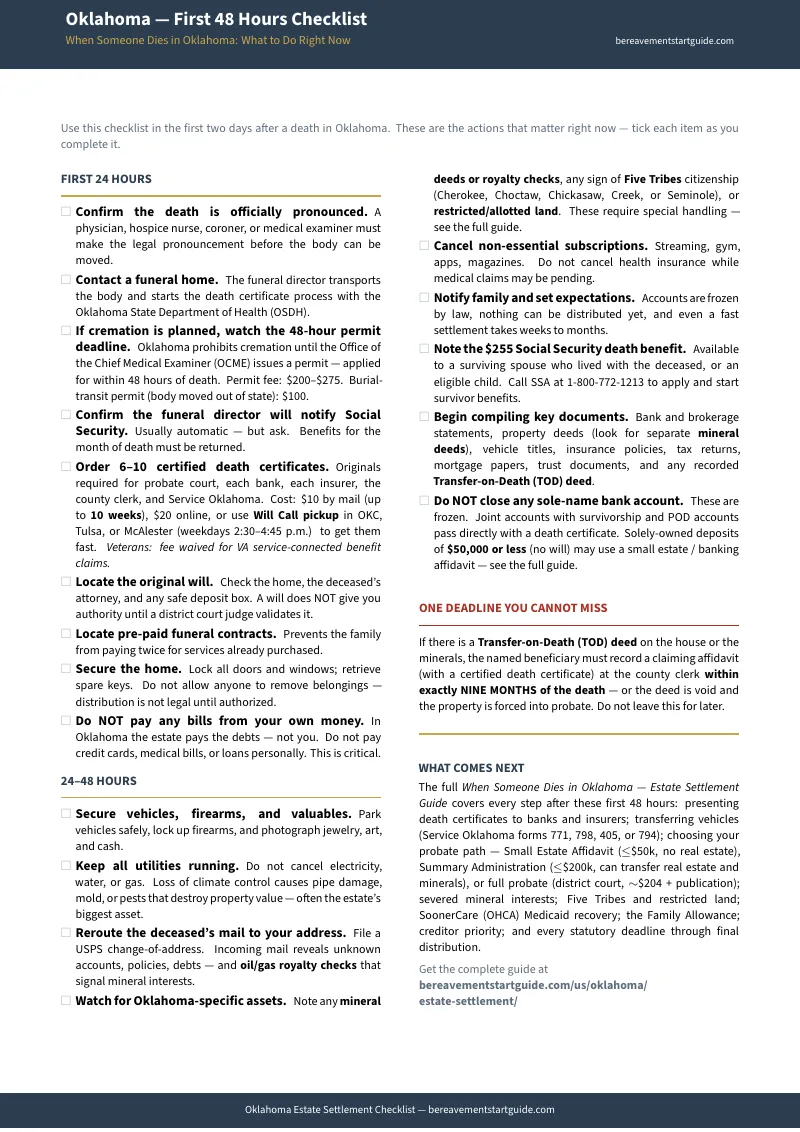
Not ready for the full guide? Download the free Oklahoma First 48 Hours Checklist — the death certificates, the 48-hour cremation permit, securing the home, the financial boundary that protects you, and the one nine-month deadline you cannot miss. It is enough to get through tonight and tomorrow.
You did not ask for this job. But you are the one doing it. The bank will not release the money. The county clerk will not explain the forms. The clock on the TOD deed is already running. This guide puts every Oklahoma step into one sequence so you can stop searching and start settling.