The Clerk Took Your $204 Filing Fee. Then She Handed You a Blank Petition, a Notice to Creditors With No Instructions, and Told You She Cannot Give Legal Advice. Now the Mineral Company Wants a Court Decree You Do Not Know How to Get.
You were named executor — or nobody was, and you are the closest relative who showed up. You drove to the district court with the death certificate and a copy of the will, expecting someone to tell you what to file and in what order. The clerk accepted your money, handed you a stack of blank forms, and said those five words: "We cannot give legal advice." You sat in the parking lot and stared at a Petition for Probate, an Order for Hearing, and a Notice to Creditors form that requires a specific calendar date you do not know how to calculate.
Then the petroleum landman called. Your parent owned a fractional mineral interest in an Oklahoma well. Royalties are suspended until someone "clears title through the court." You tried the Small Estate Affidavit — and the clerk rejected it, because Oklahoma's affidavit cannot transfer real estate or mineral rights under any circumstances. You searched online and found three different probate tracks, two different dollar thresholds, a nine-month deadline on a deed you may or may not have, and a Medicaid recovery agency that may be coming for the house. Every source told you to hire an attorney. The retainer starts at $3,250.
Here is the fact that changes everything: Oklahoma has not adopted the Uniform Probate Code. There is no informal track handled by a registrar. Every probate in this state goes through a judge. But within that system, Oklahoma offers three distinct paths — and choosing the right one on day one can save you months, thousands of dollars, and the kind of mistakes that make you personally liable for debts that were never yours.
The Oklahoma Probate Process Guide gives you The Oklahoma Court Roadmap — the complete sequence from first filing through final decree, translated from Title 58 statutes into the plain-English steps you actually follow at the district court. Not a national template that mentions Oklahoma in the header. A 20-chapter manual built around the specific Oklahoma rules — three probate tracks, the nine-month TOD cliff, severed minerals, the Stigler Act, SoonerCare recovery, creditor priority — that generic guides skip and grieving families pay for.
What's Inside The Oklahoma Court Roadmap
A 20-chapter guide plus a standalone Probate Quick-Start Checklist — covering every stage from determining whether you need the court at all through recording the final decree, built specifically for Oklahoma's Title 58 statutes, district court procedures, Service Oklahoma forms, and the county-clerk rules that make probate here unlike any UPC state:
Chapter 1: Do You Even Need Probate?
Joint tenancy property, POD bank accounts, TOD investments, life insurance with a named beneficiary, and trust assets all skip the court entirely. This chapter walks you through the separation — probate assets versus non-probate assets — so you know exactly which pile needs the judge and which pile you can claim with a death certificate and a phone call. If everything the person owned already has a named beneficiary or a surviving joint owner, you may not need the court at all. Start here before you file anything.
Chapter 5: The Three-Track Decision — The Most Important Choice You Will Make
Oklahoma gives you three paths, and most families pick the wrong one because nobody explains the thresholds. The Small Estate Affidavit: personal property and deposits under $50,000, no court, no filing fee — but it can never touch real estate or minerals. Summary Administration: the Oklahoma sweet spot — estates under $200,000, or a non-resident decedent, or someone who died more than five years ago — a single hearing, one decree, often done in 60 to 90 days, and it can clear title to real estate and minerals. Standard Probate: for everything else — six to twelve months, multiple hearings, mandatory bond. A side-by-side comparison table with the value thresholds, creditor windows, timelines, and filing costs so you choose correctly the first time.
Chapter 6: Summary Administration — The Accelerated Track
This is the chapter that saves most readers thousands of dollars. Summary Administration under 58 O.S. § 245 collapses the entire probate into a combined notice, a Special Administrator appointment, an accelerated 30-day creditor window, and a single final hearing at roughly 50 to 60 days. It produces the same title-clearing judicial decree as a full probate — including for mineral rights. If your estate qualifies, this is the path. The chapter gives you the petition, the notice, the hearing, and the decree — step by step.
Chapter 11: The Nine-Month TOD Deed Trap
The single most dangerous deadline in Oklahoma estate law. A Transfer-on-Death deed passes real estate outside probate — but only if the named beneficiary records a claiming affidavit at the county clerk within exactly nine months of death. Miss it by one day and the deed is void. The property reverts to the probate estate and goes through the full court process the deceased set the TOD deed up to avoid. This chapter tells you what affidavit to file, where to file it, what documents to attach, and why you record it first — not last.
Chapter 13: Severed Mineral Interests — The Oklahoma Wild Card
Millions of Oklahomans own fractional oil, gas, or mineral rights — often a small share inherited generations ago, sometimes without the family knowing until a royalty check or a landman's letter arrives. You cannot transfer minerals with a Small Estate Affidavit, period. The guide explains your two real options: the Affidavit of Death and Heirship under 16 O.S. § 67, which costs almost nothing but takes ten years to mature into marketable title (with royalties locked the entire time) — or Summary Administration, which clears title and frees suspended royalties in weeks. If there is a producing well, a pending lease offer, or a landman asking questions, this chapter alone pays for the guide many times over.
Chapter 14: Medicaid Estate Recovery — The Lien That Keeps Families Awake
If the deceased was 55 or older and received SoonerCare nursing-home or home-care benefits, the Oklahoma Health Care Authority is mandated to recover those costs from the probate estate. The fear of losing the family home stops people in their tracks. This chapter lays out the critical fact most families never learn: Oklahoma is a "probate only" recovery state — assets that bypass probate through joint tenancy, TOD deeds, or trusts are completely shielded. It maps the exact exemptions that block a lien even on probate assets: a surviving spouse in the home, a minor or disabled child, a resident sibling with equity — plus the undue-hardship waiver and the burial carve-outs.
Chapter 15: Managing Creditor Claims — The Rules That Protect You
The fear of being chased for a parent's credit-card debt paralyzes more executors than anything else. Here is the law: you are not personally liable for the deceased's debts unless you co-signed them. The guide explains the Notice to Creditors that bars late claims — including the requirement for a specific calendar date, not "60 days from receipt" — the strict statutory payment priority (funeral first, last illness, family allowance, taxes, then general creditors), and the rule that distributing assets before the creditor period closes makes you personally liable for the shortfall. This chapter keeps you from making that mistake.
Chapter 19: Native American Restricted Lands and the Stigler Act
If the deceased was a citizen of one of the Five Civilized Tribes or owned restricted or allotted land, you are in a different legal world governed by federal law. Restricted lands must be probated in Oklahoma state court under the Stigler Act — the BIA does not handle these. Full-blood will requirements add another layer of complexity. This chapter tells you plainly that this is the one situation you do not attempt alone, and exactly what kind of counsel to find.
Chapters 4 and 18: Your Duties as Executor — And How to Get Out
Every obligation and every liability risk, start to finish. The fiduciary duty that means you cannot sell estate property to a family member at a discount. The strict order for paying debts that keeps you from becoming personally liable. The non-resident executor rules. The Final Account and Petition for Distribution that closes the estate. The executor and attorney fee schedules set by statute. And the process for recording the decree in every county where the estate owns property — the step most people forget, and the one that leaves title clouded if you skip it.
Who This Guide Is For
- The executor who just got handed blank forms at the district court — you paid the filing fee, nobody explained the process, and you need the forms, the deadlines, and the order before you file something wrong. This guide is the instruction manual the clerk is prohibited from giving you.
- The out-of-state heir whose parent died in Oklahoma — you live in Texas or California or Colorado, you cannot keep driving to the courthouse, and you need to know whether Summary Administration lets you handle this remotely in a single hearing.
- The family that just discovered mineral rights — a landman called about suspended royalties on a fractional interest nobody knew existed, the Small Estate Affidavit cannot touch it, and you need the fastest path to clear title through the court.
- The surviving spouse terrified of Medicaid recovery — the OHCA mailed a notice about nursing-home costs and you do not know whether the house is safe. The guide maps the exemptions that protect it.
- The family managing a modest estate under $200,000 — you qualify for Summary Administration but nobody told you it existed, nobody explained the accelerated creditor window, and nobody mentioned that it clears mineral title the same way full probate does.
- The price-sensitive executor who can do the paperwork — you are organized, capable, and willing to file the forms yourself rather than pay a $3,250 retainer for a process that this guide walks you through step by step.
Why Free Resources Will Not Get You Through Oklahoma Probate
The forms are available online. The knowledge of which form, when, and what happens if you get it wrong is not. Here is what actually happens when you try to probate an Oklahoma estate from free sources:
- The district court clerk will hand you blank forms and tell you she cannot advise you. She cannot tell you which probate track to choose, how to calculate the $50,000 versus $200,000 threshold, how to draft the creditor notice with the correct calendar date, or what happens if you distribute assets before the creditor window closes. The forms exist. The instructions do not.
- National platforms miss the Oklahoma rules that actually matter. LegalZoom, Nolo, and Trust & Will offer clean interfaces and generic templates — and routinely skip the three-track system, the nine-month TOD acceptance deadline, the ban on transferring minerals by affidavit, the Stigler Act for restricted land, and the SB 212 foreign-ownership affidavit that every deed has required since November 2023. A template built for UPC states will get rejected at an Oklahoma district court.
- Attorney blogs explain the danger to sell you the retainer. Local probate firms write accurate content — structured to convince you the process is too complex to attempt without spending $3,250 or more. For contested estates and tribal land, that can be true. For a straightforward estate going through Summary Administration, the steps are sequential, predictable, and entirely doable yourself.
- Government sites each cover one slice and never connect them. The district court covers filings. Service Oklahoma covers vehicles. OSDH covers death certificates. The Corporation Commission covers minerals. OHCA covers Medicaid recovery. Each one covers its own domain. None tells you the order, the dependencies, or the consequence of doing Step 7 before Step 3.
Free sources give you blank forms and statute numbers. The Oklahoma Court Roadmap gives you the complete sequence — petition to decree — in the order you file it, in the language you understand.
— Less Than One Hour With an Oklahoma Probate Attorney
A straightforward probate retainer in Oklahoma starts around $3,250 and climbs with complexity. Hourly rates run $150 to $300. National estate-software subscriptions charge you annually for generic tools that have never heard of severed minerals, the nine-month TOD cliff, or the Stigler Act. This guide costs less than a single hour of attorney time and gives you the complete Oklahoma-specific court roadmap — every statute, every deadline, every form, the three-track decision tree, and the honest line that tells you whether you need professional help or whether you can file it yourself.
Your download includes the complete 20-chapter guide covering all three probate tracks, mineral interests, Medicaid recovery, creditor priority, tribal land, taxes, and closing the estate — plus seven standalone reference cards built to print and keep at your desk: the Probate Quick-Start Checklist, the Three-Track Probate Decision Tree, the Nine-Month TOD Deed Deadline Walkthrough, the Severed Mineral Interests Guide, the Medicaid Estate Recovery Map, the Creditor Priority and Executor Liability Reference, and the Native American Restricted Land and Stigler Act Overview. Instant download, no account required.
30-day money-back guarantee. If the guide does not give you clarity on which probate track applies, what to file, and what order to file it in, email us for a full refund. No questions asked.
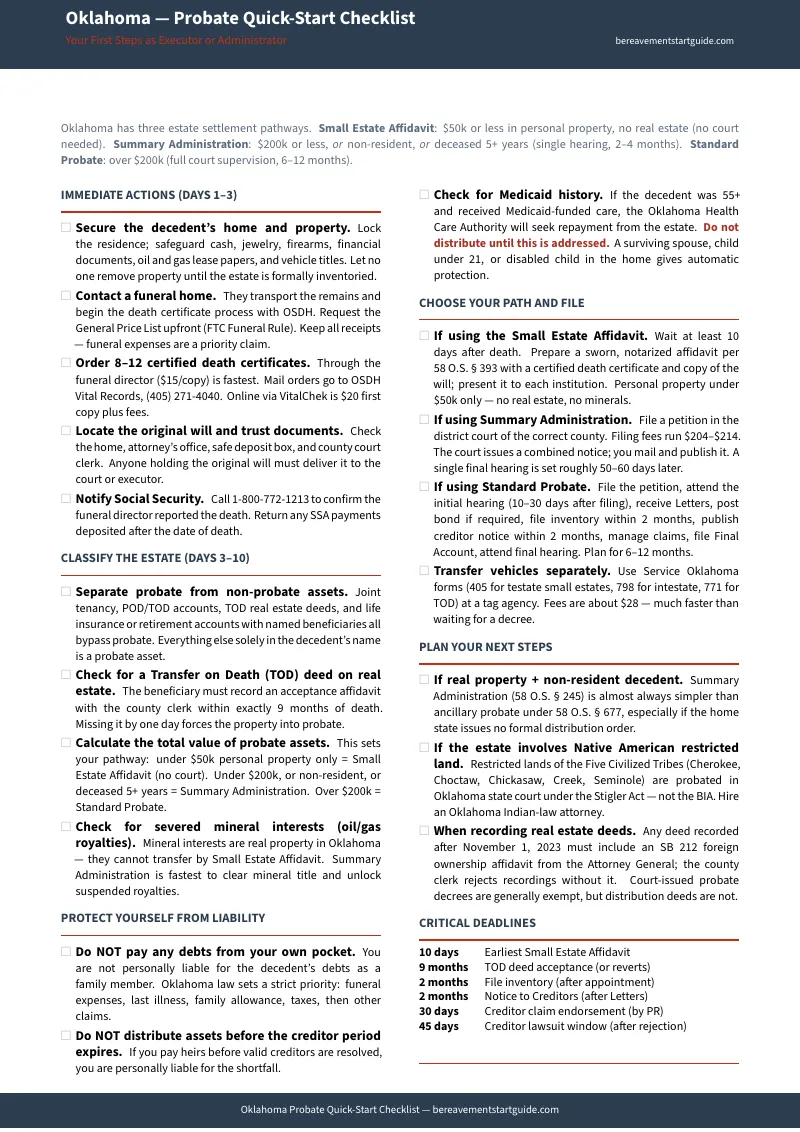
Not ready for the full guide? Download the free Oklahoma Probate Quick-Start Checklist — the 18-item action list covering the first steps, how to classify the estate, the three-track decision, and the liability traps to avoid from day one. It is enough to get your bearings before you file anything.
You did not ask to become the executor. But the court file has your name on it now. The clerk will not explain the forms. The landman will not wait forever. The nine-month clock on the TOD deed is already running. This guide puts every Oklahoma probate step into one sequence — petition to decree — so you can stop searching and start filing.