
The County Clerk Handed You a Blank Affidavit and Said "We Are Legally Prohibited From Explaining It." The Bank Froze the Accounts. And Somewhere in the Fine Print Is a $1 Million Tax Cliff Nobody Warned You About.
Someone you love just died in Oregon. You went to the bank to pay a bill and the teller said the account is frozen until you produce "Letters Testamentary" from the circuit court — a document you do not have and do not know how to get. You called the county clerk and were told, almost word for word, that they are legally prohibited from giving legal advice or explaining the forms. You searched online and found a "Simple Estate Affidavit" that sounded fast and easy — then discovered the real property cap is $200,000, the average Oregon home is worth $450,000, and the shortcut does not apply to you.
And then you saw it: Oregon imposes an estate tax starting at $1 million. Not the federal threshold of $15 million — one million dollars. A modest Portland home, a retirement account, and a life insurance policy can push a middle-class family over the line. No spousal portability. No inflation indexing. Form OR-706 is due within 12 months of death, and the penalties for missing it are real. Nobody at the funeral mentioned this. Nobody at the bank mentioned this. You found it buried in a DOR bulletin at 2 a.m.
Here is the truth that makes Oregon different from almost every other state: Oregon gives families a streamlined small estate process — then walls it off with caps so low that most families with a house cannot use it, imposes an estate tax that starts lower than 47 other states, and runs a Medicaid recovery program so aggressive it pursues assets outside of probate. The Oregon DHS Estate Administration Unit recovers $14 for every $1 invested. They do not just file claims against the probate estate — they pursue joint accounts, Transfer-on-Death designations, and living trust assets that families thought were protected. The funeral home gives you a sympathy folder. The state gives you blank forms and statute numbers. Neither one gives you the order to do them in.
The When Someone Dies in Oregon — Estate Settlement Guide gives you The Oregon Sequence — the right things, in the right order, translated out of statute language and into plain English. Not a national template with "Oregon" pasted into the header. A 16-chapter manual built around the specific Oregon rules — the $1 million estate tax cliff, the aggressive Medicaid recovery, the Simple Estate caps that exclude most homeowners, the four legal disposition options including human composting — that generic guides miss and grieving families pay for.
What's Inside The Oregon Sequence
A 16-chapter guide, the standalone First 48 Hours Checklist, plus four appendices and printable reference sheets — covering every stage from the moment of death through final distribution, built specifically for Oregon statutes, Oregon Judicial Department forms, DHS Estate Administration Unit procedures, and the Department of Revenue rules that make settling an estate here unlike anywhere else:
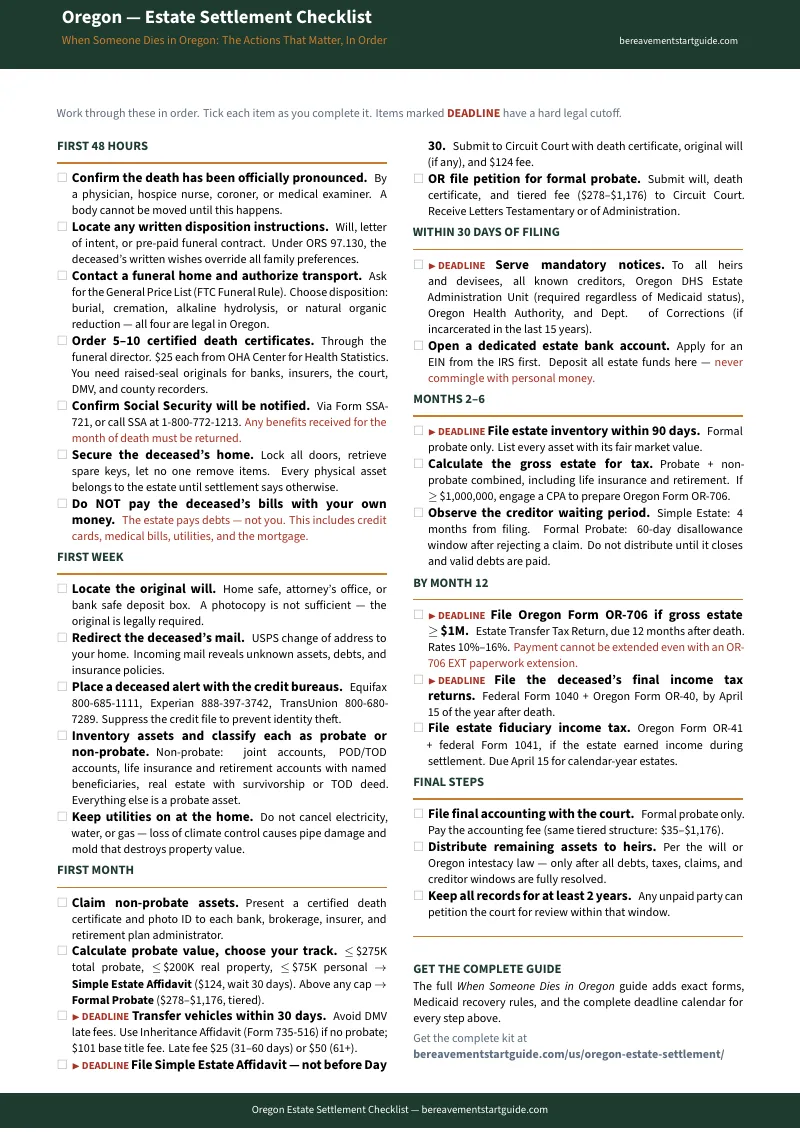
The First 48 Hours — Including the Disposition Decisions Only Oregon Offers
Oregon is one of the few states that offers four legal options for final disposition: traditional burial, cremation, alkaline hydrolysis (water cremation), and natural organic reduction (human composting) — legalized in 2021 under HB 2574. This chapter walks you through coordinating with the funeral director, the exact number of certified death certificates to order (8 to 12 for most Oregon families — banks, insurers, the circuit court, DMV, and the Department of Revenue each need originals), and why ordering extras on the first pass saves weeks. Oregon vital records operates through county health departments, and replacement orders are slow. Get the count right the first time.
The First Week — Securing the Estate and Setting Expectations
Before any court gives you authority, you have a legal duty to keep the estate's assets from being lost, damaged, or wasted. Lock the home, keep the utilities on — a burst pipe in a Portland winter can destroy your largest asset — reroute the mail (your single best tool for discovering hidden accounts, recurring bills, and insurance policies), and the rule that matters more than any other: do not pay one cent of the deceased's debts with your own money. The estate pays the debts, not you. Paying out of pocket or out of the statutory priority order is how personal representatives end up personally liable for the difference.
Choosing Your Settlement Track — The Most Important Decision
This is the single decision that determines your timeline, your cost, and your sanity. Oregon offers two primary paths, and most families end up on the one they did not expect. The Simple Estate Affidavit is fast, court-free, and requires only a $124 filing fee — but the caps are brutal: $75,000 in personal property and $200,000 in real property, and you must wait 30 days after death to file. With the average Oregon home valued around $450,000, most families with real estate are immediately disqualified. That means formal probate through the circuit court — which is not the nightmare it sounds like. For uncontested estates, Oregon probate is predictable, sequential, and manageable without an attorney if you know the steps. The guide gives you the decision tree, the side-by-side comparison, and the filing costs for each path.
The Simple Estate Affidavit — Step by Step
If your estate qualifies — personal property under $75,000, real property under $200,000, and 30 days have passed since death — this chapter walks you through the entire affidavit process: what the clerk needs, what the affidavit must contain under ORS 114.515, what you can and cannot claim with it, and the traps that disqualify you. For many families settling a parent's apartment with modest savings and no real estate, this is the entire process.
Formal Probate — Step by Step
For estates that exceed the Simple Estate caps — which includes most Oregon homeowners — this chapter walks you through the full circuit court proceeding: filing the petition, the notice requirements, receiving Letters Testamentary or Letters of Administration, the creditor claim period, the inventory, and final distribution. Oregon probate runs through the county circuit court, not a separate probate court. The guide covers what to file, where to file it, and the specific Oregon Judicial Department forms you need at each stage.
Transferring Vehicles — The DMV Process
Oregon DMV has its own transfer process that runs parallel to probate. The guide covers which forms to use based on whether the estate goes through probate or the Small Estate Affidavit, the title transfer with or without Letters, and the registration steps. Bring the wrong paperwork and you make a wasted trip to DMV — this chapter makes sure you bring the right documents the first time.
Transferring Real Property
For most Oregon families, the house is the largest asset in the estate — and the one that causes the most confusion. This chapter covers how real property transfers depending on your settlement path: surviving joint tenancy (which passes outside probate with just a death certificate and an affidavit), Transfer-on-Death deeds, and property that must go through formal probate. It includes the recording requirements at the county clerk's office and the specific documents needed to clear title.
Paying Debts — Priority Order and Personal Liability
The fear of being personally chased for a parent's credit-card debt paralyzes more personal representatives than anything else. You are not personally liable for the deceased's debts unless you co-signed them. But pay the debts in the wrong order and you can become liable for the difference. Oregon statute prescribes a strict priority: funeral expenses and costs of administration first, then family allowance, then federal and state taxes, then medical expenses of the last illness, then everything else. The guide gives you the exact order and the Notice to Creditors process that bars late claims — protecting you and the estate from collectors who show up months later.
Medicaid Estate Recovery — Oregon's Aggressive Program
This is the chapter that families wish they had read six months earlier. Oregon's DHS Estate Administration Unit is one of the most aggressive Medicaid recovery programs in the country — it recovers $14 for every $1 invested in the program. What makes Oregon different: the EAU uses an expanded estate definition that pursues assets outside probate. Joint accounts, Transfer-on-Death designations, and living trust assets that families thought were protected are all reachable. Claims are deferred — not erased — if there is a surviving spouse or a child under 21 or a disabled child. The guide lays out exactly when the EAU can file a claim, what assets are reachable, the exemptions that block recovery, and the hardship waiver process. If the deceased received any Oregon Health Plan long-term care benefits after age 55, read this chapter before you transfer anything.
Oregon Estate Tax — The $1 Million Cliff
This is the rule that catches middle-class Oregon families completely off guard. Oregon imposes its own estate tax starting at a gross estate of just $1 million — while the federal threshold sits at $15 million. There is no spousal portability (a surviving spouse cannot use the deceased spouse's unused exemption). There is no inflation indexing (the $1 million line has not moved). A modest home in the Portland metro area, a retirement account, and a life insurance policy can push an otherwise ordinary estate over the line. Form OR-706 is due within 12 months of death, and the penalties for late filing are real. The guide explains how to calculate the gross estate, which deductions apply, and the interaction between Oregon and federal estate tax — plus the Initiative Petition 51 that may repeal it on the November 2026 ballot.
When You Need Professional Help
This guide is honest about its own limits. It tells you plainly where you can handle the routine 80% yourself and where Oregon's specific triggers — the $1 million estate tax cliff, Medicaid recovery against non-probate assets, complex real property holdings, business interests, or a contested estate — make professional help not a luxury but cheap insurance. A simple uncontested probate in Oregon typically costs $3,000 to $5,000 for an attorney; contested estates or those requiring estate tax filings run far higher. This guide costs a tiny fraction of that and tells you whether you even need to make the call.
The Master Deadline Calendar
Every Oregon deadline in one place, from Day 1 through Month 12 and beyond: death certificate ordering, the 30-day waiting period for the Simple Estate Affidavit, the creditor claim window, the 12-month estate tax filing deadline, the fiduciary income tax deadline, and the final accounting. Print it and work it top to bottom.
Advance Directives and Pre-Death Planning Documents
Oregon's advance directive framework — including its intersection with the Death with Dignity Act, the state's pioneering end-of-life legislation — affects what documents you may find among the deceased's papers and what legal weight they carry. This chapter explains what to look for and what each document means for the estate settlement process.
Fiduciary Income Tax — Form OR-41
If the estate earns income after the date of death — rent, dividends, interest, proceeds from a property sale — the estate becomes a separate Oregon taxpayer and must file Form OR-41. This chapter explains when the return is required, what income triggers it, and how it interacts with the federal Form 1041. Most families do not realize the estate can owe income tax independent of the estate tax until the first April 15 passes.
Oregon Intestacy — What Happens When There Is No Will
When there is no will, Oregon's intestacy statutes decide who inherits. The rules are not always intuitive — the surviving spouse's share depends on whether the deceased had children, and whether those children are also the spouse's children. Community property does not exist in Oregon, but the state's elective share and homestead protections give a surviving spouse specific rights. This chapter maps the intestacy tree so you know exactly who inherits what, without a will.
Non-Probate Transfers — Claiming What Bypasses the Court
Life insurance, retirement accounts with named beneficiaries, joint tenancy property, Transfer-on-Death deeds, Payable-on-Death bank accounts — these assets pass outside probate entirely. But they still require action: filing claims, presenting death certificates, recording affidavits. This chapter covers every common non-probate transfer in Oregon and the steps to actually collect each one. These are often the fastest assets to access — and the ones families overlook because they assume someone else is handling it.
Appendices — Forms Directory, Agency Contacts, Asset Inventory, and Creditor Tracking
Four appendices give you the working tools: a directory of every Oregon estate settlement form and where to find it, key agency contact information (circuit courts, DHS Estate Administration Unit, Oregon Department of Revenue, DMV, vital records), a printable asset inventory worksheet, and a creditor notification tracking sheet to document every notice sent and every response received.
Who This Guide Is For
- The surviving spouse who cannot access the frozen accounts — the bank wants Letters Testamentary you do not have, the mortgage payment is due, and no one will explain how to get past it. The guide tells you which accounts are already yours by operation of law, when the Small Estate Affidavit releases the rest, and when you need the circuit court.
- The adult child named personal representative who has never filed a legal document — everyone is looking at you and you have no idea what the job actually involves. The guide is the complete job description: what to do, what never to do, the debts you must not pay out of order, and the deadlines that decide whether you fulfill your duty or breach it.
- The out-of-state heir whose parent died in Oregon — you live in Washington or California, the county clerk's office will not explain the forms, and you cannot keep driving to the courthouse. The guide gives you every form, fee, and deadline so you can coordinate the process without being physically present for every step.
- The family that just discovered the estate is over $1 million — the house, the retirement accounts, and the life insurance push you past Oregon's estate tax threshold, and you had no idea the state taxed estates this low. The guide explains the calculation, the deductions, and the 12-month filing deadline for Form OR-706.
- The family afraid of losing the home to Medicaid recovery — DHS mailed a recovery notice for long-term care costs and you do not know your options. The guide lays out exactly what the Estate Administration Unit can reach — including assets outside probate — and the exemptions and waivers that may protect the home.
- The family that thought the Simple Estate Affidavit would handle everything — and just discovered the real property cap is $200,000, the house is worth $450,000, and formal probate is the only path forward. The guide walks you through it step by step so you know it is manageable, not terrifying.
Why Free Resources Will Not Get You Through This
The forms are free. The knowledge of which form, when, and how is not. Here is what actually happens when you try to settle an Oregon estate from free sources:
- County clerks hand you blank forms and are legally prohibited from helping. Oregon law explicitly bars clerks from giving legal advice or explaining how to fill out the forms. The forms exist. The instructions do not.
- National platforms miss the Oregon rules that actually matter. Nolo, LegalZoom, and Trust & Will offer clean interfaces and generic templates — and routinely gloss over the $1 million estate tax cliff, the Medicaid EAU's expanded estate definition that reaches non-probate assets, and the Simple Estate caps that exclude most homeowners. A template that ignores those gets you in trouble, not out of it.
- Attorney blogs explain the danger to sell you the retainer. Oregon probate firms write accurate, detailed content — designed to convince you the process is too dangerous to handle without spending $3,000 to $5,000 on a retainer. For complex or contested estates, that can be true. For a straightforward estate, the steps are sequential, predictable, and entirely doable yourself with the right roadmap.
- Government sites cover one slice each and never connect the dots. Oregon Vital Records handles death certificates, DMV handles vehicles, the circuit court handles probate, DHS handles Medicaid recovery, the Department of Revenue handles estate tax. Each covers its own domain. None tells you the order, the dependencies, or the consequence of doing one before another.
- Legal aid is income-gated and limited. Oregon legal aid organizations offer free consultations — typically 15 minutes, restricted by income eligibility, and focused on triage rather than the full process. They can tell you what you need; they cannot walk you through it.
Free resources give you blank forms and a warning not to make mistakes. The Oregon Sequence gives you the complete order — death certificate to final distribution — translated into plain English, built for Oregon law.
— A Fraction of a Single Hour With an Oregon Probate Attorney
A simple, uncontested probate in Oregon typically costs $3,000 to $5,000 for an attorney, and estates requiring estate tax filings or Medicaid recovery defense run far higher. Hourly rates for Oregon probate attorneys range from $200 to $500 per hour. This guide costs less than a fraction of a single attorney consultation and gives you the complete Oregon-specific roadmap — every statute, every deadline, every form, the settlement track decision tree, and the honest line that tells you whether you even need to make that call.
Your download includes the complete 16-chapter guide with four appendices, the standalone Oregon First 48 Hours Checklist, and six printable reference sheets — the Master Deadline Calendar, the Simple Estate vs. Formal Probate Decision Tree, the Medicaid Recovery Exemptions Reference, the Estate Tax Filing Reference, the Creditor Priority and Liability Reference, and the Asset Inventory Worksheet. Instant download, no account required.
30-day money-back guarantee. If the guide does not give you clarity on what to do next and confidence that you are doing it in the right order, email us for a full refund. No questions asked.
Not ready for the full guide? Download the free Oregon First 48 Hours Checklist — the death certificates, securing the home, the financial boundary that protects you, and the critical deadlines you need to know before the first week is over. It is enough to get through tonight and tomorrow.
You did not ask for this job. But you are the one doing it. The bank will not release the money. The county clerk cannot explain the forms. The $1 million estate tax clock is ticking and the Medicaid recovery unit already knows about the estate. This guide puts every Oregon step into one sequence so you can stop searching and start settling.