The Hospital Said a Funeral Home Must Pick Up the Body. The Death Certificate Must Be Filed in Black Ink or It Gets Rejected. Your Mother Wanted Human Composting but Nobody Knows if It Is Legal. And the State Will Claw Back Her Medicaid Costs From Her House.
Someone just died in Oregon, and you are the person trying to figure out what happens next. You called the hospital and they told you a funeral home needs to come get the body. That is not Oregon law — it is the facility's internal policy. Oregon is one of the few states where families have the absolute legal right to handle everything themselves: prepare the body, transport it in a personal vehicle, file the death certificate, and manage the entire disposition without ever involving a licensed funeral director. But the hospital staff did not tell you that. They told you what they always tell families, and now you are on the phone with a funeral home that just quoted you $11,794 for a "full-service burial package."
Meanwhile, the clock is running. The medical certifier has 48 hours to sign the cause of death on the certificate. You need to file the 24-Hour Death Notice with the county registrar. If you want to handle this without a funeral home, you need the "Home Burial Packet" from the Oregon Health Authority — a paper death certificate, a metal identification tag, and strict filing instructions that require black ballpoint ink with zero tolerance for white-out or cross-outs. One mistake on the form voids it. A voided certificate delays the cremation, delays the burial, delays the insurance claim, and forces you to request a new form while the daily refrigeration fees accumulate.
Then there is the money. Oregon's estate tax threshold sits at $1 million — not indexed for inflation, no spousal portability. A family home in Portland or Bend that has appreciated over the past decade can push a middle-class estate over the threshold, generating a $50,000 or larger tax bill. And if the deceased received Medicaid after age 55, the Oregon Department of Human Services will pursue estate recovery — at a documented rate of $14 recovered for every dollar the state invests in the program. They use an expanded definition of "estate" that reaches assets passing outside of probate: joint bank accounts, payable-on-death designations, beneficiary listings. Simply putting your mother's name on a joint account does not protect the money.
The Oregon Funeral Laws & Consumer Rights Guide is a Death-Care Defense Manual — a plain-English, statute-by-statute reference covering every decision, deadline, and financial trap Oregon families face from the moment of death through estate settlement. Not a sympathy resource. Not a blog post from a funeral home designed to funnel you into their most expensive package. Not a national overview that mentions Oregon in a footnote. A 12-chapter manual built entirely on Oregon Revised Statutes, Oregon Administrative Rules, and the FTC Funeral Rule — organized in the order you will actually face these decisions.
What's Inside the Death-Care Defense Manual
A 12-chapter guide covering every legal, financial, and procedural question Oregon families face — from who has the authority to make decisions through final estate settlement and asset defense:
Chapter 1: Who Has the Legal Right to Make Decisions
Before any arrangement can proceed, you need to know who Oregon law says is in charge. ORS 97.130 establishes a strict hierarchy: the decedent's own written instructions take first priority, then surviving spouse, then adult children, then parents, then siblings, down through legal guardian, next of kin, personal representative, and public health officer. The guide covers the full 9-tier hierarchy, the criminal homicide forfeiture rule, how DD Form 93 supersedes state documents for military personnel, and what happens when two siblings at the same priority level disagree — because Oregon law provides no built-in tie-breaking mechanism.
Chapter 2: The First 48 Hours — Immediate Steps After a Death
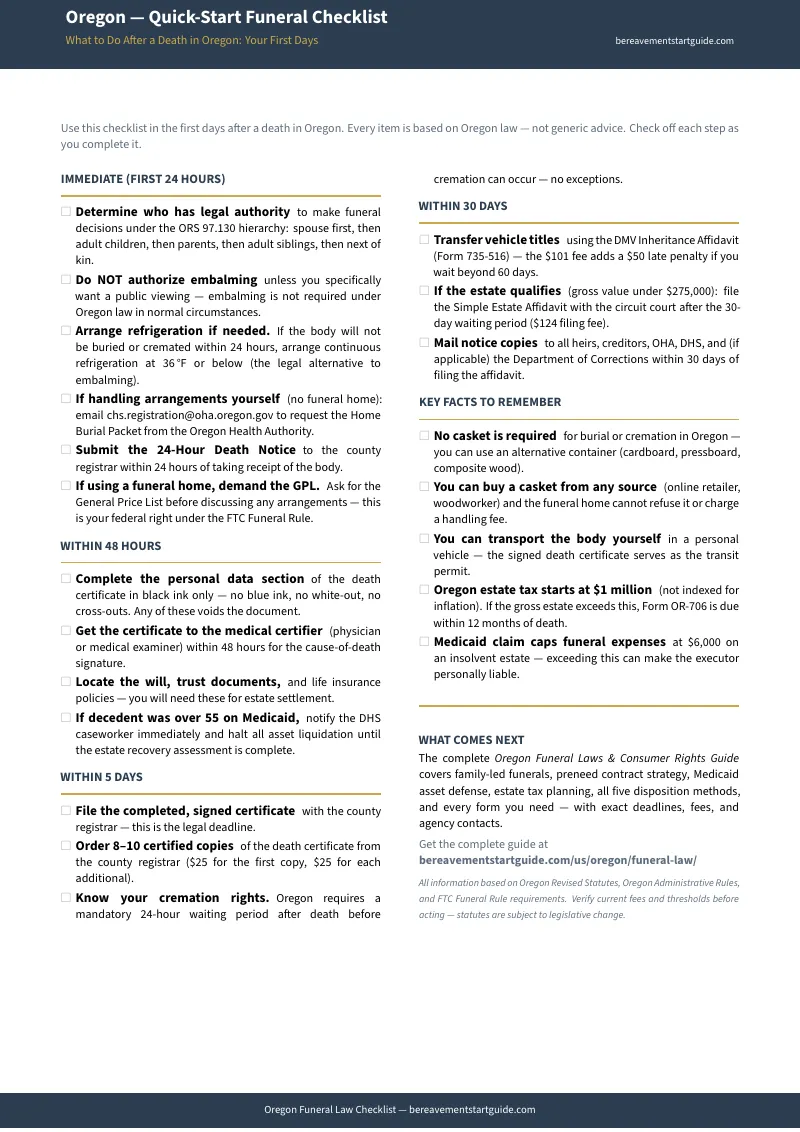
Oregon runs on one of the tightest vital records timelines in the country. The 24-Hour Death Notice must be submitted to the county registrar within 24 hours of receiving the body. The death certificate must reach the medical certifier within 48 hours. The original must be filed with the county within 5 days. Certified copies cost $25 each — order at least 8-10 in one request. The guide walks through every step in sequence, including the embalming vs. refrigeration decision (refrigeration at 36 degrees or below is the legal alternative), the "24-hour myth" that hospitals use to pressure families, and the document preservation checklist for the first 48 hours.
Chapter 3: Family-Led Funerals — How to Handle Everything Without a Funeral Home
Oregon families have the absolute legal right to act as their own funeral service practitioner under ORS 432.005. The operational steps are specific and unforgiving. You must email the Oregon Health Authority Center for Health Statistics to request the Home Burial Packet ([email protected]). The paper death certificate must be completed in black ballpoint ink — no blue ink, no felt-tip markers, no white-out, no cross-outs. The metal identification tag must stay with the remains throughout the entire process. The guide covers every step, the exact statutes to cite when hospital staff try to block you, and the OMCB complaint process when facilities refuse to cooperate.
Chapter 4: Your Consumer Rights — The FTC Funeral Rule and Oregon Protections
Every funeral home must provide a General Price List to anyone who asks — before discussing arrangements, without requiring your name. You can buy a casket from any online retailer and the funeral home cannot refuse it or charge a handling fee. Embalming cannot be performed without your explicit written or documented oral permission. Oregon Administrative Rules go further: funeral home contracts must display the facility's registered business name and physical location in a minimum 10-point font. The guide gives you a compliance checklist for the funeral home meeting and the exact process for filing a complaint with the Oregon Mortuary and Cemetery Board when your rights are violated.
Chapter 5: Choosing a Final Disposition Method
Oregon offers one of the broadest menus of legal disposition options in the country. Traditional burial (no casket or vault required by state law). Direct cremation ($7,410 average with service — dramatically less without). Alkaline hydrolysis, legal since 2009. Natural Organic Reduction (human composting), legalized under House Bill 2574, effective July 1, 2022 — approximately $7,000, using 87% less energy than cremation. Private property burial with specific zoning, easement, and disclosure requirements. The guide covers the rules, costs, and logistics of every option, plus the scattering rules for each type of land — private property, state parks, national parks, BLM land, ocean, and aerial.
Chapter 6: Preneed Funeral Contracts and Medicaid Planning
This chapter bridges funeral law and financial defense. Oregon places no maximum financial limit on Irrevocable Funeral Trusts — making them one of the most powerful Medicaid spend-down tools available in any state. The guide covers the revocable vs. irrevocable distinction (only irrevocable trusts protect assets from Medicaid eligibility counts), the 60-month look-back period, the 30-day refund notification rule when preneed plans are altered after a Medicaid recipient dies, and the certification requirements for funeral homes selling trust-funded contracts.
Chapter 7: Estate Settlement — Affidavit vs. Full Probate
The Simple Estate Affidavit lets heirs settle estates under $275,000 without full probate — $124 filing fee, 30-day waiting period, 4-month creditor window. But the thresholds use gross fair market value with no deduction for debts or mortgages: a house worth $250,000 with a $200,000 mortgage still counts as $250,000. The guide covers both paths, filing fees by estate value ($278 to $1,176), vehicle title transfers via DMV Form 735-516, and the real property recording fees that vary by county.
Chapter 8: The Oregon Estate Tax — The $1 Million Threshold
Oregon's estate tax hits estates above $1 million at rates from 10% to 16%. No inflation indexing. No spousal portability. A $1.5 million estate — a Portland home plus a retirement account — owes $50,000. The guide covers the progressive bracket system, the Natural Resource Exemption (up to $15 million for farm, forest, and fishing property), the A/B bypass trust strategy for married couples, Form OR-706 filing deadlines (12 months from death, with the critical warning that filing extensions do not extend the payment deadline), and the Form OR-41 fiduciary income tax for post-mortem estate income.
Chapter 9: Medicaid Estate Recovery — Protecting the Family Home
Oregon recovers $14 for every dollar it invests in administering its Medicaid recovery program. The state uses an expanded definition of "estate" that reaches beyond probate assets. The $6,000 funeral expense cap for insolvent estates can catch families off guard — and executors who spend estate funds on funeral costs exceeding this cap before satisfying the DHS lien can be held personally liable. The guide covers the immediate steps when Medicaid is involved, the irrevocable funeral trust defense, and the 60-90 day assessment window during which you should not distribute any estate funds.
Chapter 10: Advance Directives, POLST, and the Death with Dignity Act
Oregon pioneered medical aid in dying, and the 2023 repeal of the residency requirement brought a new wave of out-of-state participants. The guide covers the updated advance directive form (Senate Bill 199), the specific witness exclusions (attending physicians and facility employees cannot serve as witnesses), the POLST form's legal authority, and the DWDA documentation protocols — including the strict rules about what must and must not appear on the death certificate.
Chapters 11-12: Religious Accommodations and When to Hire a Professional
The final chapters cover how Oregon law accommodates traditions requiring swift un-embalmed burial, family-led body preparation, and environmentally conscious disposition — plus a clear decision framework for when you need a CPA ($250-$450/hr), a probate attorney, the DHS Estate Administration Unit, or the OMCB complaint process.
Who This Guide Is For
- The family member who wants to handle arrangements without a funeral home — who needs the exact Home Burial Packet request process, the black-ink-only death certificate rules, the metal identification tag requirements, and the specific statutes to cite when hospital staff insist that a licensed funeral director must be involved. Oregon gives families this right. This guide gives you the operational manual to exercise it.
- The person trying to protect a family home from Medicaid recovery — who has been told that joint tenancy and payable-on-death accounts will protect their assets, but does not know that Oregon's expanded estate definition reaches beyond probate. The guide covers the irrevocable funeral trust strategy, the $6,000 insolvent estate cap, and the specific steps to take before the DHS 60-90 day assessment.
- The price-conscious family facing an $11,794 funeral home quote — who needs the FTC Funeral Rule provisions, the cost benchmarks for every disposition method, and the knowledge that embalming is not required in Oregon under normal circumstances, that caskets are not required for cremation, and that direct cremation without a service costs a fraction of the full-service price.
- The out-of-state family navigating Oregon's Death with Dignity Act — who needs to understand the post-death documentation protocols, the transit permit process for crossing state lines with remains, and the strict death certificate rules that prohibit any reference to the medication or governing statutes.
Why Free Resources Will Not Protect You
Oregon funeral and estate information exists online. It is scattered across the Oregon Revised Statutes in dense legal syntax, the Oregon Health Authority website in bureaucratic administrative rules, funeral home blogs written to drive you into their service pipeline, and national platforms that cover Oregon as a footnote in a 50-state overview. Here is what you actually encounter when you try to protect yourself:
- Oregon Funeral Resources & Education (oregonfuneral.org) covers family-led funerals in depth but ignores estate taxes, Medicaid recovery, and financial defense entirely. If your only concern is transporting a body yourself, the site is useful. If your concern includes protecting a $1.2 million estate from a $20,000 tax bill or stopping the state from putting a lien on the family home, the site has nothing for you.
- The Oregon Mortuary and Cemetery Board (oregon.gov/omcb) is the regulatory authority but its content is written for licensed professionals, not grieving consumers. The statutes and administrative rules are technically public. They are also cross-referenced across multiple ORS titles and OAR chapters, written in opaque legal language, and organized by regulatory function — not by the decisions a family needs to make in the first 48 hours.
- Earth Funeral and other alternative disposition providers produce polished content that functions as a marketing funnel for a $7,000 service. They explain human composting beautifully. They do not tell you how to file a death certificate yourself, how to avoid unauthorized embalming charges, or how to use an irrevocable funeral trust to protect your assets from Medicaid recovery.
- Elder law firm blogs cover estate tax and Medicaid defense thoroughly but ignore funeral logistics completely. A Portland estate attorney can explain the A/B bypass trust and the Natural Resource Exemption. They will not explain the Home Burial Packet, the black-ink rule, or the 20-day disposition deadline for funeral establishments — and the consultation costs $250-$450 per hour.
Free resources give you fragments written by different people for different purposes, with no sequencing, no connection between funeral logistics and financial defense, and no single document that covers both. The Death-Care Defense Manual bridges the gap — funeral rights, consumer protections, estate tax strategy, and Medicaid defense in one Oregon-specific reference, organized by the decisions you actually face.
— Less Than a Single Death Certificate Copy
The average Oregon funeral costs $11,794 for a burial with vault. Direct cremation without a service costs a fraction of that. The difference is driven almost entirely by charges that are optional, not required: embalming you did not authorize, a casket for a cremation that legally requires only a combustible container, a vault the state does not mandate. Beyond the funeral itself, a single misunderstanding of the $1 million estate tax threshold can generate a five-figure tax bill, and a failure to understand Medicaid recovery rules can cost the family its home. This guide costs less than a single certified copy of the death certificate and tells you how to avoid every one of those outcomes.
Your download includes 6 PDFs: the complete 12-chapter guide, the Oregon Funeral Consumer Rights Checklist, and 4 standalone printable worksheets — the Immediate Actions Checklist (first 7 days with deadlines), the Estate Tax Assessment Worksheet (is the estate above $1 million?), the Estate Settlement Path Decision Guide (affidavit vs. full probate), and the Disposition Method Comparison Chart (every legal option side by side). Print the ones you need. Use them independently or alongside the full guide.
Money-back guarantee, no time limit. If the guide does not give you clarity on your rights, your options, and the specific Oregon laws that protect you — email us for a full refund. No questions asked.
Not ready for the full guide? Download the free Oregon Funeral Consumer Rights Checklist — a summary of the key rights, deadlines, and cost-saving steps that most families never learn about until after they have already signed a contract.
You did not choose this situation. But you can choose to walk into it with the laws, the numbers, and the leverage — so every conversation with a funeral home, a county clerk, or a state agency is a negotiation, not a surrender.