The Court Clerk Slid a Blank Petition Across the Counter and Said "We Cannot Provide Legal Advice." The Bank Froze the Accounts. The Oregon Health Authority Is Waiting for a Notice You Did Not Know You Had to Send. And the 60-Day Inventory Deadline Is Already Running.
Someone you love just died in Oregon. You went to the circuit court clerk's office expecting help. They handed you a blank petition form and said, almost word for word: "We cannot provide legal advice. You may wish to consult with an attorney." Then they pointed you toward the door.
You tried the bank. Chase, OnPoint, Umpqua, wherever the checking account lives. The teller looked at the death certificate, said "the account is frozen," and asked for "Letters Testamentary" or a "certified Simple Estate Affidavit" — two documents you cannot produce because you do not know which one applies to your situation, and the clerk who just handed you blank forms is legally prohibited from telling you.
You went online. One site says you can skip formal probate with a Simple Estate Affidavit if the estate is under $275,000. Another says you must wait 30 days before filing. A third mentions a mandatory four-month creditor claim window. A fourth says the Oregon Health Authority and the Department of Human Services both need separate written notices — but nobody explains what those notices must say, where to mail them, or what happens if you forget. And a fifth warns you about Oregon's $1 million estate tax threshold — one of the lowest in the country — without explaining how to calculate whether the estate is affected or what to do if it is.
Here is the problem: Oregon requires one of the most procedurally rigid probate processes in the country — and then legally forbids the people who administer it from explaining how to complete it. Every circuit court clerk in every county will hand you blank forms and refuse to walk you through them. Every state website publishes raw statutes and no instructions. And every probate attorney blog explains exactly how dangerous it is to file alone — because the alternative is a $3,000 to $5,000 retainer.
The Oregon Probate Process Guide is the Clerk's Missing Filing Sequence — the step-by-step procedural manual that the circuit court is legally prohibited from giving you. Not a generic legal overview. Not a national template with "Oregon" pasted into the header. An Oregon-specific guide built around ORS Chapter 113, ORS 114.510, and the exact county-level filing procedures that determine whether your petition is accepted or rejected at the clerk's window.
What's Inside the Clerk's Missing Filing Sequence
A comprehensive guide, the Probate Quick-Start Checklist, and standalone reference sheets — covering every stage from the moment of death through final distribution to the heirs, built specifically for Oregon statutes, circuit court procedures, and the state-level notification requirements that make probate here different from any other state:
The First 30 Days: Why You Cannot File Yet and What to Do While You Wait
If the estate qualifies for a Simple Estate Affidavit, Oregon law imposes a mandatory 30-day waiting period after the date of death before you can file anything. This is not optional. Families that try to file early are turned away at the clerk's window. The guide covers exactly what to do during this mandatory waiting period: ordering the right number of certified death certificates from the Oregon Health Division (the first copy costs $25 and additional copies cost $25 each when ordered at the same time — coming back later means navigating the OVERS system separately), securing the home, rerouting mail, canceling recurring charges, and building the asset inventory you will need regardless of which path you take.
The Big Decision: Simple Estate Affidavit vs. Formal Probate
Not every estate needs formal probate. If the total gross fair market value is $275,000 or less — up to $200,000 in real property and $75,000 in personal property — the Simple Estate Affidavit under ORS 114.510 may apply. But the threshold is calculated on gross value, meaning mortgages and liens are not subtracted. A house worth $195,000 with a $150,000 mortgage still counts as $195,000 for qualification purposes. If you file the affidavit for an estate that exceeds these limits, your authority as affiant is immediately terminated. The guide includes the decision tree that walks you through every qualification requirement, including the 2025 update under Senate Bill 15 that explicitly addresses manufactured homes.
Formal Probate: Filing the Petition Through Final Distribution
If the estate exceeds the threshold or you need Letters Testamentary to satisfy a financial institution, formal probate follows a strict statutory sequence. Filing the petition at the circuit court. Submitting the original will and certified death certificate. Securing a probate bond under ORS 113.105 — unless the will waives it, you are the sole beneficiary, or all heirs agree in writing. Publishing the notice to interested persons. Opening a dedicated estate bank account with its own EIN. Filing the detailed inventory within 60 days of your appointment under ORS 113.165. Managing the four-month creditor claim window. The guide maps every milestone with the exact forms, attachments, and filing fees — $278 for estates under $50,000, $591 for estates up to $1 million, $882 for estates up to $10 million.
The Oregon Health Authority and DHS Notices
This is where most DIY attempts go wrong. Oregon requires separate written notices to both the Oregon Health Authority and the Department of Human Services — and the consequences of skipping them are severe. If the deceased received Medicaid long-term care benefits after age 55, the Estate Administration Unit is legally mandated to seek recovery from the estate. Approximately 60 percent of recovered funds stay in Oregon and 40 percent returns to the federal government. The state files a Request for Notice on property titles, meaning title companies will flag any attempt to sell or transfer real estate without clearing the Medicaid claim first. The guide provides the exact mailing addresses, the required content of each notice, and the timeline for when these must be sent.
Oregon's $1 Million Estate Tax Threshold
While the federal estate tax exemption sits above $13 million, Oregon's exemption remains at $1 million — one of the lowest in the nation. The tax rates are progressive, starting at 10 percent and climbing to 16 percent. Oregon does not allow portability between spouses, meaning a surviving spouse cannot use the deceased partner's unused exemption. For families with appreciated real estate in the Portland metro area, the Willamette Valley, or the coast, this threshold catches estates that most families consider solidly middle-class. The guide explains how to calculate whether the estate exceeds the threshold, the Natural Resource Exemption that shields farm and forest property up to $15 million, and the fractional formula for non-residents with Oregon property.
The Four-Month Creditor Window and Personal Liability
After publishing the notice to interested persons, Oregon law creates a four-month window for creditors to file claims against the estate. You cannot safely distribute assets to heirs until this window closes. During those four months, you are personally responsible for managing the estate's carrying costs — property taxes, utilities, mortgage payments, insurance. If you distribute assets before settling creditor claims, Medicaid recovery demands, or outstanding state taxes, you can be held personally liable for the shortfall. The guide maps the priority of claims when the estate cannot pay everyone and explains exactly when distribution becomes safe.
Letters Testamentary vs. the Simple Estate Affidavit
Banks, title companies, and financial institutions ask for "Letters" — but most families do not understand that Letters Testamentary are only issued through formal probate. Filing a Simple Estate Affidavit does not produce Letters. It produces a certified affidavit that serves a similar functional purpose for smaller asset transfers. This distinction matters because some institutions will not accept the affidavit and will demand formal probate regardless of the estate's size. The guide explains which institutions typically accept which documents and what to do when a bank rejects your paperwork.
Executor Compensation and Closing the Estate
Oregon law entitles the personal representative to statutory compensation under ORS 116.173 — 7 percent of the first $1,000, 4 percent of the next $9,000, 3 percent of the next $40,000, and 2 percent on the balance. Most executors do not know this. The guide also covers the final accounting requirements, the court approval process, and the specific steps for formally closing the estate so your fiduciary duties — and personal liability — officially end.
Who This Guide Is For
- The surviving spouse who cannot access the bank accounts — the checking account is frozen, the mortgage is due in two weeks, and the bank is demanding court documents you do not know how to create. The guide tells you exactly which filings unlock sole-owner accounts, which joint and POD accounts you can access immediately, and how the 30-day waiting period affects your timeline.
- The adult child named as personal representative who has never filed a legal document — you are now personally responsible for managing someone else's financial affairs under Oregon fiduciary duty laws, and the 60-day inventory deadline started the moment you were appointed. The guide gives you the complete job description: what to file, what to mail, what deadlines to meet, and where personal liability begins.
- The out-of-state executor who cannot drive to the courthouse — you live in California or Washington or somewhere else and your parent died in Oregon. The circuit court website says they cannot provide legal advice. The guide gives you every form, every mailing address, every filing fee, and every deadline so you can coordinate everything remotely.
- The family trying to decide whether formal probate is necessary — the attorney quoted a $3,000 to $5,000 retainer. You suspect the Simple Estate Affidavit might work but you do not know whether the gross value threshold includes the mortgage balance, whether manufactured homes count after Senate Bill 15, or what happens if you file the wrong one. The guide includes the decision tree.
- The executor worried about Medicaid estate recovery — the deceased spent years in a nursing facility and you know the state will seek reimbursement, but you have no idea what the Request for Notice means, which assets are recoverable, or whether the surviving spouse can keep the house. The guide explains every step of the EAU process.
- The family blindsided by Oregon's estate tax — the house, the retirement accounts, and the life insurance add up to more than $1 million and nobody realized Oregon's threshold was that low. The guide explains the calculation, the rates, the exemptions, and the filing requirements.
Why Free Resources Will Not Get You Through This
The forms exist for free. The filing sequence does not. Here is what actually happens when you try to navigate Oregon probate using free sources:
- Circuit court clerks give you blank forms and say they cannot help. Multnomah, Washington, Clackamas, Lane, and Marion County all post probate forms online. Every site includes some version of the same warning: court staff cannot provide legal advice or tell you which forms to use. They hand you blank petitions, blank affidavits, and a suggestion to hire an attorney. The forms are there. The instructions — how to calculate the $275,000 threshold, which notices to mail to the Oregon Health Authority, what attachments the clerk requires — are not.
- National legal platforms miss the Oregon-specific rules that actually matter. Nolo, LegalZoom, and FindLaw offer polished overviews of estate settlement. They also gloss over the 30-day mandatory waiting period for the Simple Estate Affidavit, skip the separate DHS and OHA notification requirements, never mention the Request for Notice process for Medicaid recovery, and treat Oregon's $1 million estate tax threshold as a footnote. A generic probate template that ignores these requirements creates delays, rejected filings, and potential personal liability.
- Attorney blogs describe the danger to justify the retainer. Oregon probate attorney blogs are well-written and legally accurate. They explain the four-month creditor window, the probate bond requirements, and the estate tax threshold in careful detail. But every article is structured to convince you the process is too dangerous to attempt alone — because the conclusion is always the same: call our office. For contested estates, that advice is correct. For straightforward, uncontested estates, the statutory steps are sequential, predictable, and fully documented in the Oregon Revised Statutes.
- State government websites cover their own piece and refuse to connect them. The Oregon Judicial Department publishes the forms. The Oregon Health Authority manages the Estate Administration Unit. The Department of Revenue handles the estate tax. The DMV has its own vehicle transfer process. Each covers its own domain. None tells you the order, the dependencies, or the consequences of filing one before the other.
Free resources give you blank forms and a warning not to make mistakes. The Clerk's Missing Filing Sequence gives you the complete Oregon procedure — from death certificate to final distribution — in the order you actually need to execute it.
— Less Than Thirty Minutes With an Oregon Probate Attorney
A single consultation with an Oregon probate attorney costs $200 to $400 per hour. Full representation for an uncontested estate runs $3,000 to $5,000. Trust and Will charges $1,999 or more for flat-fee probate services that route you back to a local attorney anyway. The Simple Estate Affidavit filing fee alone is $124 — and formal probate fees run up to $1,176 depending on the estate's value. This guide costs less than thirty minutes of professional legal time and gives you the complete Oregon-specific filing sequence — every statute, every deadline, every form, every county filing fee, and the decision tree that tells you whether you even need an attorney at all.
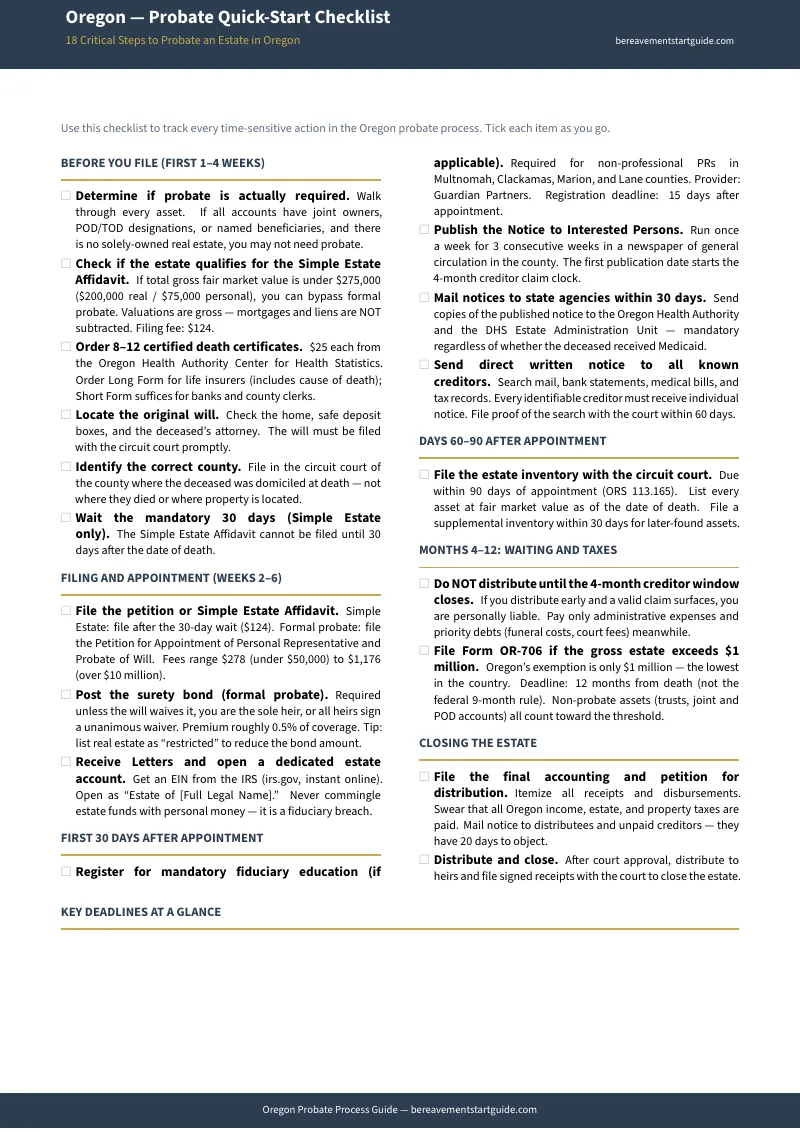
Your download includes the complete guide, the standalone Oregon Probate Quick-Start Checklist, and eight printable reference sheets — the Probate vs. Simple Estate Decision Tree, the Statutory Deadline Calendar, the OHA and DHS Notification Guide, the Creditor Claim Priority Reference, the Estate Tax Threshold Calculator, the Medicaid Estate Recovery Guide, the Executor Compensation Reference, and the Probate Bond Requirements Guide. Ten files total. Instant download, no account required.
Money-back guarantee, no time limit. If the guide does not give you clarity on what to do next and confidence that you are doing it in the right order, email us for a full refund. No questions asked.
Not ready for the full guide? Download the free Oregon Probate Quick-Start Checklist — covering death certificate ordering, the 30-day waiting period, immediate financial actions, and the critical decisions that determine which probate path applies. It is enough to get through the first week.
You did not ask for this job. But you are the one doing it. The circuit court clerk will not explain the forms. The bank will not release the money. The Health Authority is waiting for a notice nobody told you to send. This guide puts every Oregon-specific step into one filing sequence so you can stop searching and start settling.