Your Spouse's PERS Pension Just Stopped. Social Security Wants Back the Last Payment. The Estate Tax Threshold Is $1 Million. And Nobody Told You About the 60-Day Deadline That Determines Your Income for Life.
Someone you depended on just died in Oregon, and the financial reality is hitting before the grief has even settled. The last PERS retirement payment deposited into the joint account? It has to be returned — Oregon PERS will send an overpayment invoice and collect every dollar issued after the date of death. Social Security works the same way. If you do not report the death this week, the next deposit hits the account, you spend part of it on groceries, and then the federal government demands it back.
Meanwhile, there is a 60-day clock running that you probably do not know about. Once Oregon PERS sends you the benefit estimate for the Optional Spouse Death Benefit, you have exactly 60 days to decide between a lump-sum payout, a partial distribution, or a lifetime annuity. This single decision determines whether you receive monthly income for the rest of your life or a one-time payment that runs out. If you miss the deadline, PERS makes the choice for you. Nobody at the funeral mentioned this. The retirement system will not call you — they mail a packet and start the clock.
Then comes the estate math. Oregon's estate tax exemption sits at $1 million — one of the lowest thresholds in the country, not indexed for inflation. The house in Portland or Bend that appreciated over the past decade, plus a life insurance payout, plus the 401(k) balance — that is how a middle-class Oregon family ends up owing $50,000 in state estate taxes that nobody planned for. And if the deceased received Medicaid after age 55, the Oregon Department of Human Services will pursue the family home to recoup those costs, using an expanded definition of "estate" that reaches joint accounts and payable-on-death designations that most families assume are protected.
The Oregon Survivor Benefits Navigator is a Deadline Defense System — a chronological, step-by-step guide that sequences every benefit claim, every agency notification, every financial decision, and every tax filing in the exact order Oregon law requires them. Not a sympathy pamphlet. Not a generic national checklist that mentions Oregon in a footnote. Not a law firm blog post designed to generate a $325-per-hour consultation. A 16-chapter reference built entirely on Oregon Revised Statutes, federal regulations, and current agency requirements — organized around the deadlines that actually cost families money when they are missed.
What's Inside the Deadline Defense System
A 16-chapter guide with worksheets, formulas, and filing instructions covering every financial decision Oregon survivors face — from the first week through final tax filings:
Chapter 1: The First 7 Days — Stopping the Bleeding
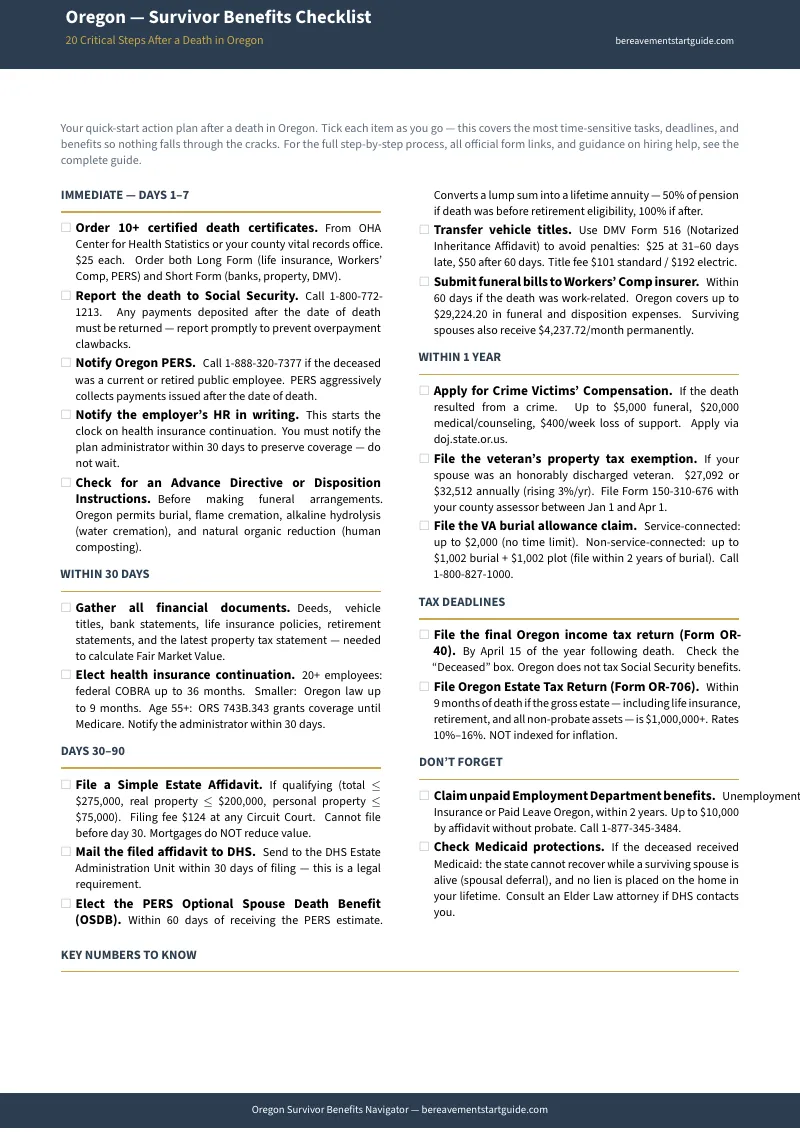
The actions that prevent the most expensive downstream problems. Reporting the death to Social Security before the next direct deposit. Notifying Oregon PERS before they issue another annuity payment you will have to return. Contacting the employer to start the 30-day health insurance continuation clock. Ordering 10+ certified death certificates (both Long Form and Short Form, $25 each). Locating the Advance Directive, the will, the life insurance policies, and the most recent property tax statement before you need them urgently and cannot find them.
Chapter 2: Financial Assessment — The Numbers That Determine Everything
Before you file a single form, you need to know what you are working with. This chapter includes a complete asset mapping worksheet that separates probate assets from non-probate assets — because the distinction determines whether you qualify for Oregon's simplified estate process. The critical Oregon trap: Fair Market Value means the full appraised value of the house, not your equity after the mortgage. A home worth $450,000 with a $350,000 mortgage counts as $450,000 for estate purposes. This worksheet catches that mistake before it costs you.
Chapter 3: Estate Settlement — Affidavit vs. Full Probate
Oregon's Simple Estate Affidavit lets you settle an estate without formal probate — but only if real property is under $200,000 and personal property is under $75,000 in total Fair Market Value. The 30-day waiting period before filing. The $124 court filing fee. The requirement to mail the filed affidavit to the DHS Estate Administration Unit within 30 days. The background check questions the affiant must answer under oath. If you do not qualify, the guide covers full probate filing fees ($278 to $1,176 based on estate value), the 4-month creditor claim window, and the appointment of a personal representative.
Chapters 4–5: Social Security and Oregon PERS
The exact formulas for federal survivor benefits — how much you receive as a surviving spouse at 60 versus full retirement age, the reduction percentages, and the earnings test that reduces payments if you are still working. Then the PERS chapter that most families desperately need: the Optional Spouse Death Benefit election, the 60-day deadline, the difference between Tier One/Tier Two and OPSRP calculations, the special rule granting police and firefighter survivors 25% of the unmodified retirement allowance, and the employer-matching death benefit that many spouses do not know exists.
Chapter 6: Workers' Compensation Death Benefits
If the death was work-related, the surviving spouse receives a permanent monthly benefit of 4.35 times 66-2/3% of the state average weekly wage — currently $4,237.72 per month. Children under 19 receive 4.35 times 25% of the deceased worker's average weekly wage. The insurer must also cover funeral and disposition expenses up to $29,224.20, but bills must be submitted within 60 days. This chapter includes the exact formulas, the filing process, and what to do if the insurer disputes the claim.
Chapter 7: Health Insurance Continuation
Losing the primary earner's employer health plan is one of the most immediate financial emergencies survivors face. Federal COBRA covers employers with 20+ employees for up to 36 months. Oregon state continuation law covers smaller employers for up to 9 months. And a provision most people miss entirely: ORS 743B.343 gives surviving spouses age 55 and older the right to continue group coverage indefinitely until Medicare eligibility. The employer and plan administrator have strict notification deadlines. This chapter lays out every timeline, your rights, and the exact steps to elect coverage before the window closes.
Chapter 8: The Oregon Estate Tax
Oregon taxes estates above $1 million at rates from 10% to 16%. No inflation indexing, no spousal portability. The total gross estate includes everything — the house, the retirement accounts, the life insurance payout, the investment accounts. A $1.5 million estate — entirely typical for a homeowner in the Portland metro area — owes approximately $50,000. This chapter covers the progressive bracket system, Form OR-706 (due 9 months after death), the critical warning that filing extensions do not extend the payment deadline, the Natural Resource Exemption for farm and forest property, and the A/B bypass trust strategy for married couples.
Chapter 9: Medicaid Estate Recovery
Oregon recovers $14 for every dollar it spends administering its Medicaid recovery program. The state uses an expanded estate definition that reaches assets you thought were protected — joint tenancy, payable-on-death accounts, Transfer-on-Death designations, and living trusts all fail to shield assets after the surviving spouse eventually dies. The deferrals while a surviving spouse is alive. The exemption when the deceased is survived by a child under 21 or a child who meets Social Security disability criteria. The $6,000 funeral expense cap for insolvent estates. This chapter covers every protection available and every trap to avoid.
Chapters 10–16: Deadlines, Tax Filing, Property Tax Relief, Crime Victims' Compensation, VA Benefits, Document Checklists, and When to Hire a Professional
The Master Deadline Calendar that sequences every filing across all agencies. The veteran's surviving spouse property tax exemption ($27,092 or $32,512 annually, increasing 3% per year, filed by April 1 with the county assessor). Crime Victims' Compensation covering up to $20,000 in medical and counseling costs plus $5,000 for funeral expenses. VA burial allowances. Vehicle title transfers through DMV Form 516 with the penalty schedule ($25 at 31–60 days late, $50 after 60 days). The complete document checklist. And a clear framework for when self-management ends and a CPA or probate attorney is genuinely necessary.
Plus 10 Standalone Printable Worksheets
Every key tool extracted as its own PDF — print just the page you need and bring it to your appointment, pin it to your wall, or fill it in at the kitchen table:
- Deadline Calendar — every statutory deadline with a fill-in column for your dates
- PERS Decision Guide — lump sum vs. lifetime annuity, tier differences, what to bring to PERS
- Estate Value Worksheet — determine Simple Estate Affidavit eligibility
- Estate Tax Threshold Worksheet — calculate whether the gross estate exceeds $1 million
- Probate Decision Tree — visual flowchart for Simple Estate vs. formal probate
- Medicaid Recovery Defense — protections, waivers, and traps to avoid
- Workers' Comp Worksheet — benefit formulas and fillable expense tracker
- Health Insurance Roadmap — COBRA vs. state continuation vs. Age 55+ indefinite coverage
- Document Checklist — tracking sheet for every document you need to gather
- Forms Directory — every official Oregon form with download links
Who This Guide Is For
- The surviving spouse trying to replace lost household income — who needs to know exactly which benefits they qualify for, the precise dollar amounts, and the deadlines that will permanently close if missed. Oregon PERS, Social Security, Workers' Comp, VA survivor benefits, property tax exemptions — each with different eligibility rules, different forms, different agencies, and different clocks running simultaneously.
- The adult child managing a parent's estate from out of state — who needs to determine whether the estate qualifies for a Simple Estate Affidavit or requires formal probate, calculate whether the gross estate breaches the $1 million estate tax threshold, and avoid personal liability for mistakes in the settlement process.
- The family of a veteran, crime victim, or worker killed on the job — who needs the specialized benefit formulas, application-based entitlements, and strict filing windows that generic checklists never cover. These benefits are not automatic — you must know they exist and apply within the statutory deadlines.
- The spouse worried about losing the family home to Medicaid recovery — who has been told that joint tenancy or a payable-on-death designation will protect the house, but does not know that Oregon's expanded estate definition reaches beyond probate once the surviving spouse dies.
Why Free Resources Leave You Exposed
Oregon survivor benefits information exists online. It is scattered across 12 different state and federal agencies, each explaining their own program in isolation, none of them telling you how their deadlines interact with the others or which ones cost you the most money when missed. Here is what you actually encounter:
- Oregon PERS (oregon.gov/pers) explains the Optional Spouse Death Benefit in technical jargon but does not explain how to evaluate your options. You get a packet with actuarial tables and 60 days to make a decision that determines your monthly income for life. The website does not tell you how to compare a lump sum against a lifetime annuity, or explain the employer-matching death benefit that many spouses never claim.
- The Oregon Department of Revenue publishes estate tax forms but does not flag the $1 million threshold as a middle-class trap. The forms assume you already know you owe. Families who never imagined their estate was taxable discover the liability only when their CPA files the final return — by which point the 9-month payment deadline may have already passed.
- Oregon DHS explains Medicaid estate recovery in bureaucratic language that obscures the real risk. The website mentions expanded estate recovery without explaining that standard probate-avoidance tools like living trusts and TOD designations do not work in Oregon the way financial blogs suggest they do.
- National survivor benefits sites (AARP, NerdWallet, SmartAsset) cover Oregon as a footnote in 50-state overviews. They mention Social Security formulas but miss the Oregon-specific interactions: that Oregon does not tax Social Security benefits, that PERS rules differ dramatically from other state pension systems, and that the $1 million estate tax threshold catches families that are nowhere near the federal exemption.
Free resources give you one agency's rules at a time, with no sequencing, no interaction mapping, and no single document that tells you which deadline matters most this week. The Deadline Defense System sequences every obligation across every agency in chronological order — so you handle the $50,000 decisions before they expire, not after.
— Less Than One Hour With a Probate Attorney
The median Oregon attorney charges $325 per hour. A flat-fee probate engagement starts at $3,000. A single missed PERS election deadline, a single overlooked property tax exemption, or a single failure to file the estate tax return on time costs more than most families can absorb while they are already reeling from a death. This guide costs less than a single certified death certificate and covers every deadline, every formula, every form, and every filing requirement Oregon law imposes on surviving families.