The Bank Froze the Accounts and Wants "Short Certificates" You've Never Heard Of. The Register of Wills Says They "Cannot Give Legal Advice." And Somewhere in the Fine Print Is a Three-Month Discount Window — and an Inheritance Tax That Started at the Very First Dollar.
Someone you love just died in Pennsylvania. You walked into the bank to keep a bill from going unpaid and the teller told you the account is frozen — they need "Letters" and a "short certificate" from the Register of Wills, documents you do not have and cannot picture. You called the county courthouse and a kind voice read you a sentence about not being able to offer legal advice, then pointed you toward a form numbered REV-1500 that reads like it was written for accountants. You searched online and found a wall of statute numbers — Title 20 this, § 3101 that — none of it in plain English, none of it in order.
And buried in all of it, almost in passing, you saw something about a 5% discount if you pay the inheritance tax within three months of death. Tax? Nobody warned you Pennsylvania taxes an inheritance. It turns out it taxes nearly every dollar, starting at the first one, with no general exemption — and the clock on that discount may already be running while you are still ordering death certificates.
Here is the truth that makes Pennsylvania different from almost every other state: Pennsylvania surrounds a grieving family with friction that exists nowhere else — and punishes the executor personally for getting the order wrong. An inheritance tax that starts at dollar one. A frozen bank account that only a specific 2026 statute can pry open — up to $20,000, but only with the right two documents. A home that must be valued through something called the Common Level Ratio because Pennsylvania refuses to recognize the transfer-on-death deeds every neighboring state allows. A Medicaid estate recovery program that can lay claim to the family house, with a 45-day window that cuts both ways. And the word that should keep every executor up at night: surcharge — a personal judgment against your own money for paying the wrong person first. The funeral home hands you a sympathy folder. The Commonwealth hands you forms and statute numbers. Neither one hands you the order to do them in.
The When Someone Dies in Pennsylvania — Estate Settlement Guide gives you The Pennsylvania Sequence — the right things, in the right order, translated out of Title 20 statute language and into plain English. Not a national template with "Pennsylvania" pasted into the header. An 11-chapter manual built around the specific Pennsylvania rules — the inheritance tax and its 5% discount, the $20,000 bank release, the Common Level Ratio, Medicaid estate recovery, executor surcharge liability, and the Family Settlement Agreement — that generic guides miss and grieving families pay for.
What's Inside The Pennsylvania Sequence
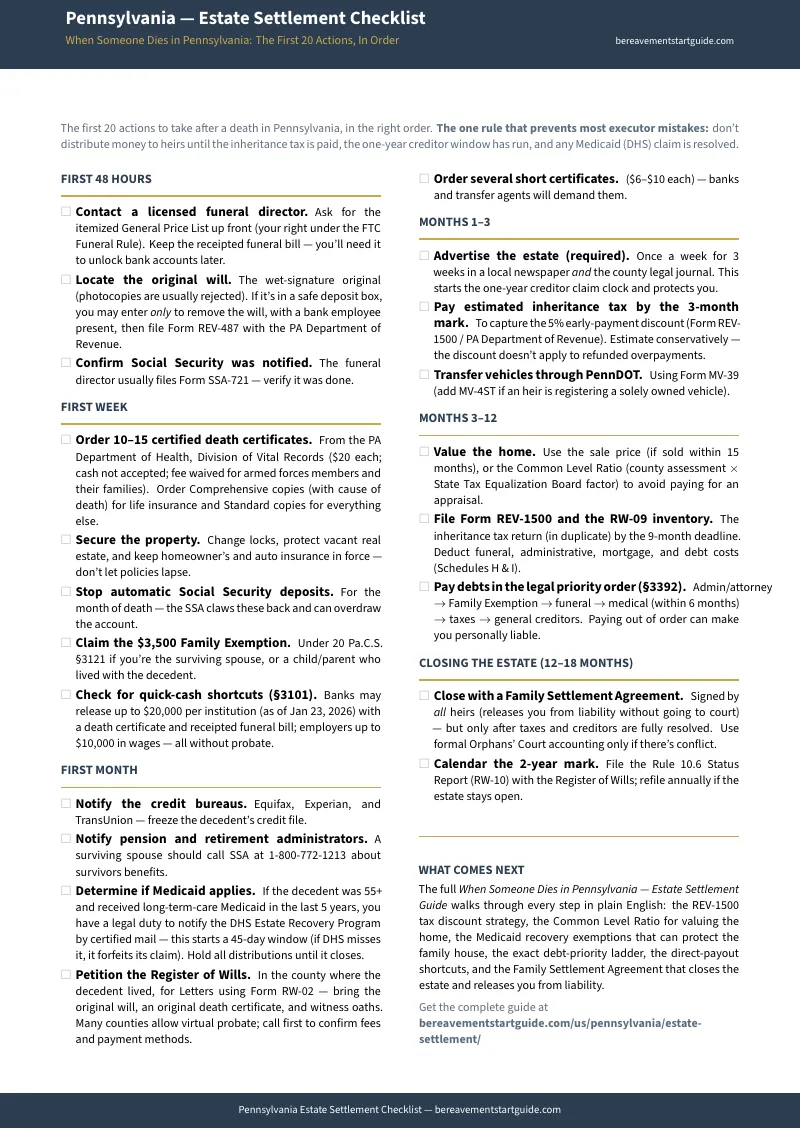
An 11-chapter guide, the standalone First 48 Hours Checklist, plus a timeline, a key-forms appendix, and standalone reference sheets — covering every stage from the moment of death through final distribution and your release from liability, built specifically for Pennsylvania statutes, PennDOT forms, the county Register of Wills, and the Department of Revenue rules that make settling an estate here unlike anywhere else:
The First 48 Hours — and Ordering Enough Death Certificates the First Time
The certified death certificate is the master key that unlocks everything that follows — the bank, the insurer, the Register of Wills, PennDOT, the Department of Revenue. The guide explains the difference between the standard and comprehensive certificate, the roughly $20 per-copy fee, and where to order: in person at one of six regional offices, by mail to New Castle, or online through VitalChek (Pennsylvania's only approved online vendor, which adds a $10 surcharge per transaction). Most families guess one or two copies and spend the next two months reordering. Order 10 to 15 at the outset and you stop the bleeding before it starts.
Securing the Estate — and the Single Rule That Protects You
Before any court gives you authority, you have a duty to keep the estate's assets from being lost, taken, or wasted. Lock the home, keep the utilities on, reroute the mail — your best tool for discovering hidden accounts and bills — and learn the safe deposit box trap most families walk straight into. Above all, the rule that matters more than any other: do not pay one cent of the deceased's bills with your own money, and do not pay anyone out of order. The estate pays the debts. Pay them yourself, or pay the wrong creditor first, and you have just exposed yourself to a personal surcharge.
The $20,000 Frozen Bank Account Release — the 2026 Liquidity Lifeline
The frozen account is the first wall almost every family hits, and Pennsylvania just changed the rules in your favor. Under 20 Pa.C.S. § 3101 — expanded by Act 50 / HB 1176 effective January 23, 2026 — a bank or credit union can pay up to $20,000 per institution directly to prioritized family (spouse, then child, then parent, then sibling) without opening an estate or producing a short certificate. The catch the statute keeps quiet: it requires an original death certificate and a receipted funeral bill, the limit is per institution (so $18,000 at each of three banks releases $54,000 with no probate), and whoever takes the money is still "answerable to anyone prejudiced by the distribution." The guide tells you exactly when this works, when a will blocks it, and how to use it for liquidity without treating it as the final word on who inherits.
Vehicle Title Transfers — Filing PennDOT Form MV-39
Pennsylvania moves a vehicle on its own track, outside probate, using Form MV-39 (Notification of Assignment/Correction of Vehicle Title Upon Death of Owner). The right path depends on whether the car was jointly owned or solely owned, and whether a surviving spouse is claiming it — no title transfer fee applies for a surviving spouse on a jointly owned vehicle. The guide includes the decision so you bring the correct documents the first time, because a minor clerical error on the MV-39 can force you to restart the weeks-long process.
Real Estate and the Common Level Ratio — Why Pennsylvania Has No TOD Deed
This is where Pennsylvania diverges hardest from its neighbors. The Commonwealth does not recognize Transfer-on-Death deeds for real estate — a solely owned home must pass through probate, and the inheritance tax lien must be cleared before any title company will let it be sold. The REV-1500 demands a precise date-of-death value for the house, and one of your three valuation paths runs through the Common Level Ratio (CLR) — the state factor that converts a county's assessed value into fair market value. Use the wrong number and you either overpay the tax or invite a Department of Revenue challenge. The guide walks the CLR math in plain English and tells you when an appraisal beats it.
The Pennsylvania Inheritance Tax — Form REV-1500 and the 5% Discount
The tax nobody warned you about, made manageable. Pennsylvania taxes the estate of every resident decedent regardless of size, at rates set by the heir's relationship: 0% to a surviving spouse, 4.5% to children and lineal heirs, 12% to siblings, 15% to everyone else. It reaches both probate and non-probate assets — POD accounts, jointly held property, IRAs passing to non-spouses — because skipping the Register of Wills never skips the Department of Revenue. The chapter explains the REV-1500 filed in duplicate, the nine-month filing deadline, and the move that saves real money: a conservative estimated payment within three months of death captures a 5% discount on the tax paid — a worked example shows a family keeping $2,000 simply for acting early. It is a lien on all estate property until paid, which is exactly why premature distribution is so dangerous.
Medicaid Estate Recovery — and the 45-Day Window That Cuts Both Ways
If the deceased was age 55 or older and received Medicaid for nursing-facility care, Community HealthChoices, or home-based services, the Pennsylvania Department of Human Services (DHS) is legally required to try to recover those costs from the probate estate — and it can target the family home. But the same rule that threatens you also protects you: once you give DHS proper written notice, it has exactly 45 days to file its claim, and if it misses that window it forfeits the right to recover. The guide tells you how to notify properly, why you must hold all distributions until the window closes, and the exemptions that block a lien — a surviving spouse or minor or disabled child in the home, and the Caregiver Exception for an heir who lived in and cared for the decedent for at least two consecutive years.
Creditors, Debts, and Surcharge Protection
The fear of being personally chased for a parent's debt paralyzes more executors than anything else. Heirs do not inherit debt. But the executor who pays creditors out of the strict statutory order under 20 Pa.C.S. § 3392 — funeral expenses, administration costs, and the Family Exemption ahead of general creditors — can be personally surcharged for the difference. The guide gives you the mandatory creditor advertising (three weeks, two publications, starting the one-year claim clock), the priority ladder for an insolvent estate, and the boundaries that keep your own money out of reach.
The Two Closing Paths — Family Settlement Agreement vs. Orphans' Court
How you close the estate decides whether you walk away protected or exposed. The guide lays out both paths side by side: the Family Settlement Agreement (FSA) — the private, faster, cheaper route preferred for most estates where the heirs agree and the debts and taxes are settled — and the formal accounting before the Orphans' Court, the court-supervised path you need when there is conflict, insolvency, or an unresolved DHS or Department of Revenue claim. It tells you plainly which one your situation calls for, why you never sign an FSA with creditor claims open, and not to forget the Rule 10.6 Status Report that too many executors miss.
Special Situations — Intestacy, Insolvency, and the Family Exemption
When there is no will, Pennsylvania's intestate succession statute decides who inherits — and it rarely matches what the family assumes. The guide maps the shares, walks the debt-priority ladder for an insolvent estate, and explains the Family Exemption under § 3121: the surviving spouse's (or household children's or parents') right to retain up to $3,500 of property ahead of general creditors and even state recovery liens. Most families never claim it because no one tells them it exists.
The Complete Timeline and Deadline Calendar
Every Pennsylvania deadline in one place, Day 1 through Month 18: the death certificate ordering, the three-month inheritance tax discount window, the creditor advertising and the one-year claim clock, the nine-month REV-1500 filing deadline, the 45-day DHS window, and the final accounting and release. Print it and work it top to bottom.
Who This Guide Is For
- The surviving spouse who cannot access the frozen accounts — the bank wants "Letters" and a "short certificate" you do not have, the bills are piling up, and no one will explain how to get past it. The guide tells you which accounts are already yours, how the $20,000 release works and exactly which two documents it needs, and when you finally need the court.
- The adult child named executor who has never filed a legal document — everyone is looking at you and you have no idea what the job involves. The guide is the complete job description: what to do, what never to do, and the surcharge rules that decide whether you fulfill your duty or pay for the mistake out of your own pocket.
- The out-of-state heir whose parent died in Pennsylvania — you live in another state, the county Register of Wills cannot give legal advice, and you cannot keep driving back to the courthouse. The guide gives you every form, fee, and deadline — and tells you which counties let you file by mail.
- The family afraid of losing the house to Medicaid recovery — DHS may have a claim for nursing-home costs and you do not know your options. The guide spells out the 45-day forfeiture rule, the exemptions that block a lien, and the Caregiver Exception that can permanently protect the home.
- The family settling an estate with no will — intestate succession now decides everything, and the guide maps the shares, the Family Exemption, and the order of payment so you do not hand money to the wrong person and get surcharged for it.
Why Free Resources Will Not Get You Through This
The forms are free. The knowledge of which form, when, and in what order is not. Here is what actually happens when you try to settle a Pennsylvania estate from free sources:
- The county Register of Wills hands you forms and says they cannot help. They are legally prohibited from telling you which path to take, how the 5% discount window works, how to compute the Common Level Ratio, or how to notify DHS to start the 45-day clock. The forms exist. The instructions, and the order, do not.
- National platforms miss the Pennsylvania rules that actually matter. LegalZoom, Nolo, and Trust & Will offer clean interfaces and generic templates — and routinely gloss over the inheritance tax that starts at dollar one, the 5% three-month discount, the ban on TOD deeds, the Common Level Ratio, and the DHS 45-day forfeiture rule. A national template that ignores those leaves money and protection on the table.
- Attorney blogs explain the danger to sell you the retainer. Pennsylvania probate firms write accurate, detailed content — designed to convince you the process is too dangerous to attempt for less than $300 to $500 an hour. For contested or insolvent estates, that can be true. For a straightforward estate, the steps are sequential, predictable, and doable yourself with the right roadmap.
- Government sites cover one slice each and never connect the dots. Vital Records handles certificates, PennDOT handles vehicles, the Register of Wills handles probate, the Department of Revenue handles the REV-1500, DHS handles recovery. Each covers its own domain. None tells you the order, the dependencies, or the surcharge consequence of doing one before another.
Free resources give you blank forms and a warning not to make mistakes. The Pennsylvania Sequence gives you the complete order — death certificate to final release — translated into plain English, built for Title 20.
— A Fraction of a Single Hour With a Pennsylvania Probate Attorney
A Pennsylvania estate attorney typically bills $300 to $500 an hour, and probate fees vary wildly by county — roughly $344.75 in Allegheny County, $370.25 in Philadelphia, but only $150 in Mercer. National estate-software subscriptions bill you every year for generic tools that have never heard of the Common Level Ratio or the 45-day DHS window. This guide costs less than a fraction of a single attorney consultation and gives you the complete Pennsylvania-specific roadmap — every statute, every deadline, every form, the two closing paths, and the honest line that tells you whether you even need to make that call.
Your download includes the complete 11-chapter guide with a key-forms appendix and a full settlement timeline, the standalone Pennsylvania First 48 Hours Checklist, and printable reference sheets — the Inheritance Tax and 5% Discount Walkthrough, the § 3101 Bank Release Reference, the Medicaid Recovery Exemptions, the Creditor Priority and Surcharge Reference, and the Complete Deadline Calendar. Instant download, no account required.
Money-back guarantee, no time limit. If the guide does not give you clarity on what to do next and confidence that you are doing it in the right order, email us for a full refund. No questions asked.
Not ready for the full guide? Download the free Pennsylvania First 48 Hours Checklist — the death certificates, securing the home, the financial boundary that protects you, and the first deadlines that start ticking the day someone dies. It is enough to get through tonight and tomorrow.
You did not ask for this job. But you are the one doing it. The bank will not release the money. The Register of Wills will not explain the forms. The three-month discount clock is already running. This guide puts every Pennsylvania step into one sequence so you can stop searching and start settling.