The Funeral Director Slid a General Price List Across the Table — $4,200 for a "Traditional Package" — and Said Embalming Was Required for a Viewing. It Is Not. Pennsylvania Law Gives You the Right to Refuse It, and a Dozen Other Services the Funeral Home Never Mentions Are Optional.
Someone you love just died in Pennsylvania. You walked into the funeral home expecting compassion and clarity. Instead, you got a price list with fees you have never seen before — a $995 "basic services" charge, a $400 "transfer fee," an $800 embalming line item presented as mandatory — and a casket selection room where the least expensive option was conveniently tucked in the far corner. Nobody explained that federal law requires them to hand you that price list before discussing anything else. Nobody mentioned that Pennsylvania does not require embalming for any disposition if the body is refrigerated or placed in a sealed container within twenty-four hours. Nobody told you that you have the right to bring your own casket, skip the viewing entirely, or handle the burial yourself without hiring a funeral director at all.
Here is the reality that makes funeral planning in Pennsylvania uniquely difficult: Pennsylvania layers state-specific rules on top of federal consumer protections in ways that create confusion funeral homes have no financial incentive to clear up. A mandatory twenty-four-hour waiting period before cremation — plus a $50 coroner authorization fee the family pays out of pocket. A ninety-six-hour window to file the death certificate that most families do not know is ticking. County-by-county variation in burial reserve limits for Medicaid planning that can swing by thousands of dollars. A preneed trust law that requires 100% of service funds to be held in trust — but says nothing useful about what happens when you want to transfer that contract to a different funeral home. An inheritance tax that lets you deduct the funeral luncheon and the headstone on Schedule H of the REV-1500 — deductions that nobody at the funeral home, the cemetery, or the Register of Wills will volunteer. And a home burial option that is fully legal in the Commonwealth but functionally invisible because no institutional player benefits from telling you it exists.
The Pennsylvania Funeral Laws & Consumer Rights Guide gives you The Consumer Shield — every Pennsylvania funeral law, consumer protection, and cost-saving strategy translated out of Title 20 and Title 49 statute language and into plain English. Not a national overview with "Pennsylvania" pasted into the header. A guide built around the specific Pennsylvania rules — the FTC Funeral Rule as it applies in this state, the embalming and refrigeration requirements under 49 Pa. Code § 13.201, the cremation authorization process and the coroner's $50 fee, the disposition authority hierarchy under 20 Pa.C.S. § 305, the preneed trust and irrevocable burial reserve rules, the home burial and green burial provisions, the REV-1500 deductions, and the complaint process through the State Board of Funeral Directors — that generic consumer guides miss and grieving families pay for.
What's Inside The Consumer Shield
A comprehensive guide with standalone checklists and printable reference sheets — covering everything from the moment a death occurs through final disposition and tax filing, built specifically for Pennsylvania's funeral statutes, the FTC Funeral Rule, and the consumer rights that protect families who know them:
Your Federal Rights at the Funeral Home — The FTC Funeral Rule, Enforced in Pennsylvania
Before the funeral director discusses a single service, federal law requires them to hand you an itemized General Price List. You have the right to select only the services you want. You cannot legally be required to purchase a casket from the funeral home as a condition of service. You cannot be charged a "handling fee" for a casket you purchased elsewhere. The guide lays out exactly what the Funeral Rule requires, word for word, so you can walk into the arrangement room knowing precisely what you are entitled to demand and what you are entitled to decline. Most families do not know these rights exist until after the contract is signed.
Embalming — When It Is Required, When It Is Not, and What to Say
Pennsylvania does not require embalming for burial or cremation. Under 49 Pa. Code § 13.201, if final disposition does not occur within twenty-four hours, the body must be embalmed, placed in a sealed container that prevents odors, or refrigerated between 35 and 40 degrees Fahrenheit. Refrigeration is the legal alternative that funeral homes rarely volunteer — because embalming generates revenue and refrigeration does not. The guide tells you when embalming is genuinely required (communicable disease under 28 Pa. Code § 27.203, public viewing beyond thirty-six hours of refrigeration), when it is entirely optional, and the exact language to use when a funeral director implies otherwise.
Cremation in Pennsylvania — The 24-Hour Wait, the Coroner, and the $50 Fee
Pennsylvania mandates a twenty-four-hour waiting period after death before cremation can proceed. No exceptions. Before the crematory fires, the county coroner or medical examiner must issue a separate authorization — a step that requires a statutory $50 fee the family pays directly. A disposal permit from the local registrar is also required before the body can be moved. The guide walks the full cremation authorization sequence, explains who has the legal authority to authorize cremation when family members disagree, and covers the scattering rules — Pennsylvania has no state law restricting where you scatter ashes, but federal rules apply at sea and local ordinances apply in parks.
Who Controls the Disposition — The Statutory Hierarchy That Settles Family Disputes
When family members disagree about burial versus cremation, viewing versus no viewing, or which funeral home to use, Pennsylvania law does not leave it to consensus. Under 20 Pa.C.S. § 305, there is a strict legal hierarchy: first, any person the decedent explicitly designated in writing or in a will. Second, the surviving spouse. Third, an adult child. The chain continues through parents, siblings, and extended kin. The guide maps the full hierarchy, explains how a decedent can override it through a signed designation or a provision in the will, covers the military exception via DD Form 93, and addresses what happens in cases of estrangement — because "next of kin" and "the person who should decide" are not always the same.
Home Burial, Green Burial, and Alternative Disposition
Pennsylvania law does not prohibit home burial on private property, does not require the use of a licensed funeral director for any part of the disposition process, and does not require outer burial containers or concrete vaults at the state level — though individual cemeteries can mandate them in their bylaws. The guide covers home burial step by step: zoning restrictions, the environmental rule that prohibits burials on land draining into a municipal water supply within one mile of the city, the recommendation to map the burial site and attach the drawing to the property deed, and the disposal permit you need before moving the body. It also covers green burial, the current legal status of alkaline hydrolysis (not yet authorized in Pennsylvania, though House Bill 722 passed the House in the most recent session), and how some funeral homes arrange out-of-state transport for families who want water cremation.
Preneed Contracts and Medicaid Burial Reserves — Protecting Funds Before Death
Pennsylvania's Preneed Act requires that 100% of funds collected for funeral services and 70% of funds for cemetery merchandise be placed into a trust within thirty days. These are among the strictest trust requirements in the country. The guide explains the critical difference between revocable and irrevocable preneed contracts, the portability question — what happens if you want to switch funeral homes after prepaying — and the intersection with Medicaid planning. For families using an irrevocable burial reserve to protect assets during a Medicaid spend-down, the guide provides the county-specific maximum limits (capped at 125% of the average county burial cost, varying from roughly $11,800 in Allegheny County to $16,600 in Washington County) and the beneficiary designation rule that prevents those funds from being clawed back by the Department of Human Services.
Transporting Human Remains — Within Pennsylvania and Across State Lines
Families who choose to transport the body themselves — from a hospital to a home, from one county to another, or across state lines — must follow specific rules. Pennsylvania requires the body to be transported horizontally, face up, and completely shielded from public view. If using a common carrier and the destination will not be reached within twenty-four hours, the body must be embalmed or placed in a hermetically sealed metal container. The guide covers private transport requirements, common carrier rules, the transit permit that must accompany the body, and the additional documentation needed for out-of-state or international transport.
The Death Certificate — Who Files It, When, and How Many You Need
The medical certifier determines the cause of death. The funeral director — or the person acting as the person in charge of interment in a home funeral — files the Report of Death within ninety-six hours. The guide explains the division of responsibilities, the difference between electronic and paper filing (electronic yields immediate certificates; paper requires working through the funeral home), and the number you actually need. Most families order one or two copies and spend weeks reordering. The banks, the Register of Wills, PennDOT, the Department of Revenue, and every insurer each require a certified original. Order 8 to 12 on the first pass.
Funeral Expense Deductions on the Pennsylvania Inheritance Tax Return
Pennsylvania is one of a handful of states that imposes an inheritance tax starting at the first dollar transferred. On Schedule H of the REV-1500 return, the estate can deduct funeral expenses — and the definition is broader than most families realize. The deductible items include the funeral director's fee, the cemetery plot, the headstone or marker, the funeral luncheon, flowers, and the costs of transporting the body. The guide lists every qualifying deduction so the executor captures every dollar the estate is entitled to — deductions that are permanently lost if nobody claims them on the return.
Filing a Complaint — When the Funeral Home Gets It Wrong
If you experience illegal billing practices, undisclosed fees, unauthorized embalming, refusal to provide a General Price List, or any other violation of your consumer rights, the Pennsylvania State Board of Funeral Directors under the Bureau of Professional and Occupational Affairs is the regulatory body with enforcement authority. The guide provides the exact contact information — phone, email, and mailing address — the scope of the Board's authority under Act 48, and the practical steps for documenting and filing a complaint that is taken seriously.
Who This Guide Is For
- The family sitting in the funeral home arrangement room right now — the director is explaining packages, the numbers feel high, and you do not know what you are legally allowed to decline. The guide tells you your rights under the FTC Funeral Rule, which services are required by Pennsylvania law and which are not, and the exact questions to ask before signing anything.
- The executor who just got the funeral bill and is not sure which costs the estate can deduct — Pennsylvania's inheritance tax starts at dollar one, but every qualifying funeral expense reduces the taxable estate. The guide lists every deduction allowed on Schedule H of the REV-1500 so you do not leave money on the table permanently.
- The family planning ahead for a parent in long-term care — Medicaid spend-down is underway and you need to structure an irrevocable burial reserve correctly. Get the county-specific limits wrong or designate the wrong beneficiary, and the Department of Human Services recovers the funds. The guide gives you the exact caps and the designation rule that protects them.
- The family that wants a home funeral, a green burial, or cremation without a viewing — you know these options exist but you are not sure whether Pennsylvania law allows them, and every source you find was written by someone selling the traditional alternative. The guide gives you the statutes, the requirements, and the steps without steering you toward a more expensive option.
- The out-of-state family member arranging a funeral in Pennsylvania — you do not live here, you do not know the rules here, and you are making decisions over the phone with a funeral director who has every financial incentive to default to the most comprehensive package. The guide levels the playing field.
Why Free Resources Will Not Protect You at the Funeral Home
The laws are public. The ability to apply them under pressure, in a specific Pennsylvania funeral home, while grieving, is not. Here is what actually happens when you try to navigate funeral planning from free sources:
- The FTC publishes the Funeral Rule but not what it means in Pennsylvania. The federal rule gives you the right to an itemized price list. Pennsylvania adds its own embalming rules, cremation waiting periods, disposition authority statutes, and preneed trust requirements on top. The FTC page does not mention a single one of them.
- Funeral home websites explain their services, not your rights. The information is accurate as far as it goes — and it stops exactly where your right to decline begins. No funeral home website explains that embalming is optional if the body is refrigerated, that you can bring your own casket, or that Pennsylvania law does not require you to hire them at all.
- National legal sites write for all fifty states and miss the Pennsylvania-specific rules. Nolo and FindLaw provide useful overviews that gloss over the twenty-four-hour cremation wait, the $50 coroner fee, the county-specific Medicaid burial reserve limits, and the REV-1500 deductions. A national article that says "check your state laws" is not a guide — it is a redirect.
- Elder law firms explain the danger to sell you the retainer. Pennsylvania probate and elder law firms write accurate, detailed content about preneed contracts and Medicaid burial reserves — designed to end with "call our office for a consultation." For families that need a lawyer, that advice is sound. For families that need the rules explained clearly enough to act on them, a $300-per-hour consultation to learn what an irrevocable burial reserve is and what the county cap is wastes estate capital on information transfer.
Free resources give you fragments of the law. The Consumer Shield gives you every Pennsylvania funeral right, cost-saving strategy, and consumer protection in one place — sequenced, cited, and written for the person sitting across from the funeral director.
— Less Than the Markup on a Single Casket Upgrade
A funeral home casket upgrade runs $500 to $2,000 — for a product the FTC says you have the right to purchase elsewhere or decline entirely. An elder law attorney charges $300 or more per hour to explain the irrevocable burial reserve limits and Medicaid rules that this guide covers in plain English with the county-specific numbers. A preneed contract structured without understanding the trust requirements or the beneficiary designation rule can cost the estate thousands in Medicaid recovery. This guide costs less than a single line item on a funeral invoice and gives you the complete Pennsylvania-specific consumer rights roadmap — every statute, every protection, every cost-saving deduction, and the honest line that tells you when professional help is genuinely warranted.
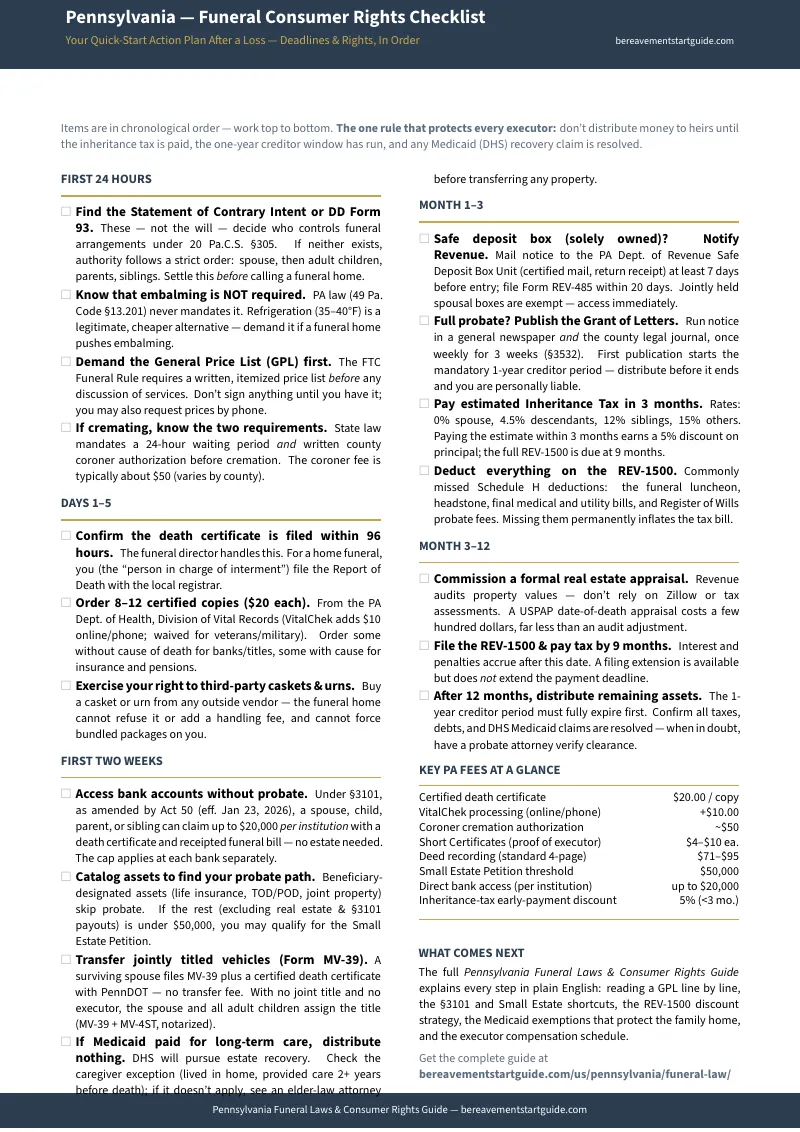
Your download includes the complete Pennsylvania Funeral Laws & Consumer Rights Guide, the standalone Pennsylvania Funeral Consumer Rights Checklist with every time-sensitive step and key deadline, and printable reference sheets: the FTC Funeral Rule Rights and Price List Negotiation reference, the Embalming and Refrigeration Rules quick reference, the Cremation Authorization Sequence, the Disposition Authority Hierarchy under § 305, the Preneed Contract and Burial Reserve Limits by county, and the REV-1500 Funeral Expense Deductions worksheet. Instant download, no account required.
Money-back guarantee, no time limit. If the guide does not give you clarity on your rights and confidence that you are not overpaying, email us for a full refund. No questions asked.
Not ready for the full guide? Download the free Pennsylvania Funeral Consumer Rights Checklist — your core consumer rights, the key Pennsylvania deadlines, and the questions to ask before signing any funeral contract. It is enough to walk into the arrangement room with your eyes open.
The funeral director is a professional running a business. That is not a criticism — it is a fact. You are a consumer with federal and state rights. You just need to know what they are before you sit down at the table. This guide puts every Pennsylvania funeral law and consumer protection into one document so you can make decisions based on what you want, not what you are told you need.