The Register of Wills Handed You Blank Forms and Said They Cannot Give Legal Advice. The Bank Wants a "Short Certificate" You Have Never Seen. And Somewhere in the Fine Print, a Three-Month Window Is Already Closing — One That Could Save the Estate Thousands of Dollars.
You just became a Pennsylvania executor. Maybe you found out from a will you were not expecting to read. Maybe a sibling called and said the bank froze everything. Either way, you walked into the county Register of Wills, and someone behind the counter handed you a stack of blank forms — RW-02, RW-07, RW-09 — and recited the sentence you will hear a dozen more times: "We cannot provide legal advice or help you fill these out." You searched online and hit a wall of statute numbers — Title 20, Section 3101, 20 Pa.C.S. § 3532 — none of it in order, none of it telling you what to do first.
And then, buried in a law firm blog written to sell you a retainer, you saw something about a 5% discount on the Pennsylvania Inheritance Tax if you pay within three months of death. Tax? Nobody told you Pennsylvania taxes an inheritance. It turns out the Commonwealth taxes nearly every dollar transferred at death — starting at the first dollar, with no general exemption — and the discount window may already be closing while you are still trying to figure out what a Short Certificate is.
Here is what makes probate in Pennsylvania different from almost everywhere else: Pennsylvania surrounds a new executor with friction that exists nowhere else — 67 counties with different fee schedules and different local forms, an inheritance tax that starts at dollar one, a one-year creditor window that can make you personally liable if you distribute too early, and no one at the courthouse who can tell you the order to do things in. You cannot simply present a will and unlock accounts. You need Letters. Letters require a Petition. The Petition triggers a bond question. The bond triggers a waiver question. Meanwhile, the estate's real estate cannot be sold until the inheritance tax lien is cleared — and Pennsylvania refuses to recognize the Transfer-on-Death deeds that neighboring states allow. Everything is sequential. Miss one step and the next one stalls. The attorney who offers to handle it all charges a percentage of the estate under the Johnson Estate fee schedule — roughly 5% on the first $100,000, 4% on the next $100,000 — which means a straightforward $300,000 estate can cost the family $12,000 or more in legal fees for what is fundamentally paperwork, waiting, and following a statutory sequence.
The Pennsylvania Probate Process Guide gives you The Probate Sequence — every step of Pennsylvania estate administration, in the right order, translated out of Title 20 statute language and into plain English. Not a national template with "Pennsylvania" pasted into the header. A 14-chapter manual built around the specific Pennsylvania rules — the 67-county Register of Wills system, the inheritance tax and its 5% discount, the Section 3101 frozen-account bypass, the Small Estate Petition under Section 3102, the Common Level Ratio for valuing real estate, Medicaid estate recovery, the creditor priority ladder, fiduciary compensation under Johnson Estate, and the Family Settlement Agreement — that generic guides miss and grieving families pay for.
What's Inside The Probate Sequence
A 14-chapter guide with two appendices and a standalone Quick-Start Checklist — covering every stage from the moment you are named executor through final distribution and your release from liability, built specifically for Pennsylvania's Probate, Estates and Fiduciaries Code, the county Register of Wills, the Orphans' Court, and the Department of Revenue rules that make probate here unlike anywhere else:
Do You Actually Need Probate? — The Decision Tree That Could Save You the Entire Process
Before you file a single form or pay a single fee, walk through every asset the deceased owned. Joint accounts with right of survivorship, POD/TOD designations, funded trusts, and beneficiary-designated retirement accounts all bypass probate entirely. If every asset falls in the "no probate" column, you do not need the Register of Wills at all. The guide gives you the complete decision tree — including the trap that catches families: a single overlooked asset, a vehicle title with no survivorship, or a piece of real estate titled as tenants in common that forces the entire estate into court. And the inheritance tax trap most families miss: even non-probate transfers are subject to the Pennsylvania Inheritance Tax.
The Section 3101 Direct Transfer — Bypassing Probate for Smaller Accounts
Under 20 Pa.C.S. Section 3101, expanded by Act 50 effective January 23, 2026, a bank or credit union can release up to $20,000 per institution directly to prioritized family — spouse first, then child, then parent, then sibling — without formal probate, without Letters, without filing fees. The limit is per institution, not per estate: $18,000 at each of three banks releases $54,000 with no court involvement. The guide explains the two documents every bank requires, when a will blocks the transfer, what happens when the account exceeds the limit, and the liability the person receiving funds accepts.
Filing the Petition — How to Get Letters and Short Certificates
The Petition for Grant of Letters (Form RW-02) is the document that formally opens the estate. Letters Testamentary when there is a will. Letters of Administration when there is not. The guide walks the filing step by step: which documents you bring, the sliding-scale filing fees that vary by county, what happens at the swearing-in, the bond requirement and when it can be waived, and why you need 6-8 Short Certificates on the first pass — because every bank, every title company, PennDOT, and the Department of Revenue will demand one, and coming back later costs weeks.
Intestate Succession — When There Is No Will
When a Pennsylvania resident dies without a valid will, intestate succession under 20 Pa.C.S. Chapter 21 decides who inherits — and it rarely matches what the family assumes. The guide maps every share: the surviving spouse's portion when there are children from the marriage versus children from a prior relationship, the distribution when there is no spouse, and the priority of kin that determines who has the right to serve as administrator. It covers the Renunciation (Form RW-06) that anyone ahead of you in priority must sign before the Register will appoint you.
Every Deadline That Matters — The Complete Timeline
Every statutory deadline in one place, from Day 1 through Month 24 and beyond. The three-month inheritance tax discount window. The three-month notice deadline for Form RW-07. The 45-day Medicaid recovery clock. The nine-month inventory and tax return deadline. The one-year creditor claim period under 20 Pa.C.S. § 3532 — the deadline that decides whether distributing assets is safe or a personal liability trap. The two-year Status Report. Print the timeline and work it top to bottom.
The Pennsylvania Inheritance Tax — Form REV-1500 and the 5% Discount
The tax nobody warned you about, made manageable. Pennsylvania taxes the estate of every resident decedent regardless of size, at rates set by the beneficiary's relationship: 0% to a surviving spouse, 4.5% to children and lineal heirs, 12% to siblings, 15% to everyone else. It reaches both probate and non-probate assets. The chapter walks the REV-1500 filed in duplicate, the nine-month filing deadline, and the move that saves real money: a conservative estimated payment within three months of death captures a 5% discount on the tax paid. A worked example shows a family keeping hundreds or thousands of dollars simply for acting early. Miss the window and the money is gone permanently.
Medicaid Estate Recovery — The 45-Day Rule
If the deceased was 55 or older and received Medicaid for nursing-facility care, Community HealthChoices, or home-based services, the Pennsylvania Department of Human Services is legally required to recover those costs from the probate estate — and it can target the family home. But the same rule that threatens you also protects you: once you give DHS proper written notice with all seven required data points, it has exactly 45 days to file its claim. Miss the window and the claim is forfeited. The guide tells you how to notify properly, why you must hold distributions until the window closes, and the exemptions that block a lien — including the Caregiver Exception for an heir who lived in and cared for the decedent for at least two consecutive years.
Costs, Fees, and the Johnson Estate Compensation Schedule
Everything the probate process actually costs, with real numbers. Sliding-scale Register of Wills filing fees by estate value. Short Certificate fees that range from $7 to $10 per copy depending on county. Publication costs for creditor advertising. Bond premiums when a bond is required. And the number every executor negotiating with an attorney needs to know: the Johnson Estate fee schedule — the 1983 Delaware County precedent that lets attorneys charge a percentage of the gross estate, roughly 5% on the first $100,000. The guide lays out the percentages, the total fee for common estate sizes, and the fiduciary commission rules under 20 Pa.C.S. § 3537 that let executors take their own reasonable compensation.
Debt Priority — What Gets Paid First
Heirs do not inherit debt. But the executor who pays creditors out of the strict statutory order under 20 Pa.C.S. § 3392 — administration costs, the $3,500 Family Exemption, funeral expenses, and Commonwealth claims ahead of general creditors — can be personally surcharged for the difference. The guide gives you the mandatory creditor advertising, the priority ladder for an insolvent estate, and the boundaries that keep your own money out of reach.
Closing the Estate — Family Settlement Agreement vs. Orphans' Court
How you close the estate decides whether you walk away protected or exposed. The guide lays out both paths side by side: the Family Settlement Agreement — the private, faster, cheaper route where all beneficiaries sign a contract releasing the executor from liability, entirely bypassing the Orphans' Court — and the formal First and Final Accounting (Form OC-01), the court-supervised path required when beneficiaries disagree, the estate is insolvent, or a DHS or Revenue claim remains unresolved. It tells you plainly which one your situation calls for.
County-Level Variations, Forms Reference, and When You Need a Lawyer
Pennsylvania's 67 counties each run their own Register of Wills with different fee schedules, different local forms, and different e-filing capabilities. The guide covers the county variations that actually matter, provides a complete forms reference for every standard probate document, and gives you the honest line: which estates you can handle yourself with this guide and which ones — contested wills, hostile beneficiaries, complex business interests, insolvent estates — genuinely require a licensed probate attorney.
Who This Guide Is For
- The executor who has never filed a legal document — everyone is looking at you and you have no idea what a Short Certificate is, where to get one, or what to do with it. The guide is the complete job description: what to file, in what order, at which office, and the surcharge rules that decide whether you fulfill your duty or pay for a mistake out of your own pocket.
- The family trying to access a frozen bank account — the bank wants Letters and Short Certificates before it will release a dime. The guide tells you whether you even need probate, whether the Section 3101 bypass applies, and exactly what to bring to the Register of Wills if you do need court involvement.
- The executor afraid of the inheritance tax — you just found out Pennsylvania taxes an inheritance starting at dollar one and you do not know how to calculate it, when to pay it, or how to capture the 5% discount before the three-month window closes. The guide walks the REV-1500 step by step.
- The out-of-state heir who inherited Pennsylvania real estate — you live in another state and the title company says the property cannot be sold without a Pennsylvania tax clearance. The guide explains ancillary probate, the Common Level Ratio for valuation, and the inheritance tax lien that must be satisfied before closing.
- The family worried about Medicaid recovery taking the house — DHS may have a claim for nursing-home costs and you do not know your rights. The guide lays out the 45-day forfeiture rule, the exemptions that block a lien, and the Caregiver Exception that can permanently protect the home.
Why Free Resources Will Not Get You Through This
The forms are free. The knowledge of which form, when, and in what order is not. Here is what actually happens when you try to probate a Pennsylvania estate from free sources:
- The county Register of Wills hands you blank forms and says they cannot help. They are legally prohibited from telling you which path to take, whether you qualify for the Small Estate Petition, how the 5% discount window works, or how to notify DHS to start the 45-day clock. The forms exist. The instructions, the sequence, and the strategy do not.
- National platforms miss the Pennsylvania rules that actually matter. Nolo, FindLaw, and eForms offer clean interfaces and generic templates — and routinely gloss over the inheritance tax that starts at dollar one, the Section 3101 per-institution bypass, the ban on TOD deeds for real estate, the Common Level Ratio, and the DHS 45-day forfeiture rule. A national template that ignores those leaves money and protection on the table.
- Attorney blogs explain the danger to sell you the retainer. Pennsylvania probate firms write accurate, detailed content — designed to convince you the process is too dangerous to attempt without spending $300 to $500 an hour. For contested or insolvent estates, that can be true. For a straightforward estate with cooperating beneficiaries, the steps are sequential, predictable, and doable yourself with the right roadmap.
- Government sites cover one slice each and never connect the dots. Vital Records handles death certificates, PennDOT handles vehicles, the Register of Wills handles probate, the Department of Revenue handles the REV-1500, DHS handles Medicaid recovery. Each covers its own domain. None tells you the order, the dependencies, or the surcharge consequence of doing one before another.
Free resources give you blank forms and a warning not to make mistakes. The Probate Sequence gives you every step — petition to final release — in the right order, built for Title 20, covering all 67 counties.
— A Fraction of a Single Hour With a Pennsylvania Probate Attorney
A Pennsylvania estate attorney typically bills $300 to $500 an hour, and the Johnson Estate fee schedule lets them charge roughly 5% of the first $100,000 in estate value — meaning a straightforward $300,000 estate can generate $12,000 or more in legal fees for work that is fundamentally sequential paperwork. National estate-software subscriptions bill you every year for generic tools that have never heard of the Common Level Ratio or the 45-day DHS forfeiture rule. This guide costs less than a fraction of a single attorney consultation and gives you the complete Pennsylvania-specific probate roadmap — every statute, every deadline, every form, the cost breakdown, the two closing paths, and the honest line that tells you whether you even need to make that call.
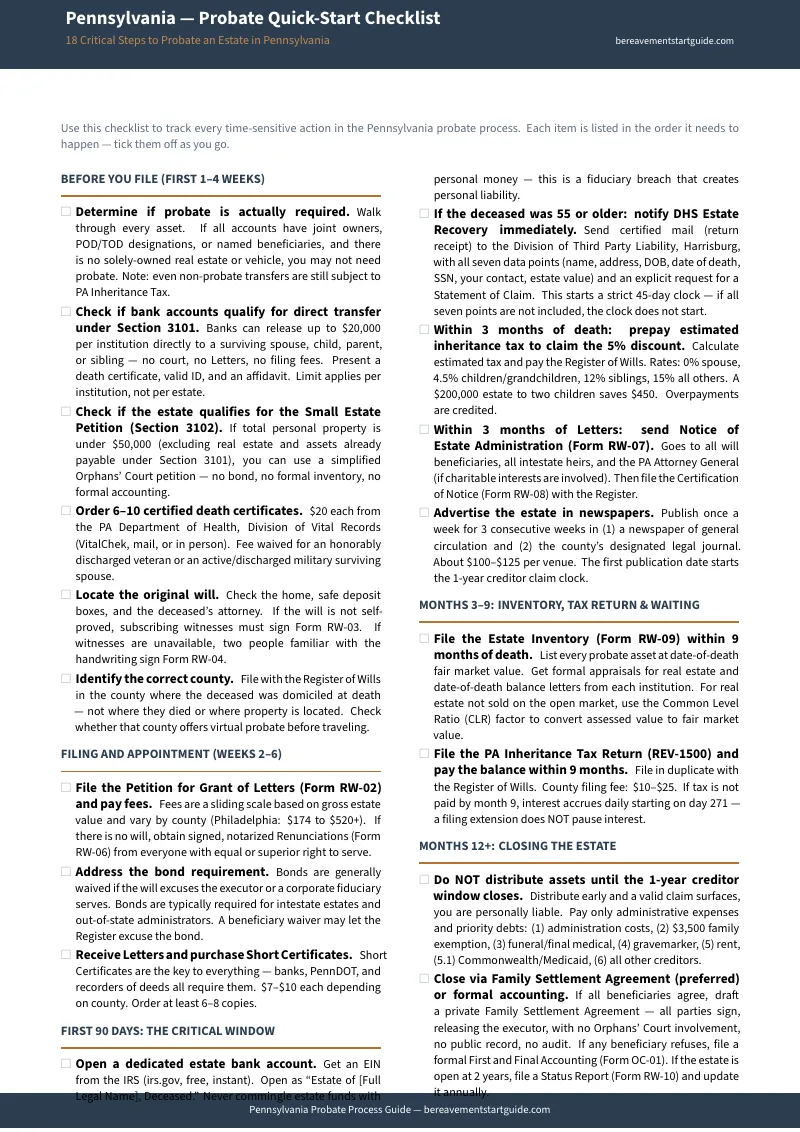
Your download includes the complete 14-chapter guide with two appendices — a probate vs. non-probate asset quick reference and a key contacts directory — plus the standalone Pennsylvania Probate Quick-Start Checklist with 18 critical steps and a deadline-at-a-glance table, and six printable reference sheets: the Inheritance Tax and 5% Discount Walkthrough, the Section 3101 Direct Transfer Reference, the Medicaid Estate Recovery and 45-Day Rule, the Johnson Estate Fee Schedule and Cost Breakdown, the Creditor Priority and Surcharge Protection reference, and the Family Settlement Agreement and Closing Paths comparison. Instant download, no account required.
Money-back guarantee, no time limit. If the guide does not give you clarity on what to do next and confidence that you are doing it in the right order, email us for a full refund. No questions asked.
Not ready for the full guide? Download the free Pennsylvania Probate Quick-Start Checklist — the 18 time-sensitive steps in order, the key deadline dates, and the decision points that tell you whether you need formal probate at all. It is enough to see the whole process at a glance.
You did not ask for this job. But you are the one doing it. The bank will not release the money. The Register of Wills will not explain the forms. The three-month discount clock is already running. This guide puts every Pennsylvania probate step into one sequence so you can stop searching and start settling.