Rhode Island Has 39 Separate Probate Courts, an Invisible Tax Lien on Every House, and a Medicaid Recovery Office Nobody Tells You About. You Just Became Responsible for All of It.
Your loved one died in Rhode Island, and you are now navigating one of the most fragmented probate systems in the country. Not one courthouse — 39 separate municipal probate courts, each with its own judge, its own hearing schedule, and its own newspaper advertising requirements. Johnston meets on the second and fourth Tuesday. South Kingstown meets on the third Thursday. The newspaper deadlines run 14 days before the hearing. And nobody at city hall can tell you where to start — because under Rhode Island law, court clerks are prohibited from giving legal advice.
You tried calling the bank. They told you the accounts are frozen and you need "Letters Testamentary" — a term you have never heard. You looked into selling the house and a title company told you there is a "statutory lien" on the property. You Googled "Rhode Island probate" and found a Secretary of State website full of blank PDF forms — PC-1.5, PC-1.9, PC-10.13, T-77 — with zero guidance on which ones you need, in what order, or how they connect to each other.
Meanwhile, a Rhode Island probate attorney charges $300 to $600 per hour. Full estate administration runs one to four percent of the estate's value. And the first thing they tell you is that several of the deadlines started running from the date of death — not the date you walked into their office.
The Municipal Navigation System — One Sequence Through 39 Courts
The When Someone Dies in Rhode Island — Estate Settlement Guide takes the 39-court probate maze, the invisible tax lien, the Medicaid recovery rules, the creditor priority statutes, and the scattered government forms and organizes them into one chronological action plan. It tells you which court has jurisdiction over your case, which forms to file, in what order, and — critically — which deadlines are already running while you are reading this.
What You Get
The Complete Estate Settlement Guide
A 14-chapter guide covering every step of settling an estate in Rhode Island — organized by timeline, not by agency. Written for executors, administrators, and families, not probate attorneys.
- First 48 Hours Protocol — The immediate actions that protect the estate: pronouncement and body transport, cremation requirements (RIGL 23-3-18 mandates a 24-hour wait plus a cremation certificate from the Office of State Medical Examiners), ordering 10-15 certified death certificates ($22 walk-in, $25 by mail from the Center for Vital Records in Cranston), securing the home, and the one thing you must not do — pay any of the deceased's bills from your own money.
- 39-Court Municipal Navigator — Rhode Island's probate system is not centralized at the county level. Each of the 39 cities and towns appoints its own probate judge, sets its own hearing calendar, and requires advertising in specific local newspapers — the Providence Journal, the Newport Daily News, the Bristol Phoenix, or the Sakonnet Times, depending on the municipality. The guide identifies which court has jurisdiction, what each court's filing requirements are, and how to avoid having your petition rejected for advertising in the wrong paper or missing a 14-day deadline.
- The Tax Lien Trap — Rhode Island places an automatic statutory lien on every piece of real estate the moment someone dies. Even if the estate is worth $400,000 — well below the $1,838,056 estate tax threshold for 2026 — you cannot sell, transfer, or refinance the property until you file Form RI-706 and submit Form T-77 (Discharge of Estate Tax Lien) in triplicate. The T-77 requires the exact tax assessor's description from the municipal property tax bill and must be typed without a single error, or it will be rejected. The guide walks you through the entire lien discharge process so one rejected form does not stall your real estate closing.
- Bank Account Unlocking Sequence — Which accounts are frozen and which are not. Joint accounts with right of survivorship remain accessible. Payable-on-Death accounts transfer to named beneficiaries with a death certificate. Accounts held solely in the deceased's name require Letters Testamentary from the municipal probate court — or, for estates under $15,000 in intangible personal property with no real estate, the small estate affidavit (Form PC-1.9 or PC-1.10) that lets you claim the funds without full probate.
- Vehicle Transfer Roadmap — Three separate DMV processes depending on your situation: surviving spouse transfer (no probate required, no sales tax), sole heir affidavit, or executor transfer with court-issued letters. The guide covers the January 2024 titling rule change, the exact forms for the Cranston DMV (TR-1, Sales Tax Exemption Certificate), and how to avoid the registration limbo that strands vehicles for months.
- Real Estate Transfer System — Rhode Island does not permit Transfer-on-Death deeds for real property. Every house, condo, and coastal property must pass through probate or qualify for a specific legal exemption. The guide covers the Certificate of Devise or Descent (Form PC-10.6), recording requirements at municipal land evidence records offices, and the coordination between the T-77 lien discharge and the actual deed transfer.
- Probate vs. Small Estate Decision Tree — Rhode Island's small estate process (RIGL 33-24-1) applies only when the estate contains $15,000 or less in intangible personal property, zero real estate, and 30 days have elapsed since the death. One coastal timeshare, one co-owned lot, or $15,001 in bank accounts pushes you into full probate. The decision tree maps exactly which path applies to your situation.
- Creditor Defense Guide — RIGL 33-12-11 establishes a binding priority for paying debts: funeral charges first, then medical expenses from the last illness, then federal debts, then state and town taxes, then child support and wages — and only then unsecured credit card debt. The guide gives you the statutory authority to reject aggressive, low-priority creditors who call during the six-month claims window.
- Medicaid Estate Recovery Playbook — If the deceased was 55 or older and received Medicaid-funded care, the EOHHS can file claims against the estate. But Rhode Island is a "probate-only" recovery state — assets passing outside probate (joint tenancy, irrevocable trusts) are beyond the recovery program's reach. Recovery is permanently blocked if a surviving spouse, a child under 21, or a disabled child survives. The guide explains the mandatory Fiduciary's Affidavit (RIGL 33-11-5.2) and the exemptions that may protect the family home.
- Intestate Succession Rules — When there is no will, Rhode Island distributes assets according to a statutory formula that most families find surprising. The surviving spouse does not automatically inherit everything. The guide maps every scenario: spouse only, spouse plus children, no spouse, no children, and the distant-relative tiers that determine who inherits when there is no immediate family.
- Complete 12-Month Timeline — Every deadline mapped from the date of death: the 7-day death certificate filing window, the 90-day inventory requirement, the 6-month creditor claims period, the 9-month estate tax filing deadline, and the month-by-month sequence that takes the estate from petition to final distribution.
- When to Hire a Lawyer — The guide is designed to handle straightforward estates independently. For contested wills, business interests, complex real estate, or significant debt, it tells you exactly when professional help becomes not just useful but functionally mandatory — and how to reduce your attorney's billable hours by walking in with organized paperwork instead of questions.
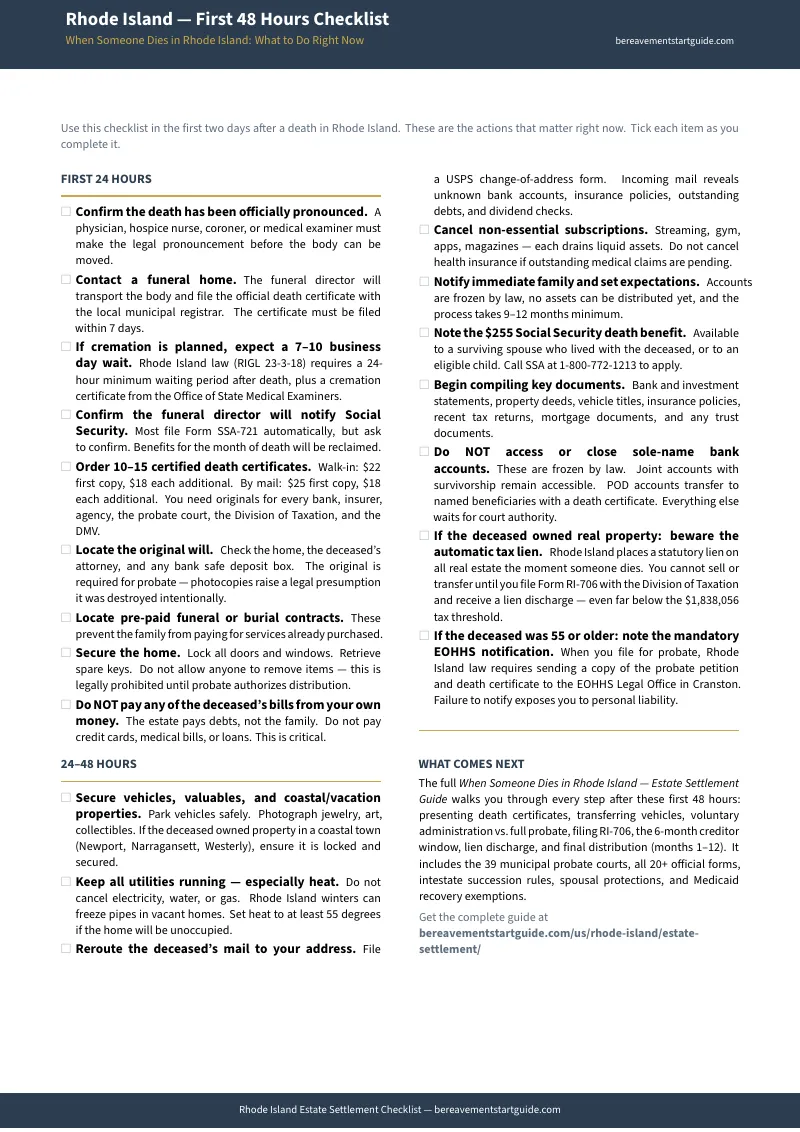
The First 48 Hours Checklist
A 19-item printable checklist covering every critical action in the first two days after a death in Rhode Island. Organized by urgency — the first 24 hours, then 24-48 hours — with Rhode Island-specific requirements including cremation waiting periods, the automatic real estate tax lien, and the EOHHS notification for Medicaid recipients over 55. Enough to start immediately, even before opening the full guide.
5 Standalone Printable References
Print these separately and bring them to the courthouse, post them on the fridge, or hand them to your attorney:
- Estate Settlement Deadline Calendar — Every statutory deadline from day one through final distribution, organized by time period. Post it where you can see it.
- 39-Court Municipal Probate Quick Reference — Hearing schedules, filing fees, and advertising costs for Rhode Island's largest municipal probate courts.
- Official Forms Quick Reference — Every form referenced in the guide — PC-1.5, RI-706, T-77, TR-1, and 20+ more — with its purpose and where to get it.
- Probate vs. Small Estate Decision Tree — Work through the qualifying factors on paper to determine whether the estate qualifies for simplified voluntary administration or requires full probate.
- Final Distribution Checklist — 12 items that must be completed before distributing estate assets to beneficiaries. Check them off over months as each one clears.
Who This Is For
- Executors who received a stack of blank probate forms from the Secretary of State's website and have no idea which ones apply, in what order, or which municipal court to file them with
- Surviving spouses who need to access frozen bank accounts, transfer a vehicle title, and understand their inheritance rights under Rhode Island law — all while managing funeral arrangements and grief
- Out-of-state family members managing a Rhode Island estate remotely who need to navigate the municipal probate system, comply with RIGL 33-18-9's requirement to appoint a resident agent, and handle the local newspaper advertising requirements from another state
- Sole heirs trying to determine if the estate qualifies for the $15,000 small estate process — and whether that timeshare or the car pushes them into full probate
- Families whose loved one owned Rhode Island real estate and just discovered the automatic statutory tax lien that blocks every sale, transfer, and refinance until Forms RI-706 and T-77 are filed and approved
- Anyone whose loved one was 55 or older and received Medicaid, who needs to understand whether the family home is actually at risk or whether the "probate-only" recovery rules and categorical exemptions protect it
Why Not Free Resources?
The information exists. It is scattered across 39 municipal court websites, a Secretary of State forms page, the Division of Taxation portal, the EOHHS Legal Office, and the DMV. Assembling it into one actionable sequence — while you are grieving and multiple statutory deadlines are running simultaneously — is a different problem entirely:
- The Secretary of State provides blank probate forms (PC-1.5, PC-1.9, PC-10.13, T-77) without instructions on which ones your situation requires, in what sequence, or how the forms interact with each other and the municipal court's local rules
- Local attorney blogs explain the probate process in just enough detail to justify a $300-to-$600-per-hour retainer — no standalone checklist, no chronological roadmap, no form-by-form walkthrough you can use independently
- National legal sites like Nolo and EstateExec cover Rhode Island in generic state overview pages that miss the 39-court municipal fragmentation, the T-77 tax assessor requirement that rejects typos, the mandatory EOHHS notification, and the January 2024 DMV titling rule change
- Reddit threads contain advice from executors in other states whose probate systems, tax lien rules, and small estate thresholds do not apply in Rhode Island
- Municipal court clerks cannot help — Rhode Island law explicitly prohibits them from giving legal advice, so they will hand you a form and tell you to see a lawyer
— Less Than One Hour of Attorney Time
A Rhode Island probate attorney charges $300 to $600 per hour. Full estate administration runs one to four percent of the estate's value. This guide costs a fraction of one consultation and covers the entire 12-month settlement process — from the first 48 hours through final distribution — so you understand which court to file in, which forms to use, in what order, and by when.
For straightforward estates, this guide can replace dozens of hours of confused research across 39 different municipal court websites. For complex estates, organizing your paperwork with this guide before your first attorney meeting can save thousands in billable hours — because you walk in with a completed inventory, a clear timeline, and the right forms already identified.
60-day, no-questions-asked refund guarantee. If this guide does not save you at least 10 hours of frustrated research across Rhode Island's fragmented municipal probate system, email us for a full refund. You keep the guide.
Not ready for the full guide? Download the free Rhode Island — First 48 Hours Checklist — the 19 most urgent actions, deadlines, and warnings that most families do not discover until the bank freezes the accounts or the title company flags the statutory lien.
You did not plan to be the person navigating 39 municipal courts, an invisible tax lien, and a Medicaid recovery office. But the statutory deadlines started running the moment your loved one died, the bank accounts are frozen until you file the right forms with the right court, and every hour an attorney spends sorting paperwork is an hour billed to the estate. This guide turns Rhode Island's uniquely fragmented system into a single organized sequence — so you walk into your municipal probate court prepared, not paralyzed.