The Division of Taxation Filed a Lien on the House. The Pension Office Said to Call Back After You File a Death Certificate With Warwick. The Municipal Probate Court Said They Cannot Advise You on Which of the 39 Courts Has Jurisdiction. You Are Grieving, and Rhode Island's Benefit System Assumes You Already Know How All of This Works.
You called the Employees' Retirement System of Rhode Island to ask about the survivor pension. They told you to submit certified death certificates to the operations center in Warwick, to verify which payment option your spouse selected at retirement, and to call back after processing. They could not explain how the payment option affects your monthly income, whether the Teachers' Survivorship Benefit applies differently than the municipal plan, or whether your dependent children qualify for a separate family benefit. They suggested you consult an attorney.
You drove to the probate court to ask about filing the will. The clerk asked which municipality the deceased resided in. You said Providence. She said you are in the wrong building — the City of Providence has its own probate court, separate from all other municipalities, and each of the 39 cities and towns in Rhode Island operates its own independent probate court with its own forms, filing fees, and procedures. She suggested you consult an attorney. You went home and searched online. You found the Division of Taxation website with a PDF about Form T-77 for estate tax lien discharge, three law firm blogs that explained how dangerous your situation is and ended with "schedule a consultation at $240 per hour," and a Reddit thread where someone said they could not sell their parent's house because no one told them about the automatic statutory lien. You do not know what is true, what applies to your situation, or where to start.
Meanwhile, you may be missing benefits you do not know exist. A $20,000 workers' compensation burial benefit if the death was work-related. A property tax exemption for veterans' surviving spouses that varies by municipality — up to $46,500 in Westerly, a different amount in Warwick, another in Newport. A health insurance continuation under Rhode Island's mini-COBRA statute that has a strict 30-day election window. A Crime Victim Compensation award of up to $25,000 if the death resulted from a violent crime. An ERSRI or Teachers' Survivorship Benefit pension that requires specific documentation filed within specific deadlines. Every one of these programs is administered by a different agency, with different forms, different deadlines, and different eligibility rules. None of them tells you about the others.
The Rhode Island Survivor Benefits Navigator is a 39-Court Benefit Recovery System for every pension, exemption, insurance continuation, death benefit, and government program available to surviving spouses and dependents in Rhode Island. Not a generic national checklist repurposed with Rhode Island's name. Not a law firm blog designed to convince you that $240 per hour is your only option. A plain-English, Rhode Island-specific manual that tells you what the pension offices, municipal courts, and state agencies cannot: which benefits exist, who qualifies, which agency administers each one, what forms to file, in what order, and which deadlines will cost you money if you miss them.
What's Inside the 39-Court Benefit Recovery System
A step-by-step guide, a survivor benefits checklist, and standalone reference sheets — covering every benefit available to surviving spouses and dependents in Rhode Island, built on the Rhode Island General Laws, the ERSRI pension rules, the municipal tax codes, and the state agency procedures that make this process different from any other state:
ERSRI and Teachers' Survivorship Benefit Pensions Decoded
This is the chapter that cuts through the most opaque benefit system in Rhode Island. If the deceased was a state employee under the Employees' Retirement System of Rhode Island or a public school teacher under the Teachers' Survivorship Benefit plan, their retirement payment option — selected at the time of retirement — determines exactly what you receive. The guide explains every payment option, identifies whether you qualify for ongoing monthly benefits or a one-time lump-sum refund, walks you through the documentation requirements for the ERSRI operations center in Warwick, and addresses the complications introduced by the Municipal Employees' Retirement System for police, fire, and municipal workers. It includes the phone scripts and the exact sequence for contacting 401-462-7600 to halt current payments and initiate survivor benefits.
Estate Tax Lien Discharge: Form T-77 and the Automatic Statutory Lien
This is the chapter that prevents the single most common surprise in Rhode Island estate administration. Rhode Island places an automatic statutory lien on every piece of real estate owned by the deceased — regardless of whether the estate owes any tax at all. Even if the estate is worth $300,000, well below the taxable threshold, the executor must file Form T-77 in triplicate with the Division of Taxation to discharge the lien before the property can be sold or transferred with a clear title. The guide provides step-by-step instructions for completing T-77, explains how to locate the required "Tax Assessor's Description" from local property tax bills, covers Form T-79 for releasing liens on Rhode Island securities, and walks you through the submission process that the Division of Taxation's website describes in statutory language.
Property Tax Exemptions: Municipality-by-Municipality Relief
Rhode Island administers property tax exemptions at the municipal level, which means the rules, application windows, and exemption amounts vary across all 39 cities and towns. The basic surviving spouse exemption exists under state law, but each municipality sets its own dollar amount. Veterans' surviving spouses qualify for additional exemptions under R.I. Gen. Laws 44-3-4, and the amounts vary dramatically — Westerly offers up to $46,500, while other municipalities offer different tiers. Surviving spouses of law enforcement officers or firefighters killed in the line of duty qualify for a 100% property tax exemption under R.I. Gen. Laws 44-5-13.40, provided they do not remarry. The guide maps the exemption tiers, explains the application process for your town's tax assessor office, identifies the documentation you need, and flags the filing deadlines that vary by municipality.
Workers' Compensation Death Benefits
If the death resulted from a workplace injury or occupational disease, Rhode Island provides a $20,000 burial expense benefit and ongoing weekly compensation equal to 75% of the deceased employee's average weekly wages — capped at the state maximum — plus $40 per week for each dependent child. These claims are administered by the Department of Labor and Training and require the Memorandum of Agreement form (DWC-02). The guide covers eligibility, the claims process, the specific forms the DLT requires, the calculation of weekly benefits, and the dependency rules that determine whether adult children or other dependents qualify.
Health Insurance Continuation Under Mini-COBRA
The death of a spouse who carried the family health insurance triggers an immediate coverage crisis. Rhode Island provides a specific pathway through the state's mini-COBRA statute — R.I. Gen. Laws Section 27-19.1-1 — which allows surviving spouses and dependents to maintain the deceased's group health insurance for up to 18 months. The surviving spouse must elect to continue participation within 30 days of coverage termination. Federal COBRA offers additional options for employers with 20 or more employees. HealthSource RI, the state's health insurance marketplace, provides a Special Enrollment Period triggered by the qualifying life event. The guide maps every pathway based on the source of the deceased's coverage and provides the enrollment windows, the forms, and the agency contacts for each one.
Medicaid Estate Recovery: What the State Can and Cannot Take
This is the chapter that replaces fear with facts. If the deceased received Medicaid benefits for nursing home care or long-term services, Rhode Island's Executive Office of Health and Human Services has the legal right to seek recovery of those costs — but only from assets that pass through probate. Rhode Island uses a "probate-only" definition for estate recovery, meaning assets held in joint tenancy, living trusts, or with designated beneficiaries are not subject to recovery. The state cannot enforce recovery while the surviving spouse is alive. The guide explains the exact scope of Rhode Island's recovery authority, the specific exemptions that protect surviving spouses and disabled children, and when the asset protection strategies that elder law attorneys charge thousands to explain actually apply to your situation.
The 39 Municipal Probate Courts and the Cesspool Act
Rhode Island does not use a unified court system for probate. Each of the 39 cities and towns operates its own independent probate court, with its own filing procedures, fee structures, and administrative requirements. The small estate threshold is only $15,000 in personal property with no real estate — one of the lowest in the country. If any real estate is involved, you enter full probate administration. Out-of-state owners of Rhode Island vacation homes trigger ancillary probate. And the Cesspool Act of 2007 mandates that any cesspool serving a property being transferred must be removed and replaced within 12 months of closing — an expense that can reach tens of thousands of dollars. The guide identifies which court has jurisdiction over your case, explains the inventory filing fee structure, and flags the environmental compliance requirements that blindside executors selling coastal or older properties.
Who This Guide Is For
- The surviving spouse who just lost a state employee or teacher — who needs to understand what the deceased's retirement payment option means for their income starting next month, how to contact the ERSRI operations center in Warwick, and what documentation the pension system requires before it will release a single payment
- The surviving spouse who cannot sell or transfer the house — who discovered that Rhode Island placed an automatic statutory lien on the property regardless of the estate's value, and needs to file Form T-77 in triplicate with the Division of Taxation to clear the title before any transaction can proceed
- The veteran's surviving spouse who does not know what exemptions exist — who may be paying full property taxes on a home that qualifies for a partial or total municipal exemption under R.I. Gen. Laws 44-3-4, and whose exemption amount depends entirely on which of the 39 municipalities they live in
- The family of a worker killed on the job — who needs to file for the $20,000 burial benefit and ongoing weekly compensation through the Department of Labor and Training using Form DWC-02, and does not know where to start or what the dependency rules are
- The adult child helping a surviving parent navigate benefits from another state — who is trying to coordinate federal, state, and municipal benefits for a parent in Rhode Island remotely, and needs every agency, form, deadline, and eligibility rule in one document instead of calling five different offices and navigating 39 different court systems
- The surviving spouse whose health insurance just ended — who has 30 days to elect continuation under Rhode Island's mini-COBRA statute or secure coverage through HealthSource RI's Special Enrollment Period, and cannot afford a gap in coverage while managing everything else
Why Free Resources Will Not Get You Through This
Rhode Island survivor benefit information exists. The ERSRI publishes retirement handbooks, the Division of Taxation publishes tax forms, and dozens of agencies maintain websites. Here is what you actually encounter when you try to navigate benefits using free sources:
- ERSRI publishes pension handbooks — written for actuaries, not widows. The handbooks explain retirement payment options using terms like "co-participant annuity" and "service-connected disability retirement." They assume you understand the difference between the state employees' plan, the municipal employees' plan, and the Teachers' Survivorship Benefit. They do not explain what happens to your income next month in plain language. They do not tell you which forms to submit to the Warwick operations center. They tell you to call 401-462-7600, and the representative tells you to submit certified documents and call back.
- The Division of Taxation provides the forms — and zero guidance on when to file them. Form T-77 is available as a PDF. Understanding that you must file it in triplicate, that you need the "Tax Assessor's Description" from your municipal property tax bill, that the lien exists even if the estate owes zero tax, and that failing to file will prevent you from selling or refinancing the property — none of this appears on the form or in the instructions. The Division of Taxation does not advise on completion.
- The 39 municipal probate courts each publish their own procedures — and none of them cross-reference. Providence's probate court has different forms than Warwick's, which has different forms than Newport's. The Secretary of State provides generic probate forms but explicitly states they do not provide information on completion or legal matters. Figuring out which court has jurisdiction, what the filing fee is, and whether the estate qualifies for the small estate process requires checking with the specific municipality.
- Law firm blogs explain how dangerous your situation is — and end with a phone number. Every probate and elder law firm in Providence, Warwick, and Cranston publishes blog posts about survivor benefits. They are accurate, alarming, and deliberately incomplete. The post explains the risk. It never explains the solution in enough detail to act on. It always ends with "schedule a consultation." Those consultations run $240 per hour.
- No free resource synthesizes all of these programs into one chronological action plan. The pension office handles pensions. The Division of Taxation handles estate tax liens. The municipal tax assessor handles property tax exemptions. The DLT handles workers' compensation. HealthSource RI handles marketplace insurance. The EOHHS handles Medicaid recovery. The SSA handles Social Security. The VA handles veteran benefits. Each agency knows its own program and nothing about the others. No free resource tells you which benefits you are owed, which agency administers each one, what forms to file, in what order, and which deadlines will cost you if you miss them.
Free resources give you pension handbooks written in actuarial language, a Division of Taxation that cannot advise you, 39 municipal courts that each operate independently, and law firm blogs that end with a billable-hour phone number. The 39-Court Benefit Recovery System puts every Rhode Island survivor benefit, form, deadline, and eligibility rule into one document, in the order you actually need them.
— Less Than Fifteen Minutes With a Rhode Island Probate Attorney
A consultation with a Rhode Island probate or elder law attorney runs $240 per hour on average. A single session to review your benefit eligibility and explain the pension options, property tax exemptions, Form T-77 lien discharge, Medicaid recovery rules, and health insurance pathways will consume that first hour and often a second. This guide costs less than fifteen minutes of professional legal time and gives you the complete Rhode Island-specific benefit roadmap — every program, every agency, every form, every deadline, and the coordination rules that determine how state and federal benefits interact.
Your download includes the complete step-by-step guide covering every survivor benefit category, the standalone Rhode Island Survivor Benefits Checklist, and printable reference sheets: the Benefit Eligibility Decision Tree, the ERSRI and TSB Pension Options Reference, the Form T-77 Lien Discharge Walkthrough, the Property Tax Exemption Application Guide, the Health Insurance Transition Pathway, the Workers' Compensation Claim Checklist, the Medicaid Estate Recovery Quick Reference, and an Agency Contact Directory with every relevant state, municipal, and federal office. Instant download, no account required.
Money-back guarantee, no time limit. If this guide does not save you hours of hold time with state agencies and make the benefit claims process immediately clearer, email us for a full refund. No questions asked.
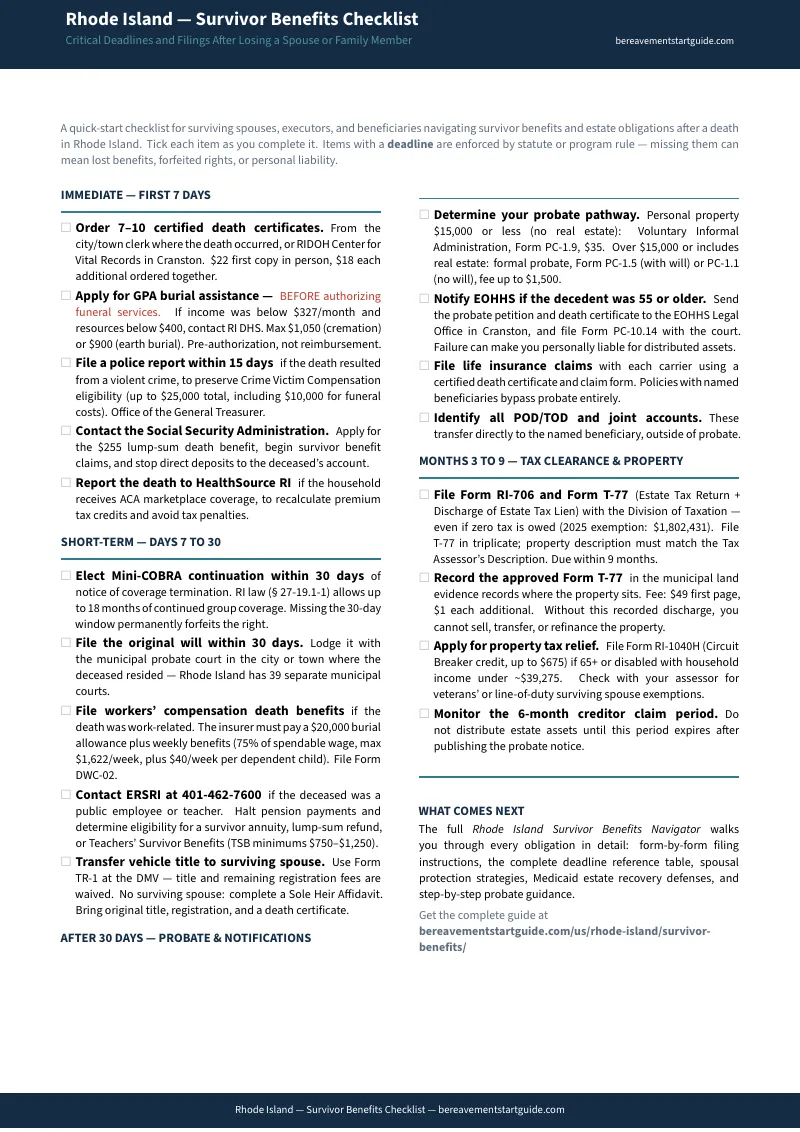
Not ready for the full guide? Download the free Rhode Island — Survivor Benefits Checklist — an overview of the benefits available, the key agencies, the 2026 thresholds, and the critical deadlines. Enough to understand what you may be owed and whether you need the full guide.
Nobody trained you for this. The pension office assumes you understand payment options. The Division of Taxation assumes you know about the automatic lien. The 39 municipal courts each assume you know which one has jurisdiction. You have something none of them provide — a single roadmap that connects every Rhode Island survivor benefit into one sequence, with plain-English instructions for each one.