The Funeral Director Said Embalming Is "Standard." The Crematory Said They Need a Signed Authorization From the "Next of Kin." The Price List Shows $8,200 and Nobody Will Tell You What You Can Legally Refuse.
Maybe you are sitting in an arrangement room right now, staring at a bundled package that includes embalming, a casket rental, a memorial service fee, and something called a "basic services" charge — and you have no idea which of those items you are legally required to pay for. Maybe the funeral home told you they cannot proceed with cremation because your brother objects, even though you are the surviving spouse and South Carolina law says you outrank everyone except a designated agent. Maybe you just found out your mother prepaid for a funeral contract ten years ago, and the funeral home you want to use says transferring the contract triggers a 10% penalty — and you do not know whether that is a real rule or an industry negotiating tactic.
You are grieving. Decisions have to happen within hours. And the funeral industry is counting on the fact that you do not know your rights — that you will accept every recommendation because challenging a funeral director while planning your loved one's burial feels impossible.
Here is what they are not volunteering: South Carolina has no state law requiring embalming. Federal law requires the funeral home to give you an itemized price list over the phone before you walk in the door. You have the absolute legal right to buy a casket from any third-party supplier without paying a handling fee. And if your family disagrees about burial versus cremation, it is not the funeral home's decision — South Carolina Code § 32-8-320 determines exactly who holds authority, and the hierarchy is not negotiable.
The South Carolina Funeral Laws & Consumer Rights Guide is the Consumer Defense Playbook — a plain-English action plan that translates Title 32, Title 44, Title 62, the FTC Funeral Rule, and federal EPA regulations into a single sequential reference. Not a law school textbook. Not a generic fifty-state overview that cannot distinguish South Carolina's cremation authorization hierarchy from California's. A state-specific operational guide built for the family member who just learned that the funeral industry is a commercial business — and that knowing the law is the only way to negotiate from a position of strength.
What's Inside the Consumer Defense Playbook
A 20-chapter guide covering every legal right, consumer protection, form, fee, and alternative disposition option under South Carolina law — organized in the sequence you actually need to act, from the hours after death through final disposition and estate reimbursement:
Chapter 1: Who Has the Legal Right to Make Decisions
South Carolina Code § 32-8-320 establishes a strict 10-step hierarchy that determines who controls disposition — and the funeral home cannot legally bypass it. The guide walks through every priority level: (1) a designated agent named in a verified document, (2) surviving spouse, (3) adult children, (4) parents, (5) adult siblings, down through court-appointed guardians and the county coroner. When siblings of equal priority disagree, the funeral home freezes operations until a probate court judge resolves it. The guide explains exactly how to assert your authority, what documentation to bring, and what to do when the funeral director tells you they "need everyone's agreement" — because legally, they do not.
Chapter 2: Death Certificates
The electronic EDRS filing system and the 5-day deadline. How many certified copies to order from the SC Department of Public Health ($12 for the first, $3 each additional). The critical exemption under § 44-63-74 that allows families conducting home funerals to file paper certificates directly. Why you need 10 to 15 copies (banks, insurance companies, the DMV, retirement accounts, and real estate transfers all demand originals).
Chapter 3: Cremation Authorization — The Rules Nobody Explains Clearly
The mandatory 24-hour waiting period under § 32-8-340. The cremation authorization form — and why the person who signs it must be the person at the top of the § 32-8-320 hierarchy, not whoever is most available. The coroner's cremation permit, which is a separate legal step from the burial-transit permit. What happens when a medical examiner holds the body. Pacemaker removal requirements before flame cremation — and why alkaline hydrolysis eliminates that requirement entirely.
Chapter 4: Embalming — What South Carolina Law Actually Requires
Nothing. South Carolina has no embalming mandate. Refrigeration and dry ice are completely legal alternatives. The narrow exceptions: some funeral homes require embalming for open-casket viewings as corporate policy (not state law), and common carrier airlines may require it for transport. How to decline embalming and what the funeral home must disclose — because the FTC Funeral Rule requires written consent before they proceed, and they must tell you it is not legally required.
Chapter 5: Home Funerals — Your Legal Right Under § 44-63-74
South Carolina explicitly allows families to handle everything — washing, dressing, transporting, and preserving the body — without a licensed funeral director. No licensing exemption paperwork needed. Family members acting without compensation are legally exempt from all funeral director regulations. The guide covers body preparation at home, transport in a personal vehicle, preservation with dry ice or refrigeration, and filing the paper death certificate within five days.
Chapters 6–8: Burial, Green Burial, and Alternative Disposition
Private home burial on family land — legal under state law, but county zoning requires setbacks (150 feet from water, 25 feet from property lines). Recording the burial on the property deed. Green burial sites operating in South Carolina (Ramsey Creek Preserve, Greenhaven Preserve, Dust to Dust) at $2,000–$5,000 versus $8,200+ for traditional burial. Alkaline hydrolysis (water cremation) fully legalized under § 32-8-347 at $1,045 to $3,900. Direct cremation comparisons across providers.
Chapter 9: Scattering Ashes
No state law broadly prohibiting scattering (§ 32-8-345). Private land requires owner consent. The federal rules for coastal scattering along the Grand Strand: three nautical miles offshore, biodegradable containers only, written EPA Region 4 notification within 30 days. State parks and inland waterways are subject to local municipal ordinances.
Chapter 10: Your Federal Rights Under the FTC Funeral Rule
The itemized General Price List that every funeral home is legally required to hand you — over the phone, before you visit, and at the start of any in-person arrangement conference. Your right to select individual services instead of accepting bundled packages. Your right to purchase a casket from any third-party supplier (including online retailers) without facing handling fees or surcharges. How to use these rights when the funeral director pushes back with language like "most families choose" or "it's included in our standard service."
Chapters 11–12: Preneed Contracts and Medicaid Protection
Irrevocable preneed contracts are fully excluded from Medicaid countable assets with no dollar cap in South Carolina — a critical Medicaid spend-down tool. The 10% transfer penalty on the face amount and 10% on final-year earnings if you switch providers. Revocable versus irrevocable contract mechanics. How to audit a contract for compliance. Filing a complaint with the SC Board of Funeral Service (110 Centerview Drive, Columbia) and the evidence you need.
Chapters 13–20: Transport, Veterans Benefits, Cemetery Access, Heirs' Property, Estate Protections, and the Complete Planning Checklist
Burial-transit permit requirements. Domestic shipping logistics and airline carrier rules. VA burial benefits and national cemetery eligibility. The Gullah-Geechee cemetery access crisis and heirs' property protections under the Clementa C. Pinckney Act. The surviving spouse's elective share (one-third of the probate estate). Funeral expense reimbursement as a top-priority estate claim under S.C. Code § 62-3-805. The $45,000 small estate affidavit shortcut (Form 420ES). And a complete chronological planning checklist covering every step from the first phone call through final disposition.
Who This Guide Is For
- Families arranging a funeral right now who need to know which services are legally required versus which are funeral home corporate policy — and how to use the FTC Funeral Rule to decline embalming, unbundle packages, and compare prices over the phone before committing to a provider
- Surviving spouses who were told "the whole family needs to agree" on disposition — who need to understand that South Carolina's § 32-8-320 hierarchy gives the spouse near-absolute authority, and that the funeral home cannot legally wait for a dissenting sibling's blessing
- Adult children managing a parent's funeral from out of state who need to understand burial-transit permits, transport logistics, ancillary probate for real estate, and whether the estate qualifies for the $45,000 small estate affidavit
- Families considering home funerals, green burial, or water cremation who need definitive proof of their legal rights under § 44-63-74 and § 32-8-347 so local authorities and funeral homes do not illegally impede their plans
- Proactive planners protecting assets from Medicaid recovery who need to understand how irrevocable preneed contracts shelter funeral funds from the estate — and how the 10% transfer penalty works if they switch providers
- Gullah-Geechee descendants and coastal families dealing with cemetery access disputes, heirs' property complications, and the intersection of ancestral land rights with funeral planning and informal probate
- Small estate administrators trying to avoid formal probate — who need to understand how funeral expense reimbursement works as a top-priority estate claim, and how the Form 420ES affidavit bypasses court for estates under $45,000
Why Free Resources Will Not Protect You in the Arrangement Room
The laws governing funerals in South Carolina are public record. The problem is not access — it is coherence. Here is what you actually face when you try to protect yourself with free sources alone:
- The funeral home will give you a price list if you ask. Federal law requires it. But the General Price List is designed to present options, not explain rights. It will not tell you that embalming is optional, that you can supply your own casket, or that "basic services of funeral director and staff" is a mandatory charge the FTC explicitly allows funeral homes to tack onto every arrangement. You need to know which charges are legally mandated, which are federally permitted, and which are the funeral home padding the invoice.
- State agency websites give you raw statutes, not a sequence. DHEC handles death certificates and burial-transit permits. The Board of Funeral Service handles licensing and complaints. The probate court handles small estate affidavits and disposition disputes. No single agency connects the cremation authorization process to the death certificate timeline to the burial permit requirements to the estate reimbursement rules. They each own one piece. Nobody publishes the sequence.
- National directories are templated across fifty states. US Funerals Online, Nolo, and Funeral Care Directory publish South Carolina pages that repeat the same generic cost averages and legal summaries they use for every state. They do not cover the § 32-8-320 priority hierarchy in depth, they get the small estate threshold wrong, and they completely ignore alkaline hydrolysis, heirs' property protections, and the preneed contract transfer penalties. South Carolina's specific statutory landscape is not a footnote — it is fundamentally different from neighboring states.
- Elder law firms write blogs to sell $300/hour consultations. Their articles accurately describe the complexity of preneed contracts and Medicaid estate recovery — and then withhold the actionable steps until you schedule a paid appointment. For the family negotiating a funeral price or filing a complaint with the Board of Funeral Service, you do not need a retainer. You need the right form, the right statute, and the right sequence.
Free resources give you fragments. The Consumer Defense Playbook gives you the sequence — every South Carolina statute, consumer right, form, and deadline in the order you actually need them, with plain-English instructions for using each one.
— Less Than a Single Line Item on a Funeral Home Invoice
The average traditional funeral in South Carolina exceeds $8,200. A single "embalming" line item runs $700 to $900 — for a service state law does not require. A one-hour consultation with an elder law attorney about preneed contracts costs $250 to $400. This guide costs less than any of those individual charges and gives you the complete South Carolina-specific consumer protection manual: every statute, every deadline, every form, every federal right, and every alternative disposition option — organized in the exact sequence a grieving family needs.
Your download includes the complete 20-chapter Funeral Laws & Consumer Rights Guide covering disposition authority, death certificates, cremation rules, embalming rights, home funerals, burial options, alternative disposition, preneed contracts, FTC protections, estate reimbursement, and a full planning checklist — plus 8 standalone printable references you can bring to the funeral home, the crematory, and the county office:
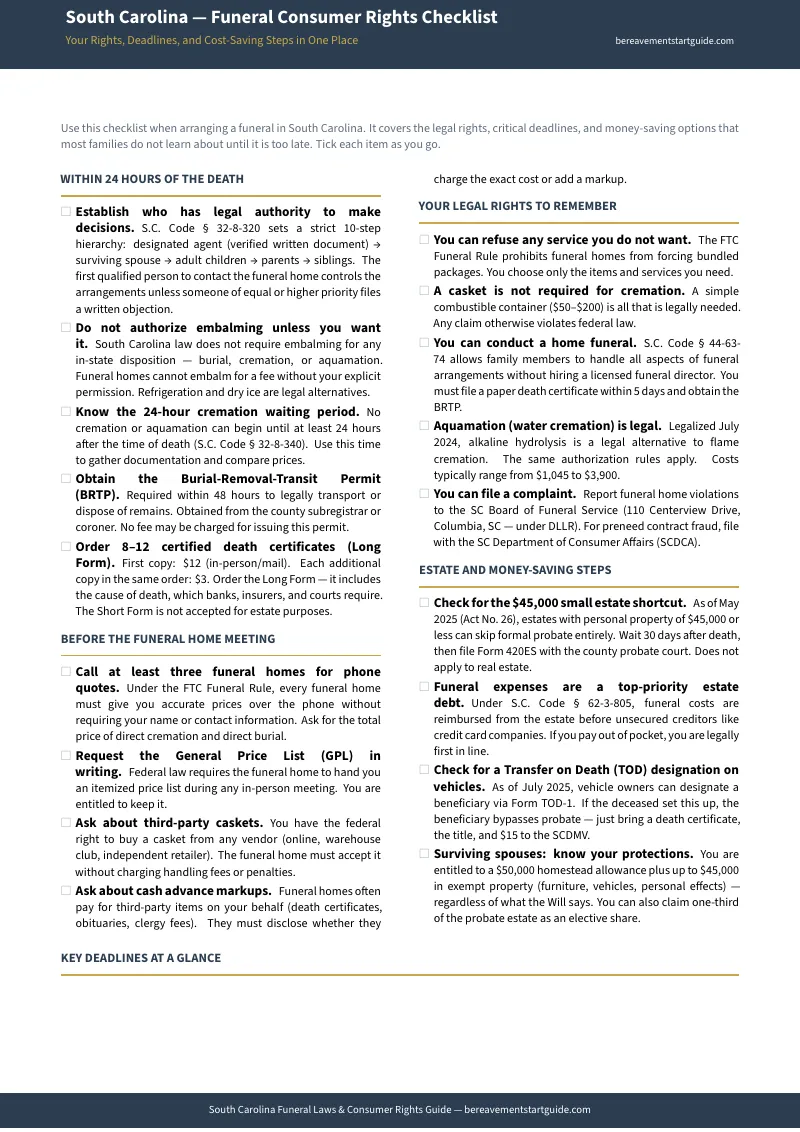
- Funeral Consumer Rights Checklist — one-page summary of rights, deadlines, and cost-saving steps
- Disposition Rights Hierarchy — the complete § 32-8-320 priority card showing who controls decisions
- Cremation Authorization Guide — waiting periods, documentation, coroner's permit, and pacemaker rules
- FTC Compliance Checklist — your federal rights in the arrangement room
- Funeral Cost Worksheet — fillable comparison sheet with South Carolina cost ranges
- Preneed Contract Reference — Medicaid exclusion, transfer penalties, and SCDCA complaint filing
- Home Burial Requirements — zoning, setbacks, deed recording, and Lowcountry coastal warnings
- Complaint Filing Guide — step-by-step for the SC Board of Funeral Service, SCDCA, and FTC
Money-back guarantee, no time limit. If the guide does not give you clarity on your legal rights and confidence to negotiate with a funeral provider from a position of knowledge, email us for a full refund. No questions asked.
Not ready for the full guide? Download the free South Carolina Funeral Consumer Rights Checklist — covering the immediate steps every family needs: who has legal disposition authority under § 32-8-320, what to ask when the funeral home calls, which services you can legally decline, and how to request an itemized price list before signing anything. It is enough to protect you in the first conversation.
The funeral industry is a business. This guide makes sure you negotiate like you know it.