You Were Just Named Executor in South Carolina. The Probate Court Wants Form 300ES Filed. The Bank Wants Letters Testamentary. The Creditors Want Money. And You Have No Idea What to Do First.
Maybe the bank told you the accounts are frozen and they need "Fiduciary Letters" before they will release a cent. Maybe you are staring at the South Carolina Judicial Branch website trying to figure out whether Form 300ES or Form 420ES is the one you need — and what happens if you pick wrong. Maybe you just found out that a "small estate affidavit" could let you skip court entirely, but every website you check still says the threshold is $25,000 when the law changed it to $45,000 over a year ago.
You are grieving. You did not ask for this job. And the state of South Carolina is already running deadlines you cannot see. You have 30 days after your appointment to notify every heir using Form 305ES — and file notarized proof you did it. You have 90 days to file a complete Inventory and Appraisement on Form 350ES, with every asset valued at the exact date of death. Miss that deadline and the Probate Judge issues a compliance summons. And behind all of it sits the question that keeps you awake: if I pay the wrong creditor first, or distribute assets too early, or file the wrong form at the wrong courthouse — am I personally liable for all of it?
The answer depends on whether you follow South Carolina's strict creditor priority hierarchy under S.C. Code 62-3-805, whether you wait the full eight months before distributing anything, and whether you know the difference between informal probate (an administrative process with no courtroom hearing) and formal probate (litigation before a judge). Most executors do not learn these distinctions until after they have already made a costly mistake.
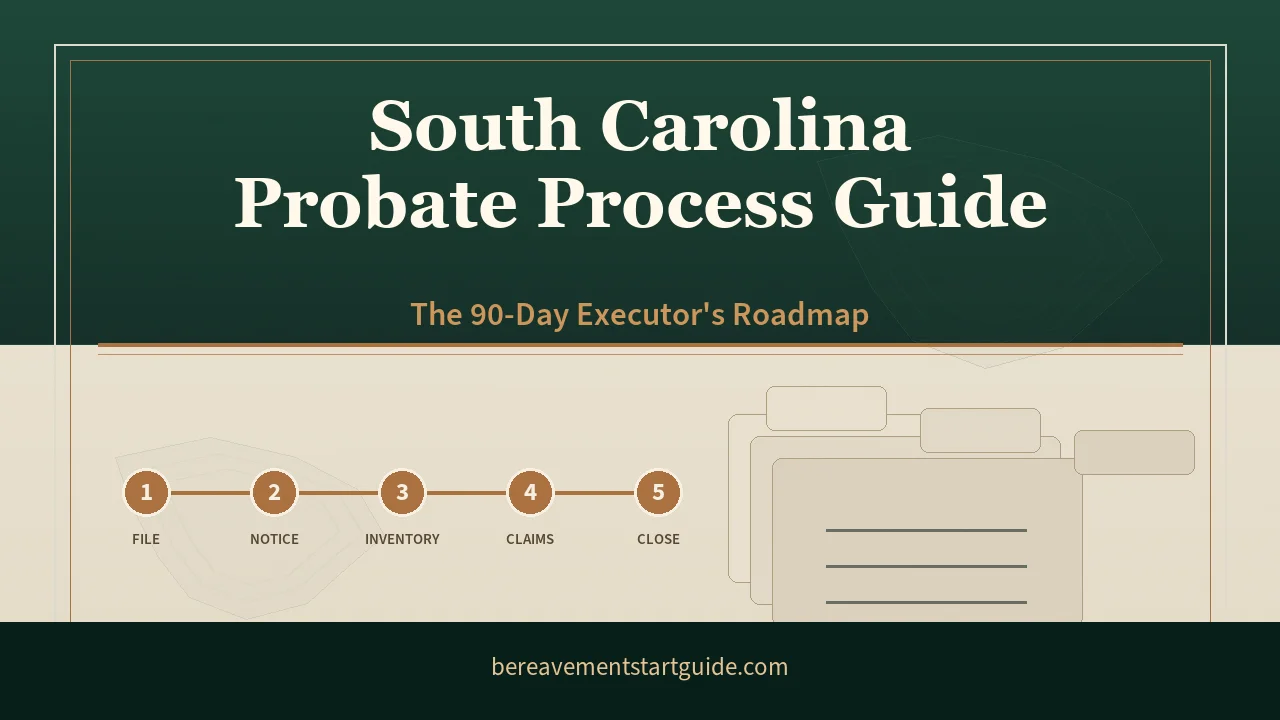
The South Carolina Probate Process Guide is the 90-Day Executor's Roadmap — a plain-English manual built specifically for South Carolina Title 62 that tells you exactly what to file, when to file it, and in what order. Not a law textbook. Not a generic national template that does not know South Carolina from South Dakota. A structured, state-specific operational sequence from the week of death through final estate closure, designed for the executor who has never done this before and does not want to pay an attorney $150 to $400 per hour to fill out paperwork the court designed for self-represented filers.
What's Inside the 90-Day Executor's Roadmap
An 18-chapter guide covering every stage of South Carolina probate — from gathering death certificates through closing the estate and being discharged by the Probate Judge. Every chapter maps to the specific South Carolina statutes, forms, and deadlines that govern the process:
Chapter 1: First Steps After the Death
Before you file anything, you need the foundational documents every subsequent step depends on. How many certified death certificates to order from the SC Department of Public Health (10 to 15 — the first costs $12 for a standard search or $17 expedited, additional copies $3 each). Where to find the original will — not a photocopy, not a scan, the original signed document that South Carolina Probate Courts require for informal probate. And the critical distinction between probate assets and non-probate assets: joint accounts, life insurance with named beneficiaries, POD accounts, and the new Transfer on Death vehicle designations (Form TOD-1, effective July 2025) all bypass probate entirely. The guide helps you separate what goes through court from what does not.
Chapter 2: The Small Estate Shortcut — Do You Even Need Full Probate?
As of May 8, 2025, Act No. 26 raised South Carolina's small estate threshold from $25,000 to $45,000. If the estate's personal property (excluding real estate and after subtracting liens) falls below that line, you can skip formal probate using Form 420ES — the Affidavit for Collection of Personal Property. The guide walks you through the exact eligibility requirements, the mandatory 30-day waiting period, the filing fees ($25 to $67.50 depending on value), and what to do when the estate includes real property that pushes you beyond the affidavit path into Summary Administration under S.C. Code 62-3-1203.
Chapter 3: Opening the Estate — Filing Form 300ES
The step-by-step process for filing the Application for Informal Probate and/or Appointment with the Probate Court in the county where the decedent was domiciled. What to submit with it (original will, certified death certificate, filing fee), how to handle renunciations when someone with higher priority declines to serve (Form 302ES), when a fiduciary bond is required and how much it costs ($85 flat minimum, scaling by estate value), and exactly what "Fiduciary Letters" are — the document banks and financial institutions demand before they will work with you.
Chapter 4: Your First 30 Days as Personal Representative
The clock starts the day of your appointment. Within 30 days you must deliver Form 305ES (Information to Heirs and Devisees) to every beneficiary and statutory heir — and file notarized Proof of Delivery (Form 120PC) with the court. This chapter also covers opening a dedicated estate bank account, securing the decedent's property, and the fiduciary duties that protect you from personal liability claims.
Chapters 5-6: Inventory, Appraisement, and the 8-Month Creditor Window
You have 90 days from appointment to file the Inventory and Appraisement (Form 350ES) — every probate asset valued as of the date of death. If you need more time, Form 352ES buys you an extension, but you must file it before the deadline, not after. Then the creditor process: the court publishes a Notice to Creditors in a local newspaper for three consecutive weeks ($85 to $100+), opening an eight-month window during which creditors file claims. The guide details the strict payment hierarchy — administration expenses first, then federal taxes, then medical bills and Medicaid claims, then state taxes, then general unsecured debts. Pay a credit card company before a hospital bill and the estate runs short? You are personally liable to the higher-priority creditor.
Chapters 7-8: Spousal Protections and Medicaid Estate Recovery
The surviving spouse's elective share (one-third of the probate estate under S.C. Code 62-2-201, regardless of what the will says). The $45,000 Exempt Property Allowance that must be set aside before almost any creditor gets paid. And the Medicaid Estate Recovery program — SCDHHS will file a claim against the estate if the decedent received long-term care over age 55, but they will not file if the estate is $25,000 or less, and undue hardship waivers exist for family homes where an immediate family member (now including grandchildren as of August 2025) has been living. The guide maps when each claim must be filed and how to respond.
Chapters 9-10: Transferring Real Estate and Vehicles
South Carolina does not allow Transfer on Death deeds for real property. Period. If the decedent owned a house solely in their name, it goes through probate and requires a Deed of Distribution (Form 400ES) recorded at the Register of Deeds. The guide covers the recording fee, the transfer tax exemption under S.C. Code 12-24-40, the property tax consequences for beneficiaries (the 4% vs. 6% assessment ratio), and the partial exemption application due by January 31st. For vehicles: the new TOD-1 path, the joint title survivorship path, and the probate path with DMV Form 400.
Chapter 11: Heirs' Property — A Critical South Carolina Issue
If the estate involves land passed down through generations without a formal will or recorded deed — particularly in the Lowcountry and Gullah Geechee communities — this chapter covers the Clementa C. Pinckney Uniform Partition of Heirs' Property Act (right of first refusal against forced partition sales), the 2026 Heirs' Property Tax Relief Act (preventing tax reassessments when families clear title), and how to get free legal assistance through the Center for Heirs' Property Preservation.
Chapters 12-14: Ancillary Probate, Compensation, and Closing the Estate
For out-of-state executors managing South Carolina vacation or retirement property: how ancillary probate works, the requirement to appoint an in-state resident agent under S.C. Code 62-3-203, and the filing process in the county where the property is located. Your statutory right to compensation (up to 5% of the personal estate under S.C. Code 62-3-719). And three methods for closing the estate — the Verified Statement (Form 421ES for small or sole-heir estates), Closing by Waiver (Form 364ES when all beneficiaries agree), and Full Accounting and Settlement (Forms 361ES, 410ES, 412ES, 416ES for contested or transparent closings).
Chapters 15-18: Taxes, Professional Help, Timeline, and Reference
South Carolina has no state estate tax or inheritance tax — but you still need to file the decedent's final income tax returns and a fiduciary income tax return if the estate earned income. The honest assessment of when you need an attorney (contested wills, insolvent estates, heirs' property) versus when this guide handles the entire process. The complete timeline from Week 1 through Month 12+ with every statutory deadline in sequence. And a full reference appendix: every key statute in Title 62, every state agency contact, every probate form with its filing trigger.
Who This Guide Is For
- The first-time executor who has never seen Form 300ES, has no idea what "Fiduciary Letters" are, and just learned they have 30 days to notify heirs, 90 days to file an inventory, and eight months before they can safely distribute a single asset — who needs every step laid out in chronological order with the exact form numbers attached
- The surviving spouse whose bank accounts were frozen this morning — who needs to know whether the estate qualifies for the $45,000 small estate affidavit or requires full probate, and how to claim the Exempt Property Allowance that South Carolina law guarantees before creditors touch anything
- The out-of-state executor whose parent retired to Hilton Head, Charleston, or Myrtle Beach — who just discovered that Letters Testamentary from another state do not work in South Carolina, that ancillary probate must be opened in the county where the property sits, and that a resident agent must be appointed for service of process
- The family with no will trying to understand South Carolina's intestate succession rules, whether a fiduciary bond is required, how much it costs, and whether the estate is small enough to avoid court entirely
- The executor worried about Medicaid who heard the state takes the family home — who needs to understand the $25,000 recovery threshold, the undue hardship waivers, and the expanded immediate family definition that now includes grandchildren
- The Lowcountry family dealing with heirs' property — land held informally across generations without a deed — who needs to understand their protections under the Clementa C. Pinckney Act and the 2026 Tax Relief Act before an outside investor forces a partition sale
- The cost-conscious executor managing a modest estate who refuses to spend $150 to $400 per hour on an attorney for what amounts to administrative filings the court designed for self-represented personal representatives
Why Free Resources Will Not Get You Through This
The information exists. It is scattered across 46 county probate court websites, the SC Department of Public Health, the SC Judicial Branch forms portal, federal agency sites, and law firm blogs that reference each other in circles. Here is what you actually encounter when you try to handle probate using free sources alone:
- County probate courts give you blank forms and tell you to hire a lawyer. Charleston County publishes Form 300ES and a fee schedule. Richland County posts filing instructions. Greenville County has a self-service counter. But every court explicitly states it "cannot provide legal advice." The clerk will hand you a blank form. They will not tell you which form to file first, how to fill it out, or what the step after that is. They are legally prohibited from giving you a sequence.
- National legal directories still cite the old threshold. Nolo, FindLaw, and Justia reference the $25,000 small estate limit — not the $45,000 figure that has been law since May 2025. They cannot guide you through county-specific filing fees. They do not mention the heirs' property protections, the Medicaid recovery nuances, or the ancillary probate requirements for non-resident executors. South Carolina is a footnote in their fifty-state overviews, and the footnote is wrong.
- Law firm blogs are written to convince you to hire them. South Carolina probate attorneys charge $150 to $400 per hour. Their blogs are accurate, well-written, and explicitly designed to emphasize complexity until you conclude you cannot do this without them. For contested estates, that is true. For the straightforward estate going through informal probate — the administrative process with no courtroom hearing that handles the vast majority of uncontested estates — the attorney's retainer can approach the value of the estate itself.
- No single source connects the sequence. The Probate Court handles forms but not strategy. The Department of Public Health handles death certificates but not probate. The DMV handles vehicles but does not explain how the new TOD law interacts with estate administration. SCDHHS handles Medicaid recovery but does not volunteer the hardship waivers unless you know to ask. There is no government entity that provides a unified, chronological roadmap connecting all of these agencies in the order you actually need them.
Free resources give you the pieces. The 90-Day Executor's Roadmap gives you the sequence — every South Carolina form, deadline, and procedure in the order things actually need to happen, with plain-English instructions at every step.
— Less Than a Single Hour With a South Carolina Probate Attorney
One consultation with a South Carolina probate attorney runs $150 to $400 per hour. For the many families dealing with a modest estate — a bank account, a vehicle, personal belongings, maybe a house — the attorney's bill can approach the value of the estate itself. This guide costs less than a single billable hour and gives you the complete South Carolina-specific operational manual: every statute, every deadline, every form number, every filing fee, and the chronological sequence that prevents the mistakes most first-time executors do not learn about until after they have made them.
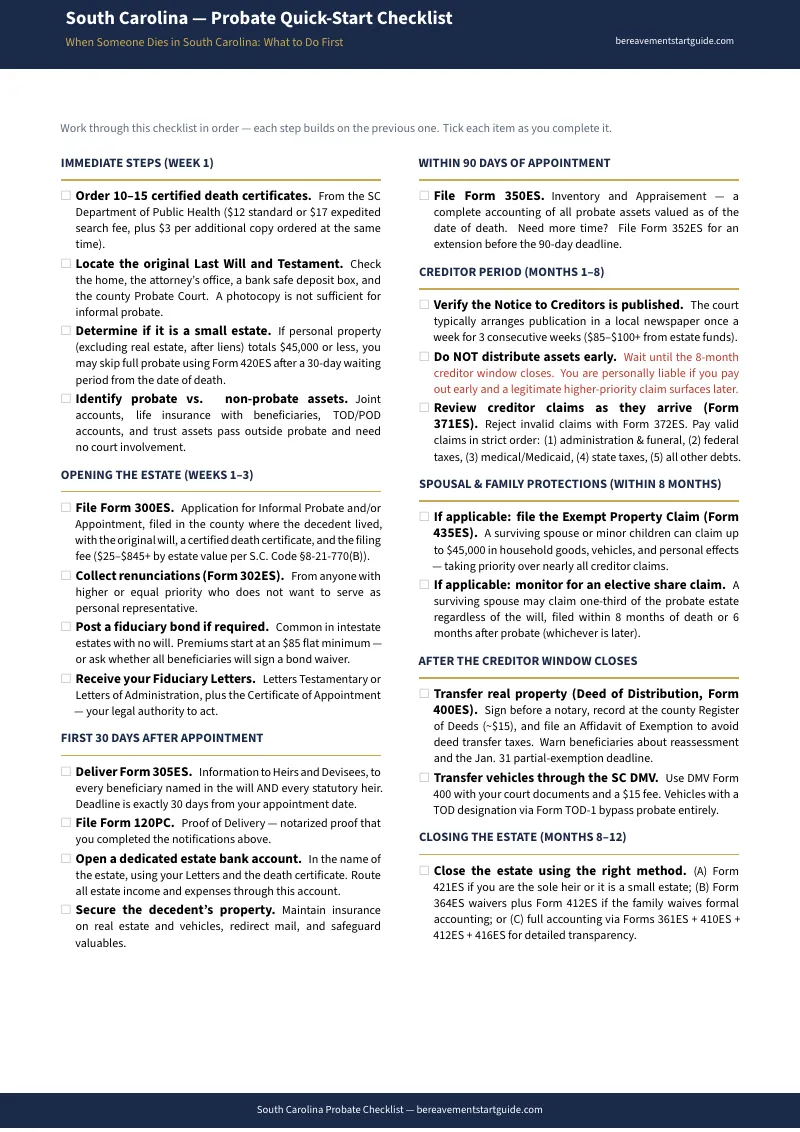
Your download includes the complete 18-chapter probate guide with key statute reference, agency contacts, and a forms quick-reference appendix — plus the standalone South Carolina Probate Quick-Start Checklist covering the critical first steps that unlock everything else. You also get five standalone printable references: the Small Estate Affidavit Walkthrough, the Creditor Priority Reference, the Complete Probate Timeline, the Filing Fee Schedule, and the Inventory and Appraisement Worksheet. Every chapter maps to the specific South Carolina statutes, court forms, and deadlines that govern the process.
Money-back guarantee, no time limit. If the guide does not give you clarity on what to file next and confidence that you are doing it in the right order, email us for a full refund. No questions asked.
Not ready for the full guide? Download the free South Carolina Probate Quick-Start Checklist — covering the immediate steps every executor needs: gathering death certificates, locating the original will, identifying probate vs. non-probate assets, and determining whether the estate qualifies for the $45,000 small estate affidavit. It is enough to get through the first week.
You did not choose this role. But you can handle it. The guide shows you exactly what to do, in exactly the right order.