Your Spouse Just Died in South Carolina. The State Owes Your Family a $45,000 Exempt Property Shield, Tax-Free Pensions, and a Health Insurance Continuation Window That Slams Shut in 31 Days. But You Have to File the Right Form — and Nobody Is Going to Tell You.
Right now, somewhere in the pile of paperwork spreading across your kitchen counter, there is a deadline ticking. Not one deadline — a half-dozen of them, each controlled by a different state agency, each requiring a different form, and each one permanently erasing money from your family's future if you miss it.
The 31-day PEBA Survivor Notice of Election that keeps your health, dental, and vision coverage alive after a state employee's death — miss it and you can never re-enroll, not at open enrollment, not ever. The $45,000 Exempt Property allowance (Form 435ES) that shields household goods, vehicles, and personal effects from every creditor — including medical debt collectors — but only if you affirmatively file within eight months. The workers' compensation death benefit that pays two-thirds of the deceased's weekly wage for up to 500 weeks plus $12,000 in burial costs. The veteran property tax exemption — a complete exemption on the home, five acres, and two vehicles — that surviving spouses can now claim retroactively for two years. The Elective Share that guarantees you one-third of the probate estate even if the will says otherwise.
You are managing all of this while grieving. While the joint bank account may be frozen. While Social Security has stopped the monthly check and nobody at the SSA office has called to explain what happens next, because survivor benefits are not automatic — you have to apply.
The South Carolina Survivor Benefits Navigator is a Deadline Defense System built from South Carolina statutes (including Act No. 26 of 2025), PEBA rules, the Workers' Compensation Commission procedures, the SCDMV transfer process, and Medicaid Estate Recovery regulations. Not a sympathy pamphlet. Not a generic estate overview written for all fifty states. A plain-English, deadline-by-deadline breakdown of every dollar the state and federal government owe your family — and the exact forms, procedures, and agency contacts to claim them before the windows close.
What's Inside the Deadline Defense System
A 15-chapter guide and the South Carolina Survivor Benefits Checklist — covering every benefit, every form, every deadline, and every protection available to surviving spouses and dependents in South Carolina:
The First 31 Days: The Deadlines That Cause Permanent Loss
Grief makes triage impossible. This chapter does it for you — a prioritized action list for the first month that separates what must happen now from what can safely wait. The 31-day PEBA health insurance continuation deadline. The 30-day requirement to deliver the original will to probate court. Ordering 8 to 12 certified death certificates from SC DPH ($12 for the first, $3 each additional in the same order — order in bulk to save). Notifying the employer to trigger workers' comp and life insurance claims. Understanding the mandatory 30-day waiting period before you can access solely-owned bank accounts or file the small estate affidavit. Every action is sequenced so the items that cause irreversible loss come first.
PEBA Pension and Health Insurance — The 31-Day Window
If the deceased was a state employee, teacher, or law enforcement officer under SCRS or PORS, survivor benefits are substantial but not automatic. The Survivor Notice of Election must be filed within 31 days to continue health, dental, and vision coverage — miss it and the window closes permanently. The guide explains the three pension payment options: Option A (lump-sum return of contributions), Option B (100% continuous monthly benefit), and Option C (50% monthly benefit). The incidental death benefit pays $2,000 to $6,000 for retirees based on years of service, or the full annual salary for active employees. It is taxable income — federal withholding is automatic, but you must actively request SC state withholding or face a surprise tax bill.
Workers' Compensation Death Benefits
When a death results from a workplace accident or occupational disease, South Carolina law provides weekly benefits equal to two-thirds of the deceased's average weekly wage — capped at $1,189.94 per week for 2026 — payable for up to 500 weeks. Minor children receive benefits until age 21 or indefinitely if mentally or physically incapable of self-support. A separate burial expense allowance covers up to $12,000. The guide covers the WCC claim forms (Form 50 and Form 52), the employer notification process, the compensation formulas, and exactly when the situation is complex enough that hiring a workers' comp attorney will save more than it costs.
Crime Victim Compensation
If the death resulted from a criminal act — homicide, fatal DUI, or any violent crime — the South Carolina Attorney General's Department of Crime Victim Compensation provides up to $15,000 in total assistance, including up to $6,500 for funeral and burial expenses. The crime must generally be reported to law enforcement within 48 hours and the compensation claim filed within 180 days. The guide walks you through the eligibility criteria and the application process.
The Elective Share — Protection Against Disinheritance
Under South Carolina law, a surviving spouse cannot be entirely disinherited. You are entitled to claim one-third of the deceased's probate estate, regardless of what the will says. But the calculation is complex — life insurance payouts naming the surviving spouse are charged against the share, and revocable trusts may or may not be included depending on how they were structured. The eight-month filing deadline is the same as the exempt property claim. The guide covers the petition process, the offset calculations, and the line where you need an attorney.
The $45,000 Small Estate Shortcut
Most South Carolina families assume they need a lawyer and full probate. Many do not. If the estate's personal property is worth $45,000 or less and there is no real estate in the estate, the small estate affidavit (Form 420ES) lets you collect assets from banks and institutions without opening a formal estate — 30 days after the date of death, no lawyer required. This threshold was recently increased from $25,000 by Act No. 26, effective May 2025. The guide gives you the decision tree for when the shortcut applies and when full probate is genuinely necessary.
Vehicle Title Transfers and the SCDMV Process
Transferring a car title in South Carolina after a death requires navigating the SCDMV with the right combination of documents. If the deceased filed a Transfer-on-Death designation (Form TOD-1), you bring the title, a certified death certificate, and Form 400 — $15 fee. If no TOD designation exists, you need the small estate affidavit or a probate Certificate of Appointment. The guide covers every scenario and the exact documents to bring so you do not get turned away at the counter.
Medicaid Estate Recovery Defense
If the deceased received Medicaid long-term care benefits, the state can attempt to recover those costs from the estate. The fear of losing the family home to the state is widespread — and usually worse than the actual legal risk. South Carolina only pursues estates valued over $25,000 where Medicaid paid more than $500. A surviving spouse completely prevents recovery. A minor or disabled child prevents it. The Undue Hardship Waiver (DHHS Form 3401) can protect a modest home when an immediate family member — including grandchildren, as of August 2025 — has lived there for at least two years and earns below 185% of the federal poverty level. The guide maps every exemption, every deadline, and the exact form to file.
Property Taxes, VA Benefits, Social Security, Real Estate, Heirs' Property, and More
The guide also covers the Homestead Property Tax Exemption ($50,000 off fair market value for over-65 or disabled survivors — with a 9-month deadline to acquire title and a requirement to remain unmarried), the complete veteran property tax exemption for surviving spouses of 100% disabled veterans (retroactive up to 2 years), Social Security survivor benefits and the $255 lump-sum death payment, the Deed of Distribution (Form 400ES) that is exempt from the $1.85 per $500 deed recording fee, heirs' property protections under the UPHPA, and South Carolina's tax-friendly treatment of retirement income and military pay.
Who This Guide Is For
- The surviving spouse whose partner just died — who needs to know about the $45,000 Exempt Property shield, the small estate affidavit shortcut, the Medicaid recovery exemptions, the Elective Share protection, and the Social Security survivor benefits that will not arrive unless you apply for them
- The adult child serving as executor — who is trying to figure out which probate pathway applies, which assets bypass probate entirely, and how to collect pension and retirement benefits without hiring a $300-per-hour attorney for routine administrative filings
- The family of a state employee, teacher, or law enforcement officer — who needs to navigate PEBA survivor benefits, the 31-day health insurance continuation deadline, and the choice between a lump-sum return of contributions and monthly survivor payments
- The family dealing with a workplace death — who needs to understand the workers' compensation death benefit formulas, the $12,000 burial allowance, the WCC filing process, and when to involve a workers' comp attorney versus handling the claim directly
- The surviving spouse terrified about Medicaid taking the house — who needs to know that a surviving spouse prevents recovery entirely, that the Undue Hardship Waiver exists for other family members, and that most families have more protection than they realize
- The family of a deceased veteran — who needs to claim DIC, the $255 Social Security lump sum, and the complete property tax exemption that can be claimed retroactively for two years
Why Free Internet Searches Will Cost You More Than This Guide
The information exists. It is scattered across PEBA.sc.gov, the SSA portal, the SC Workers' Compensation Commission, the SCDMV, the county probate court, and a dozen law firm blogs. Here is what you actually find when you try to assemble a complete benefits strategy from free sources:
- PEBA publishes a benefits guide but buries the deadlines. The 31-day Survivor Notice of Election window is buried deep in a multi-page PDF written in bureaucratic language. The incidental death benefit calculation — $2,000 to $6,000 based on years of service — is spread across multiple sections with no clear step-by-step. The forms are there; the sequence and strategy are not.
- Law firm blogs are lead generators, not guides. They give you enough information to realize the situation is complicated, then end with "Contact our office for a consultation." Their goal is a $300-per-hour retainer, not your self-sufficiency. For contested estates, that retainer is worth it. For filing Form 420ES to collect a $30,000 estate, it is not.
- National sites miss the South Carolina details that matter most. Many top-ranking blogs still list the small estate affidavit threshold at $25,000, missing the May 2025 increase to $45,000 under Act No. 26. Others do not mention the veteran property tax exemption's two-year retroactive claim or the expanded Medicaid hardship waiver that now includes grandchildren. Generic guides cannot track state-specific legislative changes — and South Carolina passed significant survivor benefits changes in 2024 and 2025.
- No single source connects the agencies. The SSA does not explain the PEBA system. PEBA does not explain the Workers' Compensation Commission. The WCC does not explain the Exempt Property allowance. And none of them tell you the sequence — what to file first, what can wait, and what deadlines are ticking while you handle the others.
Free resources give you fragments from a dozen agencies that do not reference each other. The Deadline Defense System puts every South Carolina benefit, every form, every deadline, and every statutory protection into one document — organized around the decisions you are making right now.
— Less Than One Hour of the Attorney You May Not Need
A consultation with a South Carolina probate or elder law attorney runs $300 or more per hour, with non-attorney staff billing at over $100 an hour. Filing Form 420ES for the small estate shortcut, calling the SSA to initiate survivor benefits, submitting a PEBA pension claim, and filing the Exempt Property allowance do not require an attorney. This guide costs less than a single billable hour — and covers every administrative benefit, every deadline, and every protection specific to South Carolina survivors.
Your download includes the 15-chapter Survivor Benefits Navigator, the South Carolina Survivor Benefits Checklist, and 8 standalone printable references you can bring to each agency appointment:
- The 15-Chapter Survivor Benefits Navigator — covering the first 31 days, death certificates, Social Security, PEBA pensions and the 31-day health insurance window, workers' comp death benefits, crime victim compensation, the Elective Share, the $45,000 small estate shortcut, vehicle transfers, property tax relief and the veteran exemption, Medicaid estate recovery defense, heirs' property, taxes, the master deadline calendar, and the complete forms directory
- Survivor Benefits Checklist — every action item sequenced from the first 31 days through Month 12, with the specific form number, agency, and deadline for each
- Master Deadline Calendar — every critical timeline on one page to tape to the fridge
- PEBA Pension and Health Insurance Guide — the 31-day window, pension options A/B/C, incidental death benefit, and action steps
- Workers' Compensation Death Benefits Reference — compensation formulas, the $12,000 burial allowance, WCC Forms 50 and 52
- Medicaid Estate Recovery Defense — every exemption that protects the home, the Undue Hardship Waiver, and what not to do
- Small Estate Shortcut and Vehicle Transfer Kit — the probate decision tree, Form 420ES, and the SCDMV transfer process
- Spousal Protections Reference — the $45,000 Exempt Property allowance, the Elective Share, and when to get a lawyer
- Document Gathering Checklist — every document you need to assemble, with death certificate costs
- Forms and Agency Directory — every official form number, purpose, and filing location in one reference
Money-back guarantee, no time limit. If the guide does not give you clarity on what you are owed and confidence in how to claim it, email us for a full refund. No questions asked.
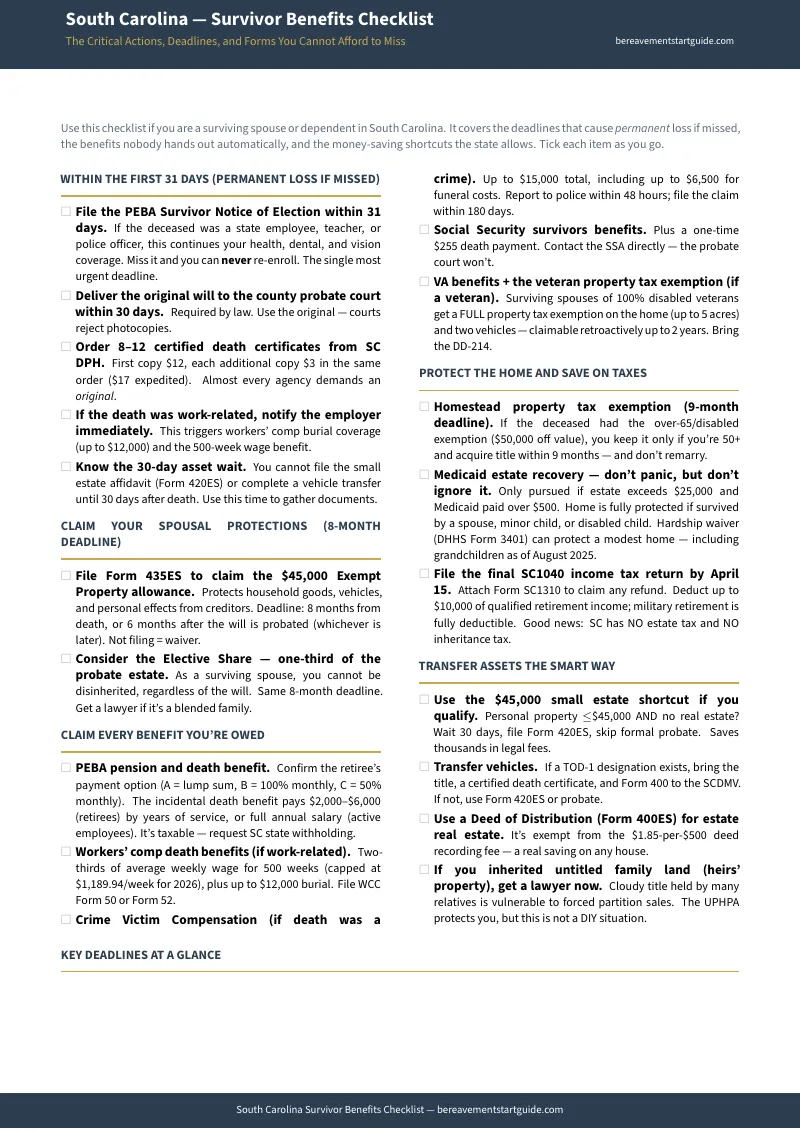
Not ready for the full guide? Download the free South Carolina Survivor Benefits Checklist — covering the most critical deadlines, the PEBA health insurance window, the Exempt Property allowance, Social Security notification, and the step-by-step actions for the first 31 days. It is enough to start the process tonight while you decide whether the full guide is right for your situation.
You did not ask for any of this. But the money is there, the protections are real, and the deadlines are moving. The only question is whether you claim what your family is owed — or let it disappear because nobody told you the form existed.