You Were Just Named Executor of a South Dakota Estate. The Court Clerk Cannot Tell You What to Do Next. An Attorney Wants $252 an Hour. And You Have a Three-Month Deadline You Did Not Know About.
The will named you Personal Representative. Or there was no will, and because you are the surviving spouse or the eldest child, the family decided you are in charge. Either way, you are now legally responsible for an estate you cannot even inventory — and the clock is already running on deadlines you have never heard of.
You called the circuit court. The clerk told you to download forms from the Unified Judicial System website. When you asked which forms you actually need and what order to file them in, the clerk said: "We cannot provide legal advice." That is not rudeness. South Dakota law explicitly prohibits court staff from advising you on which procedure to follow, what a court order means, or what to do next. They can hand you blank forms. They cannot tell you how to use them.
So you searched for a South Dakota probate attorney. The average hourly rate is $252. Standard probate representation runs $3,000 to $4,000. For an estate that consists of a family home, a checking account, a truck, and a stack of medical bills, the attorney's fee could consume a significant portion of what your family inherits. And the attorney cannot start until you retain them — meanwhile, the three-month deadline to file the court inventory under SDCL 29A-3-706 is counting down from the day you were appointed, and the four-month creditor claim window is running from the day you publish the newspaper notice.
Here is what nobody told you at the funeral: if you miss the inventory deadline, the court can revoke your authority. If you distribute assets to heirs before the four-month creditor window closes, you are personally liable for any valid claims that come in afterward. If you fail to notify the Department of Social Services within the statutory window and the deceased received Medicaid-funded care, you have a state agency recovery problem on top of everything else. And if you file for formal probate when the estate actually qualifies for a simple small estate affidavit, you just wasted a $75 filing fee and months of unnecessary court involvement.
The South Dakota Probate Process Guide is the Executor's Compliance Blueprint — a complete, South Dakota-specific manual that bridges the gap between the UJS forms you can download for free and the $252/hour attorney you cannot afford. Not a generic national overview. Not a law school textbook. A sequential, deadline-driven operational guide that tells you exactly what to file, when to file it, and what happens if you do not.
What's Inside the Executor's Compliance Blueprint
A complete probate administration guide, the Probate Quick-Start Checklist, and standalone reference worksheets — covering every stage from initial filing through estate closing, built specifically for South Dakota's Uniform Probate Code, circuit court procedures, and the state-specific rules that make probate here different from any other state:
The Threshold Decision: Do You Even Need to Open a Probate?
Before you file anything with the circuit court, you need to answer one question: does this estate actually require probate? South Dakota law provides two separate small estate affidavit paths that bypass court entirely. Personal property under $100,000 total gross value can be collected with a sworn affidavit after a 30-day waiting period — provided no debt is owed to the Department of Social Services for Medicaid. Solely owned real property under $50,000 can be transferred with a separate affidavit after a 60-day waiting period. But here is the detail that trips up families across the state: the real property affidavit explicitly excludes agricultural land. If the deceased owned a working farm or ranch, that land must go through formal probate regardless of its value. The guide includes a decision-tree flowchart that walks you through every threshold, every exception, and every disqualifying condition — so you know before you file whether you need the court at all.
Informal vs. Formal Probate: Which Path Fits Your Estate
South Dakota offers two distinct probate tracks, and using the wrong one wastes time and money. Informal probate is clerk-administered, requires no judge, and is designed for uncontested estates where a valid will exists or all heirs agree on intestate distribution. Formal probate involves a judge, mandatory hearings, and is required for contested estates, estates with ambiguous wills, or cases filed more than three years after the death. The guide explains the exact criteria for each path, what triggers a conversion from informal to formal, and why most straightforward estates never need to see a courtroom.
Filing the Application: What the Court Needs from You on Day One
The probate process begins with the Application for Informal Probate filed at the circuit court in the county where the deceased lived. You will need the original will (if one exists), a certified death certificate, and the $75 filing fee plus the $40 court automation surcharge and $7 law library fee — $122 total. The application requests appointment of a Personal Representative, and once the clerk approves it, you receive Letters Testamentary (if there is a will) or Letters of Administration (if there is not). These letters are the document every bank, title company, and government agency will demand before they release a single dollar or transfer a single title. The guide walks you through the application line by line.
The Three-Month Inventory: Your First Hard Deadline
Within three months of your appointment, SDCL 29A-3-706 requires you to file a complete inventory of every probate asset with their fair market values as of the date of death. This means every bank account, every investment, every piece of real estate, every vehicle — valued at what it was worth the day the person died, not what it is worth today. The guide explains exactly what counts as a probate asset (solely owned property) versus what is excluded (joint tenancy, Transfer on Death deeds, life insurance with named beneficiaries, payable-on-death accounts). It also covers the agricultural land valuation rules that make South Dakota inventories different from every other state.
The Creditor Notification Process: Protecting Yourself from Personal Liability
After appointment, you must publish a Notice to Creditors in a legal newspaper in the county where the estate is being administered — three consecutive weekly publications. This starts the four-month statutory window during which creditors can file claims against the estate. You are also required to send known creditors direct written notice. If you distribute assets to heirs before this four-month window closes and a valid creditor claim arrives afterward, you are personally on the hook. The guide provides the exact notice language, explains what constitutes a "known" versus "unknown" creditor, and maps the timeline so you know precisely when distribution becomes safe.
The $18,000 Family Allowance and Homestead Protections
South Dakota law provides wealth-preservation tools that most executors never learn about from free resources. The family allowance permits up to $18,000 for reasonable maintenance of the surviving spouse and minor children during estate administration — and this allowance takes priority over general unsecured creditor claims. The homestead exemption protects the family residence from most creditor claims during administration. The guide explains how to claim each protection, how they interact with the creditor priority hierarchy, and the specific circumstances under which they can be challenged.
Medicaid Estate Recovery: What DSS Can and Cannot Claim
If the deceased received Medicaid-funded nursing home care, home and community-based services, or prescription drug coverage, the South Dakota Department of Social Services will assert a claim against the estate. South Dakota uses expanded estate recovery, meaning DSS can pursue not only probate assets but also certain non-probate assets. But critical protections exist. Recovery is barred while a surviving spouse is alive, or if there is a surviving child under 21, blind, or permanently disabled. The surviving spouse can file ORFI-832 — the Petition to Limit Financial Responsibility — within six months of the death to permanently cap state recovery. The guide maps every exception, every protection, and every deadline.
Closing the Estate: The Final Filing That Ends Your Liability
Closing the estate is not optional — it is the step that terminates your fiduciary exposure. You must file a sworn closing statement, send a copy with a full accounting to all heirs and unpaid creditors, and wait for the one-year period after your appointment to officially terminate. The guide covers the exact closing statement requirements, what the accounting must include, how to handle remaining assets, and the specific circumstances that can reopen a closed estate. It also explains Personal Representative compensation under SDCL 29A-3-719: 5% on the first $1,000, 4% on the next $4,000, and 2.5% on everything above $5,000.
Who This Guide Is For
- The newly appointed executor or administrator who just received Letters Testamentary from the circuit court and has a three-month inventory deadline, a four-month creditor window, and no idea what to file first — who needs the complete sequence of fiduciary duties, court filings, and statutory deadlines in one document
- The surviving spouse who needs to understand which estate assets are protected by the homestead exemption and family allowance, what happens to joint accounts and payable-on-death designations, and whether the ORFI-832 Medicaid petition needs to be filed within six months
- The out-of-state heir who just learned that the deceased owned real property or mineral rights in South Dakota and now needs ancillary probate in a state they have never set foot in — who needs to understand venue rules, filing requirements, and the agricultural land valuation system
- The family without a will who just discovered that South Dakota intestate succession does not give the surviving spouse everything — who needs to know exactly who inherits what, whether the small estate affidavit applies, and how to navigate the court process when heirs disagree
- The proactive planner who wants to understand the probate process before their family has to go through it — so they can structure assets now with Transfer on Death deeds, beneficiary designations, and joint ownership to bypass the court system entirely
Why the UJS Forms and National Websites Will Not Get You Through This
The information exists. It is scattered across the Unified Judicial System portal, circuit court websites, state agency pages, and a dozen national platforms that treat South Dakota as a footnote. Here is what you actually encounter when you try to navigate probate using free sources alone:
- The UJS gives you blank forms and tells you not to ask questions. The South Dakota Unified Judicial System publishes the Guide and File electronic form builder and a library of pro se forms. But court staff are legally prohibited from advising you on which form to use, what order to file them in, or what a court order means. You get the raw materials with no blueprint.
- Atticus and EstateExec miss the South Dakota details that matter. National probate platforms provide general checklists that work across all fifty states. They do not cover South Dakota's $18,000 family allowance, the agricultural land exclusion from the real property affidavit, the expanded Medicaid estate recovery rules, or the ORFI-832 spousal petition deadline. Generic guidance on a state-specific process is how executors make expensive mistakes.
- Local law firm blogs are designed to sell retainers, not solve problems. South Dakota probate attorneys publish accurate, detailed blog posts about the complexity and risk of estate administration. That content is explicitly designed to convince you that the process is too dangerous to handle without paying $3,000 to $4,000 for professional representation. For contested estates and complex agricultural successions, they are right. For the majority of straightforward estates, the answer costs a fraction of that.
- Free government brochures describe the law without telling you what to do. The Attorney General's consumer protection materials explain what probate is, what a Personal Representative does, and what intestate succession means. They do not provide a chronological checklist of what to file on Day 1, Week 2, and Month 4. Description without sequence.
The Executor's Compliance Blueprint puts every South Dakota statute, filing requirement, court deadline, and procedural step into one document, in the order you actually need them — so you stop guessing which free form to download next and start executing the process in the right sequence.
— Less Than Fifteen Minutes With a South Dakota Probate Attorney
A single consultation with a South Dakota probate attorney averages $252 per hour. Standard probate representation runs $3,000 to $4,000. National probate software platforms charge $15 to $40 per month in recurring subscription fees. This guide costs less than fifteen minutes of professional legal time and gives you the complete South Dakota-specific procedural roadmap — every statute, every deadline, every form, every fee, and the decision tree that tells you whether you need formal probate at all.
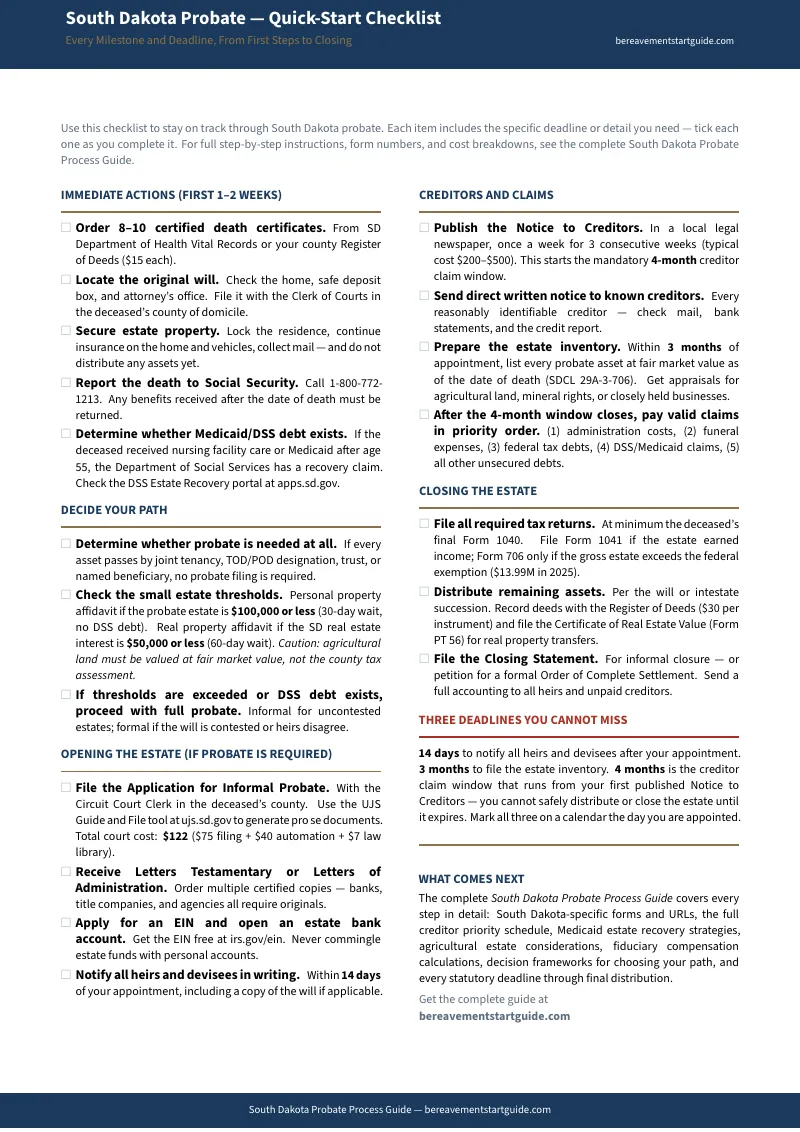
Your download includes the complete probate administration guide, the standalone South Dakota Probate Quick-Start Checklist, and printable reference worksheets: the Small Estate vs. Probate Decision Tree, the Statutory Deadline Calendar (every deadline with space for your dates), the Creditor Notification and Claims Tracker, the Probate Inventory Worksheet, and the Court Filing Fee Reference. Instant download, no account required.
Money-back guarantee, no time limit. If the guide does not give you clarity on what to do next and confidence that you are doing it in the right order, email us for a full refund. No questions asked.
Not ready for the full guide? Download the free South Dakota Probate Quick-Start Checklist — a concise reference covering the critical first steps after being appointed executor: what to file at the circuit court, how to get Letters Testamentary, when to publish the creditor notice, and the statutory deadlines you cannot afford to miss. It is enough to get oriented and start moving.
You did not ask for this responsibility. But you can handle it. The guide shows you how, one filing at a time.