
Someone You Love Just Died in Tennessee. The Bank Froze Their Accounts. The Funeral Director Needs a Number for Death Certificates. You Were Just Named Personal Representative and the Clerk's Office Told You That in Davidson County You Need an Attorney — but Nobody Told You That in 93 Other Counties, You Might Not.
You are standing in a house that is not yours anymore — not legally — holding a folder from the funeral home and a phone full of missed calls from relatives who want to know what happens next. The funeral director needs to know how many certified death certificates to order. Each one costs $15 from the Tennessee Office of Vital Records or the local county health department, and ordering more later means weeks of delay that freezes every bank account, every insurance claim, and every court filing. You guessed a number. You do not know if it is right.
The bank told you the checking account is frozen and you cannot withdraw a dollar for the mortgage payment, the electric bill, or the funeral. A letter from TennCare arrived about Medicaid reimbursement for nursing home care. The Chancery Court clerk said something about filing fees and a four-month creditor window. A sibling called to ask about the house. And the question you cannot stop asking: if I pay the wrong bill, miss a deadline I have never heard of, or sign something I should not have signed — am I personally responsible for the deceased's debts?
The short answer: you are not personally responsible for their debts. But the long answer — the one that involves Tennessee's $50,000 Small Estate Affidavit threshold, a mandatory 45-day waiting period, a Muniment of Title process that can transfer real estate without opening a full probate estate, a four-month creditor claims window, a TennCare Request for Release that must be filed before any estate can close, and county filing fees that swing from $145 in Robertson County to over $500 in Sevier County — that answer is what separates families who settle an estate in months from families who spend years and thousands of dollars untangling mistakes they did not know they were making.
The When Someone Dies in Tennessee — Estate Settlement Guide is a County-by-County Settlement System for every legal, financial, and administrative step between the funeral home and final distribution. Not a law textbook. Not a generic national checklist that does not know Tennessee from Texas. A structured, Tennessee-specific manual that separates what must be done in the first 48 hours from what can legally wait six months — so you stop guessing, stop panicking, and start working through this in the right order.
What's Inside the County-by-County Settlement System
A 15-chapter guide, the First 48 Hours Checklist, and appendices — covering every stage from the moment of death through final asset distribution, built specifically for Tennessee's probate code, the state's 95-county court system, and the procedural realities that make settling an estate here different from any other state:
The First 48 Hours: Death Certificates and Immediate Actions
The funeral director is going to ask how many certified death certificates to order, and most families guess wrong. You need originals — not photocopies — for every bank, every insurance company, the court, the county Register of Deeds if the deceased owned real property, the Department of Revenue for vehicle transfers, and the IRS. The guide gives you the exact calculation based on the deceased's assets. Each certified copy costs $15 from the Tennessee Office of Vital Records or the local county health department. Coming back weeks later for more means processing delays that freeze every other step. This chapter also covers what to do today, what to do tomorrow, and the single most important rule: do not pay any of the deceased's bills with your own money.
The First Week: Securing the Estate and Setting Family Expectations
Before the court gives you legal authority over anything, you have a common-law duty to prevent assets from being lost, stolen, or damaged. This chapter covers locking the home, securing vehicles and valuables, rerouting mail to discover unknown accounts and debts, canceling subscriptions that drain the estate, and the family meeting where you set expectations. Tennessee law lets a person named in the will access a safe deposit box just by presenting a death certificate and a copy of the will to the bank — and if no representative acts within 60 days, the surviving spouse or next-of-kin can access it. This chapter explains how to use that access before the court appoints anyone.
Banking and Financial Accounts: Unlocking Frozen Money
When a bank learns the account holder has died, individual accounts freeze immediately. Being the deceased's spouse or child does not override the freeze. But not every account is locked. Payable-on-Death accounts transfer directly to named beneficiaries with a death certificate. Joint accounts with right of survivorship stay open for the surviving owner. And if the total personal property is under $50,000, the family can use the Small Estate Affidavit to collect bank account funds — after the mandatory 45-day waiting period — without ever opening a probate estate. The guide maps every account type, what unlocks it, and what paperwork you need so you stop getting turned away at the bank.
Vehicle Title Transfers: The Affidavit of Inheritance
If the deceased owned a vehicle individually, there are no known creditors, and all heirs agree, Tennessee law does not require probate to transfer the title. The family can use the Department of Revenue's Affidavit of Inheritance form. The guide covers every path — the probate transfer requiring Letters Testamentary, the direct heir transfer using the Affidavit of Inheritance, and what happens when heirs disagree about the vehicle — including what documents to bring to the county clerk's office and what fees to expect.
Real Property: Muniment of Title vs. Affidavit of Heirship
This is where Tennessee provides two powerful shortcuts that most families never learn about. If the deceased left a valid will and the only asset requiring court involvement is real property, the Muniment of Title process allows a rapid transfer of ownership without full estate administration — no executor appointment, no creditor notice period, no final accounting. Filing fees vary by county: $334.50 in Davidson County, $367 in Wilson County. If there is no will, the Affidavit of Heirship process lets heirs transfer property through the county Register of Deeds with proper formatting, notarization, and recording fees. The guide explains exactly when each shortcut applies, who qualifies, and how to execute it step by step.
The Big Decision: Small Estate Affidavit vs. Full Probate
Not every estate needs full probate. Tennessee allows estates with total personal property under $50,000 to bypass the court entirely using a Small Estate Affidavit — but only after a strict 45-day waiting period from the date of death. The threshold applies exclusively to personal property, not real estate. The guide includes a decision tree that walks you through the exact criteria: What is the total value of personal property? Does the estate include real estate? Is a Muniment of Title or Affidavit of Heirship the better path for the house? If the family qualifies for the small estate process, the affidavit bypasses court entirely. If not, the guide tells you exactly why and what formal probate requires instead.
Formal Probate Administration: Every Milestone and Deadline
If the estate requires formal probate, this chapter walks you through every step: filing the petition, choosing between Davidson and Shelby County's dedicated Probate Courts versus the Chancery Courts that handle the other 93 counties, receiving Letters Testamentary or Letters of Administration, opening an estate bank account with its own EIN, preparing the mandatory inventory within 60 days of appointment, publishing the Notice to Creditors in a local newspaper, and managing the four-month creditor claim window before you can safely distribute a single asset. It covers the critical distinction at closing: whether to file a Statement in Lieu of Detailed Final Accounting or a Detailed Final Settlement — and why choosing wrong based on whether beneficiaries include minors or incapacitated persons delays closing by months.
TennCare Estate Recovery: The Mandatory Release Process
This is where more money is at risk than most families realize. If the deceased received TennCare-funded long-term care, the state will assert a claim against the estate. No estate in Tennessee can close — not even a small estate — without a TennCare Request for Release. But critical protections exist. Recovery does not apply while a surviving spouse is alive. Undue Hardship waivers are available for siblings who lived in the home for at least one year, and for adult children who lived in the home and provided care for at least two years before the deceased entered a nursing facility. This chapter walks through every protection, every form, and the exact process for securing the release.
Spousal Protections and Intestate Succession
Tennessee law is highly protective of surviving spouses — and most families have no idea how much. The Elective Share lets a surviving spouse override the will and take a percentage of the net estate based on marriage length: 10% for marriages under 3 years, scaling up to 40% for marriages of 9 years or more. Beyond the elective share, the surviving spouse receives Exempt Property (tangible personal property up to $50,000), a Homestead Allowance on the primary residence, and a Year's Support allowance based on their previous standard of living. When there is no will, intestate succession determines everything — and the surviving spouse does not automatically inherit the entire estate when children from a prior relationship survive. The guide explains every protection and how to claim each one.
Creditor Management: Who Gets Paid and in What Order
The estate pays the debts, not the family. But when the estate does not have enough to pay everyone, Tennessee law dictates a strict priority order: court costs and administrative expenses first, then funeral expenses, then medical bills from the final illness, then taxes, then general unsecured creditors like credit cards. The guide maps this hierarchy, explains what happens when a personal representative pays lower-priority debts before higher-priority ones — personal liability — and gives you the framework for managing demands during the four-month creditor window without making mistakes a judge will hold against you.
The Complete Timeline: Every Statutory Deadline
From Day 1 through Month 12 and beyond, every Tennessee statutory deadline in one sequential reference. The 45-day waiting period for the Small Estate Affidavit. The 60-day inventory deadline after appointment. The four-month creditor claims window. The TennCare Release deadline. Every deadline that matters, in the order it appears, with clear language about what happens if you miss it.
Who This Guide Is For
- The surviving spouse whose partner just died and whose bank accounts were frozen this morning — who needs to know which accounts stay accessible, which ones require court paperwork, and how the Elective Share, Exempt Property, and Year's Support protect the family's financial position even if the will says otherwise
- The adult child named as personal representative who has never been through probate, may live out of state, and is terrified of making a mistake that triggers personal liability — who needs the complete sequence of fiduciary duties, court deadlines, and filing requirements for Tennessee's 95-county system in one document
- The family with no will who just learned that Tennessee's intestate succession laws will decide everything — who needs to understand exactly who inherits what, whether the Small Estate Affidavit applies, and how to transfer the family home through an Affidavit of Heirship
- The person who just got rejected at the bank trying to access their deceased parent's checking account — who needs to know whether joint survivorship, a POD designation, or the $50,000 Small Estate Affidavit can bypass probate entirely, or whether Letters Testamentary are the only path forward
- The family dealing with TennCare recovery who received a letter from the state demanding reimbursement for Medicaid-funded nursing home costs — who needs to understand the Request for Release process, the assets that are vulnerable, and the Undue Hardship waivers that protect caregiving family members
- The out-of-state executor who is navigating Tennessee's court system from another state, cannot walk into the clerk's office to ask questions, and needs a localized roadmap that bridges the geographic divide — covering county-specific filing fees, the Davidson/Shelby attorney requirements, and the Chancery Court procedures for the other 93 counties
Why Free Resources Will Not Get You Through This
The information exists. It is scattered across 95 county court websites, the Tennessee Office of Vital Records, TennCare's estate recovery division, the Department of Revenue for vehicle transfers, and a dozen federal agency portals that do not reference each other. Here is what you actually encounter when you try to settle an estate using free sources alone:
- County clerk offices give you forms and tell you to hire a lawyer. Davidson County's Probate Court publishes procedural guidance. Shelby County has its own forms. The other 93 counties operate through Chancery Courts or General Sessions Courts, each with different local rules. None of them give you a chronological sequence or explain which statutory shortcuts might eliminate the need for their court entirely.
- National legal directories explain the law but miss Tennessee specifics. Nolo, FindLaw, and Justia publish broad probate overviews that rank for generic searches. They do not explain Muniment of Title, the Davidson County distinction between Statement in Lieu and Detailed Final Settlement, the agricultural implications of Tennessee property transfers, or county filing fees that range from $145 to over $500. Tennessee is not a footnote — it is a state with its own shortcuts and pitfalls.
- Local probate attorneys highlight complexity to justify retainer fees. Law firm blog posts about Tennessee estate settlement are accurate and detailed — and they are designed to convince you that the process is so dangerous you need $1,500 to $3,000 in flat fees or $100 to $400 per hour. For contested estates and complex property holdings, that is true. For the majority of straightforward estates, the answer costs a fraction of what an attorney charges.
- Funeral homes give you surface-level advice that ends after the service. Tennessee funeral home bereavement packets tell you to order death certificates and notify Social Security. They do not explain the Small Estate Affidavit, TennCare Release, creditor notification requirements, or spousal protections. Their advice covers the first two days and nothing else.
- National estate software platforms charge recurring fees and miss Tennessee details. Atticus, EstateExec, and SimplyTrust offer DIY tools for $199 to $499. They cover probate in general terms. They do not cover Tennessee's $50,000 small estate threshold, the Muniment of Title process, the TennCare Request for Release, or the Davidson County final settlement options. And for a $40,000 estate, spending $199 on software does not make financial sense.
Free resources give you fragments from a dozen sources that do not reference each other. The County-by-County Settlement System puts every Tennessee-specific statute, form, deadline, and procedure into one document, in the order you actually need them.
— Less Than Fifteen Minutes With a Tennessee Probate Attorney
A single consultation with a Tennessee probate attorney costs $100 to $400 per hour. Standard probate representation runs $1,500 to $3,000 in flat fees, or 1% to 5% of the estate value for percentage-based arrangements. National estate software platforms charge $199 to $499. This guide costs less than fifteen minutes of professional legal time and gives you the complete Tennessee-specific roadmap — every statute, every deadline, every form, every county filing fee, and the decision trees that tell you whether you even need an attorney at all.
Your download includes the complete 15-chapter guide with appendices (county court reference, key forms, and glossary), the standalone Tennessee First 48 Hours Checklist, and printable reference sheets: the Small Estate Decision Tree, Muniment of Title vs. Affidavit of Heirship Flowchart, County Court Reference (fees and contacts across 95 counties), Spousal Protection and Elective Share Worksheet, Statutory Deadline Calendar, Creditor Priority Reference, Account-Closing Checklist, and Government Notification Tracker. Instant download, no account required.
Money-back guarantee, no time limit. If the guide does not give you clarity on what to do next and confidence that you are doing it in the right order, email us for a full refund. No questions asked.
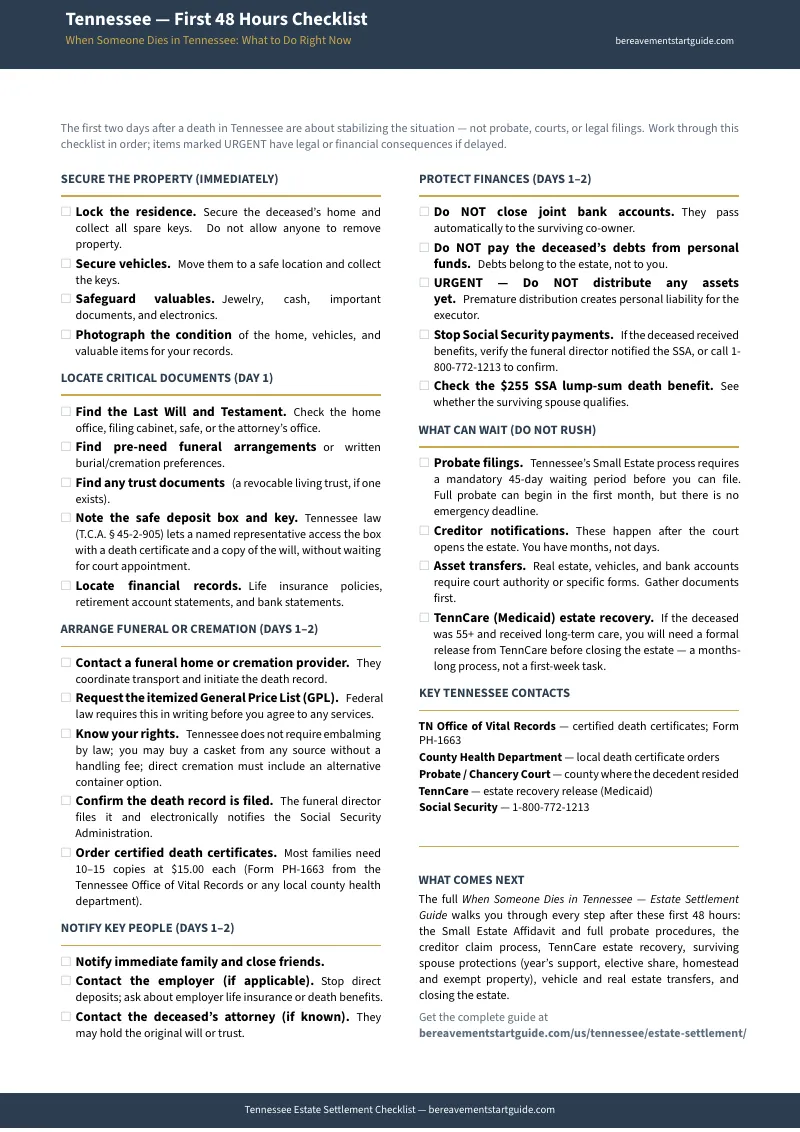
Not ready for the full guide? Download the free Tennessee First 48 Hours Checklist — 20 items covering everything that must happen in the first two days after a death in Tennessee: death certificates, securing the home, notifying Social Security, what not to pay, and what to start gathering. It is enough to get through tonight and tomorrow.
You did not ask for this job. But you can do it. The guide shows you how, one step at a time.