Tennessee Has No Estate Tax, No Inheritance Tax, and No Gift Tax — So Why Is Everyone Telling You to "Watch Out for the Death Tax"?
You typed "Tennessee inheritance tax" into a search box and the results made your stomach drop. Tax tables. Rate brackets. Warnings about "death taxes" eating into what your mother left you. A blog post citing a 9.5% rate. An attorney's page offering a "free consultation" to help you "minimize your Tennessee estate tax exposure."
Here is what almost none of those pages tell you clearly: Tennessee abolished its inheritance tax in 2016, its gift tax in 2012, and its Hall Income Tax in 2021. It never had a separate estate tax. Most of the scary numbers you found are describing law that no longer exists — or copy-pasted from a national template that was never about Tennessee at all.
So now you're caught between two bad feelings. Either you panic about a tax bill that isn't real, or you assume there's "no tax" and miss the federal return, the decedent's final income tax return, or the estate's income tax filing that actually do apply — and find out months later, with penalties attached.
The cruelest part: a CPA or estate attorney will happily charge you $291 an hour to tell you what fits on a single page. You don't need someone to do your taxes. You need someone to tell you, in plain English, which taxes even exist after a death in Tennessee — and which ones are ghosts.
Introducing the Tennessee Final Tax & Estate Tax Guide
This is the guide that separates the phantom taxes from the real ones. At its core is what we call the Tennessee Tax Clarity System — the translation layer between a decade of confusing tax-law repeals and the short list of filings you actually have to make.
Free articles give you outdated rate tables and national boilerplate. Paid tax software assumes you already know which returns apply and just want help filling them in. Neither one answers the question you're actually asking at 11pm: "Do I owe anything to the State of Tennessee, yes or no — and what about the federal side?"
The Tennessee Tax Clarity System gives you the answer up front, then walks you through only the filings that genuinely apply to your situation: the decedent's final Form 1040, the estate's income tax (Form 1041) if the estate earns income, the federal estate tax return (only if the estate is in the multi-million-dollar range), and the property-vesting and basis rules that quietly decide how much your family actually keeps.
What's Inside — and the Exact Problem Each Part Solves
The "Does Tennessee Tax This?" Verdict
A plain-English ruling, up front, on every tax people worry about: state estate tax (none), inheritance tax (repealed 2016), gift tax (repealed 2012), Hall Income Tax on dividends and interest (repealed 2021). Solves: the 11pm panic over a tax bill that does not exist — and the relief of knowing it in writing, with the statute behind it.
The Three Returns That Actually Matter
What still applies federally and why: the decedent's final income tax return, the estate's income tax return (Form 1041, if the estate earns income above the threshold), and the federal estate tax return (Form 706, which only affects estates above the multi-million-dollar federal exemption). Solves: the dangerous flip side of "no tax in Tennessee" — assuming there's nothing to file at all and missing a federal deadline.
The Immediate-Vesting Trap
In Tennessee, real property vests immediately in the heirs at the moment of death (T.C.A. §31-2-103) — the executor never controls it. This changes who reports rental income, who pays property tax, and who can sell. Solves: the executor who thinks they "own" the house through the estate and accidentally files the wrong way.
The Step-Up in Basis Explainer
The single most valuable tax fact most heirs never learn: inherited property resets to its fair-market value at the date of death. Sell soon after and the capital-gains tax can be near zero. Solves: heirs who sell an inherited home and overpay thousands in capital-gains tax they never owed because no one explained basis.
The Community Property Trust Advantage
Tennessee is one of a handful of states with a Community Property Trust Act — which can unlock a double step-up in basis for married couples, wiping out gains on the whole asset rather than half. Solves: the surviving spouse sitting on decades of appreciation who didn't know this lever existed.
The 60-Day Inventory & Deadline Map
Tennessee's 60-day inventory requirement (unless waived by the will), plus every tax-relevant date in one timeline so nothing sneaks up on you. Solves: the reluctant executor's fear of missing a filing window and being held personally responsible.
The TennCare Release Checkpoint
Before an estate closes, TennCare (Tennessee Medicaid) estate recovery requires a Request for Release — miss it and the estate stays open indefinitely. We show where this intersects with the final tax filings. Solves: the estate that's "done" on the tax side but can never actually close.
The Small Estate Shortcut
For estates under $50,000 with no real property, the Small Estate Affidavit (after a 45-day wait) can skip full probate entirely — with simpler tax handling. Solves: the cost-conscious family doing far more paperwork than their situation requires.
Who This Is For
- Executors and personal representatives who need to know, in writing, what they must file after a death in Tennessee.
- Beneficiaries and heirs worried about an "inheritance tax" on what they've received.
- Surviving spouses who want to understand step-up in basis and the Community Property Trust advantage before selling anything.
- Out-of-state family members handling a Tennessee estate from a distance who can't tell which rules are current.
- Anyone who found conflicting numbers online and just wants the truth, with the statute cited.
Why Not Just Use Free Articles?
Because free articles are where the confusion comes from. The top results for "Tennessee estate tax" routinely cite the pre-2016 inheritance tax as if it's still law, copy national estate-tax templates that don't reflect Tennessee's repeals, or bury the one fact you need under an attorney's call-to-action. They're written to capture search traffic, not to give you a clean yes-or-no.
And paid tax software has the opposite blind spot: it assumes you already know which returns apply and only helps you fill in boxes. It will never tell you that Tennessee has no inheritance tax, or explain why immediate vesting changes who reports the rental income.
This guide is the missing middle: current, Tennessee-specific, and written so a grieving non-expert can act on it tonight — without paying $291 an hour to hear "you're fine."
Our Guarantee
If this guide doesn't give you a clearer answer about what you owe — and don't owe — after a death in Tennessee than anything you found for free, reply to your receipt at any time and we'll refund every cent. No forms, no questions.
Two Ways to Start
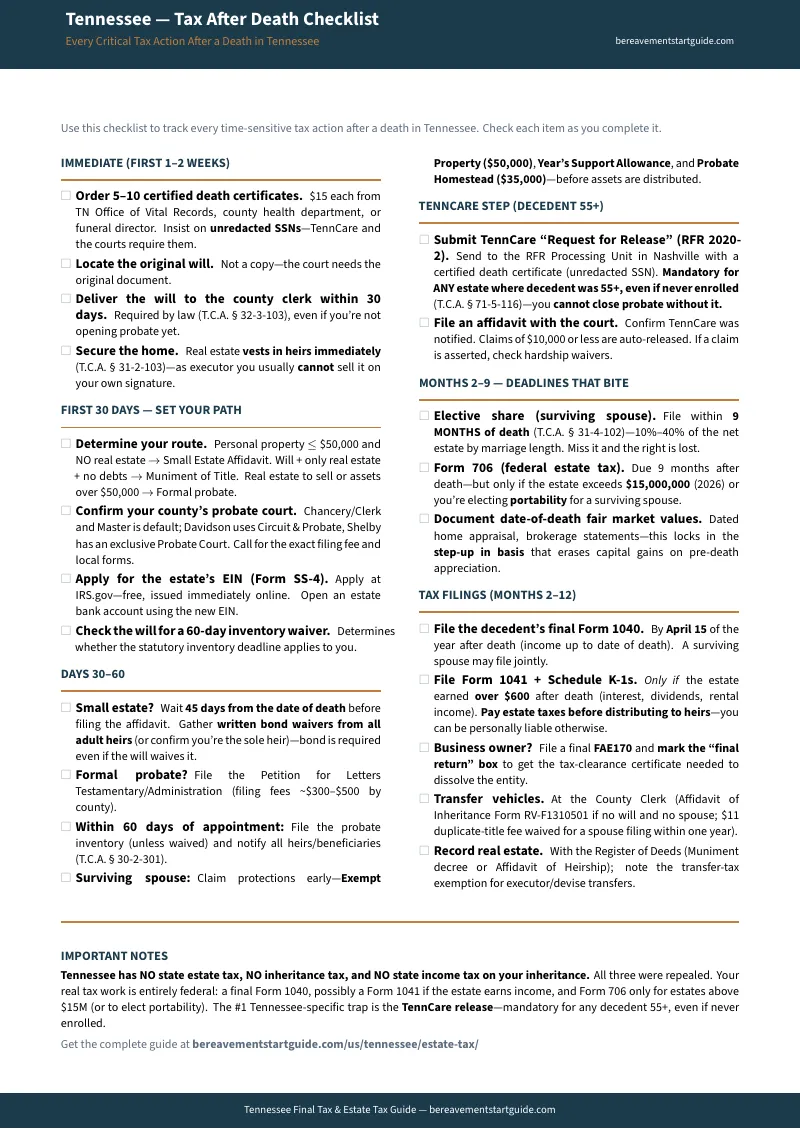
Start free: Download the Tennessee — Tax After Death Checklist. It's the one-page list of what to verify, what to file, and what to ignore — enough to stop the panic tonight.
Go deeper: The full Tennessee Final Tax & Estate Tax Guide () walks you through every filing that applies to your situation, the step-up and Community Property Trust strategies, and the deadlines that keep an estate from closing — the complete Tennessee Tax Clarity System in one place. Includes 7 standalone printable tools: tax deadline calendar, asset valuation worksheet, tax document gathering checklist, forms directory, estate path decision tree, spousal protections reference card, and TennCare release reference.