
The Funeral Director Knows Tennessee Law Better Than You Do. That Changes Today.
Someone you love has died in Tennessee. Within hours, you will be sitting in an arrangement conference with a funeral director who has a license, a price sheet, and a thorough understanding of Title 62. You have grief. You have questions you do not even know to ask. And you have a 72-hour clock ticking — because Tennessee law automatically strips your authority over the body if you do not act within that window.
Here is what the funeral director will probably not mention: embalming is not required by Tennessee law for a standard local burial or cremation. A casket is not required for cremation — a combustible container is sufficient. Tennessee permits home funerals without a licensed funeral director. And if the funeral home tries to tell you a prepaid funeral contract cannot be moved to a different provider, that claim directly violates Tennessee statute.
Free information exists. The Tennessee Code Annotated is online. The Board of Funeral Directors and Embalmers publishes rules. The FTC has a fact sheet about the Funeral Rule. But the statutes are scattered across Title 62 (funeral law), Title 68 (death registration), Title 30 (probate), and Title 46 (cemeteries). The Board will explain licensing requirements but will not walk you through the disposition hierarchy that determines who actually controls the body. A national legal aggregator will say "home funerals are legal in Tennessee" without explaining that the VRISM electronic death registration system blocks direct family access, requiring paper filing through the local health department. And nobody will connect the dots between the 2023 Small Estate Probate Act — which completely abolished the old affidavit process — and your obligation to file a TennCare estate recovery release before distributing a single asset.
The Tennessee Consumer Rights Framework
This guide consolidates every Tennessee funeral regulation, federal consumer protection, and multi-agency administrative procedure into one plain-English manual — organized around the decisions you face, in the order you face them. It functions as a consumer rights framework: you read it before the arrangement conference, and you walk in knowing exactly what the funeral home must provide, what you can legally decline, and which agency to call if they refuse.
The result: you stop paying for services you do not need, you stop signing authorizations you do not understand, and you stop deferring to an industry that profits from your confusion during the worst week of your life.
The 72-Hour Forfeiture Rule That Nobody Explains
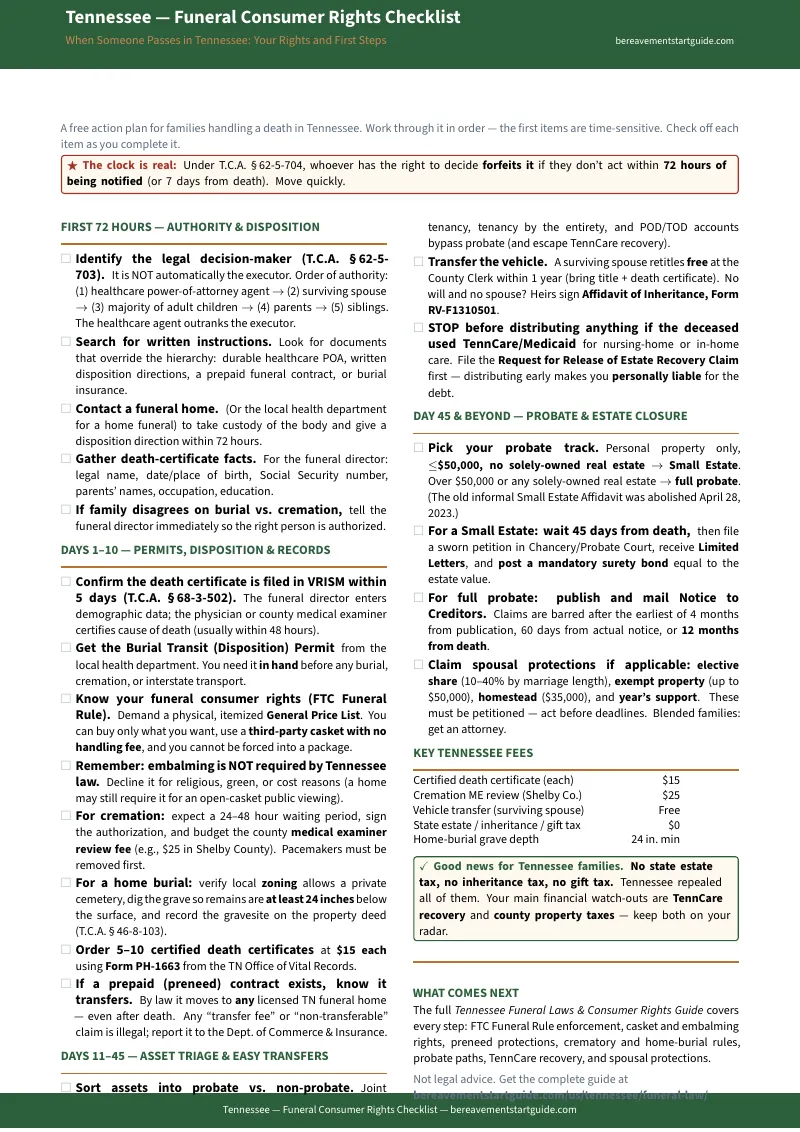
Tennessee Code Annotated § 62-5-704 imposes one of the most aggressive authority deadlines in the country. Any person who fails to exercise their right of disposition within 72 hours of being notified of the death — or within 7 days of the actual time of death, whichever comes first — completely and automatically forfeits their authority. The right passes to the next person in the statutory hierarchy. This means a surviving spouse who delays a decision about cremation versus burial can lose all legal authority to an adult child, a sibling, or even a grandparent. The guide maps this clock precisely, explains what triggers it, and shows you what to do if you are the person next in line when someone above you fails to act.
The Disposition Hierarchy: Why the Executor Ranks Ninth
Families routinely assume the executor of the estate controls funeral arrangements. In Tennessee, the executor ranks ninth. Under T.C.A. § 62-5-703, the healthcare agent named in a Durable Power of Attorney for Health Care holds absolute first priority — above the surviving spouse, above all children, above both parents. If no healthcare agent exists, the surviving spouse takes over, then the majority of surviving children, then parents, siblings, grandchildren, grandparents, the legal guardian, and finally the executor. The guide breaks down the complete hierarchy, explains the majority rule for same-class disputes, and shows what happens when a person higher in the chain is convicted of homicide in connection with the death — an automatic forfeiture provision most families never hear about.
The VRISM System and the Home Funeral Complication
Tennessee permits families to handle a funeral without hiring a licensed funeral director. You are not required to purchase a casket or a concrete burial vault. But there is a procedural catch that trips up nearly every family that attempts a home funeral: Tennessee's Vital Records Information System Management (VRISM) portal is the mandatory electronic death registration system, and access is restricted to licensed funeral directors and authorized state agents. Families managing a death at home must file paper documentation directly with the local health department registrar for manual entry into VRISM — a process that can delay the burial transit permit you need before any disposition can legally proceed. The guide provides step-by-step instructions for navigating this workaround, including the 48-hour medical certification deadline and the 5-day death certificate filing window.
What You Get — 12 PDFs
- The Complete Tennessee Funeral Law Guide — plain-English coverage of every relevant statute from the disposition hierarchy through complaint filing, with every Tennessee Code Annotated section cited
- Consumer Rights Checklist — a printable checklist of every federal and Tennessee-specific right you have when arranging a funeral, including the right to decline embalming, receive an itemized General Price List, use a third-party casket without penalty, and transfer a prepaid funeral contract to any licensed provider
- Disposition Authority Worksheet — printable reference card with the complete T.C.A. § 62-5-703 priority hierarchy for who controls funeral decisions, the 72-hour forfeiture clock, the homicide forfeiture provision, and action items for resolving disputes
- Consumer Rights Reference — a one-page reference card of every FTC Funeral Rule right and Tennessee Board Rule 0660-01 protection, with a pre-conference checklist and complaint filing instructions
- Cremation Authorization Guide — the mandatory medical examiner review, the 24-to-48-hour practical waiting period, pacemaker removal requirements, county-specific ME fees, aquamation legality, and why no funeral home can legally require you to buy a casket for cremation
- Home Funeral and Private Burial Guide — the legal requirements for caring for the deceased at home in Tennessee, including the VRISM workaround for death registration, local zoning constraints, the 24-inch minimum burial depth, and T.C.A. § 46-8-103 protections for family burial grounds
- Preneed Contract Protection Guide — your absolute statutory right to transfer a prepaid funeral contract to any licensed Tennessee funeral home, revocable vs. irrevocable contracts for TennCare Medicaid spend-down, and what to do if a funeral director refuses the transfer
- Small Estate Guide (2023 Act) — the abolished affidavit process, the new 45-day waiting period, formal court petition, mandatory surety bonds, Limited Letters, the $50,000 threshold, and one year of personal liability for premature distributions
- TennCare Estate Recovery Guide — Tennessee's narrow "probate-only" definition, statutory exemptions that block recovery entirely, the mandatory Request for Release form, and why distributing assets before clearance creates personal financial liability
- Probate Decision Guide — asset sorting (probate vs. non-probate), Chancery vs. Probate Court selection, county filing fees, the small estate vs. full probate decision rule, creditor claim deadlines, and the full probate order of operations
- Spousal Protections Guide — vehicle transfers, deed recording fees, and the four stacking spousal protections: elective share (10–40% by marriage length), exempt property ($50,000), homestead allowance ($35,000), and year's support
- Forms and Agencies Reference — every key Tennessee statute, official form with URL, agency contact, and county-variable fee in one printable reference card
Who This Is For
- Families arranging a funeral right now who need to know their rights before the first meeting with a funeral director — especially those facing embalming pressure, bundled pricing, or prepaid contract lock-in claims that violate Tennessee law
- Surviving spouses or adult children navigating the disposition hierarchy, the 72-hour forfeiture deadline, or cremation authorization delays from the county medical examiner
- Families considering a home funeral, private land burial, or aquamation who want to confirm they are meeting every Tennessee and federal requirement before proceeding — including the VRISM death registration workaround
- Pre-planners evaluating prepaid funeral contracts and wanting to understand the transferability guarantee, the trust funding requirements, and how to structure an irrevocable burial trust for TennCare eligibility
- Personal representatives who need to understand the 2023 Small Estate Probate Act changes, the mandatory surety bond, the TennCare estate recovery release process, and the one-year personal liability window for premature distributions
Why Free Information Falls Short
The Tennessee Code is free to read. But the funeral regulations span Title 62 (funeral law), Title 68 (vital records), Title 30 (probate), Title 46 (cemeteries), and Title 34 (powers of attorney). The Board of Funeral Directors and Embalmers will explain licensing requirements but will not walk you through the 72-hour forfeiture timeline. The Office of Vital Records will tell you about VRISM but not how to file paper death certificates for a home funeral. A national legal website will mention that "Tennessee allows home burial" without citing the 24-inch depth requirement, the zoning restrictions, or T.C.A. § 46-8-103. The Department of Commerce and Insurance will take your complaint about a preneed contract violation but will not explain the statutory transferability right you can invoke before it reaches that point.
This guide connects the dots between every agency, statute, and deadline — so you make decisions from knowledge, not from the grief-driven urgency the funeral industry depends on.
— Less Than One Hour of Probate Attorney Time
Tennessee probate attorneys charge hourly rates, and straightforward estates run $3,100 to $6,200 in total administrative costs. If this guide prevents just one unnecessary embalming charge, one pressure-sold package upgrade, or one premature asset distribution that triggers personal liability under the 2023 Small Estate Act, it has paid for itself many times over. If it gives you the confidence to demand an itemized General Price List before signing anything, the savings compound from there.
Every purchase includes a money-back guarantee, no time limit. If the guide does not give you the clarity and confidence you need to navigate Tennessee's funeral system, email us for a full refund.
The free Consumer Rights Checklist covers the most critical actions — the ones with hard deadlines and immediate financial consequences. The full guide covers everything in depth: the disposition hierarchy and forfeiture clock, cremation authorization, home funeral regulations, aquamation legality, preneed contract transferability, the 2023 Small Estate Act overhaul, TennCare estate recovery, complaint filing, and every Tennessee-specific consumer protection the funeral industry hopes you never learn about.