The Deadline Defense System — Every Benefit, Every Form, Every Clock That's Ticking
Your spouse died. The pension check stopped. The bank froze the joint account even though your name was on it. The health insurance letter says coverage ends in 30 days. The county trustee's office mailed a property tax bill addressed to someone who no longer exists.
And nobody — not the funeral home, not the SSA office, not the county clerk — handed you a list of what Tennessee owes you.
That's because Tennessee doesn't coordinate survivor benefits. They're scattered across Social Security, the Tennessee Consolidated Retirement System, TennCare, the Bureau of Workers' Compensation, the Division of Claims, the county trustee, the county probate or chancery court, and your former employer's insurance plan. Each agency expects you to find them, file their specific forms, and meet their specific deadlines — while you're grieving. And several of those deadlines start counting the moment the death certificate is signed, whether you know about them or not.
The Tennessee Survivor Benefits Navigator is the sequenced action plan that replaces dozens of confusing government websites with one chronological roadmap. Every benefit you might qualify for. Every form number. Every deadline that costs money if missed. Every exemption that protects the family home.
— Less Than One Hour of Attorney Time
Tennessee probate attorneys charge $200–$400 per hour, with uncontested cases routinely costing $2,500–$7,500 total. This guide is your Attorney Prep-Kit: it organizes your documents, identifies every benefit you qualify for, and answers the baseline administrative questions — so if you do hire a lawyer, you spend their time on strategy, not on explaining what a Year's Support allowance is or how the elective share works.
What's Inside
The 14-Day Emergency Stabilizer
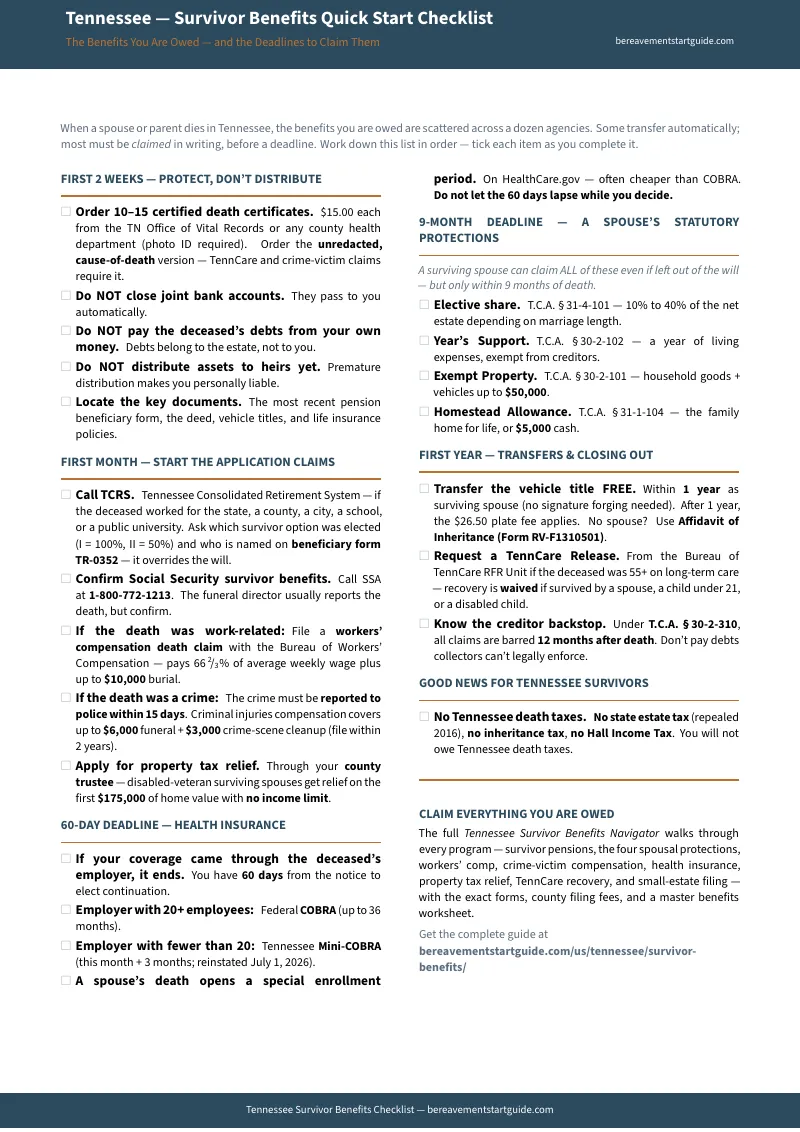
Exactly what to do (and what NOT to do) in the first two weeks: order 10–15 certified death certificates at $15 each from the Office of Vital Records, confirm the funeral director reported to SSA, and lock down assets before premature distribution creates personal liability. Includes the "Do Not Do This Yet" list — why closing joint accounts, paying the deceased's debts from your own money, or distributing assets early can cost you thousands.
The Deadline Map
Every statutory clock running against you, in one place: the 45-day probate waiting period before you can file a Small Estate petition, the 60-day window for health insurance continuation, the 9-month deadline for the elective share and year's support, the 12-month creditor cutoff, and the annual property tax relief application window. Miss any of these and the money is gone — no extensions, no exceptions.
The Spousal Protection Module (The 9-Month Window)
Four statutory protections every Tennessee surviving spouse can claim — even if you were left out of the will — but only within 9 months of death. The elective share (10%–40% of the net estate based on marriage length under T.C.A. § 31-4-101), the year's support allowance for living expenses, the $50,000 exempt property allowance for household goods and vehicles, and the homestead allowance that protects the family home for life. Each one explained with the exact filing process, the court where you file, and what to bring.
The Survivor Pension Decoder
How to file for TCRS survivor benefits — including the critical difference between Option I (100% joint and survivor annuity) and Option II (50%). Why the beneficiary designation on Form TR-0352 overrides the will. What happens when the deceased was an active member who hadn't retired yet. How to verify your election before the benefit structure locks in permanently.
Work-Related and Crime-Related Death Benefits
Workers' compensation pays 66⅔% of the deceased's average weekly wage plus up to $10,000 for burial. Criminal injuries compensation covers up to $6,000 for funeral costs and $3,000 for crime-scene cleanup — but the crime must be reported within 15 days and the claim filed within 2 years. Both programs explained step-by-step with contact information and form guidance.
The Health Insurance Decision Guide
Three paths to continuing coverage after a spouse dies — federal COBRA (20+ employees, up to 36 months), Tennessee's Mini-COBRA (fewer than 20 employees, reinstated July 1, 2026, covers the remainder of the month plus 3 additional months), or a HealthCare.gov Special Enrollment Period that's often cheaper than either. How to compare them in time to meet the 60-day election deadline.
Property Tax Relief and Title Transfers
The state property tax relief program reimburses taxes on the first $30,400 of appraised value for qualifying surviving spouses — with the disabled-veteran exemption covering the first $175,000 with no income limit. Step-by-step vehicle title transfers using the spousal fee waiver (free within 1 year) and the Affidavit of Inheritance form for non-spouses.
The TennCare Defense Module
If the deceased was 55 or older and received long-term care through TennCare, the state has the right to recover those costs from the probate estate. But recovery is waived if survived by a spouse, a child under 21, or a blind or disabled child — and the undue hardship waiver is available for everyone else. How to request a TennCare release, how to document your exemption, and what to do if the claim arrives.
The Creditor Shield
Under T.C.A. § 30-2-310, all creditor claims are barred 12 months after death. Why you should never pay the deceased's debts from your own funds, how to handle collectors, and the priority rules that determine which debts get paid from estate assets first — so your spousal allowances stay protected.
Small Estates, Filing Costs, and Closing the Loop
The $50,000 Small Estate shortcut that lets you transfer personal property with Limited Letters instead of full probate — but only after the mandatory 45-day waiting period, and only for personal property (real estate is excluded). County-by-county filing fees because Davidson, Shelby, and Knox each charge different amounts. When you need Chancery Court versus Probate Court, and how to tell which one your county uses.
Indigent Burial Programs
When the family cannot afford the funeral: county-by-county indigent burial programs (Shelby County provides free burial plots and basic caskets; Davidson County runs an appointment-based application), SSA's $255 lump-sum death benefit, VA burial allowances for veterans, and workers' comp burial benefits — with the eligibility requirements and contact information for each.
Who This Guide Is For
- Surviving spouses trying to claim every benefit before the deadlines pass — and protect the family home from TennCare recovery
- Adult children serving as executor who need to secure benefits for a surviving parent while managing the estate across Tennessee's county-by-county court system
- Families of state employees, teachers, and public workers navigating TCRS survivor pensions and the difference between Option I and Option II
- Families of workers killed on the job claiming workers' comp death benefits and the $10,000 burial benefit
- Families of veterans stacking state property tax exemptions on top of federal VA benefits
- Low-income families who need burial assistance, property tax relief, and the Small Estate shortcut to avoid expensive probate
Why Not Just Use Government Websites?
You can. Every form, statute, and eligibility rule in this guide exists somewhere on ssa.gov, treasury.tn.gov, tn.gov/tenncare, and 95 individual county clerk websites. That's the problem — "somewhere" across dozens of dense, uncoordinated government pages written in statutory language, with no chronological sequencing and no explanation of how one agency's requirements interact with another's.
Government websites are legally prohibited from giving you advice. They'll provide a blank form but won't tell you what to do first, second, or third. The state gives you the puzzle pieces. This guide gives you the picture on the box — and tells you which piece to place first.
What You Get
- The Complete Navigator — 11 chapters covering every benefit, exemption, and administrative process, organized in the order you need to act
- Quick Start Checklist — the 18 most critical actions in the exact order you need to take them
- Master Benefits Worksheet — fill-in worksheet mapping every benefit you qualify for, the agency, the form number, and your personal deadline
- Key Contacts and Statutes Reference — every Tennessee agency, statute citation, phone number, and filing fee in one printable sheet
Satisfaction Guarantee
If the Navigator doesn't save you time, confusion, or money — email [email protected] and we'll make it right. No questions, no hassle.
Start Protecting Your Family's Benefits
Download the free Tennessee Survivor Benefits Checklist for the 18 most critical actions — or get the complete Navigator with full step-by-step instructions, TennCare defense strategies, county fee tables, and every form walkthrough.