You Just Lost Someone in Texas. Now Banks Are Freezing Accounts, Bills Are Piling Up, and Nobody Will Tell You What to Do First.
The funeral director asks how many death certificates you need. You don't know — you didn't even know there was a number to get right. The bank says the account is frozen until you produce "Letters Testamentary" from a court you've never set foot in. A credit-card company calls to say your mother's balance is now your problem. (It isn't. But nobody told you that yet.)
You google "how to settle an estate in Texas" and get a wall of results: a government page citing the Texas Estates Code in language designed for lawyers, an attorney's blog that lists twenty tasks but carefully explains none of them, an Etsy planner that looks beautiful but doesn't mention community property, and a national template that's never heard of a Muniment of Title. None of them answer the question you actually have at 11pm: what do I do tomorrow morning, and in what order?
Meanwhile, probate attorneys in Texas charge flat fees of $3,000 to $7,000 for a basic estate. Half of that billable time? Waiting for grieving families to organize paperwork, track down account numbers, and figure out which assets even go through probate. You're paying a professional hundreds of dollars an hour to sort through your kitchen drawer of bank statements.
Introducing the Texas Estate Settlement Roadmap
This is the sequenced instruction manual the State of Texas doesn't give you. At its core is what we call the Texas Estate Settlement Roadmap — a chronological, decision-tree-driven system that tells you exactly what to do, in what order, based on your specific situation: whether there's a will, whether heirs agree, whether the estate qualifies for one of Texas's built-in probate shortcuts, and how to handle community property without accidentally giving half the house to stepchildren.
Free articles give you scattered lists. Attorney blogs give you just enough to scare you into booking a consultation. National templates give you forms that Texas county clerks reject. The Roadmap gives you the sequence — which call to make first, which deadline starts ticking the day you're appointed, which single state agency can keep an estate open for years if you skip one certified mailing.
Whether you handle the estate yourself using Texas's probate shortcuts or you hire an attorney and hand them a perfectly organized binder, this system puts you in control of a process designed to overwhelm you.
What's Inside — and the Exact Problem Each Part Solves
The First 48 Hours Protocol
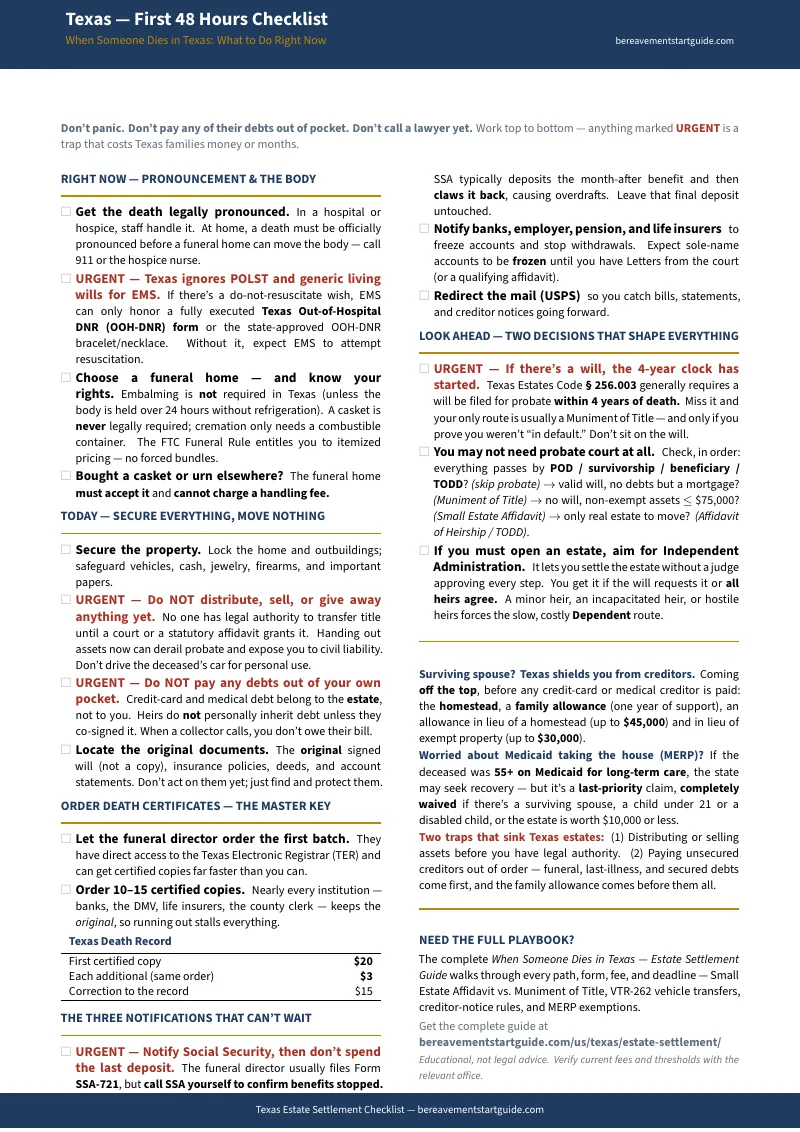
The exact sequence of calls, decisions, and property-securing steps for the first two days — including why Texas ignores POLST forms and generic living wills (EMS will attempt resuscitation unless you have the specific Texas OOH-DNR form), your rights against funeral-home upselling, and the $20/$3 death certificate pricing structure that saves families hundreds. Solves: the paralysis of not knowing which phone call to make first.
The Probate Bypass Decision Tree
Texas has more ways to skip full probate than almost any other state — but each one has strict, non-negotiable requirements. This chapter walks you through the decision in order: Does everything pass by beneficiary designation or survivorship? Does the estate qualify for a Muniment of Title (valid will, no unsecured debts)? A Small Estate Affidavit (no will, assets under $75,000 excluding homestead)? A Transfer on Death Deed? An Affidavit of Heirship? You follow the tree until you hit the path that fits. Solves: the family that hires a $5,000 attorney for a full administration when a single hearing would have transferred everything.
The Community Property Trap
Texas is a community property state, and surviving spouses routinely assume they inherit everything. They don't — not automatically. If the deceased had children from a prior marriage, the surviving spouse can end up sharing ownership of community property with stepchildren. And proving something was separate property requires "clear and convincing evidence" under Texas Family Code Section 3.003. This chapter explains which assets are community, which are separate, and how the distinction changes who inherits what. Solves: the surviving spouse who discovers six months in that half the house now belongs to someone else's children.
The Independent Administration Playbook
Independent Administration is the reason Texas estates can close in months instead of years — but you lose it if a single heir dissents, if a minor is involved, or if the will doesn't request it. This chapter covers how to secure it, what happens if you can't, and the 90-day inventory deadline that catches every new executor off guard. Solves: the executor who unknowingly triggers a Dependent Administration — and the $15,000+ in legal fees that come with it.
The Creditor Hierarchy and Debt Defense
Heirs do not inherit debt. Period. But credit-card companies call anyway, and families pay out of pocket from sheer guilt. This chapter maps the exact statutory order of claims under the Texas Estates Code: family allowance and exempt property come first (up to $45,000 in lieu of homestead, $30,000 in lieu of exempt property), then funeral expenses, then secured debts, then unsecured — and unsecured creditors get nothing until everything above them is paid. Solves: the family that empties their savings to pay a credit-card bill that legally ranked last.
The MERP Defense
If the deceased was 55 or older and received Medicaid for long-term care, the Texas Medicaid Estate Recovery Program can file a claim against the estate. But MERP is a last-priority claim, and it's waived entirely if there's a surviving spouse, a child under 21, or a disabled child. The hardship waiver can exempt a homestead valued under $100,000 if the heir's income is below 300% of the federal poverty level. And a properly executed Lady Bird Deed keeps the home out of probate entirely. Solves: the family that panics about losing the house when the law already protects them.
The Vehicle Transfer Shortcut
The Texas DMV Form VTR-262 — the Affidavit of Heirship for a Motor Vehicle — lets heirs transfer a car title without probate court, without an attorney, and without Letters Testamentary. All you need is the notarized signatures of all surviving heirs and an odometer disclosure. National guides never mention it because it's a Texas-only form. Solves: the heir who pays $3,000 to probate an estate when the only asset was a truck.
The Four-Year Rule Warning
Texas Estates Code Section 256.003 requires a will to be filed for probate within four years of death. Miss the window, and you must prove to the court you weren't "in default" — a standard most families can't meet. The will can usually only be admitted as a Muniment of Title after that, and only if the estate has no debts. Solves: the family that puts the will in a drawer and discovers two years later that they've nearly lost the right to use it.
Printable Tools You Can Use Immediately
In addition to the full guide, your download includes four standalone printable worksheets:
- Probate Decision Tree — a one-page flowchart showing the five paths through Texas probate, so you can find your route without reading the entire guide first.
- Asset Inventory Worksheet — a fillable ledger to catalog every account, policy, deed, and vehicle before you meet with an attorney or file anything with the court.
- Executor Timeline — every Texas executor deadline on one sheet: the 20-day oath, the creditor notices, the 90-day inventory, and the four-year will-filing rule.
- Creditor Tracking Sheet — a landscape ledger for tracking creditor claims, statutory priority classes, notice dates, and the four-month permissive bar deadline.
Who This Is For
- The person who just got the call. You're in the first 48 hours and need to know what to do before you can think clearly.
- The executor named in a will who needs a project management system, not a law degree, to get through the next six months.
- The family handling an intestate estate — no will, limited funds, and no $5,000 for an attorney — who needs to know which Texas shortcuts can bypass probate.
- The surviving spouse wondering what community property actually means for your home, your accounts, and your share.
- The adult child of a Medicaid recipient who got a MERP notice and needs to know whether the house is actually at risk.
Why Free Tools Fall Short
Free advice for settling a Texas estate comes in four flavors, and each one fails in a specific way:
Government sites (TexasLawHelp.org, county court pages) are accurate but deliberately fragmented — the information is scattered across dozens of pages written in statutory language, with no sequence and no empathy. They tell you what the law says. They never tell you what to do on Tuesday morning.
Attorney blogs list twenty executor duties but explain none of them in enough detail to actually complete them. The omission is the business model: the blog exists to make you feel helpless enough to book a consultation.
National legal templates (Nolo, LawDepot, FindLaw) are not written for Texas. They don't mention the Muniment of Title, the VTR-262, the Affidavit in Lieu of Inventory, or the fact that Texas community property rules rewrite who inherits what. Texas county clerks regularly reject these filings.
Etsy planners are organized and pretty and legally empty. They give you a place to write down bank account numbers. They don't tell you that Payable-On-Death accounts skip probate entirely, or that paying creditors out of order can make you personally liable.
This guide combines the legal accuracy of government sources with the chronological structure of the best planners — written for a grieving non-expert who needs to act, not study.
Our Guarantee
If this guide doesn't give you a clearer, more actionable plan for settling an estate in Texas than anything you found for free, reply to your receipt at any time and we'll refund every cent. No forms, no questions.
Two Ways to Start
Start free: Download the Texas — First 48 Hours Checklist. It's the one-page emergency guide for the first two days — who to call, what to secure, how to order death certificates, and the traps that cost families money before the week is out.
Go deeper: The full When Someone Dies in Texas — Estate Settlement Guide () walks you through the complete Roadmap — probate bypass decision tree, community property rules, Independent Administration playbook, creditor defense, MERP exemptions, vehicle transfers, and every deadline that matters — organized chronologically so you always know what comes next.