Three Agencies Regulate a Texas Funeral. The Funeral Director Answers to All of Them. You Should Know What They Know.
Someone you love has died in Texas. Within hours, you will be sitting across from a funeral director who holds a license from the Texas Funeral Service Commission, works under rules enforced by the Department of Banking, and sells insurance products regulated by the Texas Department of Insurance. You have grief. You have a family that needs answers. And you have a system that scatters its own rules across the Health and Safety Code, the Estates Code, and the Finance Code — three separate statutory frameworks that no single state agency will explain to you in full.
Here is what the funeral director will probably not mention: embalming is not required by Texas law. The 24-hour rule that funeral homes invoke to pressure embalming decisions actually permits refrigeration at 34 to 40 degrees as an alternative. A casket is not required for cremation. Texas does not require a licensed funeral director for family-directed funerals — you can legally wash, dress, and transport the body yourself. And if you signed an Appointment of Agent to Control Disposition form, that agent outranks even the surviving spouse in the statutory hierarchy, regardless of what the family assumes.
Free information exists. The Texas Health and Safety Code is online. The Funeral Service Commission publishes its rules. The FTC has a fact sheet about the Funeral Rule. But the statutes are scattered across three codes and administered by three agencies. The TFSC will explain licensing requirements but will not walk you through the disposition hierarchy under Health and Safety Code section 711.002 that determines who actually controls the body. A national legal aggregator will say "home funerals are legal in Texas" without explaining that the TxEVER electronic death registration system blocks direct family access, requiring paper filing of form VS-115 within 24 hours through the local registrar. And nobody will connect the dots between the MERP trap — Texas Medicaid estate recovery — and the fact that it disqualifies both the Small Estate Affidavit and Muniment of Title, the two procedures families use to avoid full probate.
The Texas Consumer Rights Framework
This guide consolidates every Texas funeral regulation, federal consumer protection, and multi-agency administrative procedure into one plain-English manual — organized around the decisions you face, in the order you face them. It functions as a consumer rights framework: you read it before the arrangement conference, and you walk in knowing exactly what the funeral home must provide, what you can legally decline, and which of the three agencies to call if they refuse.
The result: you stop paying for services you do not need, you stop signing authorizations you do not understand, and you stop deferring to an industry that profits from your confusion during the worst week of your life.
The Disposition Hierarchy: Why an Agent Outranks a Spouse
Families routinely assume the surviving spouse controls funeral arrangements. In Texas, that assumption fails whenever someone has signed an Appointment of Agent to Control Disposition of Remains. Under Health and Safety Code section 711.002, the designated agent holds absolute first priority — above the surviving spouse, above all children, above both parents. If no agent exists, the surviving spouse takes over, then a majority of adult children, then parents, siblings, and on down the statutory chain. The guide maps the complete hierarchy, explains the majority rule for same-class disputes, and covers what happens when the person with priority is unavailable, unwilling, or disqualified.
The 24-Hour Rule and the Embalming Pressure Play
Texas funeral homes frequently cite "the 24-hour rule" to pressure families into embalming — implying that embalming is legally required if the body is not buried or cremated within 24 hours. That is not what the law says. The actual rule permits refrigeration at 34 to 40 degrees Fahrenheit as a full legal alternative to embalming. A funeral home that presents embalming as the only option after 24 hours is describing their internal policy, not Texas law. The guide explains the rule precisely, including when dry ice qualifies as adequate refrigeration and the specific circumstances under which a justice of the peace or medical examiner can impose additional requirements.
The POLST Problem: Why Texas Families Need the OOH-DNR
If you are planning ahead and have filled out a POLST form — the Physician Orders for Life-Sustaining Treatment used in most states — it will not work for EMS in Texas. Texas does not recognize POLST for out-of-hospital settings. The only document that Texas EMS providers are legally required to honor is the Out-of-Hospital Do-Not-Resuscitate Order, which requires a specific state-approved form signed by both the patient and a physician. The guide explains the OOH-DNR requirements, the witness and signature rules, and why a standard advance directive or medical power of attorney is not sufficient to prevent unwanted resuscitation in a home or nursing facility setting.
What You Get — 12 PDFs
- The Complete Texas Funeral Law Guide — plain-English coverage of every relevant statute across the Health and Safety Code, Estates Code, and Finance Code, with every section number cited and every agency identified
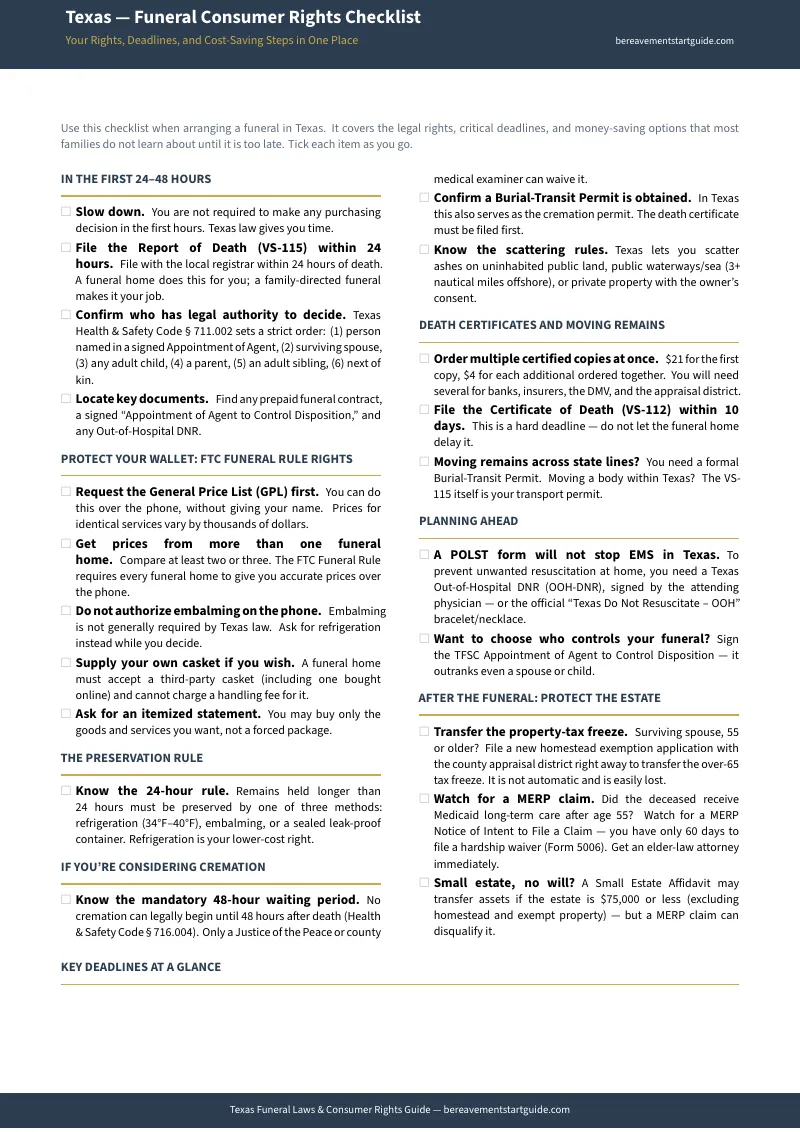
- Consumer Rights Checklist — a printable checklist of every federal and Texas-specific right you have when arranging a funeral, including the right to decline embalming, receive an itemized General Price List, use a third-party casket without penalty, and choose refrigeration over embalming under the 24-hour rule
- Disposition Authority Worksheet — printable reference card with the complete Health and Safety Code section 711.002 priority hierarchy, the Appointment of Agent to Control Disposition form, and action items for resolving family disputes
- Consumer Rights Reference — a one-page reference card of every FTC Funeral Rule right and TFSC consumer protection, with a pre-conference checklist and complaint filing instructions for all three agencies
- Cremation Authorization Guide — the mandatory 48-hour waiting period, justice of the peace and medical examiner waiver authority, pacemaker removal requirements, scattering rules for public land and waterways, and why no funeral home can legally require you to buy a casket for cremation
- Home Funeral and Private Burial Guide — the legal requirements for family-directed deathcare in Texas without a licensed funeral director, including the TxEVER workaround for death registration via paper form VS-115, local zoning constraints, burial depth requirements, and home burial on private property
- Preneed Contract Protection Guide — how DOB regulates trust-funded contracts and TDI regulates insurance-funded contracts, the 10 percent cancellation penalty cap, transferability rights, and what to do if a funeral director refuses
- Small Estate Affidavit Guide — the intestate-only requirement, the $75,000 threshold excluding homestead and exempt property, mandatory signatures from all heirs, and the MERP disqualification that blocks this path when Medicaid is involved
- Muniment of Title Guide — when a will exists but no executor is needed, the unsecured debt blocker, the MERP Certification form requirement, and why this efficient probate shortcut fails when families do not check for Medicaid liens first
- MERP and Medicaid Recovery Guide — Texas Medicaid Estate Recovery Program rules, the MERP Certification form, how MERP disqualifies both simplified probate paths, hardship exemptions, and asset protection strategies for the family home
- Spousal Protections and Asset Transfer Guide — vehicle transfers, homestead exemptions, community property rules, the surviving spouse allowance, and transferring assets without full probate
- Forms and Agencies Reference — every key Texas statute, official form with URL, agency contact for TFSC, DOB, and TDI, and filing fees on one printable reference card
Who This Is For
- Families arranging a funeral right now who need to know their rights before the first meeting with a funeral director — especially those facing embalming pressure under the 24-hour rule, bundled pricing, or cremation delays from the mandatory 48-hour waiting period
- Surviving spouses or adult children navigating the disposition hierarchy, the Appointment of Agent question, or cremation authorization when the justice of the peace has not yet signed off
- Families considering a home funeral, private land burial, or green burial who want to confirm they are meeting every Texas and federal requirement before proceeding — including the TxEVER death registration workaround and the absolute ban on aquamation for public use
- Pre-planners evaluating prepaid funeral contracts and wanting to understand which agency regulates their contract type, the cancellation penalty cap, and why the Out-of-Hospital DNR is the only advance directive that Texas EMS will honor
- Personal representatives who need to understand whether a Small Estate Affidavit or Muniment of Title will work for their situation — and the MERP trap that disqualifies both paths when the deceased received Medicaid benefits
Why Free Information Falls Short
The Texas statutes are free to read. But the funeral regulations span the Health and Safety Code (funeral and cemetery law), the Estates Code (probate and disposition), and the Finance Code (preneed contracts). The Funeral Service Commission will explain licensing requirements but will not walk you through the disposition hierarchy that determines who controls the body. The Department of Banking regulates trust-funded preneed contracts but has no jurisdiction over insurance-funded ones — that is the Department of Insurance. A national legal website will mention that "home funerals are legal in Texas" without citing the TxEVER paper-filing requirement, the zoning restrictions, or the burial depth rules. And no single agency will explain how MERP — the Medicaid Estate Recovery Program — interacts with the Small Estate Affidavit and Muniment of Title to block the two most common paths families use to avoid full probate.
This guide connects the dots between every agency, statute, and deadline — so you make decisions from knowledge, not from the grief-driven urgency the funeral industry depends on.
— Less Than One Hour of Probate Attorney Time
Texas probate attorneys charge $200 to $400 an hour, and funeral arrangements in the state run $7,000 to $12,000 on average. If this guide prevents just one unnecessary embalming charge, one pressure-sold package upgrade, or one failed Muniment of Title filing because nobody checked for MERP liens first, it has paid for itself many times over. If it gives you the confidence to demand an itemized General Price List before signing anything, the savings compound from there.
Every purchase includes a money-back guarantee, no time limit. If the guide does not give you the clarity and confidence you need to navigate Texas's three-agency funeral system, email us for a full refund.
The free Consumer Rights Checklist covers the most critical actions — the ones with hard deadlines and immediate financial consequences. The full guide covers everything in depth: the disposition hierarchy and Appointment of Agent, the 24-hour rule and embalming alternatives, cremation authorization and the 48-hour wait, home funeral regulations, the aquamation ban, preneed contract protections across two agencies, Small Estate Affidavit vs. Muniment of Title, the MERP trap, the Out-of-Hospital DNR, complaint filing with all three agencies, and every Texas-specific consumer protection the funeral industry hopes you never learn about.