You've Been Named Executor in Texas. Now There's a Court Hearing in Two Weeks, a 90-Day Deadline You Didn't Know About, and Nobody Explained the Difference Between Independent and Dependent Administration.
The attorney says you need to file an "Application for Probate" in the county where the deceased lived. You don't know what that means. The county clerk's office says filing fees run $350 to $415 — before a single billable hour. You google "Texas probate process" and get a government site quoting the Texas Estates Code in statutory language, an attorney's blog that lists twelve steps but explains none of them past the surface, and a national template that's never heard of a Muniment of Title.
Meanwhile, you've just learned that the will says "Independent Executor without bond" — but one heir is a minor, and someone mentioned that might force you into a completely different court process. You don't know if that's true, or what it would cost, or what happens if you accidentally trigger the wrong one. And a creditor called yesterday about a credit card balance you're pretty sure isn't yours to pay.
Texas probate attorneys charge $3,000 to $7,000 for a standard administration, plus $200 to $500 per hour for anything complex. A meaningful chunk of that cost is time spent explaining the process to you — time that wouldn't be billable if you already understood the system, the deadlines, and the decisions you'll be asked to make.
Introducing the Texas Probate Court Navigator
This is the step-by-step court procedure manual that Texas county clerks don't hand out. At its core is what we call the Texas Probate Court Navigator — a chronological, decision-tree-driven system that walks you through the entire probate process based on your specific situation: whether there's a will, whether heirs agree, whether a minor is involved, whether the estate qualifies for one of Texas's probate shortcuts, and what happens at every stage from filing the application through closing the estate.
Free articles tell you probate exists. Attorney blogs tell you just enough to make you feel lost. National templates give you forms that Texas county clerks reject because they've never heard of your state's Independent Administration system. The Court Navigator gives you the sequence — which form to file first, which deadline starts ticking the day you take the oath, which single procedural misstep can convert a four-month administration into a two-year supervised ordeal.
Whether you're working with an attorney and want to walk in organized, or you're handling a Small Estate Affidavit on your own, this guide puts you in control of a process designed to overwhelm you.
What's Inside — and the Exact Problem Each Part Solves
The Probate Pathway Decision Tree
Texas has more ways to handle a deceased person's estate than almost any other state — but choosing the wrong one wastes months and thousands of dollars. This chapter walks you through the decision in order: Does everything pass outside probate (beneficiary designations, survivorship deeds, POD accounts)? Does the estate qualify for a Muniment of Title — valid will, no unpaid unsecured debts, one court hearing, done? A Small Estate Affidavit — no will, assets under $75,000 excluding homestead, no attorney required? An Affidavit of Heirship for real property? You follow the tree until you hit your path. Solves: the executor who hires a $5,000 attorney for a full administration when a single Muniment of Title hearing would have transferred everything.
Independent vs. Dependent Administration
Independent Administration is the reason Texas probate can close in months instead of years. Under it, you manage the estate without returning to the judge for approval of every sale, payment, and distribution. But you lose it if a single heir won't agree, if a minor is involved without proper provisions, or if the will doesn't request it. This chapter covers how to secure Independent Administration, what triggers Dependent Administration (and the $15,000+ in legal fees that come with it), and the unanimous-consent requirement that trips up blended families. Solves: the executor who unknowingly triggers the wrong administration type and doubles the cost of settling the estate.
The Court Filing Sequence
The exact procedural steps, in order: Application for Probate, the 10-to-14-day waiting period, the prove-up hearing, the Oath of Office (20-day deadline), issuance of Letters Testamentary or Letters of Administration, the one-month creditor publication deadline, the secured-creditor notice, and the 90-day inventory filing. Each step includes the form name, the statutory section, the filing fee range, and the specific deadline that starts running. Solves: the executor who misses the 20-day oath deadline because nobody told them the clock was running.
The Inventory and Appraisement
Within 90 days of appointment, you must file a verified, sworn inventory of every asset the estate owns — or face removal. This chapter covers what goes on the inventory, what stays off (non-probate assets), the appraisal requirements, and the Affidavit in Lieu of Inventory that protects family privacy by keeping asset details out of the public record. Solves: the executor who doesn't know the 90-day deadline exists until the court sends a show-cause order.
The Creditor Claims Process
After you publish the Notice to Creditors, a clock starts. Unsecured creditors have a limited window to file claims — and if they miss it, the claim is barred. This chapter maps the statutory priority order under the Texas Estates Code, the permissive four-month bar, the mandatory six-month bar for matured claims, the family allowance and exempt property that come off the top (up to $45,000 homestead allowance, $30,000 exempt property), and the rules for accepting or rejecting claims. Solves: the executor who pays a credit-card company before funeral expenses and creates personal liability for paying debts out of order.
The Muniment of Title Deep Dive
If the will is valid and the estate has no unpaid unsecured debts, you may be able to skip full administration entirely. A Muniment of Title admits the will to probate in a single hearing, transfers title to real property and financial accounts, and requires no executor appointment, no bond, no inventory, and no creditor notice. But the requirements are strict, and the 180-day report to the court trips people up. This chapter covers every qualification, every limitation, and the exact filing procedure. Solves: the family that goes through six months of full administration for an estate that could have been resolved in a single afternoon.
The Small Estate Affidavit
When there's no will and the estate's assets (excluding homestead and exempt property) total less than $75,000, Texas allows heirs to file a sworn affidavit instead of opening a probate case. It's the only probate procedure in Texas that doesn't require an attorney. But the requirements are exact, the math is specific, and a rejected filing forfeits non-refundable court fees. This chapter walks you through the asset calculation, the required signatures, and the common mistakes that get affidavits rejected. Solves: the family spending $3,000 on an attorney for a $40,000 estate that qualified for a $300 filing.
The Four-Year Filing Deadline
Texas Estates Code Section 256.003 requires a will to be filed for probate within four years of death. Miss the window, and you must prove to the court you weren't "in default" — a standard most families can't meet. After four years, the will can usually only be admitted as a Muniment of Title, and only if the estate has no debts. This chapter covers the deadline, the exceptions, and the consequences. Solves: the family that puts the will in a drawer and discovers three years later they've nearly lost the right to use it.
Closing the Estate
An independent administration in Texas doesn't formally "close" the way estates do in other states — but there are still required steps. This chapter covers final distributions, the closing report (or sworn affidavit of distribution), discharge of the personal representative, the final accounting, and what to do if a beneficiary disputes the distribution. Solves: the executor who thinks "distribute the assets" is the last step and discovers a year later they're being sued by a creditor they forgot to notify.
Printable Court Tools
In addition to the full guide, your download includes standalone printable tools designed for the courtroom process:
- Probate Pathway Decision Tree — a one-page flowchart showing whether your estate needs full administration, a Muniment of Title, a Small Estate Affidavit, or no probate at all.
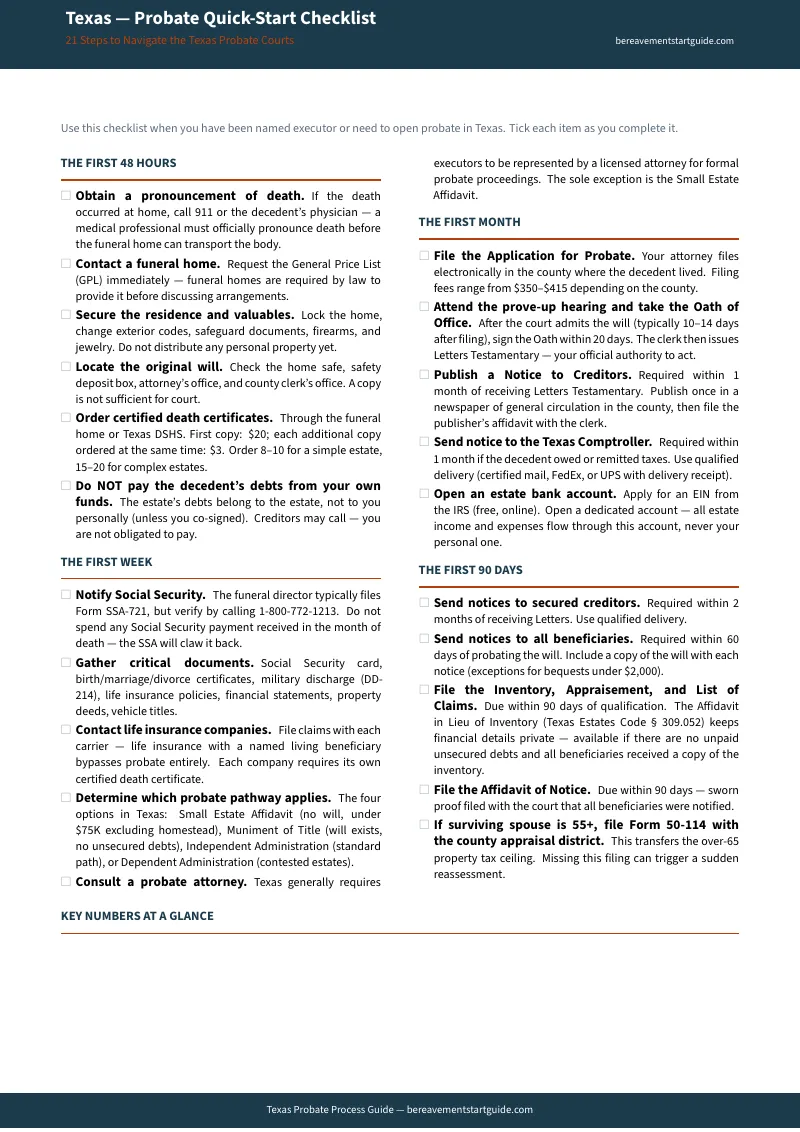
- Court Filing Checklist — every document you need, every deadline, every form number, in the order you'll need them.
- Executor Deadline Timeline — the 20-day oath, the 1-month creditor publication, the 90-day inventory, the 4-month permissive creditor bar, and the 4-year will-filing rule — all on one sheet.
- Creditor Claims Tracker — a landscape ledger for tracking every claim filed against the estate, with statutory priority class, filing date, bar date, and acceptance/rejection status.
Who This Is For
- The newly appointed executor who has a court hearing in two weeks and needs to understand every step between now and closing the estate.
- The family member wondering if you even need probate — and whether a Muniment of Title or Small Estate Affidavit can resolve everything in a single hearing.
- The pro se administrator filing a Small Estate Affidavit without an attorney, who needs to get the math right and the signatures correct on the first try.
- The heir who just received a creditor claim and needs to know whether it's valid, what priority it has, and whether the family allowance protects the assets you're counting on.
- The person working with an attorney who wants to walk into every meeting organized and informed — so billable hours are spent on strategy, not on explaining what Letters Testamentary are.
Why Free Tools Fall Short
Free probate advice for Texas comes in four varieties, and each one fails in a specific way:
Government sites (TexasLawHelp.org, county clerk pages) are accurate but deliberately fragmented — the information is scattered across dozens of pages written in statutory language, with no sequence and no decision logic. They tell you what the Texas Estates Code says. They never tell you which section applies to your situation or what to do on Monday morning.
Attorney blogs list the steps of probate but carefully explain none of them in enough detail to actually prepare. The omission is the business model: the blog exists to make you feel helpless enough to book a consultation. Every post ends with "consult an attorney" — which is true, but it's not a plan.
National legal templates (Nolo, FindLaw, LawDepot) are not written for Texas. They don't mention the Muniment of Title, the Affidavit in Lieu of Inventory, the distinction between Independent and Dependent Administration, or the fact that Texas requires attorney representation for formal probate. The forms they sell get rejected by Texas county clerks.
Etsy probate planners are organized and attractive and legally empty. They give you a place to write down account numbers. They don't tell you that missing the 90-day inventory deadline can get you removed as executor, or that paying creditors out of statutory order creates personal liability.
This guide combines the legal accuracy of government sources with the chronological structure of the best planners — written for a grieving non-expert who needs to navigate a courtroom process, not study for a bar exam.
Our Guarantee
If this guide doesn't give you a clearer, more actionable understanding of the Texas probate process than anything you found for free, reply to your receipt at any time and we'll refund every cent. No forms, no questions.
Two Ways to Start
Start free: Download the Texas — Probate Quick-Start Checklist. It's the one-page action plan covering the first steps, key deadlines, and the decision tree for choosing which probate pathway applies — so you know whether you're heading to court or not before you spend a dollar.
Go deeper: The full Texas Probate Process Guide () walks you through the complete Court Navigator — the probate pathway decision tree, Independent vs. Dependent Administration, the court filing sequence, inventory requirements, creditor claims process, Muniment of Title, Small Estate Affidavit, the four-year deadline, and every procedural step from application to closing — organized chronologically so you always know what comes next.