The Benefit Recovery System — Every Dollar Texas Owes Your Family, Every Deadline That's Ticking
Your spouse died. The pension check stopped. The bank froze the account even though your name was on it. The health insurance letter says coverage ends in 30 days. The county appraisal district mailed a property tax bill addressed to someone who no longer exists.
And nobody — not the funeral home, not the SSA office, not the county clerk — handed you a list of what you're owed.
That's because Texas doesn't coordinate survivor benefits. They're scattered across the Teacher Retirement System, the Employees Retirement System, the county appraisal district, the Division of Workers' Compensation, the Office of the Attorney General, the Texas Department of Motor Vehicles, and your former employer's insurance plan. Each agency expects you to find them, file their specific forms, and meet their specific deadlines — while you're grieving. And several of those deadlines start counting the moment the death certificate is signed, whether you know about them or not.
The Texas Survivor Benefits Navigator is the sequenced action plan that replaces dozens of confusing government websites with one chronological roadmap. Every benefit you might qualify for. Every form number. Every deadline that costs money if missed. Every exemption that protects the family home.
— Less Than One Hour of Attorney Time
Texas probate attorneys charge $250–$400 per hour, with uncontested cases routinely costing $3,000–$10,000 total. This guide is your Attorney Prep-Kit: it organizes your documents, identifies every benefit you qualify for, and answers the baseline administrative questions — so if you do hire a lawyer, you spend their time on strategy, not on explaining what a Muniment of Title is or how community property inheritance works.
What's Inside
The 14-Day Emergency Stabilizer
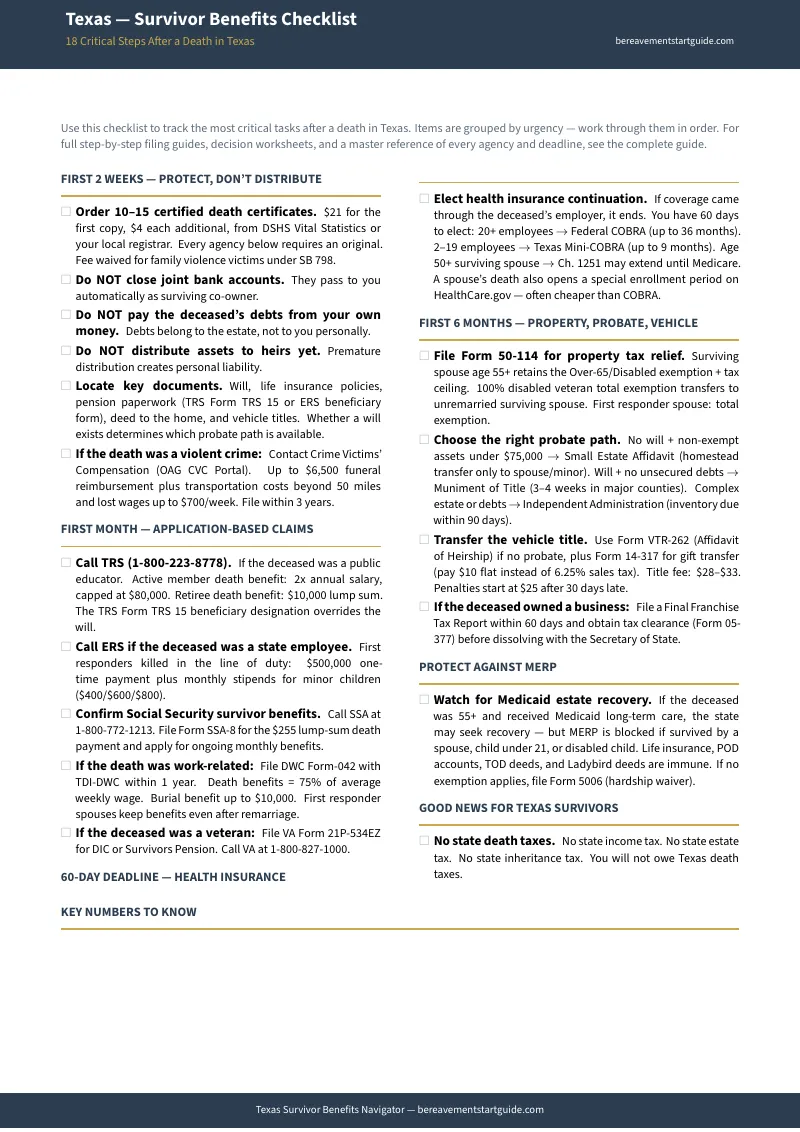
Exactly what to do (and what NOT to do) in the first two weeks: order 10–15 certified death certificates at $21 for the first copy and $4 each additional from DSHS Vital Statistics, confirm the funeral director reported to SSA, and lock down assets before premature distribution creates personal liability. Includes the "Do Not Do This Yet" list — why closing joint accounts, paying the deceased's debts from your own money, or distributing assets early can cost you thousands.
The Deadline Map
Every statutory clock running against you, in one place: the 60-day window for health insurance continuation, the 30-day vehicle title transfer deadline before $25 penalties begin, the 1-year workers' comp filing deadline, the 4-year limit to probate a will, and the 2-year window to prove a common-law marriage. Miss any of these and the money is gone — no extensions, no exceptions.
The Probate Pathfinder
Three distinct Texas probate mechanisms — and choosing the wrong one wastes months and thousands in legal fees. The Small Estate Affidavit for intestate estates under $75,000 (excluding homestead and up to $100,000 in exempt personal property). The Muniment of Title that probates a will without appointing an executor — but only when there are no unsecured debts. And Independent Administration, the Texas system that lets executors manage estates largely free of court supervision. Each path explained with eligibility rules, county filing fees, and the forms you'll need.
The TRS/ERS Pension Decoder
How to file for Teacher Retirement System and Employees Retirement System survivor benefits — including the critical difference between active member death benefits (2x annual salary, capped at $80,000) and retiree death benefits ($10,000 TRS lump sum or $5,000 ERS lump sum). Why the beneficiary designation on TRS Form TRS 15 overrides the will. How the Proportionate Retirement Program covers members who split careers between TRS, ERS, and other Texas public systems. And why you must notify TRS immediately to prevent overpayment clawbacks.
First Responder and Line-of-Duty Benefits
If the deceased was a first responder killed in the line of duty: the $500,000 one-time payment, monthly stipends for minor children ($400/$600/$800), and the total property tax exemption that transfers to the unremarried surviving spouse. First responder spouses keep workers' comp benefits even after remarriage — a protection most Texas survivors don't know exists.
Workers' Comp and Crime Victims' Compensation
Workers' compensation death benefits pay 75% of the deceased's average weekly wage plus up to $10,000 for burial — but DWC Form-042 must be filed within 1 year. Crime Victims' Compensation covers up to $6,500 for funeral costs, lost wages up to $700/week, and transportation costs beyond 50 miles — but operates as a payer of last resort. Both programs explained step by step with contact information, deadlines, and form guidance.
The Health Insurance Decision Guide
Three paths to continuing coverage after a spouse dies — federal COBRA (20+ employees, up to 36 months), Texas Mini-COBRA (2–19 employees, up to 9 months), or a HealthCare.gov Special Enrollment Period that's often cheaper than either. Plus the Texas Insurance Code Ch. 1251 provision allowing surviving spouses age 50+ to extend group coverage until Medicare eligibility. How to compare all options before the 60-day election deadline.
Property Tax Relief and Vehicle Transfers
Surviving spouses age 55+ retain the Over-65/Disabled exemption and the school district tax ceiling. Surviving spouses of 100% disabled veterans keep the total homestead exemption. Step-by-step instructions for filing Form 50-114 with your county appraisal district. Vehicle title transfers using Form VTR-262 (Affidavit of Heirship) plus Form 14-317 for gift transfer — pay $10 flat instead of the 6.25% motor vehicle sales tax.
The MERP Defense Module
If the deceased was 55+ and received Medicaid long-term care, the state may seek to recover those costs from the probate estate. But recovery is blocked if survived by a spouse, child under 21, or disabled child. MERP only reaches the probate estate — life insurance, POD accounts, TOD deeds, and Ladybird deeds are immune. How to document your exemption, and when to file the hardship waiver (Form 5006) for homesteads under $100,000.
The Community Property and Common-Law Marriage Module
Texas community property law means property acquired during marriage belongs equally to both spouses — but if the deceased dies without a will and has children from a prior relationship, the deceased's half of community property passes to those children, not to you. If you have a common-law (informal) marriage without a filed Declaration, the guide explains exactly what evidence to gather — joint tax returns, beneficiary designations, relative testimony — and why you must commence a proceeding within 2 years or face a legal presumption that no marriage existed.
The Creditor Shield
Under Texas probate law, secured creditors must file claims within the creditor notification period. Why you should never pay the deceased's debts from your own funds, how to handle collectors, and the priority rules that determine which debts get paid from estate assets first — so your survivor benefits and exemptions stay protected.
Who This Guide Is For
- Surviving spouses trying to claim every benefit before the deadlines pass — and protect the family home from creditors and Medicaid recovery
- Adult children serving as executor who need to secure benefits for a surviving parent while managing the estate across Texas's county-by-county probate system
- Families of teachers, state workers, and public employees navigating TRS and ERS survivor pensions and the irrevocable payout elections
- Families of first responders killed in the line of duty claiming the $500,000 payment, monthly stipends, and total property tax exemption
- Families of workers killed on the job filing for workers' comp death benefits and the $10,000 burial benefit
- Common-law marriage partners who need to prove their marital status to the SSA, TRS, or the probate court before the 2-year presumption window closes
Why Not Just Use Government Websites?
You can. Every form, statute, and eligibility rule in this guide exists somewhere on ssa.gov, trs.texas.gov, comptroller.texas.gov, and 254 individual county appraisal district websites. That's the problem — "somewhere" across dozens of dense, uncoordinated government pages written in statutory language, with no chronological sequencing and no explanation of how one agency's requirements interact with another's.
Government websites are legally prohibited from giving you advice. They'll provide a blank form but won't tell you what to do first, second, or third. The state gives you the puzzle pieces. This guide gives you the picture on the box — and tells you which piece to place first.
What You Get
- The Complete Navigator — 14 chapters covering every benefit, exemption, and administrative process, organized in the order you need to act
- Quick Start Checklist — the 19 most critical actions in the exact order you need to take them
- Master Benefits Worksheet — fill-in worksheet mapping every benefit you qualify for, the agency, the form number, and your personal deadline
- Deadline Map — printable table of every statutory deadline with a fill-in column for your personal dates
- Official Forms Directory — every Texas form referenced in the guide with the issuing agency and where to find it online
- Key Contacts Reference — every Texas agency, phone number, and key figure on one landscape sheet you can keep by the phone
Satisfaction Guarantee
If the Navigator doesn't save you time, confusion, or money — email [email protected] and we'll make it right. No questions, no hassle.
Start Protecting Your Family's Benefits
Download the free Texas Survivor Benefits Checklist for the 19 most critical actions — or get the complete Navigator with full step-by-step instructions, TRS/ERS pension decoder, MERP defense strategies, county filing details, and every form walkthrough.