Someone You Love Just Died in Utah. The Bank Froze Their Accounts. The Funeral Director Needs a Number for Death Certificates. Your Ward Has Been Incredible — but Nobody Can Tell You What Happens After the Service.
The first few days were carried. The Bishop called. The Relief Society organized meals. The Elders Quorum helped with the yard work and the airport pickups. The funeral was planned with care, the program was printed, and the family gathered. And then everyone went home. The casseroles stopped arriving. The phone stopped ringing. And now you are sitting at the kitchen table with a stack of unopened mail, a frozen bank account, and a list of things nobody explained how to do.
Maybe you are the surviving spouse, and the checking account you have used for thirty years is suddenly inaccessible because it was in your partner's name alone. Maybe you are the adult child who was named personal representative in a will you barely remember, and the bank just told you they need something called "Letters Testamentary" before they will release a single dollar. Maybe there was no will at all, and now siblings are asking about the house while creditors you have never heard of are sending letters demanding payment on debts you did not know existed.
You are not personally responsible for the deceased's debts. But the specific answer — the one that involves Utah's 30-day waiting period for the Small Estate Affidavit, the 120-hour survival rule for Transfer on Death deeds, a Medicaid estate recovery program that can reach into living trusts and joint accounts, a creditor notification process that runs for three months through a local newspaper, and a vehicle transfer system that bypasses probate entirely for up to four vehicles using a single form — that answer is what separates families who settle an estate in months from families who spend years and thousands of dollars fixing mistakes they did not know they were making.
The When Someone Dies in Utah — Estate Settlement Guide is a Beehive Settlement System for every legal, financial, and administrative step between the funeral and final distribution. Not a law textbook. Not a generic checklist from a national website that does not know Utah from Alabama. A structured, Utah-specific manual that separates what must be done in the first 48 hours from what can legally wait three months — so you stop guessing, stop panicking, and start working through this in the right order.
What's Inside the Beehive Settlement System
A 13-chapter guide, the First 48 Hours Checklist, and 3 appendices — covering every stage from the moment of death through final asset distribution, built specifically for Utah statutes, district court procedures, and the state-specific rules that make settling an estate here different from any other state:
The First 48 Hours: Death Certificates and Immediate Actions
The funeral director is going to ask you how many certified death certificates to order, and most families guess wrong. You need originals — not photocopies — for every bank, every insurance company, the district court, the Utah State Tax Commission for vehicle transfers, every county where the deceased owned property, and the IRS. The guide gives you the exact calculation based on the deceased's assets. The first certified copy costs $30 from the Utah Office of Vital Records and Statistics, each additional copy ordered at the same time costs $10, and coming back weeks later for more creates delays you cannot afford. Order the right number now, or pay for it in wasted weeks later. This chapter also covers what to do today, what to do tomorrow, and what to absolutely not do — including the single most important rule in this entire guide: do not pay any of the deceased's bills with your own money.
The First Week: Securing the Estate and Honoring the Community Timeline
Before probate gives you legal authority over anything, you have a common-law duty to prevent assets from being lost, stolen, or damaged. This chapter covers locking the home, securing vehicles and valuables, rerouting mail (your best forensic tool for discovering unknown accounts and debts), canceling subscriptions that drain the estate, and the family meeting where you set the single most important expectation: no one takes anything from the house until the court says so. Written with deep respect for Utah's community norms — the chapter acknowledges the Bishop's coordination, the Relief Society's meal support, and the ward's role in the immediate aftermath, then bridges you into the legal and financial work that begins once the community support naturally recedes.
Banking and Financial Accounts: Unlocking Frozen Money
When a bank receives notice that an account holder has died, individual accounts are frozen immediately. Being the deceased's spouse or child does not override the freeze. But not every account is locked. Payable-on-Death accounts transfer directly to named beneficiaries with just a death certificate. Joint accounts with right of survivorship stay open. And Utah's Small Estate Affidavit lets families claim accounts and personal property worth up to $100,000 after a mandatory 30-day waiting period — entirely without going to court. The guide maps every account type, what unlocks it, and what paperwork you need — so you stop getting turned away at the bank counter.
Vehicle Title Transfers: The TC-569C Shortcut Most Families Miss
Utah has a vehicle transfer process that most families never discover, and it saves enormous time. The Survivorship Affidavit — Form TC-569C — lets you transfer up to four vehicles, boats, or trailers directly through the Utah State Tax Commission Motor Vehicle Division, completely bypassing probate court. Vehicles are explicitly excluded from the $100,000 small estate value cap. If your parent owned a truck, a sedan, a boat, and a trailer, all four can transfer to the surviving heir with a single form and a death certificate. The guide walks through every step of the TC-569C process, what to bring to the Tax Commission office, and the common mistakes that cause rejections.
Real Property: Why the 120-Hour Rule Changes Everything
Real estate cannot be transferred via a Small Estate Affidavit under any circumstances. If the deceased owned a house solely in their name, that property must go through probate. The only ways real estate bypasses probate are joint tenancy with right of survivorship, a revocable living trust, or a Transfer on Death (TOD) deed recorded before the owner's death. But even TOD deeds carry a trap that catches families off guard: Utah enforces a strict 120-hour survival rule. The designated beneficiary must survive the deceased by at least five full days for the property transfer to be valid. If they do not, the deed fails and the property enters probate. This chapter explains exactly what that means and what to do if you are unsure whether the survival requirement was met.
The Big Decision: Small Estate Affidavit vs. Formal Probate
Not every estate needs a court proceeding. Utah's Small Estate Affidavit allows families to claim all personal property — bank accounts, investments, personal effects — if the estate contains no real property, the total value is under $100,000, at least 30 days have passed since the death, and no application for a personal representative is pending. Vehicles are excluded from the value cap entirely. The guide includes a decision tree that walks you through each criterion. If you qualify, the affidavit is presented directly to the bank or asset holder — not filed with any court. No $375 filing fee. No attorney percentage. If you do not qualify, the guide tells you exactly why and what the formal probate process requires.
Formal Probate: Every Milestone from Petition Through Distribution
If the estate requires formal probate, this chapter walks you through every step: filing the petition with the Utah district court, the court filing fee ($375), receiving Letters Testamentary or Letters of Administration, opening an estate bank account with its own EIN, publishing the Notice to Creditors in a local newspaper for three consecutive weeks, and managing the three-month creditor claim window before you can safely distribute a single asset to any beneficiary. It covers both informal probate (the streamlined path for uncontested estates) and formal probate (required when there are disputes), and explains how Utah's Uniform Probate Code makes the process different from neighboring states.
Utah's Electronic Wills Act: Handling Digital Documents
Utah is one of the few states that recognizes electronic wills as legally equivalent to paper originals. Under the Uniform Electronic Wills Act (House Bill 6001), a will can be created, signed, witnessed, and notarized entirely in electronic form — including remote witnessing where participants communicate in real time from different locations. If the deceased left a digital will stored on a device or in the cloud, this chapter tells you exactly how to authenticate it, how to present it to the Utah courts without triggering fraud concerns, and how to handle the self-proving affidavit requirements. For out-of-state families managing a Utah estate remotely, this chapter is critical.
Government Notifications: SSA, VA, IRS, and Utah Medicaid
Each agency operates on its own timeline with its own forms and its own consequences for delay. Social Security benefits must stop — payments deposited for the month of death will be clawed back if the deceased did not survive the entire month. The VA requires separate notification. The IRS needs the deceased's final Form 1040 filed. And Utah Medicaid operates one of the most aggressive estate recovery programs in the country. The guide covers every agency, every form, every deadline, and the specific consequences of missing each one.
Medicaid Estate Recovery: Utah's Expanded Clawback Rules
This is where most families get blindsided. Utah does not limit Medicaid recovery to probate assets. Under the state's "expanded estate" recovery model (U.C.A. Section 75-2-205), the Office of Recovery Services can reach into joint accounts, living trusts, and non-probate transfers to recover costs for anyone who received Medicaid at age 55 or older. If your parent had a nursing home stay or received long-term care paid by Medicaid, the state may have a claim against assets that you assumed were protected by a trust or joint ownership. The guide spells out exactly which assets are vulnerable, which are absolutely protected (surviving spouse, child under 21, blind or permanently disabled child), and how TEFRA liens work — so you know what you are dealing with before the Office of Recovery Services sends a letter.
Creditor Management: The Three-Month Shield
The estate pays debts, not the family. But when creditors start calling, most families do not know that Utah law gives the personal representative a powerful tool. Under Utah Code 75-3-801, publishing a Notice to Creditors in a local newspaper for three consecutive weeks starts a strict three-month clock. Any creditor who does not file a claim within that window is permanently barred from collecting — forever. The guide provides the exact publication process, the legal priority order for paying debts when the estate cannot cover everything, and the framework for managing demands without making mistakes that a judge will hold against you.
When You Need a Lawyer — and When You Do Not
This guide does not pretend that every estate can be settled without professional help. If the estate involves contested wills, complex real estate, business interests, or significant Medicaid recovery claims, you need a licensed Utah probate attorney. This chapter is honest about exactly when that threshold is crossed. It is also honest about the cost: Utah probate attorneys typically charge $250 to $450 per hour, with standard representation running $1,500 to $5,000. For the many families whose estate falls below the $100,000 small estate threshold, or whose assets pass entirely through non-probate channels like POD accounts, joint survivorship, and TOD deeds, this guide handles the entire process.
The Complete Timeline: Every Statutory Deadline in One Calendar
From Day 1 through Month 18 and beyond, every Utah statutory deadline in one sequential reference. The 120-hour survival rule. The 30-day Small Estate Affidavit waiting period. The three-week creditor publication window. The three-month creditor claim period. The timeline for filing informal versus formal probate. Every deadline that matters, in the order it appears, with clear language about what happens if you miss it.
Who This Guide Is For
- The surviving spouse whose partner just died and whose bank accounts were frozen this morning — who needs to know which accounts stay accessible, which ones require court paperwork, and whether the Small Estate Affidavit can unlock everything without a lawyer or a $375 court filing
- The adult child named as personal representative who has never been through probate, may live out of state, and is terrified of making a mistake that triggers personal liability — who needs the complete sequence of fiduciary duties, court deadlines, and filing requirements in one document
- The family with no will who just learned that Utah's intestate succession laws will decide everything — who needs to understand exactly who inherits what, whether the house must go through probate, and whether the small estate shortcut applies to their situation
- The person who just got rejected at the bank trying to access their deceased parent's checking account — who needs to know whether a POD designation, a joint account, or the $100,000 Small Estate Affidavit can bypass probate entirely, or whether Letters Testamentary are the only path forward
- The family dealing with Medicaid recovery who received a letter from Utah's Office of Recovery Services demanding reimbursement for nursing home costs — who needs to understand expanded estate recovery, the assets that are protected, and the exemptions that may block the state's claim entirely
- The out-of-state family member who just learned they need to settle an estate under Utah law and has no familiarity with the state's probate code, vehicle transfer process, TOD deed rules, or Medicaid recovery program — who needs every Utah-specific rule in one place before they fly home
Why Free Resources Will Not Get You Through This
The information exists. It is scattered across the Utah Courts website, Utah Legal Services pamphlets, funeral home bereavement pages, and federal agency portals that do not talk to each other. Here is what you actually encounter when you try to settle an estate using free sources alone:
- The Utah Courts website gives you forms and tells you to hire a lawyer. The court publishes MyPaperwork forms and filing instructions. But the content is fragmented across dozens of sub-pages, the navigation mixes formal probate with informal procedures, and every page explicitly states the court "cannot give legal advice." If you are dealing with a $60,000 estate and the attorney quotes $3,000, the math does not work — but the court offers no alternative path.
- Utah Legal Services targets low-income intake, not post-death crisis management. They provide basic overviews of pensions, SSN returns, and small estate limits. They do not provide sequential, step-by-step guidance for the person sitting at the kitchen table who needs to know what to do after the funeral service ends and the ward's support recedes.
- Funeral homes give you surface-level advice that ends at the cemetery. Bereavement pages from Utah funeral homes tell you to order death certificates and notify Social Security. They do not explain the TC-569C Survivorship Affidavit, the 120-hour TOD deed rule, the expanded Medicaid recovery program, or the three-month creditor shield. Their advice stops exactly where the hard questions begin.
- Local probate attorneys highlight complexity to justify retainer fees. Attorney blog posts about Utah probate are accurate and detailed — and they are explicitly designed to convince you that the process is so dangerous you need to spend thousands on representation. For contested estates, that is true. For the majority of straightforward estates, the answer costs a fraction of what an attorney charges.
- National form vendors miss Utah-specific rules and charge recurring fees. eForms, USLegalForms, and similar platforms offer generic templates for $20 to $40 per form. They do not cover the TC-569C vehicle shortcut, the 120-hour survival rule for TOD deeds, Utah's expanded Medicaid recovery laws, or the Electronic Wills Act. Utah is not a footnote — it is a state with its own rules, and generic tools miss them.
Free resources give you fragments from a dozen different sources that do not reference each other. The Beehive Settlement System puts every Utah-specific statute, form, deadline, and procedure into one document, in the order you actually need them.
— Less Than Fifteen Minutes With a Utah Probate Attorney
A single consultation with a Utah probate attorney costs $250 to $450 per hour. Standard probate representation runs $1,500 to $5,000. National estate software platforms charge $149 per year in recurring subscription fees. This guide costs less than fifteen minutes of professional legal time and gives you the complete Utah-specific roadmap — every statute, every deadline, every form, and the decision tree that tells you whether you even need an attorney at all.
Your download includes the complete 13-chapter guide with three appendices (district court reference, key forms, and glossary), the standalone Utah First 48 Hours Checklist, and eight printable reference sheets: the Small Estate vs. Formal Probate Decision Tree, TC-569C Vehicle Transfer Walkthrough, District Court Reference (fees and contacts), Medicaid Recovery Exemption Worksheet, Statutory Deadline Calendar (every deadline with space for your dates), Creditor Priority Reference, Account-Closing Checklist, and Government Notification Tracker. Ten PDFs total — instant download, no account required.
Money-back guarantee, no time limit. If the guide does not give you clarity on what to do next and confidence that you are doing it in the right order, email us for a full refund. No questions asked.
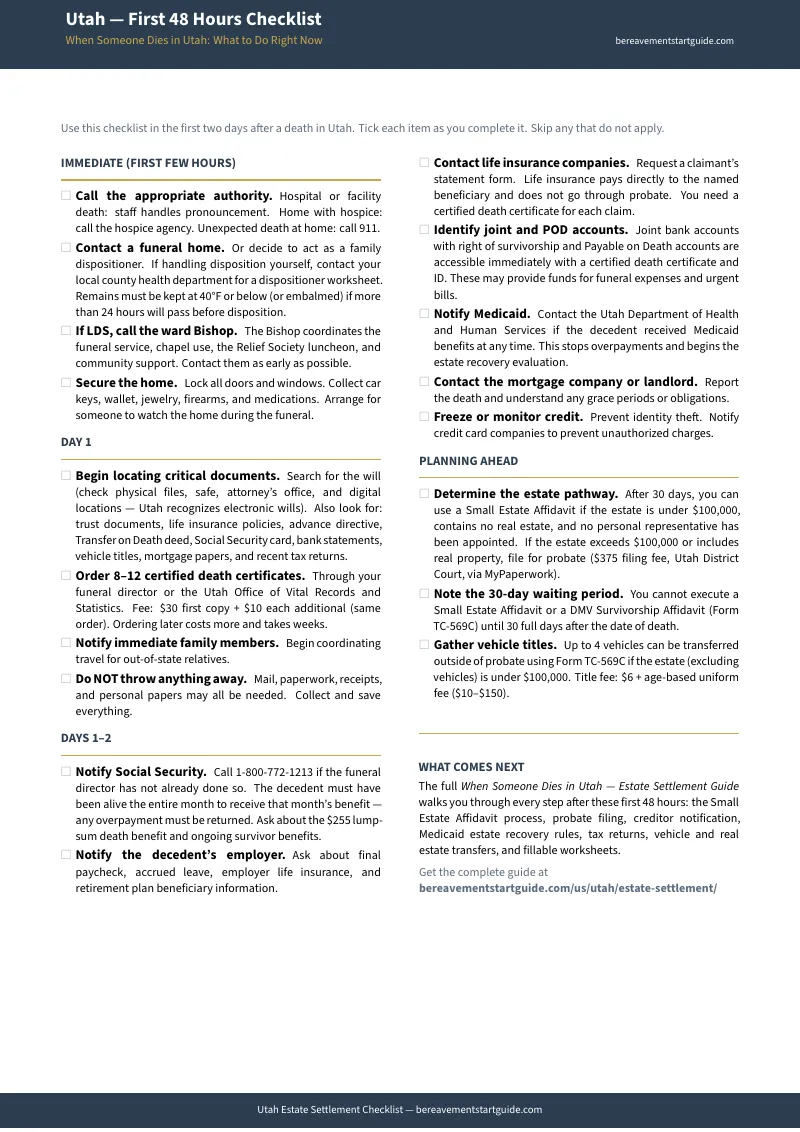
Not ready for the full guide? Download the free Utah First 48 Hours Checklist — 16 items covering everything that must happen in the first two days after a death in Utah: death certificates, securing the home, notifying Social Security, what not to pay, and what to gather. It is enough to get through tonight and tomorrow.
You did not ask for this job. But you can do it. The guide shows you how, one step at a time.