Utah Funeral Homes Know the Law Better Than You Do. The 25% Preneed Penalty, the 24-Hour Embalming Clock, and the Dispositioner Loophole They Will Never Mention.
Someone you love has died in Utah. Within 24 hours, the body must be embalmed or placed in refrigeration below 40 degrees Fahrenheit — that is Utah Administrative Code R436-8-4, not a suggestion. Within minutes of arriving at the funeral home, you will be presented with a package running $5,000 to $8,000 for a traditional burial. The person across the table has memorized every line of the Funeral Services Licensing Act. You are still trying to figure out whether your sister or your stepmother has the legal authority to make decisions.
This information gap is the foundation of the industry in Utah. Funeral homes are not required to tell you that embalming is never legally mandatory — refrigeration is always the legal alternative. They will not volunteer that Utah Code 26B-8-120 allows your family to act as its own dispositioner, filing the death certificate and arranging everything without a licensed funeral director. They will certainly not mention that if you signed a guaranteed preneed contract and want to cancel, Utah Administrative Code R156-9-616 permits the funeral home to keep up to 25 percent of the trusted amount as a revocation fee.
Free resources exist. The Utah Code is online. The Division of Professional Licensing publishes complaint forms. The FTC has a national fact sheet about the Funeral Rule. But these resources share a common problem: the statutes are dense legalese spread across Title 58, Title 26B, and Title 75, the DOPL website requires you to already know which form you need, and national consumer guides miss Utah-specific rules like the augmented estate Medicaid recovery program, the two-unrelated-witness requirement for disposition instruments, the one-eighth-inch particle size rule for scattering ashes, and the fact that alkaline hydrolysis is fully legal with no casket required.
The Beehive State Regulatory Shield
This guide consolidates every Utah funeral regulation, federal consumer protection, and multi-agency administrative procedure into one plain-English manual — organized around the decisions you actually face, in the order you face them. It is designed to function as a regulatory shield: you read it before the arrangement conference, and you walk in knowing exactly what the funeral home is required to provide, what you can legally decline, and which agency to call if they push back.
The result: you stop paying for services you do not need, you stop signing authorizations you do not understand, and you stop deferring to an industry that profits from your confusion during the worst week of your life.
The 24-Hour Clock and the Embalming Pressure Play
Utah's preservation rule creates an artificial sense of urgency. If the body is not buried or cremated within 24 hours of death, it must be embalmed or refrigerated below 40 degrees. For LDS families planning a traditional service — which customarily takes place roughly one week after death, with a viewing the evening before and again the morning of the funeral — this week-long delay gives funeral homes enormous leverage to push embalming as "necessary." It is not. Refrigeration is always the legal alternative, and it costs a fraction of the embalming fee. The guide maps this clock, explains what triggers it, and gives you the exact language to decline embalming while honoring a full week of LDS funeral customs.
The Disposition Authority Hierarchy and the Two-Witness Trap
Utah Code 58-9-602 establishes a rigid ten-tier hierarchy for who controls funeral decisions. A designated agent named in a Written Instrument to Control Disposition holds top priority — but that instrument requires acknowledgment by a notary public or execution with the formalities of a will, and it must be signed in the presence of at least two witnesses who are not related to you. A generic power of attorney dies with the person. If your family has not executed this specific instrument with two unrelated witnesses, the authority defaults to the surviving spouse, then a majority of adult children, then parents, then siblings. When blended families disagree about cremation versus burial, the funeral home freezes all services while the body sits in commercial refrigeration at daily rates. The guide breaks down the entire priority list, explains the majority rule for same-class disputes, and shows how the Written Instrument could have prevented the standoff entirely.
The 25% Preneed Revocation Penalty
Pre-planners who locked funds into a guaranteed preneed funeral contract may discover too late that cancellation carries a brutal penalty. Under Utah Administrative Code R156-9-616, the funeral establishment can retain up to 25 percent of the amount received from the sale — plus the trust earnings — as a revocation fee. If you paid $8,000 into a guaranteed contract, you could lose $2,000 just for changing your mind. The guide explains the difference between guaranteed and non-guaranteed contracts, the DOPL trust account protections, and the insurance-funded portability option that lets you transfer value to a different provider without forfeiting the principal.
What You Get
- The Complete Utah Funeral Law Guide — 16 chapters covering everything from the first 24 hours through filing a complaint, written in plain English with every relevant statute cited
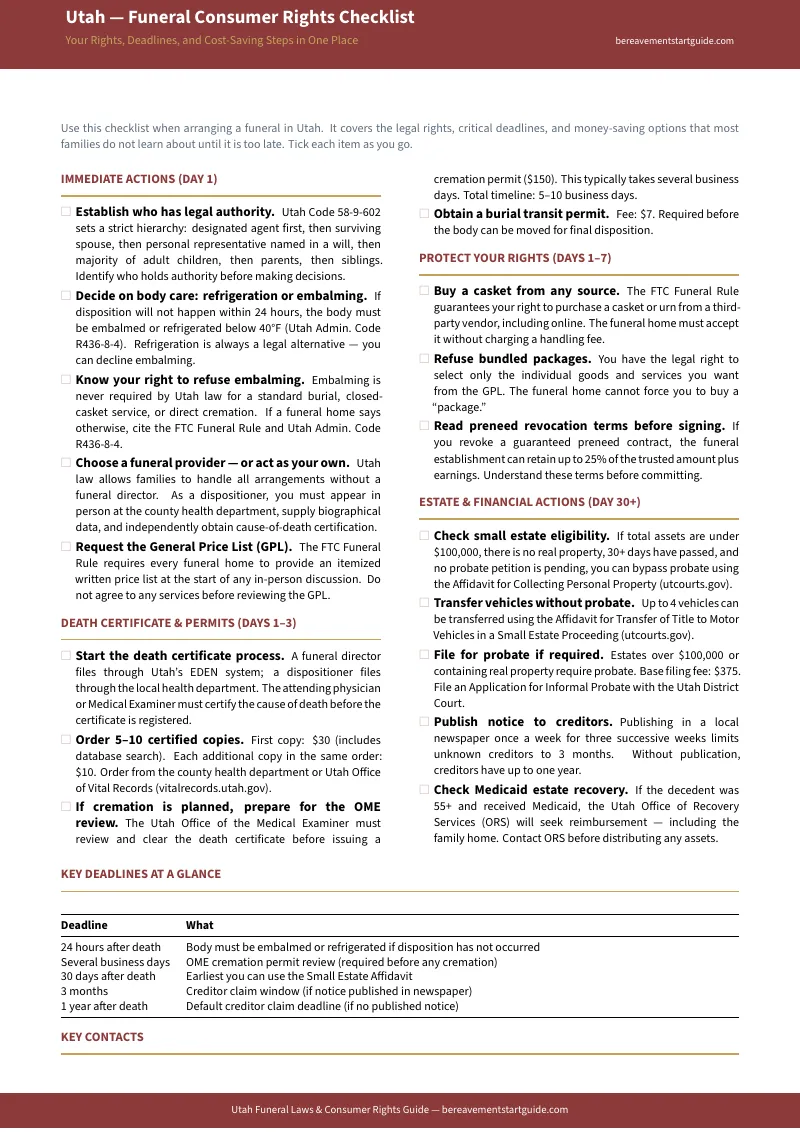
- Consumer Rights Checklist — a printable checklist covering the most urgent actions, from the 24-hour refrigeration rule through the DOPL complaint process
- Right of Disposition Hierarchy Chart — the complete ten-tier priority list under Utah Code 58-9-602, with the Written Instrument requirements, majority rule for same-class disputes, and guidance on resolving family conflicts
- Cremation Authorization Guide — the Office of the Medical Examiner review process, the $150 cremation permit fee, and the documentation trifecta that delays families who are not prepared
- Home Funeral and Green Burial Guide — the legal requirements for acting as your own dispositioner under Utah Code 26B-8-120, including death certificate filing, burial-transit permits, county zoning rules for private property burial, and the dispositioner fee schedule
- Alkaline Hydrolysis and Ash Scattering Guide — full legal status of aquamation under Utah Code 58-9-102, the prohibition on casket requirements for the process (58-9-615), the one-eighth-inch particle size rule for scattering (58-9-611), and public land permit requirements
- Preneed Contract Protection Guide — the 25% revocation fee trap, guaranteed versus non-guaranteed contracts, DOPL trust account audit authority, insurance-funded portability rights, and Medicaid asset protection implications
- Complaint Filing Guide — how to file a regulatory complaint with the Division of Professional Licensing when a funeral home violates your rights, the parallel path through the Division of Consumer Protection for billing fraud, and the concurrent federal FTC complaint process
- Agency Navigation Map — the exact handoffs between DOPL, the Office of Vital Records, the Office of the Medical Examiner, county health departments, and the Division of Consumer Protection, with contact information, form numbers, fee amounts, and deadline windows for each
- Medicaid Estate Recovery Overview — how Utah's augmented estate recovery model under Utah Code 26-19-13.5 reaches beyond standard probate assets into joint tenancy, living trusts, life estates, and TOD deeds, and the specific family circumstances that delay or block recovery
Who This Is For
- Families arranging a funeral right now who need to know their rights before the first meeting with a funeral home — especially those facing a $5,000+ price quote and wondering what they can legally decline, what refrigeration actually costs compared to embalming, and whether the "package" they are being presented is a legal requirement or a sales tactic
- LDS families planning a traditional service navigating the intersection of week-long funeral customs and the 24-hour preservation rule — particularly those who need to understand how refrigeration substitutes for embalming during the extended viewing and visitation period without compromising religious practices or violating state health codes
- Families considering a home funeral, green burial, or alkaline hydrolysis who want to confirm they are meeting every Utah and federal requirement — including acting as their own dispositioner, filing death certificates without a funeral director, complying with county zoning for private property burial, and verifying that no casket is required for aquamation
- Pre-planners and estate protectors evaluating prepaid funeral contracts and needing to understand the 25% revocation fee before signing, the difference between guaranteed and non-guaranteed contracts, DOPL trust account protections, and how preneed contracts interact with Utah's augmented estate Medicaid recovery program
- Adult children managing a parent's affairs who are navigating family disputes over disposition authority, wondering whether a stepparent outranks them on the hierarchy, or trying to determine whether a Written Instrument executed years ago is still legally valid without the required two unrelated witnesses
Why Free Information Falls Short
The Utah Code is free to read online. But the funeral regulations alone span Utah Code Title 58 Chapter 9, Title 26B Chapter 8, Title 75 Chapter 2, and multiple sections of the Utah Administrative Code — each cross-referencing the others without providing a coherent sequence of actions. The DOPL website will give you a blank complaint form but will not explain the difference between a licensing violation (DOPL) and a billing fraud complaint (Division of Consumer Protection). The Office of Vital Records will tell you that families can act as dispositioners but will not explain the county-by-county fee schedule or the EDEN system workflow. A national funeral consumer advocacy site will tell you green burial is "legal in Utah" without mentioning that nearly every Utah cemetery requires an outer burial container regardless of state law, or that the one-eighth-inch particle size rule applies before you can legally scatter ashes.
The guide bridges this gap — not by replacing legal counsel, but by connecting the dots between every relevant agency, statute, and deadline so you can make decisions from a position of knowledge rather than grief-driven urgency.
What This Guide Does Not Do
This guide is an educational and administrative tool — not legal representation. It does not constitute legal, tax, financial, or medical advice, and purchasing it does not create an attorney-client relationship. It does not guarantee eligibility for Medicaid benefits or predict the outcome of an estate recovery claim. When you need a probate attorney, an elder law specialist, or intervention from DOPL, the guide tells you exactly which professional and why.
— Less Than One Hour of Elder Law Attorney Time
Utah elder law attorneys charge $250 to $350 per hour. If this guide prevents just one unnecessary embalming service, one pressure-sold casket upgrade, or one missed deadline that triggers daily refrigeration fees, it has paid for itself many times over. If it gives you the confidence to demand an itemized General Price List before signing anything — and to walk out if the funeral home refuses — the savings compound from there.
Every purchase includes a money-back guarantee, no time limit. If the guide does not give you the clarity and confidence you need to navigate Utah's funeral system, email us for a full refund.
The free Consumer Rights Checklist covers the most critical actions — the ones with hard deadlines and immediate financial consequences. The full guide covers every chapter in depth: the right of disposition hierarchy, the Written Instrument requirements, cremation authorization, the 25% preneed revocation penalty, home funeral regulations, alkaline hydrolysis rules, ash scattering compliance, Medicaid estate recovery, the dispositioner process, and the DOPL and DCP complaint paths.