You've Been Named Personal Representative in Utah. The Bank Froze the Accounts, the Court's Online System Won't Generate Probate Forms, and Nobody Explained the Difference Between a $100,000 Threshold and a $375 Filing Fee.
The bank tells you they need "Letters Testamentary" before releasing a single dollar. You don't know what that means. You search "Utah probate forms" and find the state court website — which lists PDF forms with names like 1001ES and 1006ES, but no instructions for which one to file first, which deadline it triggers, or what happens if you get it wrong. You try the state's Online Court Assistance Program, because it helped a friend with a divorce filing. It doesn't support probate. At all.
Meanwhile, the deceased owned a house, which means you can't use the small estate affidavit — even if every other asset is under $100,000. Someone mentioned a Transfer-on-Death deed, but you're not sure if one was recorded, and you just learned there's a 120-hour survival rule that can void it. A nursing home is asking about Medicaid recovery, and a relative in another state says you need something called "ancillary probate" for a cabin they co-owned.
Utah probate attorneys charge an average of $337 per hour, or $2,000 to $5,000 as a flat fee for standard administration. A meaningful chunk of that cost is time spent explaining the process to you — time that wouldn't be billable if you already understood the system, the deadlines, and the decisions you'll be asked to make.
Introducing the OCAP Gap Navigator
Utah's Online Court Assistance Program generates documents for divorces, evictions, and protective orders. It deliberately excludes probate. That means you're left assembling scattered PDF forms from the state court website with no software assistance, no sequencing, and no decision logic. This is the gap the guide fills — and we call it the OCAP Gap Navigator.
At its core is a chronological, decision-tree-driven system that walks you through the entire Utah probate process based on your specific situation: whether there's a will, whether the estate includes real estate, whether assets fall under the $100,000 small estate threshold, whether a Transfer-on-Death deed was recorded, and what happens at every stage from the mandatory 120-hour waiting period through closing the estate.
Free articles tell you probate exists. Attorney blogs tell you just enough to make you feel lost. National templates give you forms that don't mention the Utah Uniform Electronic Wills Act, the expanded Medicaid estate recovery rules, or the fact that the small estate affidavit excludes real property entirely. The OCAP Gap Navigator gives you the sequence — which form to file first, which deadline starts ticking the day of your appointment, and which procedural misstep converts a four-month administration into a year-long supervised case.
Whether you're working with an attorney and want to walk in organized, or you're handling a small estate affidavit on your own, this guide puts you in control of a process that was designed for lawyers, not families.
What's Inside — and the Exact Problem Each Part Solves
The Probate Pathway Decision Tree
Utah offers several ways to handle a deceased person's estate, but choosing the wrong one wastes months and hundreds of dollars in non-refundable filing fees. This chapter walks you through the decision in order: Does everything pass outside probate (beneficiary designations, joint tenancy, POD accounts)? Does the estate qualify for a small estate affidavit — personal property under $100,000, no real estate, 30 days since death? Can you use informal probate — uncontested, all parties sign waivers, handled by the court registrar without a judge's hearing? Or does the situation require formal probate — contested will, missing heirs, disputes among beneficiaries? You follow the tree until you hit your path. Solves: the executor who pays the $375 court filing fee for full probate when a small estate affidavit would have transferred everything without going to court.
Informal vs. Formal Probate
Informal probate is the reason Utah estate administration can close in months instead of years. Under it, the court registrar appoints you without a hearing, and you manage the estate without returning to a judge for approval of every sale, payment, and distribution. But you lose it if a single interested party refuses to sign a waiver of notice, if a will is contested, or if an heir can't be located. This chapter covers how to secure informal probate, what triggers formal probate (and the hearing schedule, litigation costs, and mandatory mediation in some districts that come with it), and the waiver-of-notice requirement that trips up families with estranged relatives. Solves: the executor who unknowingly triggers the wrong track and doubles the cost and timeline of settling the estate.
The Court Filing Sequence
The exact procedural steps, in order: the mandatory 120-hour (5-day) waiting period after death, the Application for Informal Probate (Form 1001ES for intestate, 1002ES for testate), the District Court Cover Sheet for Probate Actions, the Statement of Informal Probate, the Acceptance of Appointment, the Letters Testamentary or Letters of Administration, the creditor notice publication, and the 90-day creditor claims window. Each step includes the form name, the statutory section under Title 75, the filing fee, and the specific deadline that starts running. Solves: the executor who doesn't know there's a 120-hour waiting period and drives to the courthouse the day after the funeral to file paperwork that gets rejected.
The Small Estate Affidavit
When the estate's personal property is worth $100,000 or less and there's no real property to transfer, Utah allows heirs to bypass the court entirely with a sworn affidavit presented directly to banks and other third parties. But the requirements are exact. The affidavit can't be signed until 30 days after death. Real property disqualifies the estate completely. And up to four motor vehicles can be transferred via a separate DMV survivorship affidavit — excluded from the $100,000 cap. This chapter walks you through the dollar calculation, the vehicle exception, the notarization requirements, and the common mistakes that get affidavits rejected by banks. Solves: the family spending $2,000 on an attorney for a $60,000 estate that qualified for a notarized affidavit.
The Inventory and Appraisement
Within three months of appointment, Utah Code 75-3-705 requires you to file a verified inventory of every probate asset the estate owns — or face removal. This chapter covers what goes on the inventory, what stays off (joint tenancy accounts, TOD real estate, beneficiary-designated retirement accounts), the appraisal requirements, and the critical distinction between probate assets subject to inventory and non-probate assets that may still be subject to Medicaid recovery. Solves: the executor who doesn't know the three-month deadline exists until the court sends a notice demanding compliance.
The Creditor Claims Process
After you publish a notice to creditors in a newspaper of general circulation, a 90-day clock starts. Known creditors get 60 days from direct written notice or 90 days from publication, whichever is later. If you never publish, the absolute statute of limitations is one year. This chapter maps the statutory priority order under Utah Code, the family protections that come off the top — the $22,500 homestead allowance and the $15,000 exempt property allowance — and the rules for accepting or rejecting claims. Solves: the executor who pays a credit-card company before funeral expenses and creates personal liability for paying debts out of statutory order.
Utah's Expanded Medicaid Estate Recovery
This is where most generic probate guides fail Utah families entirely. Utah's Office of Recovery Services pursues Medicaid costs not just from the probate estate, but from non-probate assets: joint tenancy property, living trusts, and real estate transferred via Transfer-on-Death deeds. A TEFRA lien can be placed on a home during the recipient's lifetime if they're in a nursing facility. This chapter explains the recovery hierarchy under Utah Code 26-19-13.5, when family allowances supersede Medicaid claims, hardship exemptions, and the specific steps to challenge an ORS demand. Solves: the family that assumes a TOD deed on the house protects it from Medicaid recovery — and discovers too late that Utah's expanded definition reaches further than almost any other state.
Transfer-on-Death Deeds and the 120-Hour Rule
Utah allows TOD deeds that transfer real estate directly to a named beneficiary at death, bypassing probate. But the beneficiary must survive the owner by 120 hours. If a valid TOD deed was recorded, the beneficiary records a notarized affidavit and a certified death certificate with the county recorder — no court required. But the house is only one asset. The deceased's bank accounts, personal property, and everything else still need either a small estate affidavit or formal probate. This chapter covers recording requirements, the survival rule, and the common misconception that a TOD deed eliminates all need for probate. Solves: the heir who thinks the TOD deed handled everything and discovers six months later that the bank accounts are still frozen.
Electronic Wills Under the UEWA
Utah was a pioneer in adopting the Uniform Electronic Wills Act in 2020. An electronic will — complete with remote witnessing and digital self-proving affidavits — is entirely valid under Utah Code 75-2-1405. If the deceased created their will electronically (increasingly common), this chapter covers how to validate it, how to present it to the court, and what happens when the registrar encounters a digital document for the first time. Solves: the executor holding a digitally signed will who can't find anyone to confirm whether it's legally valid in Utah.
Ancillary Probate for Out-of-State Heirs
If the deceased owned real property in Utah but lived in another state, the home-state probate doesn't clear the Utah title. A secondary proceeding — ancillary probate — must be opened in Utah, even if the primary estate is being managed in the deceased's home state. The filing fee for foreign probate documents is $35, and the process is largely a matter of filing authenticated copies of the domiciliary letters and the foreign will with the appropriate Utah district court. This chapter gives out-of-state executors a step-by-step procedure to clear the Utah property title without necessarily retaining local counsel. Solves: the out-of-state executor whose home-state attorney says "I'm not licensed in Utah" — leaving them to either hire a second lawyer or figure it out alone.
Closing the Estate
Once the 90-day creditor period has expired and all valid debts, taxes, and Medicaid recovery claims are resolved, the remaining assets are distributed according to the will or Utah's intestacy succession laws. The executor files a closing statement with the court, declaring the administration complete and initiating the formal discharge from fiduciary duty. This chapter covers final distributions, the closing statement, discharge of the personal representative, and what to do if a beneficiary disputes the allocation. Solves: the executor who distributes assets and considers the job done — without filing the paperwork that protects them from future lawsuits.
Printable Court Tools
In addition to the full guide, your download includes standalone printable tools designed for the courtroom process:
- Probate Pathway Decision Tree — a one-page flowchart showing whether your estate needs formal probate, informal probate, a small estate affidavit, or no probate at all.
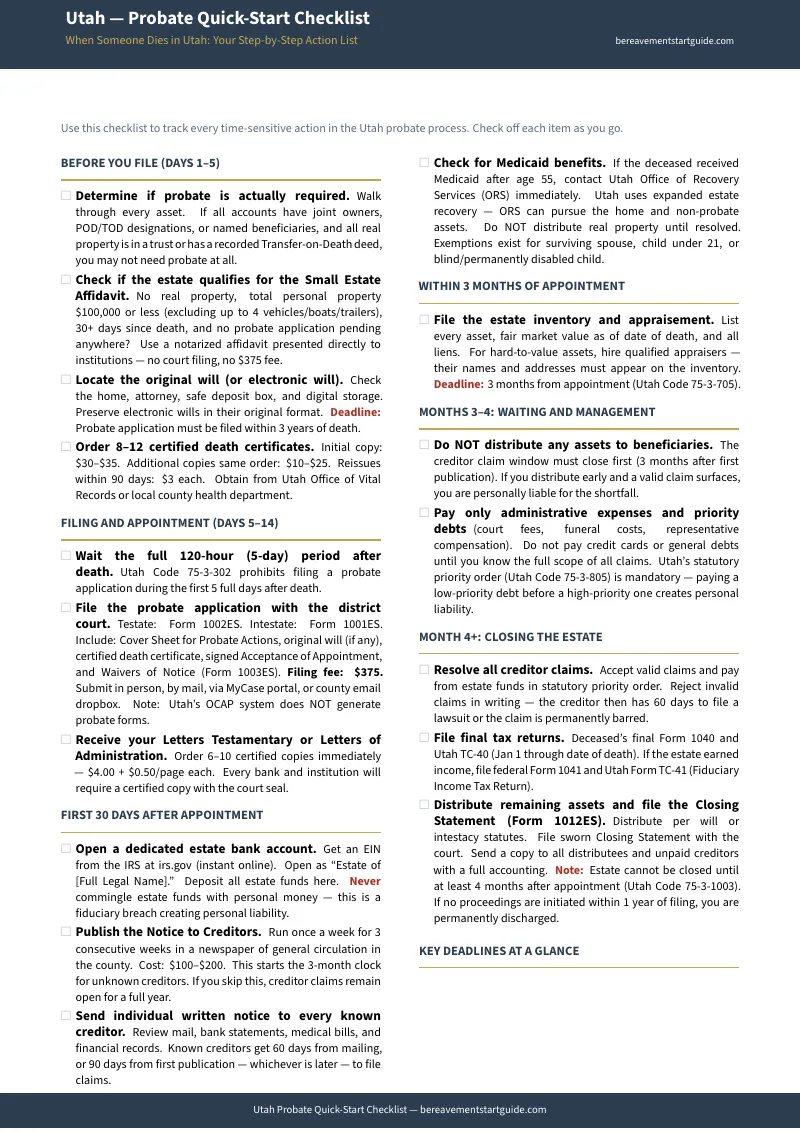
- Court Filing Checklist — every document you need, every deadline, every form number, in the order you'll need them.
- Executor Deadline Timeline — the 120-hour waiting period, the 30-day small estate affidavit wait, the 3-month inventory deadline, the 90-day creditor window, and the 3-year filing limit — all on one sheet.
- Creditor Claims Tracker — a landscape ledger for tracking every claim filed against the estate, with statutory priority class, filing date, bar date, and acceptance/rejection status.
Who This Is For
- The newly appointed personal representative who has a $375 filing fee to pay and needs to understand every step between now and closing the estate — before the three-month inventory deadline arrives.
- The family member wondering if you even need probate — and whether a small estate affidavit or a Transfer-on-Death deed can resolve everything without going to court.
- The heir handling a small estate on their own who needs to get the $100,000 calculation right, the vehicle exception documented, and the affidavit accepted by the bank on the first try.
- The out-of-state executor dealing with a Utah cabin or investment property who needs to clear the title through ancillary probate without retaining a second attorney.
- The family facing a Medicaid recovery claim who needs to understand exactly how far Utah's expanded estate recovery rules reach — and which family allowances take priority.
- The person working with an attorney who wants to walk into every meeting organized and informed — so billable hours are spent on strategy, not on explaining what Letters Testamentary are.
Why Free Tools Fall Short
Free probate advice for Utah comes in four varieties, and each one fails in a specific way:
The Utah Courts website (utcourts.gov) is the authoritative source — but it's deliberately fragmented. Forms are scattered across multiple pages, instructions are written in statutory language, every page warns you to "consult an attorney," and the court's own Online Court Assistance Program refuses to generate probate documents. The forms are free. The assembly instructions don't exist.
Utah attorney blogs (ProvenLaw, Cutler Riley, StG Estate Planning) list the steps of probate but carefully explain none of them in enough detail to actually prepare. The omission is the business model: the blog exists to make you feel overwhelmed enough to book a $337/hour consultation. Every post ends with "contact us" — which may be wise, but it's not a plan.
National legal templates (eForms, Nolo, US Legal Forms) are not written for Utah. They don't mention the OCAP Gap, the Uniform Electronic Wills Act, the expanded Medicaid estate recovery that reaches into non-probate assets, or the DMV survivorship affidavit for vehicles. The forms they sell lack the Utah-specific statutory citations that court clerks expect.
Generic estate planners are organized and attractive and legally empty. They give you a place to write down account numbers. They don't tell you that missing the three-month inventory deadline can get you removed as personal representative, or that paying creditors out of statutory order creates personal liability, or that Utah's Medicaid recovery program can reach assets you thought were protected.
This guide combines the legal accuracy of government sources with the chronological structure of the best planners — written for a grieving non-expert who needs to navigate a courtroom process, not study for a bar exam.
Our Guarantee
If this guide doesn't give you a clearer, more actionable understanding of the Utah probate process than anything you found for free, reply to your receipt at any time and we'll refund every cent. No forms, no questions.
Two Ways to Start
Start free: Download the Utah — Probate Quick-Start Checklist. It's the one-page action plan covering the first steps, key deadlines, and the decision tree for choosing which probate pathway applies — so you know whether you're heading to court or not before you spend a dollar.
Go deeper: The full Utah Probate Process Guide () walks you through the complete OCAP Gap Navigator — the probate pathway decision tree, informal vs. formal probate, the court filing sequence, small estate affidavit, inventory requirements, creditor claims process, Medicaid estate recovery, Transfer-on-Death deeds, electronic wills, ancillary probate, and every procedural step from the 120-hour waiting period to closing — organized chronologically so you always know what comes next.