URS Says the Pension Requires a 6-Month Marriage Proof You Cannot Find. The County Auditor's Property Tax Deadline Is September 1 and Nobody Mentioned It. The Office of Recovery Services Just Filed a Lien on the House You Thought Was Protected Because It Was in a Trust. And No One Has Told You About the $100,000 Small Estate Affidavit That Could Skip the Courts Entirely.
Someone has died, and now you are the person responsible for figuring out what the surviving family is owed in Utah. You called the Utah Retirement Systems and were told the deceased's pension survivor benefit pays 65% of the monthly retirement amount --- but only if you can prove the marriage lasted at least six months, and if you do not file within 90 days, the effective date shifts to the following month. You called the county auditor about the property tax bill on the inherited house and learned that a Circuit Breaker credit worth up to $1,412 per year exists for surviving spouses --- but the application deadline is September 1, and the office cannot tell you whether the deceased already filed for the current year. You called the district court about probate and were quoted a $375 filing fee before anyone explained that estates under $100,000 with no real estate can bypass the courts entirely using a Small Estate Affidavit that costs nothing to file.
Meanwhile, the Office of Recovery Services is preparing to recover every dollar of Medicaid spending from the estate --- and unlike most states, Utah uses an expanded recovery protocol that reaches assets outside probate. The house in the living trust. The property transferred by a TOD deed. The account held in joint tenancy. Every strategy the family used to "avoid probate and protect the house" fails against Utah's expanded definition of a recoverable estate. And nobody at any of these agencies will tell you about the other agencies you should also be contacting.
The Utah Survivor Benefits Navigator is a Cross-Agency Roadmap for every federal payment, state pension, county program, and statutory entitlement available to surviving families in Utah --- from the 120-hour waiting period that controls when probate can begin through the property tax credits that save thousands over the surviving spouse's lifetime. Not a grief resource. Not a blog post from a funeral home or an insurance company. A plain-English, Utah-specific administrative reference that tells you which benefits exist, who qualifies, what forms to file, what documents to bring, and which deadlines will permanently disqualify you if you miss them.
What's Inside the Cross-Agency Roadmap
4 PDFs: a multi-chapter guide, a quick-start checklist, and 2 printable reference worksheets --- covering every survivor benefit, application process, and statutory deadline that Utah families face after a death:
Immediate Administrative Triage
The first-call sequence that prevents cascading problems. Who to contact first and in what order: the funeral home or authorized dispositioner (Utah does not require a licensed funeral director --- a designated family member can legally manage final arrangements and file paperwork directly with the local health department), financial institutions (which accounts are frozen and which pass by operation of law), the Utah Office of Vital Records (death certificates cost $35 for the first certified copy and $10 for each additional --- you will need 8 to 10 because every agency requires certified originals), employer HR (final paycheck, group life insurance, COBRA or mini-COBRA election), and the critical distinction between probate assets and non-probate assets --- because in Utah, this classification determines whether the estate goes through district court or bypasses it entirely.
Small Estate Affidavit Assessment
The most important threshold in Utah probate law: if the estate's total value is under $100,000 and contains no real property, you can claim all personal property --- bank accounts, vehicles, personal belongings --- without ever stepping inside a courtroom. But you must wait exactly 30 days after the death, the affidavit must be notarized, and no one else can have filed for appointment as Personal Representative. The guide walks you through the qualification test, the 30-day waiting period, and the specific requirements for the DMV's Form TC-569C Survivorship Affidavit that transfers up to four vehicles without a probate order.
URS Pension Survivor Benefits
For survivors of public employees, teachers, firefighters, and law enforcement, the Utah Retirement Systems provides death benefits that vary dramatically based on the deceased's tier, years of service, and employment category. The 6-month marriage requirement that disqualifies recent spouses. The difference between Tier 1 and Tier 2 Hybrid calculations. The 90-day filing window --- file after day 90 and the benefit effective date shifts to the first of the following month, costing your family an entire month of pension income. The $500 lump-sum payment for members with 10 to 19 years of service versus the 65% ongoing monthly benefit for 20+ years. The firefighter death benefit equal to 75% of highest annual salary. And the Defined Contribution alternative where the vested balance goes directly to named beneficiaries instead of through the pension formula.
Medicaid Estate Recovery Defense
The chapter most Utah families do not know they need. If the deceased was 55 or older and received Medicaid benefits, the Office of Recovery Services will pursue reimbursement --- and Utah's expanded protocol reaches assets that pass entirely outside probate. TOD deeds, living trusts established after August 1, 2014, joint tenancy, and survivorship arrangements are all fair game. The guide covers the three automatic exemptions that permanently block recovery (surviving spouse, child under 21, blind or disabled child of any age), the $500 cost-effectiveness threshold below which ORS waives recovery automatically, and the 30-day window to request an undue hardship waiver before the lien becomes permanent.
Workers' Compensation Death Benefits
When death results from a workplace accident or occupational disease, Utah's Labor Commission mandates significant compensation: a burial benefit up to $8,000 ($9,000 for firefighters), plus weekly wage replacement at 66-2/3% of the deceased's average weekly wage for up to 312 weeks. The one-year statute of limitations for accident claims. The twelve-year window for occupational disease deaths. And the extended benefit period for dependent children who remain wholly dependent due to disability.
Circuit Breaker Property Tax Relief
Utah's most underused survivor benefit. Surviving spouses of any age qualify for the Circuit Breaker homeowner's tax credit --- up to $1,412 per year for households with income under $15,033, scaling down through seven income tiers to $262 for households under $44,221. The guide covers the Form TC-90H application process, the September 1 filing deadline that the county auditor will not remind you about, and the related 75+ Deferral program that lets senior homeowners defer property taxes entirely --- along with the critical warning that deferred taxes become a lien payable immediately upon death or sale of the home.
Crime Victim Reparations
If the death resulted from criminal conduct --- homicide, aggravated assault, DUI fatality --- the Utah Office for Victims of Crime provides reparations up to $25,000 per claim ($50,000 for homicide or DUI cases involving substantial medical expenses). Funeral and burial expenses are covered up to $7,000. Loss of support benefits pay up to 66-2/3% of the deceased's weekly wages. No criminal conviction is required --- only sufficient law enforcement documentation that a crime occurred. The guide covers the application process, the fact that UOVC is a secondary payor (all other sources must be exhausted first), and the documentation required for initial eligibility determination.
Health Insurance Continuation
What happens to the family's health coverage when the policyholder dies. Federal COBRA for employers with 20+ employees. Utah's mini-COBRA law (Utah Code 31A-22-722) that forces smaller employers to offer 12 months of continuation coverage --- a protection that most states do not provide. PEHP rules for public employee dependents, where coverage becomes effective the day after the spouse's death but requires immediate administrative action to update the policy. And Medicaid eligibility assessment for surviving spouses whose household income drops below the threshold after losing a primary earner.
No Estate or Inheritance Tax
Utah does not assess a state estate tax or an inheritance tax --- eliminated in 2004 when federal changes destroyed the statutory basis for Utah's pick-up tax. The State Tax Commission no longer requires Inheritance Tax Waivers to clear titles or release frozen bank accounts. The guide explains what this means practically: one fewer agency to deal with, one fewer form to file, and no state-level tax liability on inherited assets regardless of estate size. But it also covers the federal estate tax threshold and the surviving spouse's obligation to file the deceased's final state and federal income tax returns.
Printable Reference Worksheets
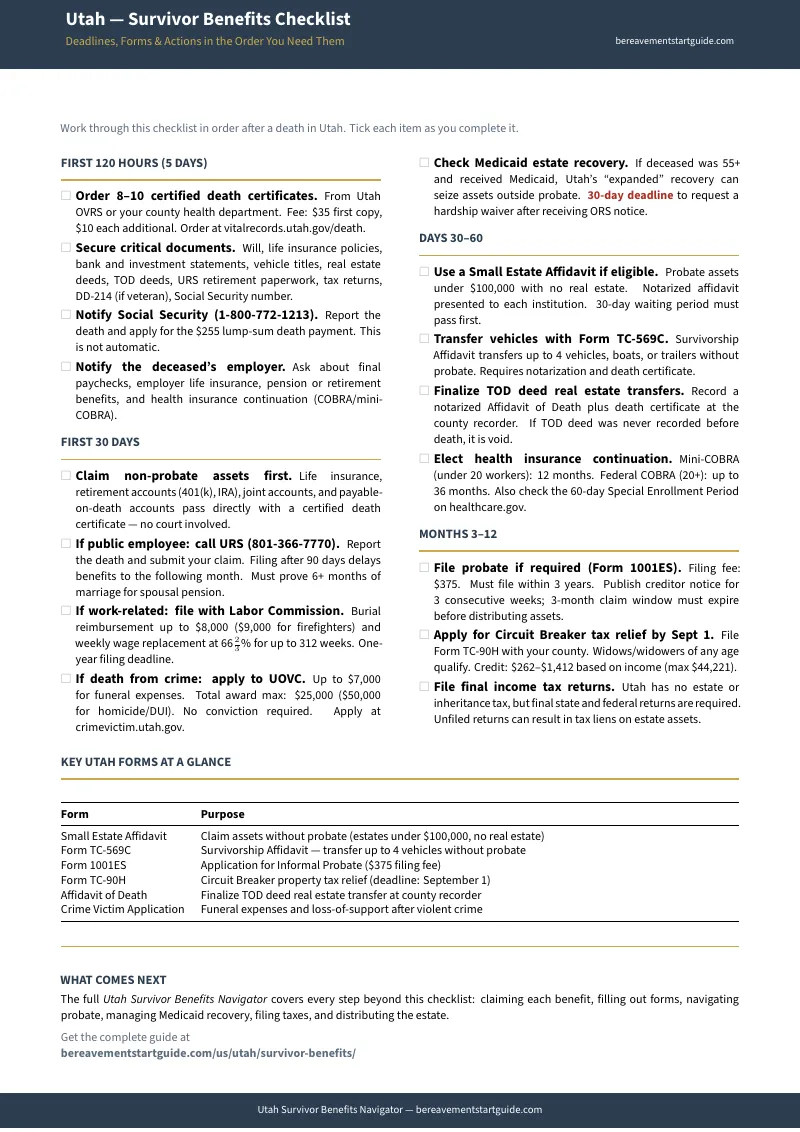
Standalone tools designed to be used independently: the Utah Survivor Benefits Quick-Start Checklist (every time-sensitive action organized by deadline from 120 hours through 1 year), the Agency Contact and Form Tracker (every form number, agency, phone number, and submission method in one table), and the Deadline Calendar (every filing window organized chronologically so you never miss a cutoff).
Who This Guide Is For
- The surviving spouse who just lost the household's primary income --- who needs to know whether the URS pension continues, how long health insurance lasts under mini-COBRA, whether the house qualifies for Circuit Breaker property tax relief, and how to collect frozen bank accounts without hiring a probate attorney. The guide maps the entire income replacement and benefit preservation sequence from the first phone call through monthly benefit activation.
- The adult child who just became an accidental executor --- who does not know the difference between informal and formal probate, has never heard of a Small Estate Affidavit, and needs to figure out whether the estate qualifies for the $100,000 threshold or requires a $375 court filing. The guide gives you the chronological action plan, the document checklist, and the cross-agency filing sequence so you can process everything systematically without paying a probate attorney to explain what you could have done yourself.
- The family of a public employee, teacher, or first responder --- who needs to file a URS death benefit claim within 90 days, prove the 6-month marriage requirement, understand the Tier 1 vs. Tier 2 calculation, and determine whether the deceased elected the Hybrid pension or the Defined Contribution plan. The guide covers every URS scenario and tells you exactly which forms to file with which office.
- The family worried about Medicaid estate recovery --- who needs to know that Utah's expanded protocol reaches assets outside probate, that the house in the living trust is not protected, that the TOD deed does not shield the property, and that the surviving spouse exemption blocks recovery entirely if it applies. The guide maps the Medicaid landscape so you know which assets are at risk and how to invoke the exemptions and hardship waivers that stop the lien.
- The family of a worker killed on the job --- who needs to file with the Utah Labor Commission within one year, claim up to $8,000 in burial expenses and 312 weeks of wage replacement, and understand why the firefighter burial cap differs from the standard cap. The guide covers the full workers' compensation death benefit process.
- The family of a crime victim --- who may not know that the Utah Office for Victims of Crime provides up to $25,000 in reparations ($50,000 for homicide or DUI) and up to $7,000 for funeral expenses, with no criminal conviction required. The guide covers the full UOVC application process and the documentation requirements.
Why Free Resources Leave Money on the Table
Survivor benefit information exists in Utah. It is spread across the Utah Retirement Systems in one set of forms, the district courts in another, the county auditor's office in a third, the Office of Recovery Services in a fourth, the Labor Commission in a fifth, the State Tax Commission in a sixth, and the Office for Victims of Crime in a seventh. Here is what happens when you try to navigate all of this yourself:
- The Utah Courts website provides self-help probate instructions. It does not mention URS pensions, property tax credits, workers' compensation death benefits, or Medicaid estate recovery. The courts handle estate administration, not benefit navigation. If you focus only on probate, you miss every benefit that has a shorter deadline and a higher dollar value than the estate itself.
- URS.org covers public pensions. It does not explain Small Estate Affidavits, property tax relief, or what happens when the Office of Recovery Services files a lien. URS is one agency with one mission. If you stop there, you miss everything else the family is owed from the county, the Labor Commission, and the courts.
- The county auditor's website lists the Circuit Breaker program. It does not tell you about the 6-month marriage rule for URS, the 30-day waiting period for Small Estate Affidavits, or the workers' compensation filing deadline. County offices handle property taxes. They will not tell you about the state agencies you should also be contacting.
- Utah.gov and benefits.gov provide broad overviews. They lack Utah-specific procedural details. They will not tell you about the expanded Medicaid recovery protocol, the $100,000 small estate threshold, the 120-hour probate waiting period, or the September 1 property tax deadline. When you need to file an actual claim in Utah, you need Utah statute numbers and Utah forms --- not a national overview.
- Hiring a Utah probate attorney for straightforward benefit claims costs $250 or more per hour. For a surviving spouse who needs to know which forms to file with which agencies in which order, a legal retainer is a disproportionate expense for what is fundamentally an organizational problem --- not a legal one.
Free resources give you one agency at a time, with no sequencing, no cross-referencing, and no way to know what you are missing. The Cross-Agency Roadmap maps every benefit to every situation, organizes every form by deadline, and tells you exactly which agencies to contact in which order --- so you can claim everything your family is owed without spending weeks navigating portals that were never designed to talk to each other.
--- Less Than One Hour of a Utah Probate Attorney's Time
Utah families leave thousands of dollars in unclaimed survivor benefits every year --- not because they are ineligible, but because no one told them the benefit existed. A surviving spouse does not file for the Circuit Breaker credit because the county auditor's website buried the application deadline. A URS pension survivor benefit gets delayed by a month because the family filed on day 91 instead of day 89. A Small Estate Affidavit goes unused because the family assumed the $100,000 threshold did not apply once there was a car to transfer --- not realizing the DMV has its own separate survivorship affidavit. A workers' compensation death benefit goes unfiled because the family assumed the employer would handle it. This guide costs less than any of those lost benefits and tells you where to find every one of them.
Your download includes 4 PDFs: the complete guide, the Utah Survivor Benefits Quick-Start Checklist, the Agency Contact and Form Tracker (every form number, agency, and submission method in one printable page), and the Deadline Calendar (every time-sensitive filing organized chronologically with a blank column for your actual dates). Print the ones you need. Use them independently or alongside the full guide.
Money-back guarantee, no time limit. If the guide does not give you a clear map of every survivor benefit available to your family, every form you need to file, and every deadline you need to meet --- email us for a full refund. No questions asked.
Not ready for the full guide? Download the free Utah Survivor Benefits Checklist --- a summary of the most time-sensitive actions, deadlines, and forms that most families do not discover until it is too late. Enough to start contacting the right agencies in the right order.
You did not plan for this. But you can plan what happens next. The guide gives you the benefits, the forms, the deadlines, and the filing sequence --- so the next six months are spent claiming what your family is owed, not discovering what you missed.