Someone You Love Just Died in Vermont. The Funeral Director Is Walking You Through Packages. You Have No Idea That Vermont Is One of a Handful of States Where Your Family Can Legally Handle Everything Without Hiring Them at All.
You are sitting in an arrangement room at a Vermont funeral home, and the director is presenting casket options, embalming services, and package pricing that starts at $6,000 and climbs from there. You are exhausted. You are grieving. And every item on the list sounds like something you are supposed to buy. What nobody in that room is going to tell you is this: Vermont is one of the few states in the country where families have the full legal authority to care for their own dead -- to wash and prepare the body, hold a home funeral, transport the remains in their own vehicle, and bury on private land -- all without a licensed funeral director involved at any point.
That is not a loophole. It is settled law, rooted in a 1973 Attorney General opinion that was codified into Vermont statute. Families have been doing it for decades. But unless you already know this, the funeral home has no obligation to mention it. And the information gap between what you know and what the funeral director knows is where the industry's margin lives.
Here is what else Vermont law says that the arrangement room will not volunteer: embalming is never required by state law. The 24-hour cremation waiting period is a statutory mandate, not a funeral home policy -- and it comes with a $25 Medical Examiner cremation certificate that the funeral home may roll into a larger fee without itemizing. The Preliminary Report of Death must be error-free with no cross-outs, or it gets rejected and everything downstream -- the death certificate, the burial transit permit, the cremation authorization -- stalls. And if you want to bury on your own land, Vermont allows it on lots of one acre or more, provided you meet specific setback rules: 150 feet from any body of water, 100 feet from a drilled well, 25 feet from a power line, and 50 feet from property boundaries.
The Vermont Funeral Laws & Consumer Rights Guide is a Consumer Shield System for every legal right, procedural requirement, and cost-avoidance strategy available to Vermont families arranging a funeral, cremation, home burial, green burial, or alternative disposition. Not a generic national overview. Not funeral home marketing dressed up as consumer advice. A structured, Vermont-specific manual that translates Title 18 (Health), Title 26 (Professions), the FTC Funeral Rule, Vermont Board of Funeral Service regulations, and the Office of Professional Regulation administrative rules into plain English -- so you know exactly what you must pay for, what you can legally refuse, and who holds the authority to make every decision.
What's Inside the Consumer Shield System
A comprehensive guide and the Vermont Funeral Consumer Rights Checklist -- covering every stage from the moment of death through final disposition, built specifically for Vermont statutes and the regulatory rules that make arranging a funeral here different from any other state:
Your Rights at the Funeral Home: The FTC Funeral Rule in Vermont
Federal law requires every Vermont funeral establishment to provide you a General Price List the moment you walk in or the moment you ask over the phone. You have the right to an itemized breakdown of every charge. You cannot be forced into a package deal. You cannot be charged a handling fee for bringing in a casket you purchased elsewhere. You have the absolute right to select only the services and merchandise you want -- and the funeral home must accommodate your choices without penalty. The guide walks you through every line item on a typical Vermont GPL, explains what each charge covers, identifies the items that carry the highest margins, and gives you the language to decline services you do not want. In a state where direct cremation prices range from $1,065 to $3,369, the difference between knowing your rights and not knowing them is often thousands of dollars.
Embalming: Vermont Does Not Require It
Vermont has no state law requiring embalming under any circumstance. That single fact is worth the price of this guide for most families, because the overwhelming majority of people sitting in a Vermont funeral home believe the opposite. What Vermont law does require: if the body is not embalmed, it must be refrigerated or held in a temperature-controlled environment. For families planning a home funeral -- which Vermont explicitly allows -- dry ice and proper cooling techniques are legal alternatives. The guide explains every scenario so you know when refrigeration or cooling is the straightforward, significantly cheaper path, and how to decline embalming with confidence.
The Disposition Hierarchy: Who Controls the Decisions
When family members disagree about burial versus cremation, which funeral home to use, or what kind of service to hold, Vermont law does not leave the answer to whoever argues loudest. 18 V.S.A. Section 5227 establishes a specific statutory hierarchy for who controls disposition decisions. An agent designated in an advance directive or a separate written disposition authorization holds the highest priority. After that comes the surviving spouse or civil union partner, then adult children, then parents, then siblings, down through the statutory chain. The guide maps the complete hierarchy, explains how to establish authority before a dispute escalates, and covers what happens when multiple people in the same class disagree or when no one in the hierarchy can be located.
Cremation: The 24-Hour Wait, the ME Certificate, and the Authorization Chain
Vermont imposes a mandatory 24-hour waiting period between death and cremation. During that window, the Medical Examiner must issue a cremation certificate -- which carries a $25 fee. The authorization to cremate follows the disposition hierarchy under 18 V.S.A. Section 5227, but with an additional layer: the authorizing agent must sign a cremation authorization form, and the Medical Examiner must confirm that no investigation is pending. The guide covers the full authorization process, how the 24-hour clock interacts with weekends, what happens when the ME flags a death for further review, and how to ensure the $25 cremation certificate fee is itemized separately on your funeral home bill rather than buried in a larger service charge.
Home Burial: The Exact Rules for Private Family Burial Grounds
Vermont law permits families to establish Private Family Burial Grounds on privately owned land, provided the lot is at least one acre. The setback requirements are specific: 150 feet from any body of water, 100 feet from a drilled well, 25 feet from a power line, and 50 feet from property boundaries. The burial ground must be filed with the town clerk. There is no requirement to hire a funeral director for a home burial -- the family can prepare the body, conduct the service, and complete the interment themselves. But the filing requirements with the town, the burial transit permit from the town clerk, and the notification obligations are procedural steps that families often miss. The guide walks through every step from selecting the site through recording the burial, with the specific Vermont forms and contacts you need.
Transporting Remains: Your Legal Right to Do It Yourself
Vermont families have the legal right to transport their own dead. You are not required to hire a funeral director or a commercial transport service. What you do need: a burial transit permit issued by the town clerk of the town where the death occurred, which must be obtained before the body is moved from the place of death to the place of disposition. Failure to obtain the permit carries a civil penalty of up to $1,000 under 18 V.S.A. Section 5211. The guide covers the permit process, the documentation required, the rules for transporting across state lines, and the practical logistics that no government website explains -- including vehicle requirements and how to handle situations where the death occurs on a weekend and the town clerk's office is closed.
Green Burial, Aquamation, and Human Composting
Vermont is one of the most legally progressive states for alternative disposition. Alkaline hydrolysis (aquamation) was legalized in 2014 under 26 V.S.A. Section 1211, though no providers currently operate in-state -- meaning families pursuing this option need to arrange transport to a facility in a neighboring state. Human composting (natural organic reduction) was legalized in 2023, making Vermont one of fewer than ten states to permit this process. Green burial without embalming, without a vault, and without a conventional casket is fully legal. The guide covers the regulatory status of each option, the practical availability, the transport requirements for out-of-state aquamation, the emerging human composting providers, and the rules for scattering cremated remains on public and private land -- including the landowner permission requirements that most families do not think to secure in advance.
Act 39: Medical Aid in Dying and the COLST Form
Vermont's Patient Choice and Control at End of Life Act (Act 39) allows terminally ill adults with six months or fewer to live to request medication to end their life. The law imposes strict procedural timelines: two oral requests separated by at least 15 days, a written request signed by two witnesses (one of whom cannot be a relative, heir, or attending physician), and confirmation from two physicians. The COLST form (Clinician Orders for Life-Sustaining Treatment) is Vermont's version of the POLST -- a portable medical order that travels with the patient and directs emergency responders on resuscitation, intubation, and comfort care preferences. The guide covers the Act 39 timeline and eligibility requirements, the COLST form and how it differs from an advance directive, and the intersection between end-of-life planning and funeral pre-arrangement.
Preneed Contracts: What Vermont Law Requires
If the deceased purchased a prepaid funeral contract, or if you are considering purchasing one for pre-planning purposes, Vermont's preneed regulations provide specific consumer protections. Preneed contract funds must be placed in trust, and the contract terms are subject to oversight by the Office of Professional Regulation. The guide explains how to verify that preneed trust funds are properly deposited, what to do if you want to transfer the contract to a different funeral home, the cancellation and refund rules, and how preneed contracts interact with Medicaid eligibility -- including the $10,000 maximum irrevocable burial trust that Vermont Medicaid recognizes as an exempt asset.
Filing Complaints: When Your Rights Are Violated
If a funeral home refused to provide a General Price List, pressured you into purchasing services you did not want, misrepresented state law to sell embalming or a vault, or failed to honor a preneed contract, you have the right to file a formal complaint. Vermont funeral service professionals are regulated by the Office of Professional Regulation (OPR) and the Board of Funeral Service. The guide provides the direct contact information for both agencies, explains the investigation process, walks you through the complaint filing step by step, and covers the parallel federal FTC complaint path for violations of the Funeral Rule. It also explains the $1,000 civil penalty under 18 V.S.A. Section 5211 for burial transit permit violations -- a provision that can work in your favor if a funeral home transported a body without proper documentation.
Death Certificates and the EDRS: Getting It Right the First Time
Vermont uses the Electronic Death Registration System (EDRS) for filing death certificates. When a family acts as its own funeral director -- which Vermont law allows -- the family is responsible for navigating the EDRS and completing the Preliminary Report of Death (PROD). The PROD must be error-free: no cross-outs, no corrections, no white-out. A rejected PROD delays the death certificate, which delays the burial transit permit, which delays every downstream action -- insurance claims, bank account access, probate filing, Social Security notification. The guide explains the EDRS workflow for families acting without a funeral director, the PROD completion requirements, the number of certified copies to order based on the deceased's financial accounts and property holdings, and the fee schedule for additional copies from the Vermont Department of Health.
The Medicaid Shield: Protecting Assets from Vermont Estate Recovery
If the deceased received Medicaid benefits after age 55, the state will pursue estate recovery against the probate estate. But Vermont recognizes an irrevocable burial trust of up to $10,000 as an exempt asset for Medicaid eligibility purposes -- meaning families who pre-fund funeral expenses in a properly structured trust can protect those funds from both Medicaid spend-down and post-death recovery. The primary home is also exempt up to $730,000 in equity during the Medicaid recipient's lifetime. The guide explains how irrevocable burial trusts work, the $10,000 cap, the home equity exemption, how Transfer-on-Death deeds and beneficiary designations can move assets outside of probate to reduce the recovery pool, and the specific circumstances under which Vermont delays or waives estate recovery.
DCF Burial Assistance: The $1,100 Maximum
Vermont's Department for Children and Families provides burial assistance for families who cannot afford funeral costs, with a maximum benefit of $1,100. The application process, income eligibility requirements, and documentation needed are not clearly explained on any single state website. The guide covers the full application process, the eligibility criteria, what the $1,100 covers and does not cover, and how to combine DCF assistance with other funding sources -- including veterans burial benefits, Social Security's $255 lump-sum death payment, and crowdfunding -- to close the gap between the assistance amount and the actual cost of even the most basic disposition.
Vermont Estate Tax: The $5 Million Threshold and No Spousal Portability
Vermont imposes its own estate tax with a $5 million exemption threshold and a flat 16% rate on the taxable amount above that threshold. Unlike the federal estate tax, Vermont does not offer spousal portability of the unused exemption -- meaning a surviving spouse cannot claim the deceased spouse's unused $5 million exemption to shelter more of their own estate later. For families with combined assets near or above $5 million, this is a planning gap that creates real tax exposure. The guide explains the Vermont estate tax calculation, the filing deadline, the interaction with the federal estate tax, and why the absence of portability makes pre-death planning significantly more important in Vermont than in states that follow the federal portability rule.
Who This Guide Is For
- The family sitting in the arrangement room right now who needs to know -- before signing anything -- which charges on the funeral home contract are legally required, which are optional, and which are cemetery policies being presented as state law
- The family who wants to care for their own dead at home and needs to know that Vermont is one of the few states where this is fully legal without a funeral director -- and exactly how to navigate the EDRS, the PROD, the burial transit permit, and the Private Family Burial Ground filing to do it properly
- The surviving spouse or adult child who was just told embalming is required and needs to know that Vermont has no embalming requirement under any circumstance -- and that refrigeration and dry ice are legal alternatives
- The family fighting over burial versus cremation who needs to know exactly who holds legal authority under 18 V.S.A. Section 5227, and whether the deceased's advance directive or written disposition authorization supersedes everyone else's opinion
- The executor dealing with a $5 million-plus estate who needs to understand Vermont's flat 16% estate tax, the absence of spousal portability, and how this interacts with federal estate tax planning
- The family interested in green burial, aquamation, or human composting who wants confirmation that Vermont law permits these options and needs to know the practical details -- including the fact that aquamation is legal but no Vermont provider currently operates, and human composting was only legalized in 2023
- The adult child protecting a parent's Medicaid eligibility who needs to understand the $10,000 irrevocable burial trust exemption, the $730,000 home equity threshold, and how to structure assets before they become countable
- The proactive planner who watched a family member get overcharged at a funeral and is determined to document their own wishes, complete a COLST form, and understand their Act 39 rights before it is too late
Why Free Resources Will Not Get You Through This
The information exists. It is scattered across Vermont state agency websites, town clerk offices, federal FTC guidance pages, and funeral home content that was written to sell services. Here is what you actually encounter when you try to navigate Vermont funeral law using free sources alone:
- Vermont state websites give you the statutes and nothing else. Title 18 and Title 26 of the Vermont Statutes Annotated are publicly available. They are also written in dense legalese, spread across multiple chapters, and cross-referenced in ways that require legal training to follow. Understanding how 18 V.S.A. Section 5227 (disposition hierarchy) interacts with 18 V.S.A. Section 5211 (burial transit permits) and the Board of Funeral Service rules governing the EDRS requires connecting dots that no single state webpage connects for you.
- Funeral homes explain the process in a way that sells their services. Vermont funeral home websites offer helpful-sounding content about cremation options, memorial services, and pre-planning. They rarely mention that families have the legal right to handle everything themselves without a funeral director. They will not tell you that embalming is never legally required. The advice consistently steers families toward purchasing the maximum number of commercial services.
- The FCA-VT provides biennial price surveys but not legal guidance. The Funeral Consumers Alliance of Vermont publishes valuable price comparison data across Vermont funeral homes. But a price survey is not a legal guide. It does not explain the PROD requirements, the EDRS workflow for families acting without a funeral director, the disposition hierarchy when siblings disagree, or the Medicaid burial trust rules. It tells you what things cost -- not what you are legally required to buy.
- National consumer advocacy sites miss Vermont-specific details. Nolo.com and national funeral consumer websites cover funeral law in general terms. They do not explain Vermont's unique family-directed funeral rights, the 1973 AG opinion, the specific Private Family Burial Ground setback rules, the PROD error-free requirement, the $25 ME cremation certificate, the fact that aquamation is legal but unavailable in-state, or that human composting was just legalized in 2023. Vermont is not a footnote -- it is a state with some of the most consumer-friendly funeral laws in the country, and generic content misses the details that matter most.
- Elder law attorneys charge for knowledge you can have for a fraction of the cost. Vermont elder law and estate planning attorneys are accurate on the legal details -- and their billing rates start at $250 per hour. For contested estates and complex Medicaid planning, legal representation is essential. For the family that simply needs to understand their rights before walking into a funeral home, the answer costs less than a single billable hour.
Free resources give you fragments from a dozen sources that do not reference each other. The Consumer Shield System puts every Vermont-specific statute, regulation, consumer right, and procedural step into one document, in the order you actually need them.
-- Less Than Twenty Minutes With a Vermont Attorney
A single consultation with a Vermont elder law or estate planning attorney costs $250 to $350 per hour. Funeral home upsells on services you are not legally required to purchase can add thousands to the final bill. This guide costs less than twenty minutes of professional legal time and gives you the complete Vermont-specific consumer protection toolkit -- every statute, every regulation, every right, every deadline, and the negotiation framework that tells you exactly what you can refuse.
Your download includes 8 PDFs -- instant download, no account required:
- The complete guide covering Vermont funeral law, consumer rights, family-directed funeral procedures, and asset protection strategies
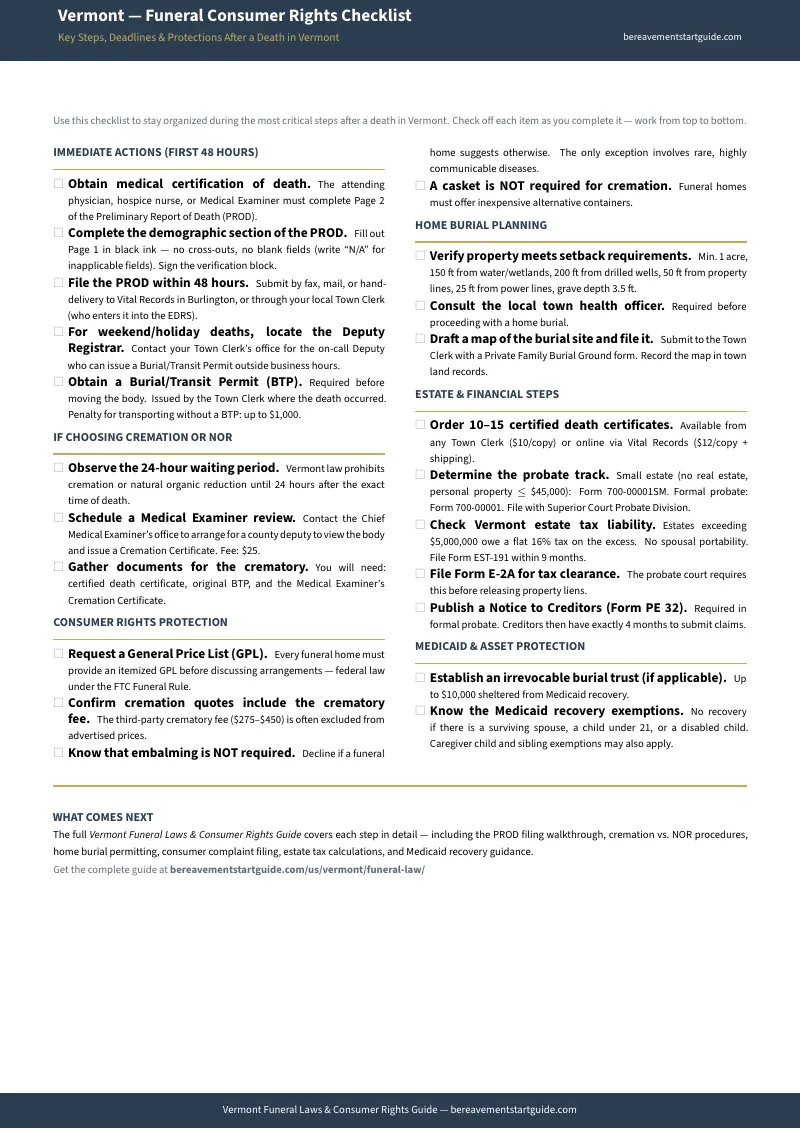
- Vermont Funeral Consumer Rights Checklist -- the critical actions, deadlines, and rights on one printable page
- FTC Compliance Checklist -- every itemized-pricing right and the language to exercise them at the funeral home
- Disposition Authority Reference Card -- the full 18 V.S.A. Section 5227 hierarchy and the advance directive priority rule
- Embalming Decision Table -- confirmation that Vermont never requires embalming, with the refrigeration and cooling alternatives for every scenario
- Cremation Authorization Checklist -- the 24-hour wait, the $25 ME certificate, the authorization hierarchy, and required forms
- Post-Death Administration Timeline -- every deadline from hours 1-24 through months 2-6 on one printable page
- Forms and Agencies Reference Card -- every form number, agency contact, and filing fee in one place
Money-back guarantee, no time limit. If the guide does not give you clarity on your rights and confidence that you are making informed decisions, email us for a full refund. No questions asked.
Not ready for the full guide? Download the free Vermont Funeral Consumer Rights Checklist -- the critical actions, deadlines, and rights you need to know before signing any funeral home contract. It covers your FTC rights, the embalming truth, the cremation waiting period, the disposition hierarchy, and the items you can legally decline. Enough to walk into the arrangement room tonight with confidence.
Nobody should have to negotiate their rights while they are grieving. The guide makes sure you do not have to.