
The Deadline Defense System — Every Vermont Benefit You're Owed, Every Clock That's Running
Your spouse died. The pension check stopped. The bank wants a death certificate recorded at the town clerk's office before they'll acknowledge your name on the joint account. The health insurance letter says coverage ends in 60 days. The Department of Taxes mailed a property tax credit form addressed to someone who no longer exists.
And nobody — not the funeral home, not the Social Security office, not the Probate Court — handed you a list of what you're owed.
That's because Vermont doesn't coordinate survivor benefits. They're scattered across the State Retirement Office (VSERS, VSTRS, VMERS), the Department of Taxes, the Probate Division of the Superior Court, 246 individual town clerks, the Department of Labor, the Department for Children and Families, and the Center for Crime Victim Services. Each agency expects you to find them, file their specific forms, and meet their specific deadlines — while you're grieving. And several of those deadlines start counting the moment the death certificate is signed, whether you know about them or not.
The Vermont Survivor Benefits Navigator is the sequenced action plan that replaces dozens of confusing government websites with one chronological roadmap. Every benefit you might qualify for. Every form number. Every deadline that costs money if missed. Every exemption that protects the family home.
— Less Than Six Minutes of Attorney Time
Vermont probate attorneys charge $282 per hour on average, with specialized estate work running $300–$800 per hour. This guide is your Attorney Prep-Kit: it organizes your documents, identifies every benefit you qualify for, and answers the baseline administrative questions — so if you do hire a lawyer, you spend their time on strategy, not on explaining what a small estate petition is or how the four-month creditor deadline works.
What's Inside
The 72-Hour Emergency Stabilizer
Exactly what to do (and what NOT to do) in the first three days: check the Vermont Advance Directive Registry for COLST orders before calling emergency services, order 10–15 certified death certificates from any Town Clerk at $10 per copy, secure the original will, and notify the Social Security Administration. Includes the emergency funding triage — workers' comp death benefits up to $10,000 for burial, CCVS crime victim compensation up to $7,000, and DCF General Assistance up to $1,100 paid directly to the funeral provider.
The Probate Pathfinder
Two distinct Vermont probate paths — and choosing the wrong one wastes months and hundreds in unnecessary filing fees. The Small Estate Petition for estates valued at $45,000 or less with no real estate beyond a timeshare — filing fee $50–$110, no formal administration required. And Formal Probate for larger estates, filed through Odyssey File & Serve (OFS) with filing fees up to $1,000. Each path explained with eligibility rules, the 30-day will delivery deadline, and the critical difference between e-filing petitions and hand-delivering the physical original will.
The Creditor Firewall
How publishing the Notice to Creditors (Form PE32) starts the four-month clock that permanently bars all unfiled claims — including Medicaid estate recovery. Why you must never pay claims out of Vermont's statutory priority order, and how doing so creates personal liability for the executor. The 60-day claim response window explained step by step.
The Pension Decoder (VSERS/VSTRS/VMERS)
If the deceased was a Vermont state employee, teacher, or municipal worker: how to file the notarized Retirement Beneficiary Form, understand the difference between 100%, 70%, and 50% survivorship payouts, and navigate the "Pop-Up" provision that reverts benefits to maximum if the beneficiary predeceases the retiree. Why the Level Income Option creates unpredictable cash flow when Social Security kicks in at 62 — and how your survivorship election interacts with it.
The Vehicle Transfer Shortcut
Vermont's Transfer on Death (TOD) designation lets you skip probate entirely with Form VT-007 and a death certificate. No TOD? The Surviving Spouse Exception uses Form VD-119 to transfer vehicles without probate letters — and exempts the first two vehicles from Purchase and Use Tax. Step-by-step instructions for both paths, plus the trailer transfer rules most survivors miss.
Workers' Comp and Crime Victim Benefits
Workers' compensation death benefits pay 66.67% of the deceased's average weekly wage (76.67% with two or more dependent children), capped at $1,836 per week, for a minimum of 330 weeks — plus up to $10,000 for burial and $5,000 for out-of-state transportation. Crime Victims' Compensation covers up to $7,000 for funeral costs, plus $500 in miscellaneous expenses and $2,000 for headstones and memorial items. Both programs explained with filing requirements and subrogation rules.
The Health Insurance Decision Guide
Three paths to continuing coverage after a spouse dies — federal COBRA, the Vermont Health Connect marketplace Special Enrollment Period (60-day window), or continuation through the state retirement system for public employee dependents. How to compare costs before the enrollment deadline passes.
The Property Tax Protection Module
How the Homestead Declaration works after death, why filing Form HS-122W prevents a state clawback if the homeowner died before April 1, and how surviving spouses maintain the homestead classification. Plus the Disabled Veteran Property Tax Exemption — $10,000 minimum on the assessed grand list value, which towns may vote to increase up to $40,000. The May 1 filing deadline for the VA Summary of Benefits Letter that most veteran families miss.
The Medicaid Estate Recovery (MERP) Defense
If the deceased was 55+ and received Medicaid-funded long-term care, the Department of Vermont Health Access may file a claim against the probate estate. But recovery is entirely blocked if there's a surviving spouse, a child under 21, or a blind or disabled child. The two-year caregiver exemption for children who lived in the home. How to file DVHA hardship waiver Forms 13, 14, and 15 before the four-month creditor deadline — miss it and the exemption is permanently forfeited.
The Estate Tax and Act 39 Module
Vermont's $5 million estate tax exemption with a flat 16% rate on the excess — and why Vermont has no portability, meaning a poorly structured estate plan permanently loses the deceased spouse's $5 million shelter. Form EST-191 filing within 9 months. Plus the Act 39 (Medical Aid in Dying) protection: Vermont law explicitly states that deaths under Act 39 are not suicide — life insurance payouts are protected and cannot be denied under suicide exclusion clauses.
The Elective Share Safety Net
A surviving spouse can reject the will and claim a one-half share of the estate, plus a homestead interest valued up to $125,000. But the window is only four months from the date of service of the notice of rights or the inventory. Miss it and the right is gone permanently. How to evaluate whether electing against the will protects your financial future.
Who This Guide Is For
- Surviving spouses trying to claim every benefit before the deadlines pass — and protect the family home from creditors and Medicaid recovery
- Adult children serving as executor who need to secure benefits for a surviving parent while managing Vermont's probate system, town clerk requirements, and state agency filings
- Families of state employees, teachers, and municipal workers navigating VSERS, VSTRS, and VMERS survivor pensions and the irrevocable payout elections
- Families of workers killed on the job filing for workers' comp death benefits, the $10,000 burial benefit, and the $5,000 transportation reimbursement
- Families of crime victims claiming CCVS funeral compensation up to $7,000
- Out-of-state executors managing a Vermont estate remotely through the Odyssey e-filing system
Why Not Just Use Government Websites?
You can. Every form, statute, and eligibility rule in this guide exists somewhere on ssa.gov, vermonttreasurer.gov, tax.vermont.gov, vtcourts.gov, and 246 individual town clerk websites. That's the problem — "somewhere" across dozens of dense, uncoordinated government pages written in statutory language, with no chronological sequencing and no explanation of how one agency's requirements interact with another's.
Government websites are legally prohibited from giving you advice. They'll provide a blank form but won't tell you what to do first, second, or third. The state gives you the puzzle pieces. This guide gives you the picture on the box — and tells you which piece to place first.
What You Get
- The Complete Navigator — 19 chapters covering every benefit, exemption, and administrative process, organized in the order you need to act
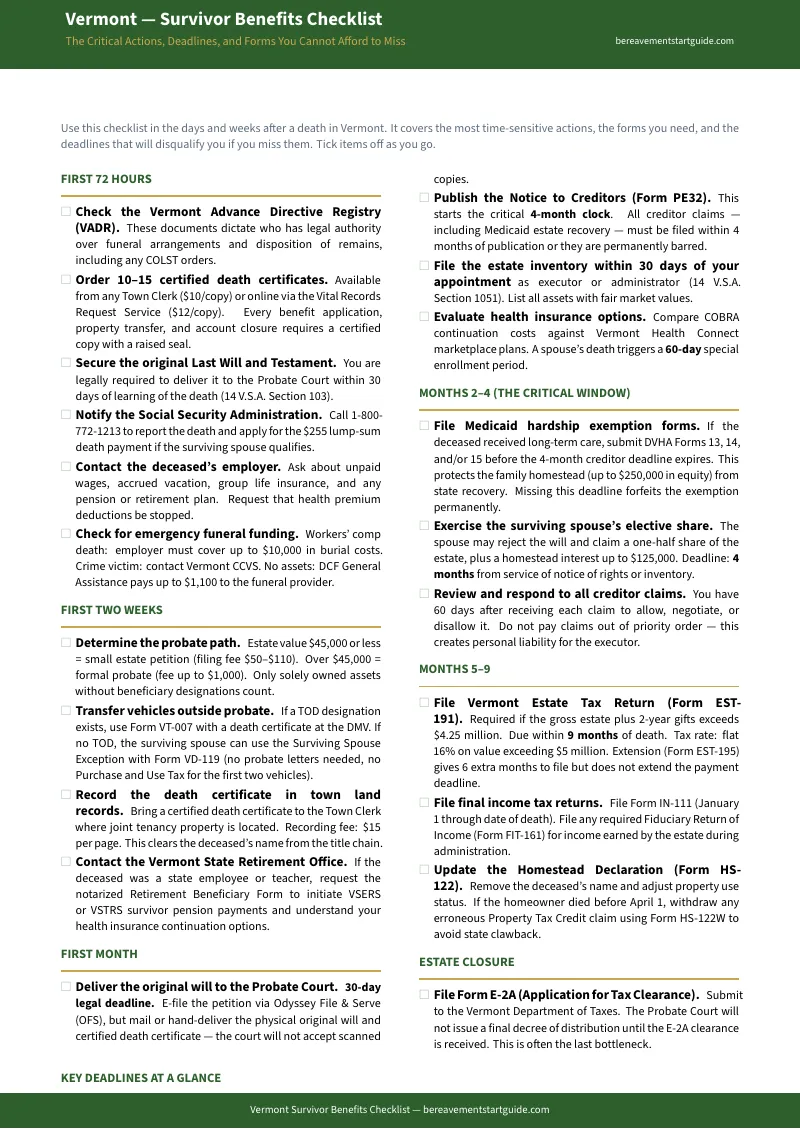
- Quick Start Checklist — the 21 most critical actions across 6 timeline groups, in the exact order you need to take them
- Deadline Map (standalone printable) — every statutory deadline from 72 hours to 9 months, with the form number and consequences of missing each one
- Official Forms Directory (standalone printable) — every Vermont form referenced in the guide with the issuing agency and where to file
- Agency Contacts Sheet (standalone printable) — every state agency, retirement board, and key filing location on one reference sheet
Satisfaction Guarantee
If the Navigator doesn't save you time, confusion, or money — email [email protected] and we'll make it right. No questions, no hassle.
Start Protecting Your Family's Benefits
Download the free Vermont Survivor Benefits Checklist for the 21 most critical actions — or get the complete Navigator with full step-by-step instructions, pension decoder, MERP defense strategies, property tax protection, Act 39 guidance, and every form walkthrough.