The Funeral Director Handed You a Package Deal for $12,000 and Said Embalming Is Required. It Is Not. Virginia Law Gives You the Right to Refuse -- but Only If You Know the Statute Number Before You Walk Through the Door.
Your mother died this morning and the funeral home is already asking questions you cannot answer. Do you want embalming? Do you want a metal casket or a wooden one? Do you want the "complete care package" or the "traditional service"? None of these are legal requirements. But the funeral director is not going to tell you that. They are going to hand you a bundled price list that buries the legally required itemized General Price List behind a glossy brochure. They are going to tell you that embalming is "standard procedure" without mentioning that Virginia Code section 54.1-2811.1 makes it illegal to embalm without your express written permission. They are going to quote you $1,200 for a casket you could purchase independently for $400. And you are going to pay it -- because you are grieving, you are exhausted, and you do not know what Virginia law actually requires.
The Virginia Funeral Laws & Consumer Rights Guide is your Consumer Protection Roadmap for every decision, deadline, and legal right that applies when someone dies in Virginia. Not a generic overview of national funeral practices. Not an attorney blog post that explains how complicated everything is and then asks you to book a consultation. A Virginia-specific manual that gives you the exact statutes, the exact rights, and the exact words to say when a funeral director tries to sell you services you do not need and Virginia law does not require.
What's Inside the Consumer Protection Roadmap
A chronological guide, a consumer rights checklist, and statutory reference sheets -- covering every phase of funeral planning and disposition in Virginia, built on Title 54.1 Chapter 28 of the Code of Virginia and the federal FTC Funeral Rule:
The First 48 Hours: What Virginia Law Actually Requires
Virginia has a strict rule that most families do not know about until after they have already been pressured into a decision: if burial or cremation does not occur within 48 hours of death, the body must be either embalmed or refrigerated. That is the law. But what the funeral home will not tell you is that refrigeration satisfies the requirement just as well as embalming -- and refrigeration costs a fraction of the price. The guide covers the 48-hour rule, the 24-hour physician signature requirement for death certificates, the 72-hour filing deadline through Virginia's Electronic Death Registration System, and the exact sequence of calls you need to make in the first two days so you are not making decisions under pressure at a funeral home conference table.
Your FTC Funeral Rule Rights: The Federal Law That Overrides the Sales Pitch
The Federal Trade Commission's Funeral Rule applies to every funeral provider in Virginia. It requires them to give you an itemized General Price List before you discuss arrangements in person. It requires them to give you accurate prices over the phone. It prohibits them from telling you that embalming is required by law when it is not. It prohibits them from refusing to handle a casket you purchased from an outside vendor. And it gives you the right to buy services individually rather than in bundled packages. Most families do not know these rights exist. The guide breaks down every protection the Funeral Rule provides, with the exact language you can use when a funeral director claims these protections do not apply.
Disposition Rights: Who Decides, and How to Prevent a Family Fight
Virginia Code section 54.1-2807.01 establishes a strict legal hierarchy for who holds the right to control final disposition. A signed, notarized designation form under section 54.1-2825 overrides everything -- spouse, children, parents, all of it. Without that document, the hierarchy follows Virginia's statutory order. When family members disagree and no designation exists, the funeral home is required to wait 30 days before proceeding without a court order or unanimous family agreement. The guide includes the full statutory hierarchy, explains the designation process, and covers the 30-day dispute waiting period so you understand exactly who has legal authority and how to establish it before a disagreement delays everything.
Cremation: The Approvals, Fees, and Rules They May Not Mention
Virginia requires a medical examiner to view the body and issue a cremation permit before any cremation can proceed. The standard state fee is $50. Pacemakers and other implanted devices must be removed before cremation. And here is the rule that saves families money: under Virginia administrative code 18VAC65-20-436, funeral homes and crematories cannot legally require human remains to be placed in a casket before cremation. An alternative container -- a simple cardboard or fiberboard box -- satisfies the legal requirement. The guide covers every step of the cremation authorization process, the mandatory waiting period, what the medical examiner fee actually covers, and how to decline a casket purchase for cremation.
Home Burial, Green Burial, and Non-Traditional Disposition
Virginia families retain the legal right to care for their own dead without hiring a funeral director. There is no state statute prohibiting home burial on private property. Family cemeteries where no graves are sold to the public are exempt from Cemetery Board regulation. The guide covers the practical requirements for establishing a family cemetery -- recording the burial site with the property deed, maintaining appropriate depth, distance requirements from water supplies and power lines -- and the legal status of green burial, shroud burial, and alternative containers. It also addresses alkaline hydrolysis directly: despite some tracking sites listing Virginia as "pending," HB 52 was defeated 6-32 in the Virginia Senate in 2024, making the practice currently illegal in the Commonwealth. Families seeking aquamation must transport remains to a legal jurisdiction like West Virginia or Maryland.
Preneed Contracts: The 2026 Rule Change That Caps What They Can Charge You
If you are planning ahead and considering a preneed funeral contract, Virginia law requires 100 percent of funds to be placed in trust for non-guaranteed contracts and 90 percent for guaranteed contracts. You have a 30-day cancellation period with a full refund. And as of June 15, 2026, emergency regulations mandated by SB 989 cap the declinable preneed funeral guarantee fee at 25 percent of the total contract price. Before these regulations, some providers charged guarantee fees that consumed a significant portion of the prepaid amount. The guide explains the difference between guaranteed and non-guaranteed contracts, the new 2026 fee cap, the trusting requirements, and how to evaluate whether a preneed contract is worth signing.
Filing Complaints: What Constitutes a Violation and Where to Report It
If a funeral director embalmed without your consent, refused to provide an itemized price list, failed to refrigerate remains at the required 40 degrees Fahrenheit or below, or pressured you into purchasing services you did not want, those are statutory violations. The Virginia Board of Funeral Directors and Embalmers investigates complaints under Title 54.1 Chapter 28 of the Code of Virginia. The FTC enforces the Funeral Rule separately. The guide provides the exact statutory codes for common violations, the complaint filing process for both the Virginia Board and the FTC, and the documentation you need to submit a complaint that gets taken seriously.
Who This Guide Is For
- The family member who just received a funeral home price list and something feels wrong -- who needs to know which charges are legally required, which are optional, and what the funeral director is prohibited from telling you is mandatory when Virginia law says otherwise
- The executor handling funeral arrangements while simultaneously managing estate administration -- who needs the funeral consumer rights checklist alongside the estate settlement timeline so nothing falls through the cracks in the first 72 hours
- The family planning ahead who wants to lock in costs without getting trapped -- who needs to understand the new 2026 preneed guarantee fee cap under SB 989 and the trusting requirements before signing a contract that may not protect their money the way the provider claims
- The family choosing cremation, home burial, or green burial -- who needs definitive answers on what Virginia law permits, what it prohibits, and what funeral homes claim is required but legally is not
- The person designated to control disposition who faces pushback from other family members -- who needs the exact statutory hierarchy under section 54.1-2807.01 and the designation form requirements under section 54.1-2825 to establish their legal authority before a 30-day delay derails the process
- The out-of-state family member coordinating a Virginia funeral remotely -- who cannot walk into the funeral home and negotiate in person, and needs every right, every price comparison tool, and every statutory citation in one document so they can advocate effectively over the phone
Why Free Resources Will Not Protect You at the Funeral Home
Virginia funeral law information exists online. It is scattered across the Virginia Legislature's website in dense statutory language, consumer advocacy pages that have not been updated since before the 2026 preneed fee regulations, attorney blogs that explain your rights and then invite you to schedule a $300-per-hour consultation, and national legal aggregators that treat Virginia like every other state. Here is what you actually encounter when you try to protect yourself using free sources:
- The Virginia Code is public -- but reading Title 54.1 Chapter 28 without legal training is like reading a technical manual in a foreign language. The statutes tell you what is prohibited. They do not tell you what to say to the funeral director who is violating them. They do not give you the words to use when someone tells you embalming is "required by the facility" or that a casket is "necessary for cremation."
- National sites like Nolo and FindLaw provide generic state overviews that miss Virginia-specific details. They do not cover the 30-day disposition dispute waiting period. They do not mention the 2026 preneed guarantee fee cap. They do not explain that Virginia families can legally handle their own funeral without hiring a director. Their pages are national content with the state name swapped in.
- The Funeral Consumers Alliance provides excellent advocacy but fragmented, undated resources. Content is scattered across static PDFs and chapter websites that may not reflect the most recent Virginia legislative changes. There is no single, sequenced document covering your rights from the moment of death through final disposition.
- Local elder law attorney blogs are accurate -- and designed to convert you into a paying client. They explain how complex funeral consumer rights are. They detail the risks of making mistakes. And every post ends with a consultation invitation. For contested cases involving fraud or gross misconduct, legal counsel is appropriate. For the family that simply needs to understand their rights before walking into a funeral home, those blog posts never quite tell you that you can handle this yourself.
Free resources give you fragments. Fragments do not protect you when a funeral director is sitting across the table with a bundled price list and your family is grieving. The Consumer Protection Roadmap puts every Virginia statute, every FTC protection, and every negotiation script into one document, in the order you need them.
-- Less Than the Markup on a Single Casket Upgrade
The average casket markup at a Virginia funeral home ranges from 200 to 500 percent. A single unnecessary add-on -- embalming you did not authorize, a vault the cemetery requires but Virginia law does not, a "complete care package" that bundles services you could purchase separately for less -- can cost your family hundreds or thousands of dollars. This guide costs less than one unnecessary funeral charge and gives you the complete Virginia-specific consumer protection roadmap: every legal right, every statutory citation, every deadline, and the exact language to use when someone tells you that something is "required" and it is not.
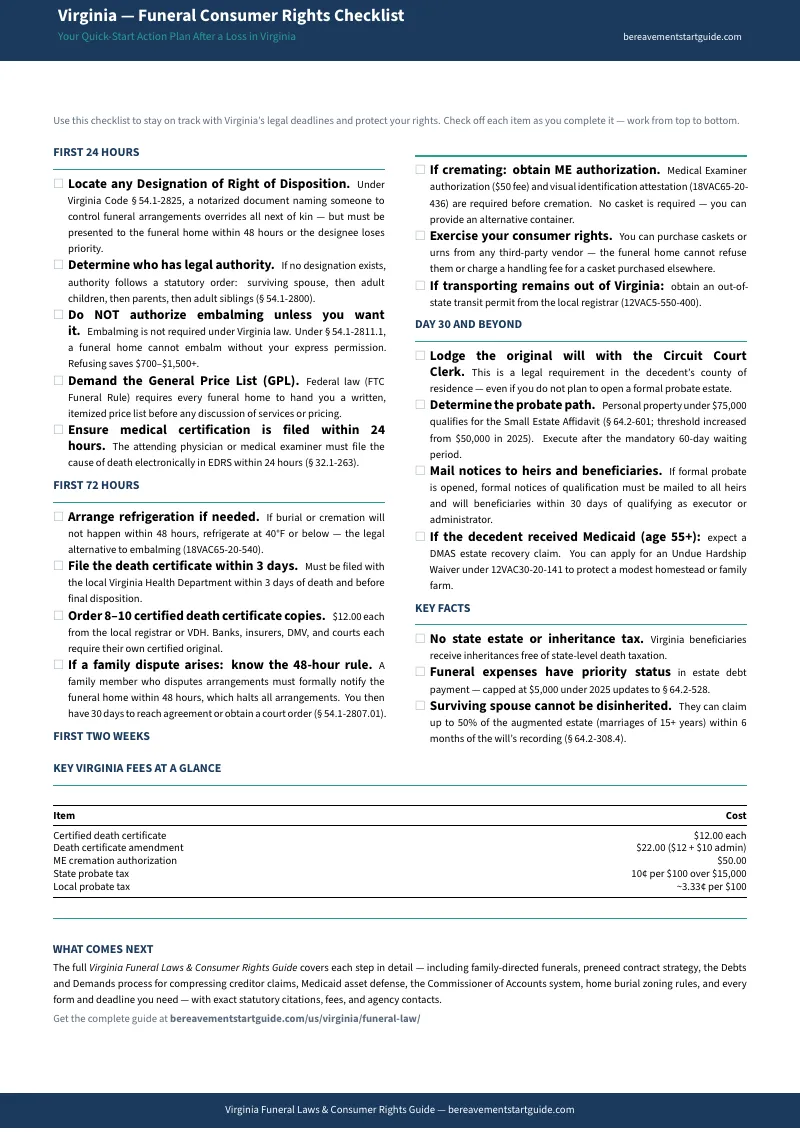
Your download includes 8 PDFs: the complete step-by-step guide covering death certificates, embalming rights, cremation authorization, burial options, preneed contracts, and the FTC Funeral Rule, plus 7 standalone printables -- the Funeral Consumer Rights Checklist (20 action items by timeline), FTC Funeral Rule Reference Card, Embalming Rights Reference Card, Cremation Authorization Checklist, Disposition Rights Hierarchy, Preneed Contract Evaluation Reference, and a Funeral Home Price Comparison Worksheet you can print and bring to three providers. Instant download, no account required.
Money-back guarantee, no time limit. If the guide does not give you clarity on your rights, the statutes that protect you, and what to say when those rights are challenged -- email us for a full refund. No questions asked.
Not ready for the full guide? Download the free Virginia -- Funeral Consumer Rights Checklist -- a summary of the key rights, deadlines, and decisions you need to know before making any funeral arrangements. Enough to walk into a funeral home prepared instead of overwhelmed.
You should not have to hire an attorney to understand your rights at a funeral home. This guide makes sure you do not have to.