The Court Clerk Handed You a Stack of Blank Forms and Said She Cannot Tell You How to Fill Them Out. The Commissioner of Accounts Will Audit Everything You File. And If You Pay the Wrong Creditor First, the Money Comes Out of Your Own Pocket.
You went to the bank with the death certificate and the original will, and they told you the account is locked until you produce a Certificate of Qualification. You drove to the Circuit Court Clerk's office, and they gave you a stack of forms and told you they are prohibited by law from giving you legal advice. They cannot tell you what to write on Form CC-1670, how to value the house, or whether the estate qualifies for the Small Estate Act. You went home and searched "Virginia probate process" and found twelve websites that all gave slightly different answers. Half of them still cite the old $50,000 small estate threshold. It was raised to $75,000. You do not know which sites to trust because none of them told you that.
Maybe you will file the inventory late and the Commissioner of Accounts will reject it because you used the wrong font size or listed the house at its tax-assessed value instead of fair market value on the date of death. Maybe you will distribute assets before the creditor period closes and discover that Virginia law holds you personally liable for debts the estate should have paid. Maybe you will pay off a credit card before you pay the funeral home and learn that Virginia Code mandates a strict statutory hierarchy for creditor payments, and you just put yourself on the hook for the difference. Maybe you are an out-of-state executor who does not know that Virginia may require you to post a surety bond before the court will qualify you. Or maybe the estate is under $75,000 and you are about to spend months in formal probate when a two-page affidavit would have handled it.
The Virginia Probate Process Guide is your Fiduciary Compliance Blueprint for every filing, deadline, and decision in a Virginia probate case -- from the initial qualification hearing through final accounting and estate closing. Not a generic overview recycled for all 50 states. Not a blog post designed to convince you that probate is too dangerous to attempt without a $3,000 retainer. A plain-English, Virginia-specific manual that tells you exactly what the Circuit Court Clerk cannot: which forms to file, when to file them in what order, how to satisfy the Commissioner of Accounts, and which mistakes will cost you months of delay or personal financial liability.
What's Inside the Fiduciary Compliance Blueprint
A chronological guide, a compliance checklist, and standalone reference sheets -- covering every phase of probate in Virginia from qualification through final accounting and discharge, built entirely on Title 64.2 of the Code of Virginia:
Before You File: Does the Estate Actually Need Formal Probate?
This is the question that saves you six months or costs you six months if you get it wrong. Virginia's Small Estate Act allows estates with personal probate property valued at $75,000 or less to transfer assets by affidavit under Virginia Code section 64.2-601, provided sixty days have elapsed since death and no personal representative has been appointed. A parallel statute, section 64.2-602, allows an institution to release a single asset valued at $35,000 or less without the formal affidavit at all. Meanwhile, joint accounts with right of survivorship, payable-on-death accounts, transfer-on-death deeds filed under section 64.2-621, and life insurance with a named beneficiary all bypass probate entirely. The guide includes a decision flowchart that walks you through every asset type to determine which path applies -- small estate affidavit, formal probate, or no court involvement at all -- so you do not file for full administration on an estate that qualifies for a two-page affidavit, and you do not attempt the affidavit on an estate that exceeds the threshold.
Qualification: Getting Legal Authority to Act
In Virginia, the document you need is not called "Letters Testamentary." It is called a Certificate of Qualification, and obtaining it requires an appointment with the Circuit Court Clerk in the jurisdiction where the decedent resided. You will need the original will (if one exists), a certified death certificate, and a list of the decedent's heirs at law. If the will does not waive the surety bond requirement, or if you are an out-of-state executor, you may need to secure a commercial bond before the court will qualify you. The guide covers the qualification process for both testate and intestate estates, the bond waiver provisions under section 64.2-505, the statutory priority for who may serve as administrator when there is no will, and the specific documents you need to bring to the Clerk's office so you qualify on the first visit.
The Commissioner of Accounts: The Auditor You Did Not Know About
This is the part of Virginia probate that catches every first-time executor off guard. After you qualify, the Commissioner of Accounts -- a court-appointed attorney who receives no state funding and is paid entirely from fees charged to the estate -- becomes your auditor. The Commissioner reviews every filing you submit. If your inventory is formatted wrong, it gets rejected. If your accounting is missing receipts, it gets rejected. If you used an Excel spreadsheet instead of the approved court form, it gets rejected. The Commissioner's fees operate on a sliding scale based on the estate's inventory value, and you pay them whether the filing is accepted or rejected the first time. The guide explains exactly what the Commissioner expects, how to format every filing to avoid rejection, and how the fee schedule works so there are no surprises.
The Four-Month Inventory: Form CC-1670 and the Rules That Get Filings Rejected
Within four months of qualification, you must file the estate inventory on Form CC-1670. The formatting requirements are strict: some jurisdictions mandate 10-12 point font and one-inch margins for electronic records compatibility. Assets must be listed at their fair market value on the date of death -- not current market value, not insured value, not tax-assessed value. Mortgages, liens, and encumbrances are not deducted from the reported value. Joint accounts with survivorship must be listed but clearly identified as non-probate assets. The guide covers every line of Form CC-1670 in plain English: what to list, what to exclude, how to value vehicles and real estate, and how to handle assets you cannot immediately locate or appraise.
Creditor Claims and the Statutory Hierarchy That Protects You
Virginia Code section 64.2-528 mandates a strict order of priority for paying estate debts, and the order is not intuitive. Costs of administration come first. Then family allowances. Then funeral expenses, but only the first $5,000. Then federal debts. Then medical expenses of the last illness, capped at $4,000 for hospitals and $550 for attending personnel. Then state debts. Then debts owed in a fiduciary capacity. Then child support. Then local taxes. Then, finally, general unsecured claims like credit cards. If you pay a low-priority debt before a high-priority one and the estate runs out of money, you are personally liable for the shortfall. Not the estate. You. The guide provides the complete statutory hierarchy as a printable reference sheet so you can verify every payment before you make it.
Real Estate: When It Drops to Heirs and When It Does Not
Virginia has a rule that surprises many executors: real estate often passes directly to the heirs at the moment of death, bypassing the probate estate entirely. A Real Estate Affidavit recorded at the Circuit Court can transfer the title without formal administration. But if the will explicitly grants the executor the "power of sale" over the real property, the property gets pulled back into the probate estate and becomes subject to the Commissioner of Accounts' fees and oversight. If multiple heirs inherit the property jointly and one wants to sell while the others do not, any co-owner can force a sale through a partition action. The guide covers when real estate stays outside probate, when it gets pulled in, how the power of sale provision works, and how partition actions affect the executor's duties.
The Augmented Estate and the Spousal Elective Share
Virginia law prohibits the complete disinheritance of a surviving spouse. Under sections 64.2-304 and 64.2-305, the surviving spouse can claim a percentage of the "marital property portion" of the augmented estate -- a calculation that reaches beyond the probate estate to include certain non-probate transfers, lifetime gifts, and the surviving spouse's own assets. The percentage is graduated based on the length of the marriage: 3% for marriages under one year, scaling to 100% for marriages of fifteen years or more. Once that percentage is determined, the spouse is entitled to claim fifty percent of it. For executors managing blended families or second marriages, this calculation can fundamentally change who gets what. The guide walks through the augmented estate formula step by step.
Medicaid Estate Recovery: Protecting the Family Home
If the deceased was over 55 and received Medicaid-funded long-term care through the Department of Medical Assistance Services, DMAS is federally required to pursue estate recovery. The family home is the primary target. But Virginia law provides defenses that many executors do not know about: recovery can be deferred during the lifetime of a surviving spouse. It is prohibited if the deceased left behind children who are under 21 or permanently disabled. Undue hardship waivers are available if the estate subject to recovery is the sole income-producing asset of the survivors, such as a family farm, or a homestead of modest value. Recent legislation under HB 855 has further limited DMAS collection practices to the federal minimum. The guide covers every exemption, the waiver application process, and the timeline for responding to a DMAS recovery notice.
Closing the Estate: Final Accounting and the Statement in Lieu
The first accounting is due within sixteen months of qualification. It must show every dollar that entered and left the estate, with supporting invoices, receipts, and canceled checks for all disbursements. The Commissioner of Accounts reviews it line by line. But there is a shortcut many executors do not know about: if the executor is also the sole residuary beneficiary of the estate, they can file a Statement in Lieu of Settlement of Account on Form CC-1681 instead of a full, itemized accounting. This two-page form replaces a potentially massive paper trail. The guide covers both paths -- the full accounting and the Statement in Lieu -- so you know which one applies to your situation and how to complete it correctly.
Who This Guide Is For
- The executor who just received the Certificate of Qualification and has no idea what to do next -- who needs to understand that the clock has already started on the four-month inventory deadline, that the Commissioner of Accounts is now watching, and that the first filing must meet formatting standards the Clerk never explained
- The surviving spouse whose bank accounts were frozen this morning -- who needs the Certificate of Qualification to unlock those accounts and cannot afford to wait months because the qualification appointment was postponed or the bond was not arranged
- The out-of-state family member managing probate from another state -- who cannot drive to the Circuit Court for help, does not know whether ancillary probate is required for Virginia real estate, and needs every form, every deadline, and every Commissioner of Accounts requirement in one document instead of calling the Clerk's office and being told they cannot give legal advice
- The family with no will navigating intestate succession -- who needs to understand exactly who the court will appoint as administrator, what bond is required, and how Virginia's intestacy statute distributes assets among the spouse, children, and parents
- The family managing a small estate under $75,000 -- who needs to know whether the Small Estate Act affidavit applies, whether the $35,000 single-asset transfer rule is an option, and how to avoid triggering months of formal probate that a two-page affidavit could replace
- The executor whose loved one received Medicaid -- who needs to understand whether the family home is at risk, which exemptions apply, and how the HB 855 limitations on DMAS recovery work before the recovery notice arrives
Why Free Resources Will Not Get You Through This
Virginia probate information exists. It is scattered across the Virginia Judicial System website, Commissioner of Accounts office pages, attorney blogs designed to generate retainer clients, and national platforms that treat Virginia like a footnote. Here is what you actually encounter when you try to navigate probate using free sources:
- The Virginia courts publish free PDF forms -- CC-1670, CC-1680, CC-1681 -- but no instructions on how to complete them. The forms are blank. The court staff are legally prohibited from telling you how to fill them out, which boxes to check, or how to value specific asset types. They hand you the forms and send you home. You get the blank test without the textbook.
- Commissioner of Accounts websites post strict formatting rules and fee schedules in language designed to intimidate, not instruct. Fairfax County's Commissioner mandates 10-12 point font, one-inch margins, and will reject filings submitted as unauthorized Excel spreadsheets. These pages tell you what you cannot do. They do not tell you what to do instead.
- National legal directories like Nolo, FindLaw, and Trust and Will regularly get Virginia details wrong. They do not explain the Commissioner of Accounts system. They do not cover the specific form numbers. They do not mention the augmented estate calculation or the strict creditor payment hierarchy. Their Virginia pages are generic national content with the state name swapped in.
- Attorney blog posts are accurate and engineered to sell you representation. Virginia probate attorneys charge $200 to $400 per hour. Retainers for standard estate administration run $2,000 to $5,000. Full probate representation can cost 5% of the first $400,000 of estate value. Every blog post explains how complex and risky the process is, and every one ends with "schedule a consultation." For contested estates, that advice is sound. For the straightforward estate where the will is clear, the heirs agree, and the assets are modest, the post never quite tells you that you can handle the administrative work yourself.
- Outdated templates and generic legal kits still cite Virginia's old $50,000 small estate threshold. The General Assembly raised it to $75,000. If you use an old affidavit form with the wrong statutory limit, it may be rejected by the institution holding the funds. If you skip the affidavit because you believed the old threshold applied, you may file for full probate on an estate that did not need it.
Free resources give you fragments from a dozen sources that do not reference each other, do not sequence the steps, and routinely get Virginia-specific procedures wrong. The Fiduciary Compliance Blueprint puts every Virginia statute, form, deadline, and Commissioner of Accounts requirement into one document, in the order you actually need them.
-- Less Than Five Minutes With a Virginia Probate Attorney
A consultation with a Virginia probate attorney runs $200 to $400 per hour. Full probate representation can cost 5% of the first $400,000 of estate value. National estate platforms charge hundreds in recurring annual subscriptions. This guide costs less than five minutes of professional legal time and gives you the complete Virginia-specific probate roadmap -- every filing requirement, every Commissioner of Accounts standard, every statutory deadline, and the decision flowchart that tells you whether you need formal probate at all.
Your download includes the complete step-by-step guide covering testate and intestate probate, the standalone Virginia Probate Compliance Checklist, and printable reference sheets: the Probate Path Decision Flowchart, Executor Duties Timeline (every statutory deadline from Day 1 through the sixteen-month first accounting), Creditor Payment Priority Sheet (the exact section 64.2-528 hierarchy that prevents personal liability), Inventory Preparation Worksheet (Form CC-1670 line-by-line guidance), Real Estate Transfer Reference (when property drops to heirs vs. stays in probate), and Administrative Cost Budget Worksheet. Instant download, no account required.
Money-back guarantee, no time limit. If the guide does not give you clarity on what to file, when to file it, and what the Commissioner of Accounts expects -- email us for a full refund. No questions asked.
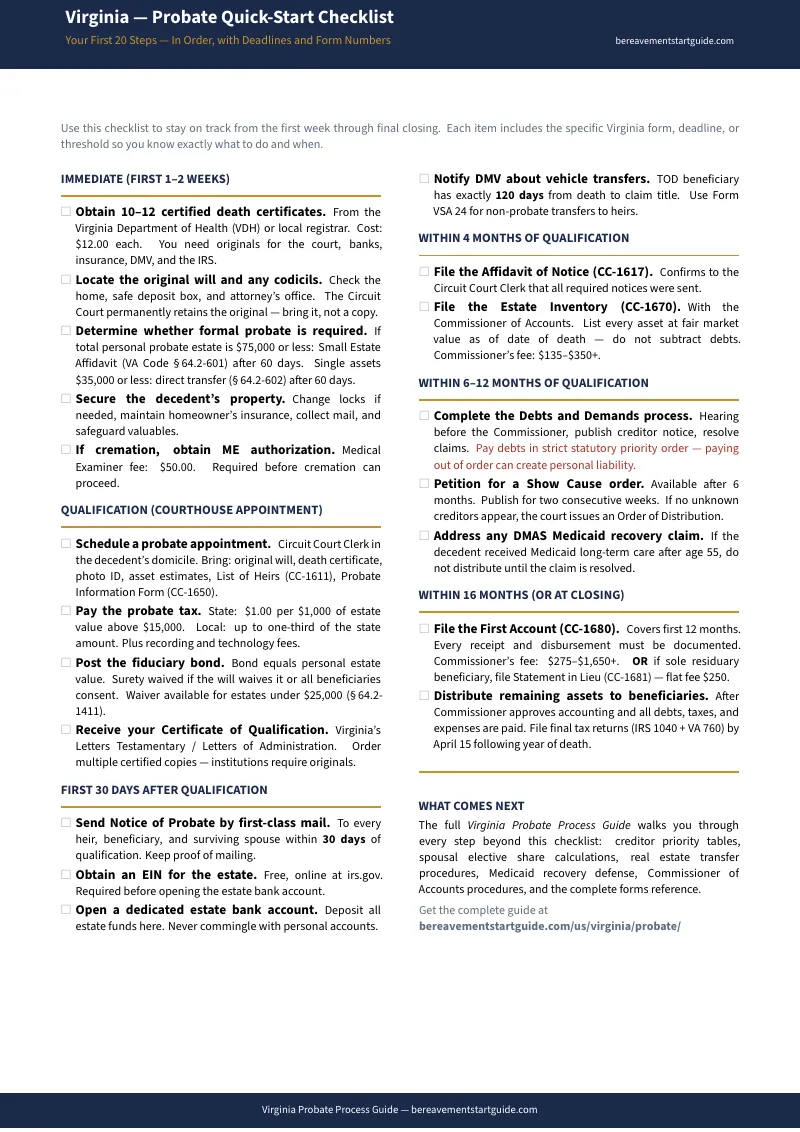
Not ready for the full guide? Download the free Virginia -- Probate Quick-Start Checklist -- an overview of the probate process and the key deadlines, decisions, and documents you need to have ready before you begin. Enough to understand what you are facing and whether you need the full guide.
Probate is not something you were trained for. But it is something you can get through with the right instructions. The guide gives you those instructions, one filing at a time.