
The Deadline Defense System — Every Virginia Benefit You're Owed, Every Clock That's Running
Your spouse died. The bank locked the joint account and demanded "letters of qualification." The VRS pension check stopped. The health insurance letter says coverage ends in 60 days. The Commissioner of Accounts wants an inventory you have never heard of, on a deadline you did not know existed.
And nobody — not the funeral home, not the Social Security office, not the Circuit Court Clerk — handed you a list of what you are owed.
That is because Virginia does not coordinate survivor benefits. They are scattered across the Virginia Retirement System, the Department of Medical Assistance Services, the Workers' Compensation Commission, the Criminal Injuries Compensation Fund, the Department of Veterans Services, 120 independent Circuit Court Clerks, the Commissioner of Accounts, and the Department of Social Services. Each agency expects you to find them, file their specific forms, and meet their specific deadlines — while you are grieving. And several of those deadlines start counting the moment the death certificate is signed, whether you know about them or not.
The Virginia Survivor Benefits Navigator is the sequenced action plan that replaces dozens of confusing government websites with one chronological roadmap. Every benefit you might qualify for. Every form number. Every deadline that costs money if missed. Every exemption that protects the family home.
— Less Than Six Minutes of Attorney Time
Virginia probate attorneys charge $200 to $400 per hour, with flat-fee estate administration retainers starting between $3,000 and $5,000. This guide is your Attorney Prep-Kit: it organizes your documents, identifies every benefit you qualify for, and answers the baseline administrative questions — so if you do hire a lawyer, you spend their time on strategy, not on explaining what a Small Estate Affidavit is or how the Commissioner of Accounts fee schedule works.
What's Inside
The First 48 Hours Emergency Stabilizer
Exactly what to do (and what NOT to do) in the first two days: engage a licensed funeral director and demand the General Price List, order 10–15 certified death certificates from the Virginia Department of Health at $12 per copy, secure the original will, and notify Social Security. Includes the emergency funding triage — workers' compensation funeral coverage, Virginia Victims Fund up to $10,000 for crime-related deaths, and local DSS General Relief burial assistance.
The Probate Bypass: Small Estate Affidavit
Two distinct paths — and choosing the wrong one wastes months and hundreds in unnecessary court fees. The Small Estate Affidavit for personal estates under $75,000: wait the mandatory 60 days, present the notarized affidavit, and banks release the funds. But it only covers personal property — real estate requires a separate Real Estate Affidavit (Form CC-1612, $25 flat tax). And some banks misapply an older $50,000 threshold. The guide explains exactly how to push back with the correct statutory citation.
The Commissioner of Accounts Compliance Guide
If the estate requires formal probate, the Commissioner of Accounts supervises everything. Four months to file the inventory. Sixteen months to file the first accounting. Fees from $293 (estates under $50,000) to $1,668 (estates up to $1 million). This guide includes pre-formatted tracking templates that align exactly with what the Commissioner expects — saving you thousands in CPA and attorney fees for ledger formatting alone.
The VRS Pension Decoder
If the deceased was a state employee, teacher, or municipal worker: how the Virginia Retirement System determines your payout, the strict statutory Order of Precedence when no beneficiary designation is on file (spouse → children → parents → estate), the difference between death-in-service and post-retirement benefits, the Partial Lump-Sum Option Payment, and the exact process to claim the Health Insurance Credit of up to $45 per month using Form VRS-45.
The 60-Day Health Insurance Window
Three paths to continuing coverage after a spouse dies — and only one has a hard 60-day deadline that permanently locks you out. VRS survivor health insurance enrollment (60-day window, no extensions). Federal COBRA continuation (up to 36 months at full premium). The ACA marketplace Special Enrollment Period (60-day qualifying life event window). For LODA families: premium-free health insurance for life. How to compare costs before the enrollment deadline passes.
Line of Duty Act (LODA) Benefits
If the deceased was a law enforcement officer, firefighter, or other first responder covered by the Virginia Line of Duty Act: $100,000 for deaths directly caused by performing duty, $75,000 for presumptive cause deaths within five years of retirement, $20,000 additional for National Guard and Reserves killed in action. Plus premium-free health insurance for the surviving spouse and dependents, and the real estate tax exemption. VRS makes the eligibility determination within 45 days of receiving all necessary information.
The Augmented Estate and Your Elective Share
If the will disinherits you or leaves you less than you are owed, Virginia law lets you reject the will and claim either one-third of the augmented estate (with surviving children) or one-half (without). The augmented estate pulls back non-probate transfers — life insurance, joint accounts, lifetime gifts — to prevent intentional disinheritance. Your percentage of the marital property portion scales with length of marriage: 3% for under one year, rising to 100% for 15 or more years. The guide includes the full sliding scale table and walks through the math for common scenarios, plus the filing deadline you cannot miss.
Spousal Allowances: $80,000 Shielded from Creditors
Three statutory allowances that protect surviving spouses before creditors get paid: Family Allowance (up to $30,000), Exempt Property Allowance ($25,000 in tangible personal property), and Homestead Allowance ($25,000). Total: up to $80,000 shielded from the estate's debts. Each must be claimed within one year of death with a written, notarized election filed with the Circuit Court Clerk.
Workers' Compensation Death Benefits
If the death was work-related: total dependents receive 66.6% of the deceased's average weekly wage for up to 500 weeks. Partial dependents receive benefits for up to 400 weeks. The presumption of compensability when a worker is found dead at the workplace. Funeral expense coverage. The nine-year statute of limitations from the date of the accident. Step-by-step filing through the Virginia Workers' Compensation Commission.
Virginia Victims Fund and Crime Victim Compensation
If the death resulted from a crime: up to $10,000 for funeral expenses, $3,500 for grief counseling, $1,000 for crime scene clean-up, income loss at two-thirds of the victim's average weekly wage, and $35,000 maximum total benefit. The 120-hour crime reporting requirement. VVF as the statutory payer of last resort — what that means and why the filing order matters.
The Medicaid Estate Recovery (MERP) Defense
If the deceased was 55 or older and received Medicaid-funded long-term care, DMAS may file a claim against the estate. But recovery is entirely blocked when a surviving spouse or disabled child is alive. The undue hardship waiver for income-producing assets and modest homesteads. The strict 30-day appeal window after a waiver denial. How to time the hardship waiver request relative to the Commissioner of Accounts deadlines.
Property Tax Relief and Military Benefits
Real estate tax exemptions for surviving spouses of service members killed in action and LODA-covered first responders — covering the principal residence and up to 10 acres, voided upon remarriage. The Virginia Military Survivors and Dependents Education Program (VMSDEP) providing up to eight semesters of tuition and fee waivers at Virginia public colleges. How to coordinate DD-214 documentation.
Vehicle Transfers and the Creditor Claims Process
How to transfer vehicle titles through the DMV using Form VSA 24 — family transfers are exempt from Sales and Use Tax. The 120-day window for Transfer on Death vehicle claims. Plus the new Notice to Creditors statute (Code § 64.2-508.1) that limits fiduciary liability — publish two weeks in a local newspaper and start the creditor bar clock.
Virginia Tax Relief
Virginia repealed its state estate tax (effective 2007) and imposes no inheritance tax. The vast majority of Virginia estates owe zero state death taxes. But federal estate tax still applies above the $12 million exemption, and inherited VRS Defined Contribution plan withdrawals are subject to both federal and state income tax. The guide clarifies exactly which benefit types are taxable and which are not.
Who This Guide Is For
- Surviving spouses trying to claim every benefit before the deadlines pass — and protect the family home from creditors and Medicaid recovery
- Adult children serving as executor who need to secure benefits for a surviving parent while managing Virginia's Commissioner of Accounts system, Circuit Court requirements, and multi-agency filings
- Families of state employees, teachers, and first responders navigating VRS survivor pensions, the Order of Precedence rules, the Health Insurance Credit, and Line of Duty Act claims
- Families of workers killed on the job filing for workers' compensation death benefits and funeral expense coverage through the Virginia Workers' Compensation Commission
- Families of crime victims claiming Virginia Victims Fund funeral compensation up to $10,000
- Surviving spouses in blended families calculating whether the augmented estate elective share protects their financial future
- Low-income survivors facing Medicaid estate recovery notices who need to assert hardship waivers before the 30-day appeal window closes
Why Not Just Use Government Websites?
You can. Every form, statute, and eligibility rule in this guide exists somewhere on ssa.gov, varetire.org, dmas.virginia.gov, vwc.state.va.us, and 120 independent Circuit Court websites. That is the problem — "somewhere" across dozens of dense, uncoordinated government pages written in statutory language, with no chronological sequencing and no explanation of how one agency's requirements interact with another's.
The VRS website publishes dense policy manuals about the Order of Precedence and the Health Insurance Credit without connecting them to the probate timeline running in parallel. The Circuit Court provides Small Estate Affidavit forms but will not tell you about the VRS enrollment window closing at the same time. DMAS publishes estate recovery guidelines but does not explain how to coordinate hardship waiver timing with the Commissioner of Accounts inventory deadline.
Government websites are legally prohibited from giving you advice. They provide blank forms without telling you what to do first, second, or third. The state gives you the puzzle pieces. This guide gives you the picture on the box — and tells you which piece to place first.
What You Get
- The Complete Navigator — 19 chapters covering every benefit, exemption, and administrative process, organized in the order you need to act
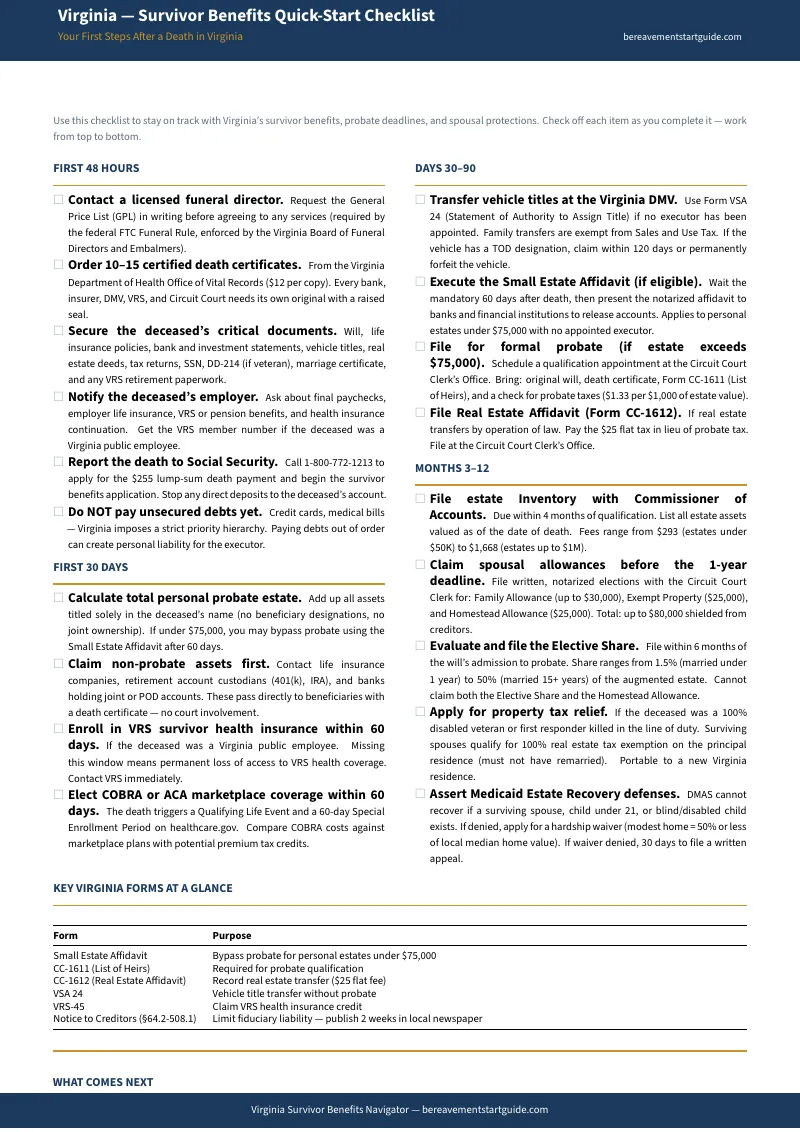
- Quick Start Checklist — the most critical actions across every timeline group, with the specific form number, agency, and deadline for each
- Deadline Map (standalone printable) — every statutory deadline from 48 hours to 16 months, with the form number and consequences of missing each one
- Official Forms Directory (standalone printable) — every Virginia form referenced in the guide with the issuing agency and where to file
- Agency Contacts Sheet (standalone printable) — every state agency, court, retirement system, and key filing location on one reference sheet
Satisfaction Guarantee
If the Navigator does not save you time, confusion, or money — email [email protected] and we will make it right. No questions, no hassle.
Start Protecting Your Family's Benefits
Download the free Virginia Survivor Benefits Checklist for the most critical actions and deadlines — or get the complete Navigator with full step-by-step instructions, the VRS pension decoder, Commissioner of Accounts compliance templates, augmented estate elective share calculations, MERP defense strategies, property tax protection, LODA benefits, and every form walkthrough.