The Hospital Says They Will Only Release Your Loved One to a Funeral Home. The Funeral Home Quoted $8,400 for a Service Package You Did Not Ask For. You Just Learned That Washington State Lets Families Transport Their Own Dead, That Embalming Is Not Required by Law, and That Cremation Prices in This State Vary by Up to 700%. Nobody Told You Any of This Until Right Now.
You are standing in a hospital corridor or sitting in a funeral home arrangement room, and someone across the desk is telling you what has to happen next. They are speaking with authority. They are using words like "required" and "standard" and "policy." And you have no way to know — in this moment, under this pressure — which of those statements are legal requirements and which are sales tactics dressed in the language of regulation.
That is the problem. Not that funeral directors are dishonest. Most are compassionate professionals doing difficult work. But they operate in a retail industry where the customer is grieving, the clock is running, and the price variation for the exact same service — a direct cremation, for example — can range from $495 to over $3,500 within a single county. Washington law gives you powerful consumer protections. The FTC Funeral Rule gives you more. But scattered across state statutes, federal regulations, administrative codes, and county-specific procedures, those protections are functionally invisible to someone making decisions under a 24-hour deadline.
The Washington Funeral Laws & Consumer Rights Guide is a Consumer Rights Defense System for every decision between the moment of death and the final disposition of remains. Not a sympathy pamphlet. Not a generic funeral planning overview that treats Washington like every other state. A structured, Washington-specific manual built around RCW Title 68, WAC 246-500, the FTC Funeral Rule, and the landmark 2026 legislation legalizing private family burial grounds — covering the exact rights you hold, the exact obligations providers owe you, and the exact steps to assert both when an institution pushes back.
What's Inside the Consumer Rights Defense System
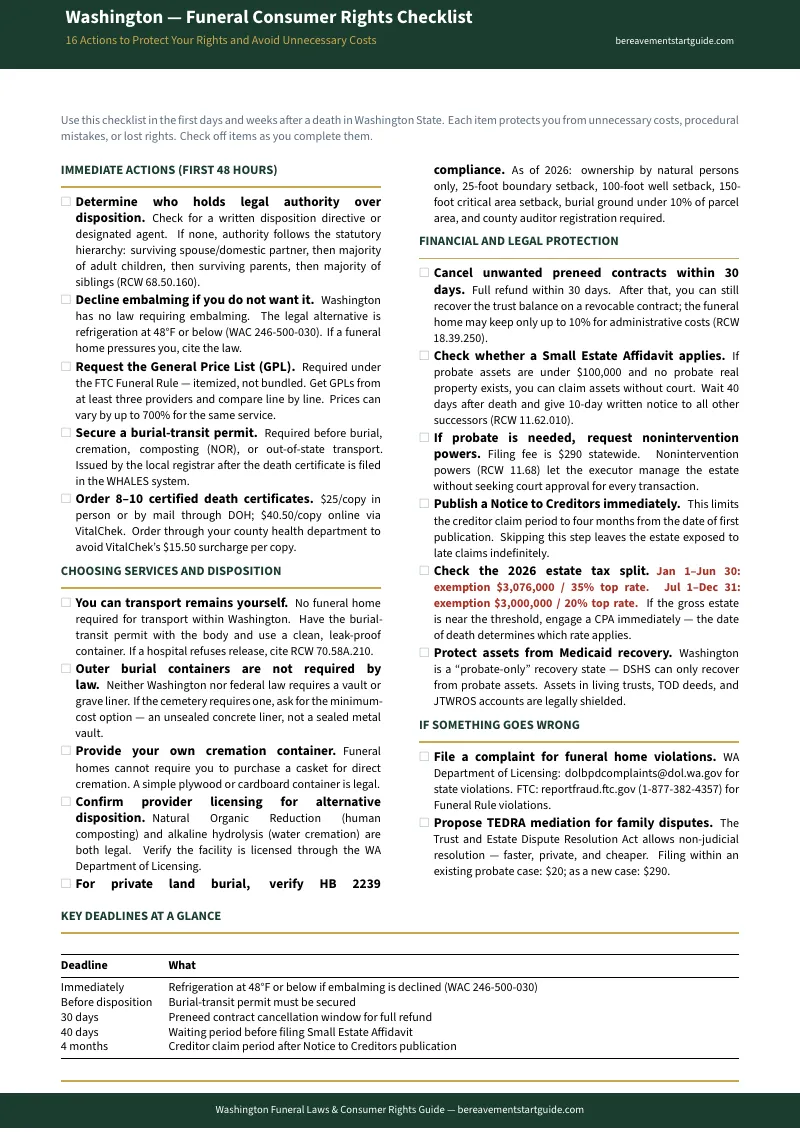
A comprehensive guide and a Funeral Consumer Rights Checklist — covering every legal right, procedural step, and negotiation strategy for Washington death care, built specifically for the state's distinctive laws on home funerals, alternative disposition, consumer protections, and the 2026 private burial ground legislation:
Your Disposition Rights: Who Decides, and How to Change It
Washington RCW 68.50.160 establishes a strict statutory hierarchy for who controls what happens to a body. The designated agent comes first. Then the surviving spouse or domestic partner. Then the majority of adult children. Then surviving parents, then siblings, and on down the line. When families disagree — and they do, especially when a second marriage or estranged relatives are involved — the person who understands this hierarchy controls the outcome. The guide explains every tier of the statutory order and includes a walkthrough for appointing a designated agent using a written, signed, dated, and witnessed document that bypasses the default hierarchy entirely. You do not have to leave this decision to a judge.
The Hospital Release: Your Right to Take Your Loved One Home
Hospitals and hospice facilities routinely tell families that remains can only be released to a licensed funeral home. This is not Washington law. Families in this state have the legal right to transport their own dead, provided they obtain a burial-transit permit from the local registrar. The guide provides the exact legal citations to present to hospital administrators, the procedural steps for securing the permit through the WHALES electronic death registration system, and the practical logistics — vehicle preparation, cooling requirements, timeline — that make family-directed transport feasible. You should not have to pay $500 to $1,200 for a professional transport you are legally entitled to handle yourself.
Embalming: The Upsell You Can Legally Decline
Chemical embalming is not required by Washington state law. Period. What the law does require, under WAC 246-500-030, is that human remains be refrigerated or embalmed upon receipt by a funeral establishment. Simple cooling methods — dry ice, Techni Ice, mechanical refrigeration — fulfill the legal obligation. Yet families report being told that embalming is "required" or "standard procedure" during arrangement conferences, often without being informed of alternatives. The guide explains the actual legal standard, the alternatives that satisfy it, and provides specific language for declining embalming services when a funeral home presents it as mandatory.
The FTC Funeral Rule: Your Federal Price Protection
Since 1984, federal law has required every funeral home in the country to hand you a printed General Price List the moment you walk in the door. They must give you itemized prices over the phone if you call and ask. They cannot force you to buy a package when you want individual items. They cannot charge a handling fee for a casket you purchased from a third party. These are not suggestions — they are enforceable federal regulations backed by the Federal Trade Commission. The guide explains each provision of the Rule, identifies the most common violations Washington consumers encounter, and provides a step-by-step process for documenting and reporting noncompliance.
Cremation, Alkaline Hydrolysis, and Natural Organic Reduction
Washington recognizes three forms of remains reduction: traditional flame cremation, alkaline hydrolysis (water cremation), and natural organic reduction (human composting). All three are legally authorized under RCW 68.50.110. The guide covers the authorization requirements for each — including who must sign the cremation authorization form and what happens when multiple siblings cannot agree — the environmental and cost differences between methods, and how to evaluate providers offering these services. Washington was the first state in the nation to legalize human composting, and the guide reflects the regulatory framework that has developed since.
Private Family Burial Grounds: The 2026 Law
Washington House Bill 2239, effective June 2026, legalizes family burial grounds on privately owned land. This is landmark legislation that fundamentally changes what is possible for families who want to keep their dead close. But the law comes with rigid requirements: a mandatory 100-foot setback from property lines and drinking wells, a maximum burial area of ten percent of the total parcel size, mandatory reporting of every burial to the Department of Archaeology and Historic Preservation, written consent from every property co-owner, and a prohibition on corporate land ownership. The guide walks through every requirement, the registration process, and the practical considerations — soil type, water table depth, county zoning — that determine whether your property qualifies.
Home Funerals: The Complete Legal Procedure
Washington is one of the most permissive states in the country for family-directed death care. You can wash and dress the body at home. You can hold a multi-day vigil with proper cooling. You can build or purchase your own casket. You can transport the body to the crematory or burial site yourself. The guide covers the entire legal procedure from the moment of death through final disposition — the death certificate filing through WHALES, the burial-transit permit, the cooling and timeline requirements under WAC 246-500-030, and the documentation you need at each step. Every instruction is specific to Washington state procedure.
Preneed Contracts and Medicaid: The Financial Strategy
For families navigating Medicaid eligibility, funeral prearrangement is not just planning — it is an asset protection strategy. Washington exempts up to $1,500 in revocable burial funds from countable Medicaid assets, and properly structured Irrevocable Funeral Trusts are fully exempt under WAC 182-512-0500. The guide explains the difference between revocable and irrevocable preneed contracts, the Medicaid spend-down implications of each, the regulatory framework under RCW 18.39.250, and the specific structuring requirements that ensure the trust will survive a Medicaid eligibility review. A single misstep in contract structure can cost thousands in nursing home fees.
Funeral Debt and Community Property: Who Actually Pays
Washington is a community property state. Under RCW 26.16.205, the expenses of the family are chargeable upon the property of both spouses — which means a surviving spouse can be held liable for funeral costs they did not authorize and did not agree to. Conversely, RCW 11.76.110 places funeral expenses at the top of the priority list for estate debt repayment. The guide explains how these two statutes interact, what a surviving spouse's actual exposure is, and how preneed arrangements can cap that liability before it becomes a crisis.
Filing a Complaint: When a Provider Crosses the Line
If a funeral home embalms without authorization, refuses to provide a General Price List, misrepresents legal requirements, or engages in deceptive pricing practices, Washington provides a formal enforcement mechanism through the Funeral and Cemetery Board at the Department of Licensing. The guide provides the exact complaint process — the specific email address, the mailing address, the information you need to include, and the types of violations that constitute actionable offenses versus those that are frustrating but not illegal. This chapter exists because consumers who know the complaint process negotiate from a position of strength.
Death with Dignity: The Paperwork That Cannot Be Wrong
Washington's Death with Dignity Act imposes exceptionally strict rules on how the cause of death must be documented. The death certificate must list the underlying terminal disease as the cause of death. It cannot mention suicide, assisted suicide, or the specific life-ending medications used. If a physician or family member enters these terms into the WHALES system, the state registrar will reject the certificate — halting the issuance of the burial-transit permit and delaying the funeral indefinitely. The guide provides explicit instructions for navigating this documentation correctly, protecting both the family's privacy and the decedent's life insurance benefits.
Scattering, Burial at Sea, and the Washington State Ferries
Scattering cremated remains in Washington is broadly permitted — on private land with the owner's permission, on state trust uplands with DNR authorization, and on public navigable waterways including Puget Sound, lakes, and rivers without any reporting requirement. The Washington State Ferries even offers a dedicated scattering service for $150, requiring a biodegradable urn and advance booking. The guide covers every legal venue, the specific permissions required for each, and the practical logistics of scattering ceremonies.
Who This Guide Is For
- The family facing a hospital that will not release their loved one — who needs the exact legal citations to present to the administrator, the burial-transit permit procedure, and the step-by-step process for transporting the body themselves instead of paying a funeral home transport fee
- The surviving spouse sitting in an arrangement conference — who was just quoted $8,400 for a "complete service package" and needs to know which items are legally required, which are optional, and how to request the itemized General Price List that federal law guarantees
- The family planning a home funeral or green burial — who needs the complete legal procedure for cooling, transport, documentation, and disposition without a funeral home, including the new 2026 private burial ground requirements under HB 2239
- The adult child helping an aging parent with Medicaid planning — who needs to understand how Irrevocable Funeral Trusts protect assets from the $2,000 Medicaid limit and how to structure a preneed contract that will survive an eligibility review
- The family dealing with a disposition dispute — where siblings disagree on burial versus cremation, or a second spouse and adult stepchildren cannot agree on final arrangements — who needs to understand the RCW 68.50.160 statutory hierarchy and the TEDRA mediation alternative
- The executor navigating funeral costs within a larger estate — who needs to know that funeral expenses are deductible on the Washington estate tax return, that they hold priority status in estate debt repayment, and how community property liability affects the surviving spouse
Why Free Resources Will Not Protect You in That Arrangement Room
The laws exist. They are published on state websites, scattered across RCW Title 68, WAC Chapter 246-500, the FTC consumer protection pages, and county registrar portals. Here is what happens when you try to navigate Washington funeral rights using free sources alone:
- The People's Memorial Association publishes the most transparent funeral pricing data in the state — but their goal is selling you a $99 membership. Their biennial price surveys are invaluable for comparison shopping. But PMA is a consumer cooperative that funnels members toward contracted partner funeral homes. They will not give you negotiation scripts for use with non-partner providers, and their educational content is scattered across dozens of web pages with no actionable sequence for someone making decisions under a 24-hour deadline.
- The Department of Licensing hosts complaint forms and licensing lookups — with zero advisory content. They publish the raw statutes and the enforcement mechanisms. They will not explain in plain English which of your rights the funeral home just violated, or walk you through the difference between a legal requirement and a cemetery policy being presented as law.
- Funeral home websites explain the process — their process. Local providers produce polished content marketing that simplifies complex laws to funnel you into their service packages. They will not explain that you can legally transport the body yourself, that embalming is optional, or that you can purchase a casket from a third party without penalty. Their content is accurate as far as it goes — it just stops at the exact point where your consumer rights begin.
- National platforms miss everything that makes Washington different. LegalZoom, Nolo, and Funeral.com produce broad overviews that consistently fail to cover the 2026 private burial ground legislation, alkaline hydrolysis regulations, the WHALES death certificate system, Death with Dignity documentation rules, and the Medicaid implications of irrevocable funeral trusts under Washington-specific administrative code. Generic guides treat Washington as a footnote. Washington is not a footnote — it has one of the most progressive and complex death care regulatory frameworks in the country.
Free resources give you fragments from a dozen sources written by people who are either selling you something else or legally prohibited from giving you advice. The Consumer Rights Defense System puts every Washington-specific right, procedure, and strategy into one document, in the order you actually need them — starting from the moment of death.
— Less Than One Hour of a Funeral Director's "Arrangement Fee"
A single consultation with a Washington elder law attorney costs $250 to $400 per hour. A funeral home "arrangement fee" — the charge just for sitting in their office and hearing the sales presentation — runs $200 to $395 at most Washington providers. National funeral planning memberships charge $99 per year in recurring fees. This guide costs a fraction of any one of those and gives you the complete Washington-specific framework — every consumer right, every legal alternative, every negotiation point, and the 2026 legislative changes that most funeral professionals have not fully absorbed yet.
Your download includes 7 PDFs — the complete 69-page guide, the printable Funeral Consumer Rights Checklist, and five standalone printable tools you can bring to arrangement conferences, post on the fridge, or share with family members making joint decisions:
- Funeral Home Comparison Worksheet — side-by-side price comparison grid for three providers, structured around every line item on a General Price List
- Critical Deadlines Tracker — every Washington-specific filing deadline from day one through estate tax, with status checkboxes
- Disposition Authority Reference — the complete statutory hierarchy under RCW 68.50.160, including designated agent requirements and majority-rule mechanics
- FTC Rights Card — your federal consumer protections in a format you can carry into any arrangement conference
- Complaint Filing Guide — the exact process, email addresses, and violation categories for reporting a funeral home to the Funeral and Cemetery Board
Covering every aspect of Washington funeral law and consumer protection: home funerals, alternative disposition, hospital release rights, preneed contract structuring, Medicaid asset protection, community property liability, the 2026 private burial ground law, and the Death with Dignity documentation rules. Instant download, no account required.
Money-back guarantee, no time limit. If the guide does not give you clarity on your legal rights and confidence to make funeral decisions based on Washington law rather than industry pressure, email us for a full refund. No questions asked.
Not ready for the full guide? Download the free Washington Funeral Consumer Rights Checklist — a printable summary of your core legal protections, the questions to ask at any arrangement conference, and the steps to assert your rights if a provider pushes back. Enough to walk into that meeting informed.
You should not have to become a lawyer to bury someone you love. But you do have to know your rights — because the people across the desk already know theirs.