You Were Just Named Personal Representative in Washington State. The Superior Court Wants a Petition You Have Never Seen. The Estate Might Qualify for Nonintervention Powers That Let You Skip Court Approval on Every Single Transaction. And Nobody Mentioned That Washington Has Its Own Estate Tax Starting at $3 Million — With the Threshold Changing Mid-Year in 2026.
You did not plan for this. Maybe you were named in the will. Maybe there was no will, and the family turned to you because you are the surviving spouse, the eldest child, or the one who lives closest to the courthouse. Either way, the funeral is barely over and the institutions have already started. The bank froze the checking account until you produce something called "Letters Testamentary." The title company will not clear the house sale without them. Your brother is asking when he gets his share. And you just discovered that Washington is a community property state — which means you cannot assume everything transfers automatically, even if you were married to the decedent for forty years.
Welcome to Washington probate. Not one process, but a forked system — nonintervention administration versus supervised administration — where the path you secure in the first hearing determines whether you spend the next year asking a judge for permission on every check you write, or whether you handle the estate with the autonomy of a competent fiduciary. The superior court has the forms but is legally prohibited from telling you which ones to file, in what order, and what happens if you get it wrong. Local probate attorneys charge $250 to $400 per hour — and on a $500,000 estate, a full representation engagement runs $5,000 to $15,000 or more.
The Washington Probate Process Guide is a Nonintervention Navigation System for every procedural step between the death certificate and the Declaration of Completion. Not a law textbook. Not a generic probate overview that treats Washington like every other state. A structured, Washington-specific manual built around Title 11 RCW and the new EHB 2445 legislation effective June 2026 — covering the exact petitions, the exact deadlines, the exact filing fees, and the exact decision points that determine whether you administer this estate freely or under continuous court supervision.
What's Inside the Nonintervention Navigation System
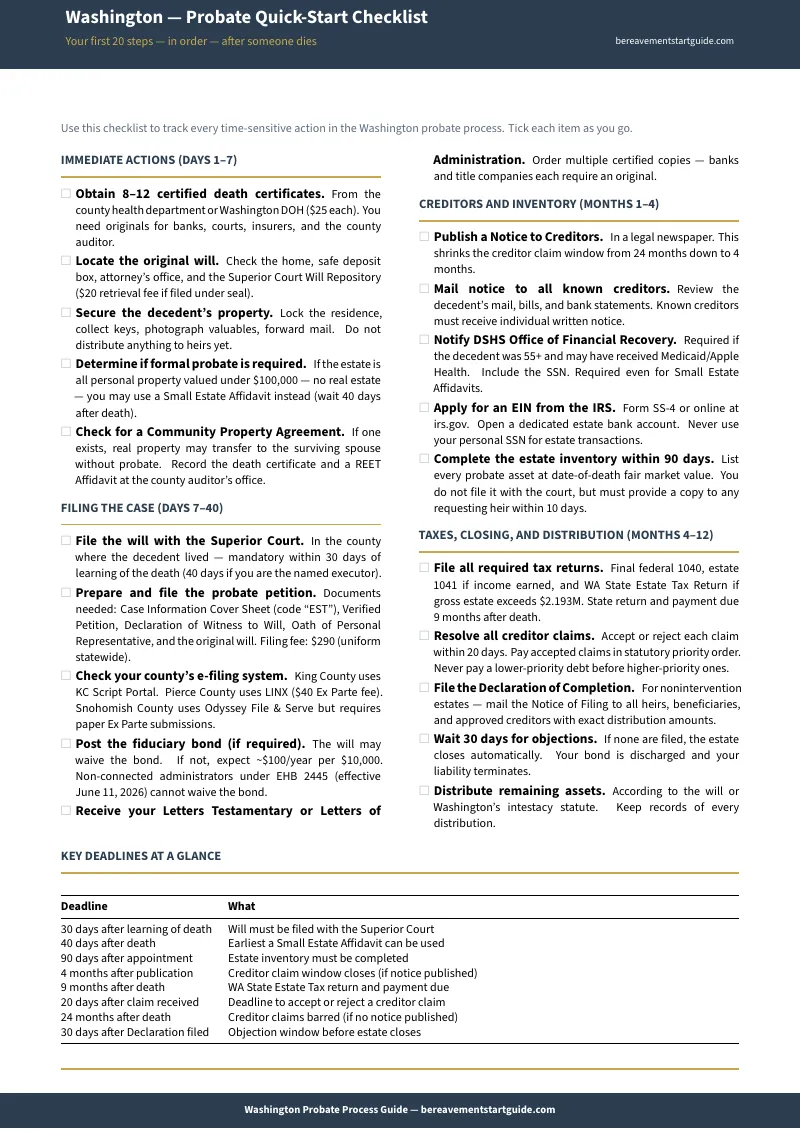
A comprehensive 16-chapter guide and a Quick-Start Probate Checklist — covering every stage from locating the will through filing the Declaration of Completion, built specifically for Washington's nonintervention framework, superior court procedures, and the state-specific rules that make probate here different from any other state:
How Washington Probate Actually Works: Nonintervention vs. Supervised
Before you file a single form, you need to understand the fork in the road. Washington does not use the "informal vs. formal" terminology found in Uniform Probate Code states. Instead, the critical distinction is between Nonintervention Administration — where the court grants you full authority to sell property, pay debts, and distribute assets without asking permission — and Supervised Administration, where every transaction requires a court order. The guide explains how nonintervention powers are granted under Chapter 11.68 RCW, what happens when the will explicitly authorizes them versus when you need signed waivers from every heir, and why securing these powers in the initial hearing is the single most important step in the entire process.
Opening the Estate: The Petition and What Comes With It
Filing the Petition for Probate is not one form — it is a package. The Case Designation Cover Sheet, the Verified Petition, the Oath of Personal Representative, the proposed Order Admitting Will, and the Notice to Creditors publication. The guide walks through each component: which documents the ex-parte commissioner needs in King County versus Pierce County versus Snohomish County, how to handle the electronic working copies requirement, and what to bring to the virtual Zoom hearing if your county uses one.
The Small Estate Bypass: When You Do Not Need Court at All
If the estate's net assets — including real property equity — total $100,000 or less, Washington's Small Estate Affidavit under RCW 11.62 may let you skip the superior court entirely. But the thresholds are deceptive: real property equity counts toward the $100,000 limit even though the affidavit cannot transfer real property title. And you must wait exactly 40 days after the date of death. The guide includes a decision tree that walks you through the qualification criteria, the mandatory debts-paid requirement, the notice to other successors, and the required mailing to the DSHS Office of Financial Recovery in Olympia.
Community Property: What Transfers Automatically and What Does Not
Washington is one of nine community property states, and surviving spouses routinely assume everything passes without probate. Sometimes it does — when a properly executed community property agreement exists. But without one, the bank will freeze accounts held solely in the decedent's name, and the title company will refuse to clear real estate without Letters Testamentary or a recorded Lack of Probate Affidavit. The guide explains how to determine which assets are community property, which are separate property, how community property agreements interact with probate, and what the surviving spouse actually needs from the court versus what can be handled with an affidavit.
Letters Testamentary: The Key That Unlocks Everything
Every bank, brokerage, title company, and insurance carrier will demand certified copies of your Letters Testamentary before releasing a single dollar. The guide covers the exact judicial sequence: filing the petition, attending the ex-parte hearing, getting the commissioner's signed order, and paying the clerk for color-certified copies. It addresses the classic Catch-22 — when the original will is locked in a safe deposit box that requires the Letters you have not yet obtained. And it explains the critical distinction between Letters Testamentary (issued when there is a valid will) and Letters of Administration (issued when there is no will).
Creditor Claims: The Four-Month Window That Protects You
Washington gives executors a powerful strategic tool: publishing a formal Notice to Creditors slashes the general statute of limitations from 24 months down to 4 months. The guide explains the publication requirements — where to publish, how long the notice must run, and what information it must contain. It covers how to evaluate and accept or reject claims, the priority order for paying debts when the estate is insolvent, and the personal liability exposure if you distribute assets to heirs before the creditor window closes.
Medicaid Estate Recovery: What the State Can Actually Claim
If the decedent was 55 or older and received Apple Health (Medicaid) long-term care services, the DSHS Medicaid Estate Recovery Program becomes a powerful potential creditor. Families hear "the state will take the house" and panic. The reality is more nuanced: recovery is prohibited when a surviving spouse, a child under 21, or a blind or disabled child survives. The guide explains the mandatory notice you must send to the DSHS Office of Financial Recovery in Olympia — including the decedent's social security number — and the personal liability you face for failing to send it. It details the exemptions, the hardship waiver process, and the timeline for DSHS to file its claim.
The Washington Estate Tax: The Split-Year Threshold
Washington is one of a handful of states with its own standalone estate tax, completely separate from the federal estate tax. The rates are graduated from 10% to 35% depending on estate size. For 2026, the filing threshold is a moving target: $3,076,000 for deaths between January 1 and June 30, then resetting to $3,000,000 for deaths on or after July 1 due to the expiration of the Consumer Price Index adjustment. The guide explains which assets count toward the gross estate — including life insurance proceeds, retirement accounts, and nonprobate transfers — and walks through the Department of Revenue filing requirements.
EHB 2445: The 2026 Law Changes You Need to Know
Engrossed House Bill 2445, effective June 2026, made sweeping changes to Washington probate law. Supervised administrations now face a presumption of readiness for closure at 24 months under RCW 11.76.030. New reporting requirements apply to estates where nonintervention powers are not granted. The personal representative disqualification standards have expanded. The guide integrates every EHB 2445 change into the relevant procedural step — so you are not reading outdated instructions based on pre-2026 law.
TEDRA: Resolving Disputes Without Litigation
Washington's Trust and Estate Dispute Resolution Act (Chapter 11.96A RCW) provides something most states lack: a unified statutory framework for resolving estate disputes through non-judicial binding agreements. Families can settle inheritance disputes, creditor negotiations, and ambiguous will interpretations through mediation and a signed agreement — entirely avoiding formal litigation. The guide explains when TEDRA applies, how to invoke non-judicial agreement procedures, and the boundaries beyond which you need a litigation attorney.
Honoring Progressive End-of-Life Choices
Washington leads the nation in end-of-life options. As executor, you may need to handle directives for natural organic reduction (human composting), alkaline hydrolysis (water cremation), or the Death with Dignity Act. The guide covers the executor's statutory duty under RCW 68.50.160 to honor written directives for remains disposition, the coordination required with licensed facilities, and the critical insurance protection — life insurance payouts cannot be voided when the decedent used medical aid in dying, because the underlying illness is legally listed as the cause of death.
Probate for Real Estate: Clearing Title and the Double Step-Up
If the decedent owned a home, the title company will block any sale until probate clears the deed. The guide covers the complete process — obtaining the date-of-death appraisal, executing the personal representative's deed, and recording it with the county auditor. It explains the massive tax advantage of the community property "double step-up" in cost basis: for married couples, the entire value of community property — not just the decedent's half — steps up to date-of-death value, potentially eliminating tens of thousands of dollars in capital gains tax exposure for the surviving spouse.
The Probate Inventory: Your 90-Day Deadline
Within 90 days of appointment, you must compile a comprehensive inventory and appraisement of every estate asset at date-of-death values. Under Washington law, this inventory does not have to be filed with the court and made public — but you must provide a copy to any requesting beneficiary within 10 days of their formal request. The guide lists the six mandatory categories and explains how to value each one.
Closing the Estate: Three Methods
Washington provides three methods for closing an estate: the Declaration of Completion (standard for nonintervention estates), the Petition for a Decree of Distribution, and the Final Report and Petition for Distribution (mandatory for supervised estates). The guide explains which method applies to your situation, the 30-day objection window for beneficiaries, and the new EHB 2445 provision allowing courts to presume supervised estates are ready for closure at 24 months.
When You Need a Lawyer and When You Do Not
This chapter is honest. For solvent, uncontested estates with unified families — which describes the majority of probates filed in Washington — the guide and the checklist are designed to get you through the process without a retainer. For contested wills, hostile sibling disputes requiring TEDRA litigation, complex Medicaid recovery negotiations, or insolvent estates facing debt abatement, the guide tells you so plainly and explains how to use its checklists to reduce the attorney's billable hours by organizing everything before the first consultation.
Who This Guide Is For
- The executor who just got rejected at the bank trying to access the deceased's checking account — who needs Letters Testamentary from the superior court but does not know which forms to file, whether the estate qualifies for the Small Estate Affidavit, or how to secure nonintervention powers in the initial hearing
- The surviving spouse in a community property state who assumed everything transferred automatically — who just learned that accounts in the decedent's sole name are frozen and the house cannot be sold without court-issued Letters or a Lack of Probate Affidavit
- The out-of-state adult child who lives in California, Oregon, or Texas and was named personal representative — who needs to know that non-resident executors must designate a Washington resident agent in the county of filing, and who needs the complete sequence of fiduciary duties in one document so they can manage the process remotely
- The family trying to avoid court entirely who needs to know whether the estate qualifies for the $100,000 Small Estate Affidavit — and who needs to understand that real property equity counts toward the threshold even though the affidavit cannot transfer real property title
- The executor terrified of Medicaid recovery who heard "the state will take the house" because the decedent received Apple Health long-term care — who needs to understand the actual recovery rules, the exemptions for surviving spouses and dependents, and the mandatory DSHS notice requirements
- The family navigating the state estate tax with an estate near the $3 million threshold — who needs to understand the 2026 split-year filing requirements and which nonprobate assets count toward the gross estate calculation
Why Free Resources Will Not Get You Through This
The information exists. It is scattered across the superior court websites, county clerk supplemental instructions, RCW Title 11, the Department of Revenue, the DSHS Office of Financial Recovery, and a dozen federal agency portals. Here is what you encounter when you try to navigate Washington probate using free sources alone:
- Wa-Probate.com offers hundreds of pages of accurate Washington probate law — with no sequence. The site is the most comprehensive free resource in the state, maintained by a Seattle law firm as a lead generation tool. The content is thorough and legally sound. But it is organized as an encyclopedia, not a workbook. You can spend hours reading about nonintervention powers without discovering the specific steps to request them in your petition. The information is all there — scattered across dozens of sub-pages that do not tell you what to do first, second, or third.
- County court websites provide the forms without explaining which ones you need. King County's superior court posts every probate form as a downloadable PDF. Pierce County and Snohomish County do the same. But the clerk's office is legally prohibited from telling you which forms apply to your situation, what order to file them, or whether the estate qualifies for a faster track. You get the pieces without the map.
- County law libraries sell paper packets for $16 to $41 — with no strategic guidance. These packets contain unannotated forms and boilerplate instructions that explicitly refuse to offer advice. They tell you what a Notice to Creditors is but not why publishing one strategically cuts your liability window from 24 months to 4. You pay more than this guide costs and get less than a quarter of what it covers.
- National platforms miss the details that make Washington different. Nolo, Trust & Will, and FindLaw produce polished overviews that consistently fail to cover nonintervention powers, the TEDRA dispute resolution framework, the community property double step-up, the standalone state estate tax, human composting directives, and the EHB 2445 changes effective June 2026. Washington is not a footnote — it has one of the most distinctive probate systems in the country, and generic tools miss it entirely.
Free resources give you fragments from a dozen sources that do not reference each other. The Nonintervention Navigation System puts every Washington-specific statute, form, deadline, and procedure into one document, in the order you actually need them.
— Less Than Fifteen Minutes With a Washington Probate Attorney
A single consultation with a Washington probate attorney costs $250 to $400 per hour. Full representation on a standard estate runs $5,000 to $15,000. National estate settlement platforms charge $149 per year in recurring subscriptions. This guide costs less than fifteen minutes of professional legal time and gives you the complete Washington-specific roadmap — nonintervention and supervised tracks, every required form, every deadline, the 2026 EHB 2445 compliance updates, and the decision trees that tell you whether you even need an attorney at all.
Your download includes the complete 16-chapter guide, the Washington Probate Quick-Start Checklist, and three standalone printable tools — a Probate Decision Tree (do you even need court?), a Cost Worksheet (estimate every fee before you file), and an Intestacy Reference Card (who inherits what when there is no will). Five PDFs total covering nonintervention powers, community property rules, the Small Estate Affidavit, creditor claim procedures, Medicaid estate recovery, the state estate tax, TEDRA dispute resolution, progressive end-of-life directives, real estate transfers with the double step-up, and closing procedures. Every tool you need to walk into the superior court with confidence. Instant download, no account required.
Money-back guarantee, no time limit. If the guide does not give you clarity on whether you need nonintervention or supervised administration and confidence that you are filing the right forms in the right order, email us for a full refund. No questions asked.
Not ready for the full guide? Download the free Washington Probate Quick-Start Checklist — a printable action list covering death certificates, securing the estate, the Small Estate Affidavit decision, and the critical deadlines for the first 90 days. Enough to get started tonight.
You did not ask for this job. But the process is knowable, the forms are finite, and the deadlines are clear. The guide shows you the path through it, one step at a time.