Your Parent Died in West Virginia. The County Clerk Handed You a Stack of Forms You Cannot Read. The Fiduciary Supervisor Says You Have 90 Days. And Nobody at the Courthouse Is Allowed to Tell You How to Fill Them Out.
You drove to the county courthouse expecting someone to walk you through the process. Instead, the clerk gave you Form ET 6.01, Form ET 6.02, a fee schedule, and a warning: you have 90 days to file a complete inventory of every asset, valued under oath, or the estate gets referred to a Fiduciary Commissioner. When you asked how to value the mineral rights your father inherited from his grandfather -- the ones that generate a few hundred dollars a year in natural gas royalties -- the clerk told you she is legally prohibited from giving you legal advice. The forms are free. The instructions are not.
Here is what makes West Virginia uniquely disorienting. The state has no estate tax and no inheritance tax. Everyone told you this would be straightforward. But the absence of a state death tax does not mean the absence of tax obligations. You still owe the decedent's final state income tax return. If the estate earns any income during administration -- rental payments, mineral royalties, stock dividends -- you must file a separate fiduciary income tax return on Form IT-141 and withhold West Virginia income tax on every distribution to an out-of-state beneficiary. The county still requires the ET 6.01 appraisement to calculate probate fees and release liens on real property. And if your parent received Medicaid-funded nursing home care, the state's third-party recovery contractor has already been notified and is preparing a claim against the estate -- including against any property transferred through a Transfer on Death deed, which does not protect the house from Medicaid recovery the way everyone assumed it would.
The West Virginia Final Tax & Estate Tax Guide is an Appalachian Asset Translator -- a complete system that converts the dense statutory language of West Virginia's decentralized probate bureaucracy into a plain-English, chronological action plan. Not legal advice. Not a stack of blank government forms you can already download for free. A preparation manual that tells you which assets go on the ET 6.01, which go on the ET 6.02, how the State Tax Division values producing mineral interests using a yield capitalization model, what changed when House Bill 2867 eliminated real property from the Small Estate process in 2025, and exactly which federal and state returns you must file and when. Built around the West Virginia Code, the Internal Revenue Code, and the county-level procedures that vary from Kanawha to Monongalia to Berkeley.
What's Inside the Appalachian Asset Translator
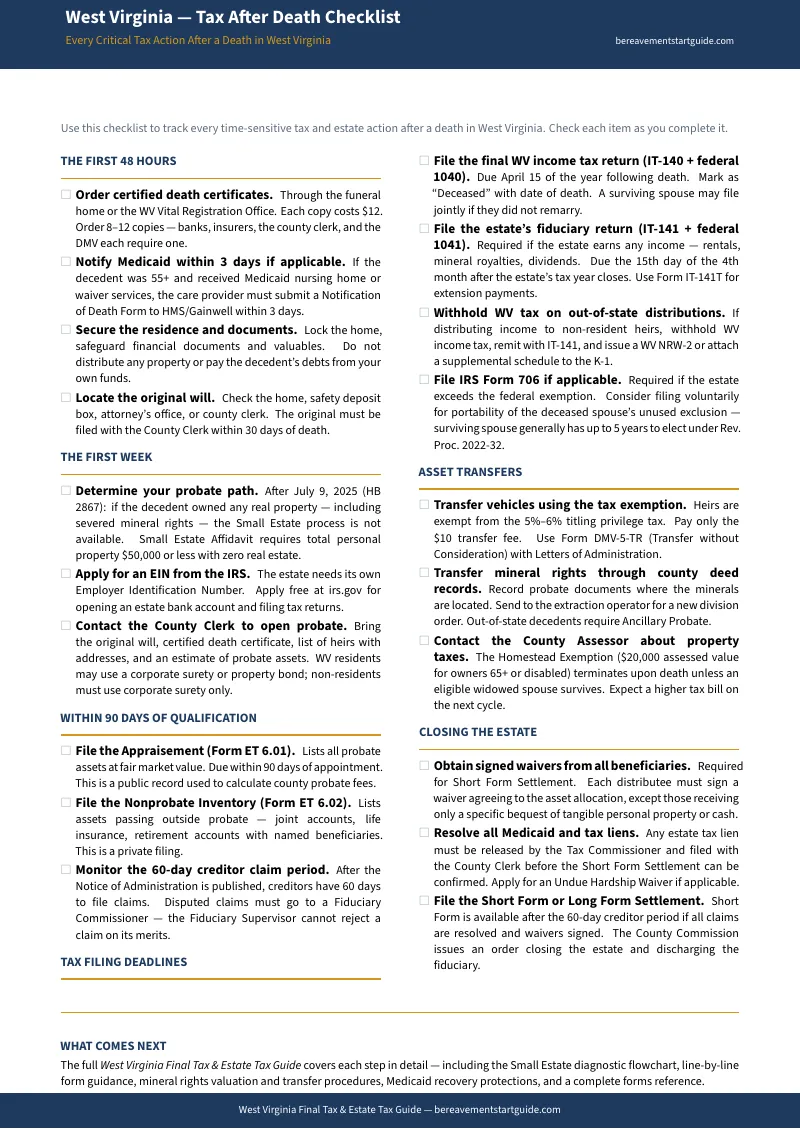
A comprehensive guide and printable Tax After Death Checklist -- covering every state and federal tax obligation, county probate requirement, Medicaid recovery defense, and asset transfer procedure specific to West Virginia estates, organized by deadline so you file the right forms in the right order:
West Virginia's Tax Landscape: No Estate Tax, But Strict Obligations Remain
West Virginia abolished its estate tax in 2005 when the federal government eliminated the state death tax credit. There is no state inheritance tax. But the 90-day appraisement mandate, the fiduciary income tax return, the final personal income tax return, and the county probate fee structure all remain in full force. The guide maps exactly which obligations apply to your estate's size and asset mix -- so you do not waste time on forms you do not need, and you do not miss the ones the Fiduciary Supervisor is waiting for.
The ET 6.01 and ET 6.02: What Goes Where and Why It Matters
The Appraisement of the Estate (Form ET 6.01) is a public record that lists every probate asset and its fair market value. The Nonprobate Inventory (Form ET 6.02) is a private filing that captures assets passing outside probate -- jointly held accounts, life insurance with named beneficiaries, retirement accounts with designated payees. Getting the classification wrong inflates probate fees, delays settlement, and exposes you to fiduciary liability. The guide walks through each asset type and tells you exactly which form it belongs on.
Severed Mineral Rights: The Appalachian Asset Most Guides Ignore
West Virginia's history of coal, oil, and natural gas extraction means surface land rights are frequently severed from the underlying mineral estate. These mineral interests are legally classified as real property. The State Tax Division values them using a yield capitalization model based on gross receipts with a two-year valuation delay, taxing them at 60 percent of appraised value. If you inherit even a tiny fractional interest, the entire estate is now disqualified from the Small Estate process and must go through full probate. If the decedent lived out of state, you must open ancillary probate in the specific West Virginia county where the minerals are located before the operator will resume royalty payments. The guide covers the valuation methodology, the ancillary probate procedure, the recording fees, and how to establish a stepped-up basis that minimizes capital gains if you eventually sell.
The 2025 Small Estate Disqualification: What House Bill 2867 Changed
Before July 2025, West Virginia allowed estates with up to $100,000 in real property to use the simplified Small Estate affidavit process. House Bill 2867 eliminated real property entirely. After July 9, 2025, any probate real estate interest of any kind -- a house, a hunting cabin, a fractional mineral right worth $50 a year -- completely disqualifies the estate from the Small Estate process. If an authorized successor files a small estate affidavit for an estate holding real property, the county clerk is legally mandated to rescind the authorization, forcing the family to restart under full probate. The guide includes a diagnostic tool so you know your path before you file the wrong paperwork.
The Final Income Tax Return: Form IT-140
Every West Virginia decedent who earned income in their final year needs a state personal income tax return alongside the federal Form 1040. The return covers January 1 through the exact date of death. Income earned after death -- rental payments, mineral royalties, stock dividends -- belongs on the estate's fiduciary return, not the personal return. The guide walks through the distinction, the surviving spouse joint filing option, and the April 15 deadline that does not move because someone died.
Form IT-141: The Fiduciary Return and the Non-Resident Withholding Trap
If the estate generates any West Virginia taxable income during administration, you must file the state fiduciary income tax return. But here is the trap most executors miss: if any beneficiary lives outside of West Virginia, the estate must withhold state income tax on their share and remit it with the IT-141. You must issue a WV NRW-2 form or attach a supplemental schedule to each non-resident beneficiary's K-1. If you claim the withholding credit on the IT-141 but fail to submit the supporting documentation, the State Tax Department will deny the credit outright. The guide covers the filing threshold, the withholding calculation, the documentation requirements, and the tentative payment form IT-141T for extensions.
Step-Up in Basis: Protecting the Most Valuable Tax Benefit in the Estate
When someone inherits property, the tax basis adjusts to fair market value at the date of death. A house purchased in 1975 for $15,000 that is worth $140,000 when your parent dies gets a new basis of $140,000. Sell it for $145,000 and you owe capital gains on $5,000 -- not $125,000. For Appalachian families holding long-term mineral rights and timberland, this step-up is worth tens of thousands in avoided capital gains. But it only works if the date-of-death valuation is accurate and documented. The guide covers how to establish the step-up, why gifting property before death destroys it, and how the ET 6.01 valuation directly determines your future capital gains exposure.
Form 706 and Portability: Planning Beyond the Federal Exemption
The federal estate tax exemption exceeds $15 million per individual. Most West Virginia estates owe nothing. But filing Form 706 is strategically important for married couples: it is the only way to elect portability, which transfers the deceased spouse's unused exemption to the survivor. A surviving spouse who does not elect portability loses that protection permanently. The guide covers the nine-month filing deadline, the portability election, alternate valuation dates, and when the CPA cost is justified even when the estate owes zero federal tax.
Medicaid Estate Recovery: The Transfer on Death Deed Does Not Protect the House
If the decedent received Medicaid-funded nursing home care or home and community-based waiver services after age 55, the West Virginia Department of Human Services will file a recovery claim against the estate. The state's third-party recovery contractors pursue reimbursement aggressively. The most dangerous misconception among West Virginia families is that a Transfer on Death deed shields the home. It does not. Under West Virginia law, if a Medicaid lien exists at death, it remains attached to the property even after it transfers via TOD deed. But the law provides deferrals -- for surviving spouses, minor children, blind or disabled adult children, and qualifying siblings -- and undue hardship waivers for adult child caregivers and family businesses. The guide walks through every exemption, the deferral conditions, and the waiver application requirements.
The Complete Administrative Timeline: 90 Days Through Final Settlement
From death certificates and EIN applications in the first week, through the 90-day ET 6.01 filing deadline, the 60-day creditor claim period, the fiduciary income tax returns, asset transfers at the DMV and county deed offices, and the Short Form or Long Form Settlement that closes the estate -- every deadline and action consolidated into one chronological reference. Missing the 90-day appraisement window freezes real estate sales and can trigger referral to a Fiduciary Commissioner, which increases costs and delays distributions for months.
Who This Guide Is For
- The overwhelmed local executor staring at blank ET 6.01 forms -- who left the county courthouse with a stack of government PDFs and no instructions for classifying assets, valuing mineral interests, or distinguishing probate property from nonprobate property
- The out-of-state heir who just learned about suspended royalty payments -- who finished probate in Ohio or Virginia and assumed the matter was settled, until an energy operator informed them they must open ancillary probate in West Virginia before royalties resume
- The family whose small estate affidavit was rejected -- who believed a modest estate qualified for the simplified process, then discovered that a fractional mineral right or a small plot of land disqualifies the entire estate under the 2025 House Bill 2867 amendments
- The family facing a Medicaid recovery claim on the family home -- who executed a Transfer on Death deed believing it would protect the property, only to receive a formal recovery notice from the state's contractor with a response deadline already running
Why Free Resources Will Not Get You Through This
The county clerk provides the forms. The State Tax Department publishes technical instructions. Law firm blogs describe the process. Here is what you actually encounter when you try to navigate West Virginia estate taxes using these free sources:
- Government sites provide forms without strategy. Kanawha County, Monongalia County, and Berkeley County offer downloadable probate packets with the blank ET 6.01 and ET 6.02 forms. The State Tax Department provides IT-141 instructions. But the forms assume you already know which assets go on which form, how to value producing mineral interests using the yield capitalization model, and whether the estate qualifies for simplified procedures under the 2025 rules. County clerks are legally prohibited from telling you how to fill in the numbers.
- Law firm blogs end at the consultation booking form. Local firms like The Skeen Firm and Jenkins Fenstermaker publish detailed articles about West Virginia probate -- then charge several thousand dollars in flat fees or premium hourly rates to answer the questions their articles deliberately leave open. Their content is designed to generate billable hours, not to help you handle this yourself.
- National legal aggregators cite outdated West Virginia rules. Nolo, FindLaw, Trust & Will, and RocketLawyer rarely mention the 2025 House Bill 2867 amendments to the Small Estate Act. If you follow their guidance, you may file a small estate affidavit that gets rescinded because the estate contains a mineral interest they never told you to check for -- losing weeks of effort and forcing you into full probate from scratch.
- Form-filling software provides the blank PDF without context. SaaS platforms like pdfFiller rank highly for "ET 6.01 WV pdf" but provide zero guidance on how to calculate the values you enter into the fields. They give you the digital version of the same blank form the courthouse handed you.
Free resources give you blank forms from agencies that cannot coordinate with each other and clerks who cannot tell you how to fill them out. The Appalachian Asset Translator puts every county filing, every state and federal tax return, every mineral rights valuation step, every Medicaid defense, and every deadline into one document, in the order you actually need them -- with the post-House Bill 2867 rules, the ET 6.01 asset classification guide, the non-resident withholding requirements, and the stepped-up basis documentation steps that tell you exactly what to file and when.
-- Less Than 15 Minutes With a West Virginia Probate Attorney
A single consultation with a West Virginia probate attorney costs several thousand dollars in flat fees or premium hourly rates. A CPA session to review mineral rights valuation and stepped-up basis documentation runs hundreds per hour. Filing a small estate affidavit that gets rescinded under the 2025 rules costs weeks of lost effort and forces a complete restart under full probate. Missing the 90-day ET 6.01 deadline triggers referral to a Fiduciary Commissioner, which substantially increases costs and delays distributions for months. Failing to withhold state income tax on distributions to out-of-state beneficiaries results in the State Tax Department denying your withholding credit outright. This guide costs less than a single short phone call with a professional and gives you the complete West Virginia tax and probate roadmap -- every form, every classification rule, every deadline, and the filing sequence that keeps the estate out of the Commissioner's office.
Your download includes 6 PDFs -- the complete guide, the printable West Virginia Tax After Death Checklist, plus 4 standalone printables: the Small Estate Diagnostic flowchart, the Mineral Rights Transfer Checklist, the Administrative Timeline deadline calendar, and the Forms and Resources Quick Reference. Instant download, no account required.
Money-back guarantee, no time limit. If the guide does not give you clarity on which taxes apply to your West Virginia estate, confidence in classifying assets between the ET 6.01 and ET 6.02, and a clear filing sequence from qualification through final settlement, email us for a full refund. No questions asked.
Not ready for the full guide? Download the free West Virginia Tax After Death Checklist -- a printable action list covering the most critical deadlines, tax forms, and filing requirements for the first 90 days and beyond. Enough to make sure you do not miss the filings that matter most.
You did not choose this. But the deadlines are real, the forms have right answers and wrong answers, and the process for filing correctly is something you can navigate. The guide puts every form, every classification, every valuation step, and every deadline in one place so you can focus on your family instead of staring at blank government PDFs that nobody at the courthouse is allowed to explain.