The Funeral Home Said Embalming Is "Standard." Your Siblings Cannot Agree on Cremation vs. Burial. The County Clerk Uses a System Nobody Explained to You. And the Two-Day Forfeiture Clock Is Already Running.
Someone just died, and you are the person making the calls. You called a funeral home in Morgantown and they quoted you $2,851 for a direct cremation. You called one in Parkersburg and the quote was $1,629 for the same service. A $1,222 difference for an identical procedure, and neither funeral home explained why. You asked if embalming is required. The answer was "it's standard practice." It is not required by any West Virginia law, under any standard circumstances. Refrigeration is the legal alternative. But nobody told you that, and you almost authorized an $800 procedure you did not need.
Meanwhile, the body is on a clock you did not know about. West Virginia Code Section 30-6-22a gives you exactly two days from the moment you are notified of the death to exercise your legal authority over funeral decisions. After that, your right passes to the next person in the hierarchy. Your brother, your estranged stepmother, the funeral director — whoever acts first. And if the family cannot agree on burial versus cremation, the funeral home cannot legally proceed. Daily refrigeration charges accumulate. The county medical examiner will not issue a cremation permit until someone with clear legal authority signs off. Nobody mediates this for you.
The West Virginia Funeral Laws & Consumer Rights Guide is an Appalachian Consumer Defense Manual for every decision, deadline, and potential overcharge in a West Virginia funeral arrangement — from the moment of death through final disposition, estate basics, and regulatory complaints. Not a sympathy resource. Not a blog post written by a funeral home to funnel you into their service packages. A plain-English, West Virginia-specific legal reference that tells you what the funeral industry is required to disclose, what they are prohibited from charging, who has the legal authority when the family disagrees, and what to do when something goes wrong — including the mineral rights complications, family cemetery access protections, and Medicaid estate recovery strategies that are unique to this state.
What's Inside the Appalachian Consumer Defense Manual
A 12-chapter guide, a consumer rights checklist, and the West Virginia-specific statutes you need — covering every legal, financial, and procedural question families face during funeral arrangements in the state of West Virginia:
Chapter 1: The First 48 Hours — Death Certification, Permits, and the Clock That Is Already Running
The attending physician must certify the cause of death within 24 hours. The death certificate must be filed within 5 days and before final disposition. No body can be buried, cremated, or transported without an authorization for final disposition. The guide covers the medical certification process, the DAVE electronic filing system, how to obtain certified copies ($12 each from the Vital Registration Office or county clerks — budget $96 to $144 for 8-12 copies), and what happens when the cause of death is recorded as "pending" during a forensic investigation.
Chapter 2: Who Controls the Funeral — The Right of Disposition Hierarchy
This is the chapter that prevents family disputes from escalating into legal paralysis. West Virginia Code Section 30-6-22a establishes a strict, legally binding hierarchy: preneed funeral contract first, then a notarized designated representative affidavit, then surviving spouse, then majority of adult children, then parents, siblings, grandparents, and so on through 11 priority levels. The guide covers the full hierarchy, the two-day forfeiture rule that strips your authority if you do not act, the criminal charge forfeiture provision, and what happens when an even split among siblings creates a stalemate that only the county court can resolve.
Chapter 3: Cremation — Waiting Periods, Permits, and Chain of Custody
West Virginia mandates a 24-hour waiting period after death before any cremation can proceed. No exceptions. A separate cremation permit from the county medical examiner or coroner is required on top of that. Written authorization must come from the person who holds legal authority under the disposition hierarchy — the crematory cannot accept authorization from someone lower in the hierarchy if a higher-priority person is available. The guide covers the three required authorizations, the chain-of-custody tracking requirements, the 21-day cremation completion deadline, and the rules for scattering ashes on private property, state parks, and West Virginia's navigable rivers.
Chapter 4: Alternative and Eco-Conscious Disposition Options
West Virginia legalized alkaline hydrolysis (water cremation) in 2022. Senate Bill 1057 in 2026 advanced natural burial protections that prohibit cemeteries from mandating vaults, embalming, or non-biodegradable containers. Home funerals are legal — families can assume custody of the body, prepare remains at home, and transport without a funeral director. Family cemeteries on private property are legal. And descendants have a statutory right under West Virginia Code Section 37-13A-1 to access ancestral graves on land that has since been sold. The guide covers every option with the specific legal requirements, practical guidelines, and agency contacts for each.
Chapter 5: Your Consumer Rights — The FTC Funeral Rule and West Virginia Protections
The chapter that saves families the most money. The FTC Funeral Rule requires every funeral home to provide an itemized General Price List to anyone who asks. It requires accurate phone quotes. It prohibits handling fees on third-party caskets and urns. It prohibits embalming without explicit authorization. West Virginia's Board of Funeral Service Examiners adds a state-level enforcement layer with an unusually rigorous embalming consent rule: a funeral director who embalms without prior authorization has violated state law, full stop. The guide covers every provision, gives you a compliance checklist for the funeral home meeting, and provides the average direct cremation costs across 10 West Virginia municipalities so you can spot a predatory quote immediately.
Chapter 6: Preneed Funeral Contracts — Planning Ahead and Avoiding Fraud
Preneed contracts are regulated by the Attorney General's Consumer Protection Division. Sellers must hold a Certificate of Authority and a License to Sell. Funds must be deposited in interest-bearing trust accounts or backed by insurance policies. The guide covers the oversight requirements, the trust funding rules, and the critical intersection with Medicaid planning — how an irrevocable preneed funeral trust can legally convert countable cash into a Medicaid-exempt asset, protecting the family home from the state's estate recovery program.
Chapter 7: Estate Basics — Small Estates and Full Probate
West Virginia's decentralized probate system runs through the County Commission, executed by the County Clerk and appointed Fiduciary Commissioners. The Small Estate Act allows a streamlined affidavit process for personal property under $50,000 (60-day waiting period, no surety bond) and real property under $100,000 (30-day waiting period). The guide covers both tracks, the full probate process for larger estates, the 90-day inventory deadline, the 60-day creditor claims window, and the Fiduciary Commissioner fee rules — including the fact that their fees cannot legally be based on a percentage of the estate value, despite what some commissioners quote.
Chapter 8: The Mineral Rights and Heirs' Property Problem
This is the chapter no other state's guide needs. West Virginia's coal, oil, and gas history means surface rights and subsurface mineral rights are frequently held by entirely different owners. When someone dies, mineral rights must go through formal probate. Royalty payments are immediately suspended. Out-of-state decedents need ancillary administration in the specific West Virginia county where the minerals are located. And multi-generational heirs' property — land passed down without wills — is vulnerable to partition actions where a single outside investor can force a public auction of the entire family tract. The guide covers ancillary probate for minerals, the Uniform Partition of Heirs Property Act protections, and when you absolutely need a West Virginia property attorney.
Chapter 9: Medicaid Estate Recovery
If the deceased received Medicaid-funded nursing home care, the state will pursue recovery from the estate. The executor must submit a Notification of Death form within three days. The state frequently targets the family home. The guide covers the recovery process, the three-day notification deadline, the exemptions that protect surviving spouses and disabled children, the five-year look-back period for asset transfers, and the practical strategies — including irrevocable preneed trusts and the caretaker child exception — that can shield family assets.
Chapters 10-12: Taxes, the Administrative Timeline, and Key Contacts
No West Virginia estate tax. No inheritance tax. The final chapters consolidate every deadline into one chronological master checklist — from medical certification within 24 hours through final estate settlement — and provide every agency contact, phone number, statutory reference, and filing address you will need. Plus a clear framework for when a guide is enough and when you need an attorney, a CPA, or the county clerk's Fiduciary Supervisor.
Who This Guide Is For
- The family member who just got a funeral home quote that feels wrong — who needs to understand exactly which charges are legally required, which are optional, and which may violate federal consumer protection law. The guide gives you municipality-level cost benchmarks for 10 West Virginia cities and a line-by-line framework for evaluating any General Price List.
- The person trying to arrange a cremation when siblings disagree — who needs to know the exact statutory hierarchy, the two-day forfeiture rule, and what happens legally when no one in the family acts. The guide maps every scenario, including the stalemate procedure and the criminal charge forfeiture provision.
- The rural family with ancestors buried on land that has changed hands — who needs to know that West Virginia Code Section 37-13A-1 grants descendants a statutory right to access family gravesites on private property, and what the notice requirements are for exercising that right.
- The person planning a home funeral, green burial, or aquamation — who needs to know that all three are legal in West Virginia, but practical details — cemetery bylaws, zoning regulations, equipment availability, SB 1057 protections — determine whether their specific plan will work.
- The family dealing with mineral rights, severed estates, or multi-generational heirs' property — who needs to know that mineral royalty payments will be immediately suspended, that ancillary probate is required for out-of-state decedents, and that the Uniform Partition of Heirs Property Act provides specific protections against forced land sales.
- The executor worried about Medicaid estate recovery on the family home — who needs the three-day notification deadline, the exemptions, the five-year look-back period, and the irrevocable preneed trust strategy that can legally protect assets from the state's recovery program.
Why Free Resources Will Not Protect You
Funeral consumer information exists for West Virginia. It is scattered across the state legislature's website in raw statutory text, the Board of Funeral Service Examiners in bureaucratic form, funeral home blogs written to generate leads, and national platforms that cover West Virginia as a footnote. Here is what you actually encounter when you try to protect yourself using free sources:
- The state government sites give you raw law, not actionable guidance. The West Virginia Legislature portal and the Board of Funeral Service Examiners website publish statutes and basic FAQs in dense, fragmented language. They do not provide step-by-step consumer advocacy, negotiation checklists, cost benchmarks, or any guidance on how to actually use your rights during a funeral home meeting. They present the law. They do not explain how to wield it.
- National platforms cover West Virginia generically. Nolo, LegalZoom, and consumer advocacy sites provide useful overviews. None of them cover the two-day forfeiture rule under Section 30-6-22a, the 2025 amendments to the Small Estates Act that restricted real estate eligibility, the county-specific Fiduciary Commissioner fee structures, the severed mineral rights problem, or the SB 1057 natural burial protections. When you need statute numbers, you get general guidance designed for fifty states.
- There is no active Funeral Consumers Alliance chapter in West Virginia. The national FCA provides excellent consumer advocacy — but their state-specific coverage depends on active local chapters. West Virginia does not currently have one. That means no local price surveys, no local funeral home accountability, and no West Virginia-specific consumer guidance from the one organization whose mission is exactly this.
- Local law firm blogs are designed to sell legal retainers, not give you the answers. West Virginia estate firms like Bowles Rice, The Skeen Firm, and Jenkins Fenstermaker publish educational articles that outline the dangers of probate and estate administration — then deliberately withhold the actionable templates and step-by-step procedures, steering you toward consultations that run $150-$300 per hour. For straightforward consumer rights questions, a legal retainer is the most expensive possible way to get a yes-or-no answer.
- Funeral home blogs are accurate, detailed, and written by the people selling you services. Every established West Virginia funeral home publishes content. Some of it is excellent. All of it exists to funnel you into that funeral home's service pipeline. The information subtly steers you toward packages and traditional services — never toward independent price shopping, third-party casket purchases, home funeral rights, or the direct cremation providers who charge half the price.
Free resources give you fragments written by different people for different purposes, with no sequencing, no West Virginia-specific statute references, and no advocacy for the consumer. The Appalachian Consumer Defense Manual puts every West Virginia funeral law, every FTC protection, every cost benchmark, and every complaint procedure into one document — organized by the decisions you actually face, in the order you face them.
— Less Than One Unnecessary Funeral Charge
The average West Virginia family pays roughly $2,400 for a direct cremation — but the range runs from $1,629 in Parkersburg to $2,851 in Morgantown, a $1,222 spread for an identical service. A full-service traditional cremation can exceed $4,700. An embalming you did not authorize: $400-$800. A casket for a cremation that legally requires only a rigid container: $2,000-$5,000. A burial vault the state does not mandate: $800-$2,500. This guide costs less than any single one of those line items and tells you which ones you can refuse.
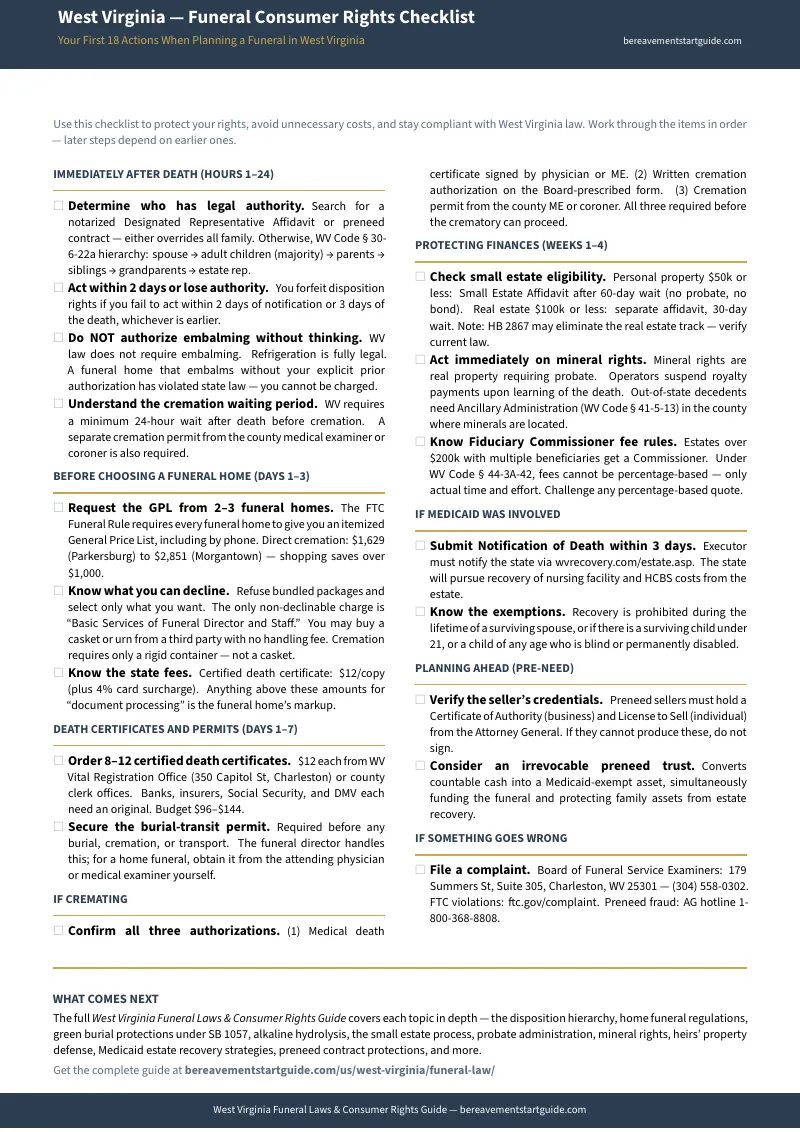
Your download includes 5 PDFs: the complete 12-chapter guide, the West Virginia Funeral Consumer Rights Checklist (a standalone printable designed to bring into the funeral home meeting), the Forms Tracker (every form you need to obtain or file, organized as a checkbox checklist), the Timeline Reference Card (every statutory deadline from medical certification through final settlement on one page), and the Contacts Reference Card (every West Virginia agency, phone number, and address you will need).
Money-back guarantee, no time limit. If the guide does not give you clarity on your rights, your options, and the specific West Virginia laws that protect you — email us for a full refund. No questions asked.
Not ready for the full guide? Download the free West Virginia Funeral Consumer Rights Checklist — a summary of the key rights, deadlines, and cost-saving steps that most families do not learn about until it is too late. Enough to walk into a funeral home meeting with your eyes open.
You did not choose this situation. But you can choose to walk into it informed. The guide gives you the laws, the numbers, and the leverage — so the funeral home meeting is a negotiation, not a surrender.